A garden shredder turns a heap of prunings into something a compost bin can actually digest. That is the whole point of it: woody material rots badly because there is too little surface for soil life to work on, and a bulky heap of branches is mostly air. Break it up and it composts far faster — or it becomes mulch for beds and paths instead. This guide covers 30 machines and, more usefully, the one decision that shapes everything else: blades or roller.
What follows is recorded testing, translated. Nobody at Truthful Reviews has fed a hedge into any of these.
Blades or roller: the decision that matters
A blade shredder is the classic design. A fast-spinning motor turns a disc carrying two or three sharp blades, behind an opening that limits how much you can feed in at once. It is quick, it produces fine, even chippings, and those chippings are ideal for mulching. It is also extremely loud — the noise comes less from the motor than from blades meeting wood — and it pulls material in roughly and in jerks, so branches have to be held and guided rather than simply dropped in. Blade machines clog sooner, and old, hard wood blunts the blades noticeably.
A roller shredder, often sold as a quiet shredder, works the other way. A slow, high-torque motor turns a steel or cast-iron roller studded with many cutters, pressing the material against a counter plate — usually aluminium — so it is squeezed and cut as it passes through a narrow gap. It is much quieter, it draws branches in by itself so you can let go and reach for the next one, and its output is coarse and fibrous, which composts well. What it does not do is cut leaves, and fibrous stalks such as sunflower, maize or Jerusalem artichoke tend to come out crushed and scored rather than chopped into pieces.
There is a third design, the auger shredder, built like a mincer: you cannot push 45 mm branches into one, but the screw feeds soft material reliably onto the cutter. It remains a niche with very few models on sale.
The rule of thumb from the test: roller for the compost heap, blades for mulch. If most of what you clear is leafy — reed grass, say — blades are the better answer, at the cost of constant pushing and of blunt blades causing jams. And the neat division is no longer absolute. Quiet blade machines now exist: the Atika AMF 2800 uses a two-stage motor controller that only steps up under load, so at idle it is barely louder than a roller and the gap under load is moderate.
What a shredder will and will not take
Practically every machine here is built for material up to 4 to 4.5 cm thick, because that is what fits through the 4.5 to 5 cm feed openings. Branches thicker than about five centimetres are outside the category altogether.
The more useful question is what comes out the other end. Rollers give coarse, chunky, fibrous material with leaves largely intact; blade discs give fine, uniform chippings. Both jam, and both jam most often on wet leaves. Every roller machine has a reverse function, usually a button, which backs the roller off a fraction and releases what is trapped; on most occasions that clears it. Long branches and whole limbs whip about as they are drawn in, which is worth knowing before you feed one in.
Maintenance splits the same way. Blade discs blunt over time and unbolt for sharpening or replacement. Roller cutters are part of the roller and cannot be removed — nor do they need to be, because they resharpen themselves against the metal counter plate as they turn. The gap to that plate is set by hand with an adjusting screw, and how tight you set it decides whether wood is cut or merely crushed.
One structural point applies to every roller machine: it runs only with its collection box fitted and latched. Remove the box, or forget to close the catch, and it stops or will not start. In practice that means you cannot let the chippings fall straight onto the ground, and you have to break off to empty the box. Some blade machines dispense with the box and blow into a hanging bag instead.
Delivery and assembly
These are heavy machines that arrive part-assembled, because anything else would make the packaging enormous. The top pick's carton weighs just under 30 kg and the assembled machine stands twice as tall as the box a freight company delivers it in. Assembly is generally a matter of bolting the drive unit onto a tubular frame and fitting the wheels and axle, using either supplied or your own tools, and it takes minutes rather than hours.
The exception is Bosch, which rolls out of its carton essentially built: no tools at all, just one knurled screw to tighten, and the box has a side opening designed for getting the machine out.
The picks
Top pick — Atika ALF 2800
The best garden shredder for most gardens. It is a quiet roller machine, and its roller cuts branches up to 4.5 cm thick with plenty of power in reserve. The feed does the work: material draws itself into the roller, so the user is not leaning on it, pushing and stuffing. It runs with a pleasant, low hum rather than the bright whine some rival rollers produce.
Build quality is largely excellent. A substantial block — drive, roller, feed hopper and controls — bolts onto a round-tube sheet-steel frame, which the buyer assembles after fitting the wheels and axle. The plastic body, the controls and the feed area stand up to scrutiny and should survive many seasons. The retaining pin on the collection box is one of the good ones: solid, long-lived and trouble-free, in a field where two machines had catches that were cheaply made or badly designed.
The control panel needs no manual: two buttons and a double switch for forward and reverse, with two small green LEDs showing which way the motor is turning. As on every machine here, the red stop button must be pressed before changing direction, because the motor has to come to a complete standstill first.
The best feature is the anti-blocking motor routine. Switch the machine off after a jam and back on again, and the motor senses that it cannot turn forwards, runs in reverse for two seconds and then resumes forwards by itself. That usually frees the branch, and because your hands are not tied up at the switches you can be working the branch loose at the same moment.
On maize stalks — the test's stand-in for fibrous material such as sunflower and Jerusalem artichoke — the automatic feed is less impressive than on branches. Partly broken stalks snap and have to be pushed down continuously, and long leaves need the pusher because the cutters cannot grip them. What comes out is crushed, deeply scored stalks rather than individual chips, and tightening the counter plate makes no difference; it was set so close that fine metal filings appeared in the box.
On woody prunings it is a different machine. The slow roller draws in a branch, its side shoots and its leaves entirely on its own, so you can let go and pick up the next one from the pile while it works — an unhurried rhythm helped by the low noise. Only when the branching is very heavy does the self-feed falter and need help.
It is not a throwaway product either: the control panel, counter plate, cutting roller and cutting chamber are all available as spare parts.
The drawbacks are weight and one piece of penny-pinching. At 31 kg it is heavy and bulky; the wheels make moving it around the garden easy enough, but nobody wants to lift it alone. And while the frame is not wobbly, the cheap rivets and the thin cross-brace that stops the base splaying are well below the standard of the rest of the machine — an easy fix for anyone willing to substitute a better brace and machine screws for the rivets. The coarse, fibrous output is a roller trait rather than a fault of this model, and it means the chippings go on the compost heap rather than onto beds as mulch.
Search Amazon UK · Search Amazon US
Fine output without the noise — Atika AMF 2800
For anyone who wants even, fine chippings and still has neighbours. This is a blade machine, so the working principle is conventional, but the motor is two-stage and quieter throughout: the controller senses load from thick branches and drops into top gear only when it needs to. At idle it is only a little louder than a typical roller, and under load the difference is moderate — during testing it was possible to hold a conversation at short range.
The construction is solid and well thought through. The motor block mounts onto the frame, and at 24 kg the machine stands securely, which matters when you are pushing large branches in from above. The feed throat is made of soft, yielding plastic, so nothing snaps off when big branches knock against it.
The manufacturer's 4.5 cm capacity figure held up, and even 5 cm sometimes went through, at the risk of stalling the motor. Wet pine brash was shredded without the discharge ever clogging. Being a blade machine, the feed is rough, particularly with heavy branches, and thick material has to be held and guided.
Its equipment is well specified: it runs only with the box latched, the stop button is red, sits right on top and is rated for rain, the motor brakes quickly when stopped, and it cannot be switched on with the cover removed — an arrangement that is not easily defeated.
Two irritations. The hex key in the tool compartment under the blade cover is not up to the job of changing blades: the metal is too soft or the key too small, and the attempt failed. Bring a properly sized steel hex key instead. And the supplied pusher is too soft, where a narrow one of the kind Einhell supplies works better in the narrow opening. That narrow opening is also the machine's weak point for leaves, grass and loose foliage.
Search Amazon UK · Search Amazon US
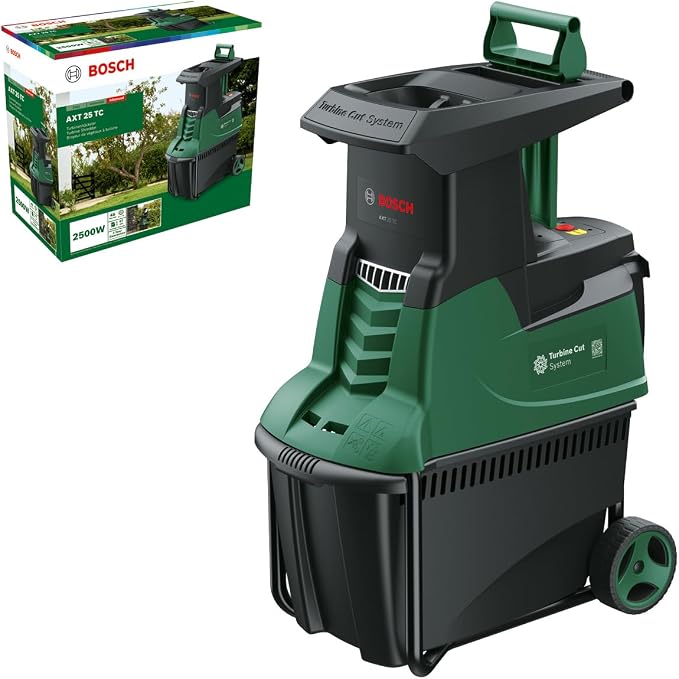
For large volumes — Bosch AXT 25 TC
If you regularly clear very large quantities from hedges, shrubs or trees, this is the one worth paying more for. Bosch calls it a turbine shredder, and the name suggests a racket that never materialises: it is as quiet as a roller machine, but it cuts thick and thin wood almost every time rather than merely breaking or crushing it. The result is homogeneous material you can spread as mulch under shrubs or on the vegetable bed.
It has the largest feed opening in the test, a multi-finger design that swallows a whole branch with all its side shoots — the branching spreads across the separate finger openings instead of blocking the throat, which makes thorny material such as robinia far less work. Because the automatic feed is not constant, you do have to push material in by hand from time to time, and here the crushing rollers are the more reliable feeders. Its throughput over a given period is nonetheless the highest here.
At around 30 kg it is heavy, and the shredding unit sits rock-solid on its tubular frame. Handle and balance are well judged, so it tips and pulls easily on its small wheels, which are plain plastic without rubber rims or reinforcement. The 53-litre box is large and sturdy, and the design has no latch at all: pull the box and the turbine stops, via a magnetic switch. Three buttons — forward, reverse, stop — and, as elsewhere, stop must be pressed before reverse will engage.
Storage is unusually tidy. The branch feed is a push-on part that stores inside the box, bringing the height down to 67 cm at 39 cm wide. The red adjusting screw draws out a locking bolt that simultaneously releases a motor interlock, so the machine will not run without the attachment fitted, and the push-on design means the finger feed can be swapped out when it eventually wears.
Two real drawbacks. The wheel spacing is an unnecessarily narrow 28 cm centre to centre, so despite the weight the machine sways on grass or sand when you are wrestling large branches on top — a longer axle with spacers would have solved it, though not in a pre-assembled state. And the inrush current is high: the manufacturer quotes 2,500 W starting and 2,300 W continuous, and on older installations rated at 10 amperes the machine will not run. It also arrives by freight rather than parcel carrier, as several of these do.
Check the price on Amazon UK · Search Amazon US
Fastest through the pile — Stihl GHE 140 L
The point of a shredder is getting the job done quickly, and this does that better than any other quiet roller here. Two features explain it. The robustly built cloverleaf feed opening takes heavily branched material, so you are not stopping to cut every side shoot off first. And when it does jam, the shaft reverses a few turns on its own and then resumes forwards, which removes the manual reset entirely.
The automatic reverse does not always trigger — the drive appears to judge from the load whether it is dealing with a substantial limb or something thinner — so the manual reverse has not disappeared altogether. Instead of a switch, Stihl uses a rotary knob that only lightly detents in the forward position: a light knock and it drops back to off, and it also cuts out if the machine is jolted or tipped over. For reverse, a slider is moved and the knob then has to be held, so reverse cannot run continuously — true of every model here.
Capacity is where it asks for restraint: hard fruitwood up to 35 mm, softwood up to 40 mm. Jams are rare if you stay within that, and they are rarest with the roller set close to the counter plate; fresh wood then comes through as strands rather than pieces, which is perfectly good for compost.
It packs away smaller than anything else in the test. One movement folds the machine down into its 60-litre box, and the free-standing handle means the 24 kg still pulls around comfortably.
Leaves are not its strength, which is true of every roller machine: large and small leaves clog the feed regularly, and clearing them out upwards is tedious. The folding mechanism helps a little, since the mush can be pulled out as it would be from a machine lying on its side. In practice it pays to pull the last, leafiest length of a branch back out and deal with it another way. The box locks with a rotary catch that pushes out a pin and closes an electrical contact, so this machine too runs only with its box in place.
Search Amazon UK · Search Amazon US
Also tested
Makita UD2500 — a solidly built roller machine that stands securely even on soft ground thanks to a wide 50 cm wheelbase and reinforced wheels, which even have rubber covers, a rarity at this level. The self-feed is dependable: often you can step back and let the machine finish, which suits thorny growth such as robinia, and up to 35 mm is dealt with without complaint. Maintenance is neatly solved by an aluminium front plate that comes off with a single hex screw for roller cleaning or replacement. Typically for a roller, output is often crushed and broken stalks still hanging together by their fibres rather than discrete pieces, and the small feed opening means heavily branched material cannot go in whole — when it does, the machine jams and the reverse button is needed. The real annoyance is the box catch, which is poorly made, wobbles and does not engage first time. Search Amazon UK · Search Amazon US
Black+Decker BEGAS5800 — a sound quiet shredder with a 2,800 W motor, rated for wood up to 4.5 cm on paper and good for about 4 cm in practice. The elongated feed opening takes heavily branched material poorly, where cloverleaf and finger designs do better. The frame is rigid, and two feet plus wheels on a single axle bring it to a 90 cm working height that makes the job genuinely pleasant, though the wheels are the simplest plastic and the 45-litre box semi-transparent. The catch on that box had to be bent before it would seat in its slot. Clogs can be cleared by winding the roller well away from the plate with a handwheel and then pushing wood through; taking off the top plate at the feed does not help. Search Amazon UK · Search Amazon US
Scheppach GS60 — presented as a quiet shredder, but at 60 rpm it runs faster and louder than the typical 46 rpm machines, measuring 94 dB — still far below the blade machines. It is surprisingly determined, pulling branched and crooked wood in hard with 2,800 W behind it, helped by a cloverleaf opening with an elongated lobe that stops branched material wedging. Hedge trimmings barely needed cutting down first, and despite heavily leafed wood the roller never clogged in testing, probably because it pulls through so quickly. Depending on the roller setting, stalks emerge broken or cut into the 60-litre box; thin brash often is not divided at all. The frame is the problem: because the feet fold and there is no rigid structure, the heavy drive swings constantly from side to side, with only the wheel axle preventing the whole thing folding up. Its 20.8 kg gives the economy away, where comparable rollers weigh comfortably around 30 kg. The supplied gloves and loppers are unusable — poor-quality shears with a slippery grip, and children's size 6 gloves that slip off constantly. Search Amazon UK · Search Amazon US
Parkside PWH 2800 C3 — a strongly motorised quiet model with a powerful self-feed for heavily branched, intact prunings; a branch need not be cut down first, and if it is not too branched the machine draws the whole thing in. As on every roller, the adjusting screw for the pressure roller sets how hard the wood is crushed or cut, and a middle setting is needed to keep the feed pulling strongly. Fresh wood up to 40 mm was shredded; dry wood at that thickness or above cannot be drawn in and the roller merely gnaws at it. Cable strain relief, a resettable overload switch and forward and reverse running make it a capable alternative, and the operation, noise and motor are all right. The mostly coarse, fibrous output is a trait it shares with every classic roller machine. Search Amazon UK · Search Amazon US
Bosch AXT Rapid 2200 — comparatively quiet for a blade machine and more versatile than a roller. Its 2,200 W blades cut wood into fine chips, noticeably finer than a roller manages, and they will also shred corn cobs and ripe sunflower heads. The toothed feed opening is the reason: short material — leaves, cobs, heads — can be pushed in quickly, where a roller would simply clog. Feeding is normally automatic as on a roller, much faster but also rougher, particularly on hard, thick wood; it cut up to 3 cm in testing, which is all that fits through the opening, and thicker pieces are torn and dragged at, so they need holding firmly — awkward given that the machine's stance is comparatively wobbly. The weak point is the toothed opening itself: the thin plastic teeth broke in places while branches were being fed in, which does not bode well after a few winters of orchard prunings. Its on/off control is a large rotary switch that doubles as the emergency stop, impossible to miss in a hurry, and it has to be turned clockwise and held for a second before the machine starts. Search Amazon UK · Search Amazon US
Wolf-Garten SDE 2800 Evo — a fundamentally solid and powerful blade-disc machine, only moderately loud, cutting thick material up to 40 mm. The feed is rough at larger diameters but the wood always comes out cleanly in pieces. A push-on funnel helps loose leaves and small material find the opening; it is rattly but does the job. Fresh foliage clogs the feed repeatedly, so in practice you alternate, pulling branches through to clear it. A clogged feed is easy to free — undo a hand screw and the machine's head pulls off — but the screw is very small and takes many turns. The blades are bolted on and can be resharpened or replaced. Search Amazon UK · Search Amazon US
Deltafox DG-ESS 2844 — a quiet roller with the small footprint of a blade machine. Instead of a box with a fiddly catch that can break, a plain 60-litre sack hangs under the discharge, and a 45-litre collection bag is supplied. Its 17 kg and small footprint make storage easy, and it has cable strain relief and a waterproof control panel with overload switch and reverse. It also has two drinks holders. The difference between 30 kg and 17 kg tells on stability, and at times the machine needs holding — a foot on the wheel axle does it. Branches to 25 mm slip straight through; up to 40 mm the roller struggles noticeably but works through, and only a substantial limb triggers the blocking function, after which reverse frees it. The feed clogs regularly when there is a lot of foliage on the branch, and reverse does not help — a problem most rollers share. The wheels and pusher are poorly made, and four machine nuts for fixing the base were missing from the carton along with the matching spanner. Search Amazon UK · Search Amazon US
Stiga Bio Silent 2500 — not a top machine on capacity. The 40 mm the manufacturer promises was not achieved: at 37 mm the drive stopped on fresh hornbeam, and branched material should not go in above 30 mm or it jams. The single-finger feed means heavy branching will not fit anyway, the opening measuring 42 mm. At 27.8 kg on a sturdy tubular frame it stands well on plain plastic wheels, which have no through-axle — which is how the box grew to 60 litres. That box is not transparent, so there is no telling when it is full without pulling it out. If space is tight the machine detaches quickly from its frame and the unit then fits inside the box, with hand screws doing the fixing. Search Amazon UK · Search Amazon US
Ikra ILH 3000 — a 3,000 W roller machine that draws in branches up to 3.5 cm, which is modest for the type; the 4.4 cm claimed, matching the feed diameter, is not achieved on branches, and at that diameter it manages only the thick stems of large sunflowers. Short material such as foliage or sunflower heads is not its strength either, since the opening suits it poorly and the roller takes it only grudgingly. The soft-touch buttons make for very quick operation with barely any travel, though a failure could not be repaired with standard switches. The milky translucent 60-litre box saves time because there is no need to release the catch and pull it out to check the level. The folding function meant to halve its storage space is theoretical — few owners will remove the wheel covers, undo two nuts from the axle and take the wheel frame off. Output is coarse chippings, thick material cut through completely, thin material often left in strands. Search Amazon UK · Search Amazon US
Ikra ILH 2800 — has the general strengths of a quiet roller, and a notably stable retaining catch on the container. At 21.5 kg it is comparatively light for a roller machine. Its running noise is a bright tone that grates, and the frame stood out as particularly wobbly. As with all roller machines, coarse chippings fall into the box and fibrous plant material mostly goes through uncut. Search Amazon UK · Search Amazon US
Einhell GC-RS 60 CB — essentially the same machine as the top pick, built to a slightly lower standard in places. The clearest sign is the upper handle shell, no longer joined to the structure beneath, so the handle flexes if you lean on it or pull the heavy machine along; and the motor unit is fixed to the base by four tiny screws into plastic, which works because the top rests on the frame but is not good engineering. Its virtues are real: low running noise, automatic feed, the anti-blocking routine, forward and reverse, and a wide, stable frame. It manages only 35 mm, though — thicker material stalls the motor — and like every quiet machine it clogs quickly with a lot of foliage, including at the discharge, which can only be cleared by hand after removing the box. Search Amazon UK · Search Amazon US
Einhell GC-KS 2540 — the successor to the GH-KS 2440, improved by a better stance, if not a good one, and by a motor controller. The two-stage control means it only screams under load; at idle it is still loud, but not deafening, though conversation is out. It cuts to 4 cm in the rough, jerky manner typical of blades. Its weakest point is the shut-off: the rocker switch is badly placed for stopping quickly, has to be hunted for down low, and is black on a black background, and the motor does not brake once switched off. Wet pine caused numerous clogs where the contemporary blade machine had none. On the plus side, blade changes are easy thanks to a large hex fitting and good access, and the plate at the feed opening is a soft, yielding plastic that looks durable. Search Amazon UK · Search Amazon US
Atika ALF 2600-2 — the top pick's sister model with a weaker motor, and it shows on thick material: it cuts branches of only 2.5 cm, and anything thicker stalls the motor. Build and appearance are essentially identical to the ALF 2800. The control panel with its large, water-protected buttons does its job but slows quick operation, though at least they are standard switches that could be bought in if one failed. The frame is the ALF 2800's — thoroughly solid, and not quite perfect. Search Amazon UK · Search Amazon US
AL-KO Easy Crush MH 2800 — a blade machine that is almost as quiet as a roller at idle; only when hard garden waste goes in do the blades clatter loudly, which is preferable to a machine that roars constantly. Blade machines shred faster than rollers, but all of them take twigs in abruptly and roughly, so the operator has to guide the material into the opening and hold it, which costs time because you cannot already be reaching for the next branch. The retaining catch on its collection basket is poor and broke during testing — not a trifle, since the machine will not start at all without it. The removable feed hopper is a genuine plus. Search Amazon UK · Search Amazon US
Ryobi RSH2545B — a blade machine, though it does not look like one at first glance. It stands stably and so suits branches and thick twigs better than the comparable Einhell. It shares the drawback of an ear-splitting run: a bright, unpleasant whine at idle, turning to screeching and rattling once branches go in, with the blades tearing hard at the wood so the operator has to hold on throughout. Its retaining catches are the same parts as the AL-KO's, and share the same flimsy design; this one did not break in testing, but it looks like a matter of time. Search Amazon UK · Search Amazon US
Stihl GHE 105 — a blade machine for wood up to 30 mm and fibrous material; the 35 mm claimed is realistic only with very soft material such as maize stalks. On fresh hornbeam, anything from 30 mm needed careful pushing to stop the blade jamming. It clogged repeatedly on foliage even though the hornbeam had been cut the day before and was not wet — disappointing, since small material and leaves are meant to be its strength, which is why the feed has a ramp for them. The four-lobe cloverleaf opening takes branched material, though wood should not exceed 25 mm or there is too much poking about in the feed. The blade turns on a disc that can be cleared of jams without tools, and because branches meet the blade at an angle there is a marginal self-feed; otherwise the blade tugs roughly at the wood. Search Amazon UK · Search Amazon US
Güde GH 2800 Super Silent — matches the top pick on power at 2,800 W and feeds branches, maize, sunflowers and the like in automatically while staying pleasantly quiet. Its plain opening is relatively small, as the top pick's is, so it suits woody growth and stalky material rather than foliage. That would make it an average roller machine, but the details grate: some plastic struts in the transport box were bent and the box handle had snapped, which points to poor packaging even if not every buyer will meet it, and no washer is supplied for the outer wheel screw. The pusher is useless — soft plastic that bends when pressed firmly into the feed opening, the only unusable one in a field where every pusher is plastic. The base is well designed and does not wobble, but the connecting strut between the wheels sits so low that the machine will barely roll over small bumps in a lawn. Search Amazon UK · Search Amazon US
Güde GH 2501 — produces fine material that can be blown straight into a bag. Its screeching noise and rough feed, which varies with branch thickness, are par for a blade machine. The short 29 cm wheelbase is the real objection: when you are handling larger branches up top, a chassis needs to sit firmly on the ground, including on bare earth or grass. In its favour are an overload switch, cable strain relief and a supplied bag, and as usual jams at the blade disc are cleared by opening the lid. Search Amazon UK · Search Amazon US
LUX E-MH-2500/45 — looks like a bulky roller machine from outside, since it uses a frame with the collection box beneath, and the box must be latched here too or it will not start. Fine material collects in the box, and the semi-transparent plastic shows the level. The broad foot means it stands securely on soil or grass. Rated power of 2,500 W is average and the blades are claimed to cut to 45 mm, which is too optimistic: fresh wood was cut to just under 40 mm, and hard or dry wood must not be fed at that thickness. The thicker the wood, the rougher the feed. Noise is much the same as other blade machines and the run is accompanied by a screech. There is no cable strain relief, though there is an overload switch that resets after a jam, and the blade disc is exposed by undoing a secured hand screw. Search Amazon UK · Search Amazon US
Gardebruk Gartenhäcksler 3100 W — a light machine that stows and moves quickly, and anyone prepared to undo two screws can pack it away remarkably small in winter, since the frame simply plugs into the drive and is secured with screws. That, plus a wheelbase of only 37 cm, gives a wobbly stance, and the frame rocks on soft ground while you are handling wood on top. The opening, rounded on one side, is optimised for the pusher, so leaves and small brash push in well — which is necessary, because as usual with blades the feed only draws in while weight is pressing on the blade disc. Fresh wood up to 35 mm is cut without complaint, though the blade gnaws roughly at it at times. Jams are cleared by undoing a hand screw and folding up the feed lid. Two cheaply made bags attach beside the opening so nothing spills and material can be carried off while the machine runs. It shreds wood, brash and foliage alike, cutting wood and leaves evenly fine. The 3,100 W in the name is only the starting current: in use it draws 1,800 to 2,400 W, normal for the class. Against it: high, partly screeching noise, a rough feed and no cable strain relief. Search Amazon UK · Search Amazon US
Ikra IMH 2500 — a compact blade machine with moderate output. Its strengths are cable strain relief, an overload switch and a waterproof control panel. The stance is the weakness: wheels, pusher and folding joint all feel unstable, and the feed clogs easily, especially with a lot of foliage. Fed sensibly sized material, it is perfectly workable. Search Amazon UK · Search Amazon US
How they were assessed
Thirty garden shredders were put through an extended test. The practical work took place in a large garden and woodland plot of 1,200 m² producing plenty of waste from trees, shrubs, hedging and the vegetable garden. Branches up to 4 cm thick were used throughout, alongside dried maize plants and sunflowers.
The maize stands in for fibrous plant material of the kind that also comes from the long stalks of sunflowers, Jerusalem artichoke and several perennials. The wood is ordinary tree and hedge prunings: not fibrous, but hard, sometimes unwieldy and sometimes fairly thick. Every machine in the test is designed for material of at most 4 to 4.5 cm, and thicker wood generally will not pass through the 4.5 to 5 cm feed openings anyway.
The short answers
Which garden shredder is the best? The Atika ALF 2800. What stands out is how little noise it makes: it ran remarkably quietly in testing. The automatic feed carries material into the machine without fuss, larger material included, the build quality convinces throughout, and the retaining catch on the box is among the best here.
Are there genuinely quiet shredders? Yes — roller machines are quiet by design. Against blade machines they produce coarser chippings and work more slowly.
Are there roller shredders without a box underneath? No. Roller machines always run with a collection box fitted, and stop or refuse to start without it. Blade machines do exist without one, feeding into a bag through a long, narrow discharge chute instead.
Which shredder handles thick branches? For branches from about five centimetres upwards, none of these machines is the right tool. The top pick shreds well only up to 4.5 cm.
Are blade shredders always this loud? No. A few only murmur at idle and become loud once shredding starts — in this field, the Atika AMF 2800.