Potting compost is the one garden purchase that decides how well everything planted in it does, and it is the one most people grab without reading the bag. There is no single perfect growing medium, because plants differ in what they want from nutrients, acidity and moisture, but for most window boxes, patio pots and beds an ordinary multipurpose compost is entirely sufficient. This guide covers 14 of them, tested over four weeks of actual growing.
What follows is recorded testing, translated. Nobody at Truthful Reviews has potted anything in these, and this page makes no health claim of any kind.
What a growing medium actually has to do
Sensible mineral supply, the ability to hold water, and enough openness for roots to push through: those three things cover most of it. It also helps if the compost is not easily overrun by mould or by fungus gnats.
Compost is not a standardisable material, because it is full of micro-organisms running a constantly changing metabolism. The usual starting material is green compost — the by-products of landscaping and horticulture, rotted leaf litter, small pieces of twig and bark. To that, makers add materials that loosen the mix for aeration and absorbency: volcanic rock as perlite, wood fibre, or coir. Most bagged composts also arrive with a fertiliser mix already in them, built around the three growth minerals nitrogen, phosphate and potassium. A balanced salt content is what lets the plant take those nutrients up in the first place.
There is no universal answer to how much nutrient a compost should contain. Some of it is organically bound and only becomes available to roots after weeks or months of decomposition. What a home gardener can measure cheaply is the pH, which says how acidic or alkaline the medium is. Seven is neutral. Many plants prefer something slightly acidic, between 5.5 and 6.5, and that includes vegetables such as potatoes, spinach and radishes. Ericaceous plants and rhododendrons want more acidity again, roughly 4 to 6. Many Mediterranean plants and a number of perennials, by contrast, do best on limey, slightly alkaline ground.
It is also worth knowing the difference between a potting compost and a coarser garden or planting soil. Potting compost is generally aimed at house and balcony plants: fine in texture, usually well stocked with nutrients, and a good start for flowers and vegetables alike. Planting soil is normally for the garden, coarser, lower in nutrients and cheaper by volume. For raising seed, a dedicated seed compost with a deliberately leaner mineral mix often makes more sense, because seedlings can only handle a small share of the minerals a full potting compost carries.
Peat and peat-free
Peat-based composts grow plants well. They are generally well aerated, they let water through, and they supply nutrients adequately. Peat itself is low in nutrients and permanently low in pH, which is precisely what makes it useful to manufacturers: adding lime and minerals to a near-blank base lets them hit fairly exact nutrient values. Many conventional bagged composts are up to 90 per cent peat, and products labelled peat-reduced can still contain a great deal of it, so the label alone tells you little about the proportion.
Peat-free composts are more complicated to make. They fall back on wood fibre, bark, coir or compost material instead, and the practical consequences show up in the testing below: they are often lighter, sometimes coarser and more fibrous, and their nutrient declarations are frequently vaguer than a peat mix's. Several of the best performers here are peat-free, and several of the vaguest declarations are too. Peat content was recorded as a mark against a compost in the source assessment; this page carries no conclusion beyond that.
Moisture, mould and fungus gnats
Mould and fungus gnats are the two unwanted extras that turn up most often on house plants, and both have an easy time when water sits in the pot — either because it cannot drain through the holes in the base, or because the medium has compacted. Coir and perlite are in many composts specifically to keep the structure open.
Where mould or gnats appear, the usual horticultural response is to water less and, if needed, to lift off the top layer of compost. As a rule the medium should be slightly moist and not wet; too much dryness does the plant no good either. Over-fertilising can also make a compost more susceptible.
Price is only a limited guide to quality, because on the bags sold in supermarkets and DIY sheds it tracks the fill volume far more closely than it tracks the compost. Once home, it pays to use a bag up reasonably quickly, since the consistency changes over time, and to keep it cool, dry and dark.
The picks
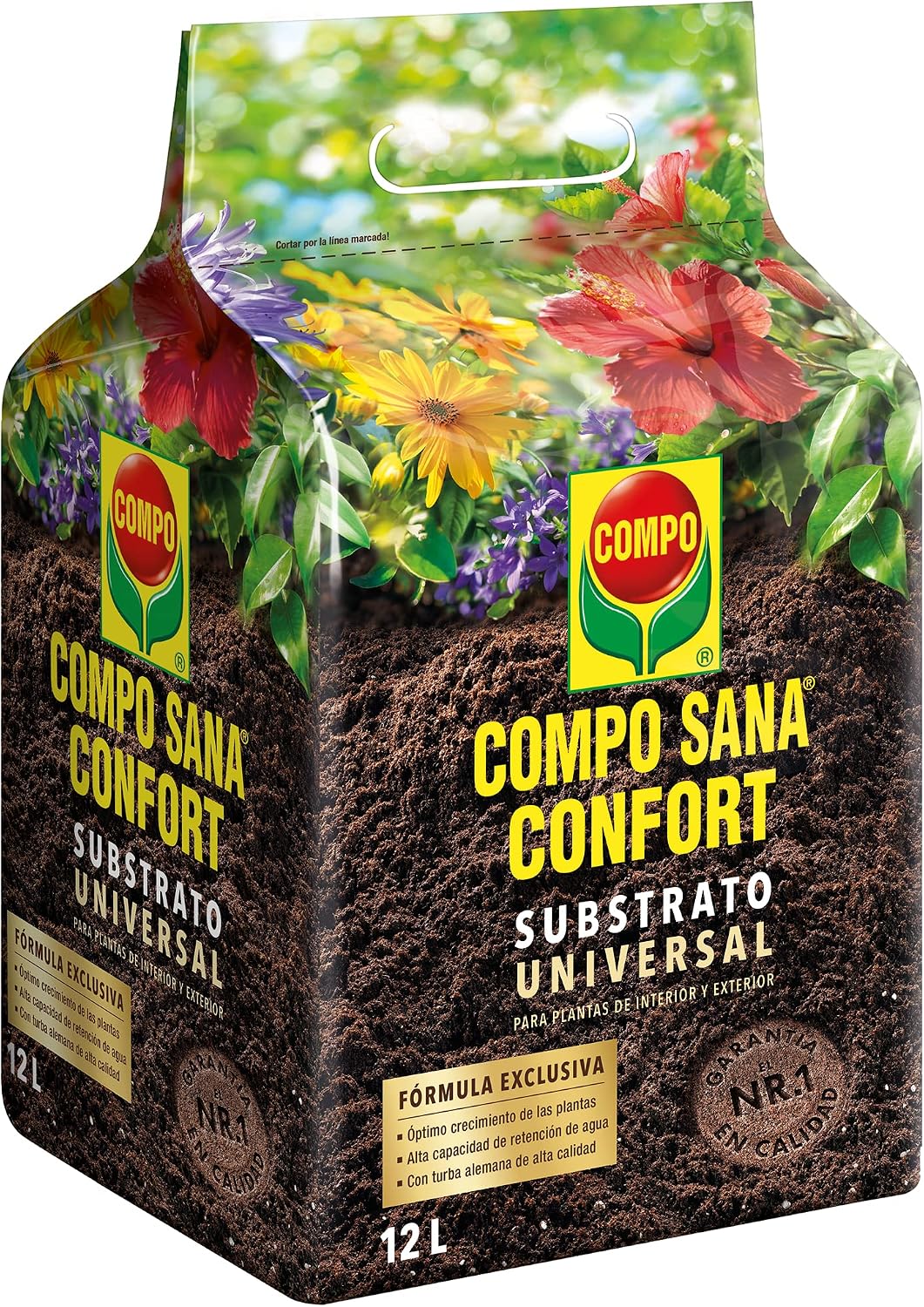
Top pick — Compo Sana Qualitätsblumenerde
Open the bag and the smell is the faintly acidic one of woodland floor. The consistency is nicely mixed: mostly fine dark granules run through with woody fibres and small white fragments, which are perlite — volcanic rock, there to stop the medium compacting and so to help both aeration and water uptake.
This is a peat compost, drawn largely from raised-bog peat in the H3 to H8 range, combined with plant materials and fertilisers. The exact composition of the peat fraction is not declared, though the manufacturer states that more than 50 per cent of the raw materials it uses are sustainable. It is intended for most indoor, balcony and garden plants; for sowing, ericaceous plants and orchids the manufacturer points to its own specialist mixes instead.
Over four weeks in seed trays sown with California poppy, petunias, radishes, French marigolds and basil, the plants developed even, healthy growth. Root formation was thoroughly solid — at the end of the test period each plant could be pulled out of its tray in one piece with the root ball intact. A single fungus gnat appeared across the whole run, which is close to unavoidable with any potting compost, and otherwise nothing unwanted turned up at all.
On moisture it is average. The marigold tray in particular dried out relatively quickly, but on a watering rhythm of every two to three days at roughly 30 to 50 ml a time the medium held a solid moisture level with no sign of waterlogging. In the closing test, where water was withheld for seven days, none of the plants in this compost survived.
Alongside the peat and perlite it contains green compost, wood fibre, carbonated lime, NPK fertiliser, methylene urea, phosphate with silicon and trace-nutrient fertiliser. Compared with the rest of the field the nutrient content is notably high:
- Nitrogen: 400 mg/l
- Phosphate: 330 mg/l
- Potassium oxide: 1,000 mg/l
- Magnesium: 170 mg/l
- Sulphur: 500 mg/l
Those figures are really too high for raising seed, but they will feed flowering plants for up to 12 weeks before any feeding is needed. The declared pH is 5.0 to 6.5; weekly measurement in the trays gave an average of 6.3. The mix also contains a root activator meant to improve establishment when potting on, and the high sulphur content stands out — it is there to help the plant process nitrogen and so support strong growth.
The verdict was that the name is earned: a fine structure that holds water solidly, good growing conditions, and a nutrient load that saves three months of feeding. No susceptibility to fungi or fungus gnats emerged. The one real reservation is that anyone buying it is choosing a peat medium.
Search Amazon UK · Search Amazon US
The peat-free alternative — Seramis Leichte Blumenerde
Soft, and astonishingly light: the manufacturer's claim is that it weighs 50 per cent less than the same brand's balcony compost, and the 12.5-litre bag comes in at just 2.33 kg, about 190 grams per litre. That matters twice over — for aeration in the pot, and for carrying the bag. The airy structure comes from a mix of wood and coir fibres plus clay granulate. Despite the fibre content the medium does not feel coarse or stringy but pleasantly fine, almost sandy. There is no peat in it at all, and the smell is fresh woodland floor. The maker rates it for both foliage and flowering plants.
In testing it made a positive impression, ranking among the substrates with the highest moisture content. With radishes and petunias in particular it seemed almost to hold moisture too well — the level stayed constantly high over several days. No mould and no fungus gnats appeared. Growth convinced: radishes, marigolds and basil all did well, and the root ball developed strongly. The one disappointment was that, despite that water retention, the plants did not come through the seven-day withdrawal at the end of the four weeks.
The maker promises a nutrient store lasting eight to ten weeks, and the declared figures sit above average: nitrogen 240 mg/l, phosphate 230 mg/l, sulphur 120 mg/l, with no magnesium figure given. The declared pH is 6.2; measurement over four weeks gave 6.8. That is an average value, suitable for most vegetables and flowers alike.
Search Amazon UK · Search Amazon US
Peat-free with pest resistance — Neudorff NeudoHum
The first thing you notice handling it is the fibrous consistency. It is not as fine as other composts, and that has genuine advantages: wood fibre is the main constituent, and besides producing an agreeable woodland smell it stops the medium compacting too much and lets the surface dry properly. According to the manufacturer that works against fungus gnats, algae and fungal attack. The second key ingredient is bark humus, which doubles as the organic fertiliser. It is rated for all indoor, balcony and terrace plants, inside and out.
Across four weeks the moisture readings came out slightly below average. The basil and marigold trays in particular tended towards dryness, though never to a problematic degree, and at no point did it look as though the plants might fail. Growth was healthy, with lush green and good root balls. There was no trouble at all with fungus gnats or mould — so the manufacturer's claim, which no compost could ever meet completely, held up here. After the test, only the basil survived seven days without water.
On ingredients this maker is more restrained than most. The nutrient supply lasts only three to four weeks before feeding is needed, which for seed raising can be an advantage rather than a fault, since young plants are overwhelmed by too many minerals early on. The declared figures are nitrogen 180 mg/l, phosphate 125 mg/l, potassium oxide 600 mg/l, magnesium 110 mg/l and sulphur 170 mg/l. Declared pH is 6.6; measurement over four weeks gave 6.9. That fairly neutral value suits flowers such as tulips and roses particularly well.
Search Amazon UK · Search Amazon US
For acid-loving plants — Floragard Blumenerde
Some vegetables — tomatoes and cucumbers among them — tend to prefer acid ground, and this is the compost in the field for them. The consistency is especially fine, almost as soft as sand, run through with fine wood fibres for an airy structure. The maker sells it as an all-round compost with starter, slow-release and trace-nutrient fertiliser for eight weeks, so it is rated for seed raising as much as for flower beds and foliage plants. At 80 per cent, the main constituent is raised-bog peat; green-cuttings compost is meant to strengthen the plants' resilience and clay minerals to store nutrients.
Against the rest of the field it holds moisture only moderately, though it could not be called quick to dry out. Plant growth was healthy and even. Root balls at the end of the test came out rather below average in strength. No trace of mould was found, and a single fungus gnat appeared once the test had finished. After the water was cut off for seven days, growth survived in one of the five trays.
The notable characteristic is the pH. The German declaration says 5.6, which need not be the whole story: the same product declares 6.7 for Italy and France and 5.0 to 6.5 for Austria, most likely to satisfy different national requirements for how precisely the figure must be stated. Contradictory declarations of that kind are not ideal. What can be said with confidence is that the value is relatively low and therefore acidic, and the high peat content is a large part of why. Measurement over four weeks averaged 5.4 — of real interest to anyone growing blueberries, potatoes, tomatoes or orchids.
The maker also declares carbonated lime and NPK fertiliser, giving nitrogen 350 mg/l, phosphate 260 mg/l, potassium oxide 750 mg/l and sulphur 30 mg/l.
Search Amazon UK · Search Amazon US
The value pick — Rewe Beste Wahl Blumenerde
Stacked on pallets by the supermarket entrance every spring, and cheaper per bag than most rivals at the same fill volume — cheaper, in fact, than many larger bags. For the outlay it makes a good impression. The consistency is loose and very soft, with small pieces of wood but no coarse lumps. The volcanic rock in it is claimed to keep the mix breathable, and the declared composition runs to wood fibre, bark humus, coir pith, perlite, clay granulate and NPK fertiliser. Nutrient values sit in the average band: nitrogen 250 mg/l, phosphate 280 mg/l, magnesium 150 mg/l, with no sulphur figure given.
The packaging declares a pH of 6.5 and measurement returned 6.3. In every respect, then, this is a balanced mix that neither overdoes nor underdoes nutrients or acidity, which makes it suitable for most growth stages and for any plant without special demands — and the maker rates it for all ornamental and garden plants.
The practical test bore that out. Average moisture sat in a good range and the compost was hardly ever found dried out. Plant growth was positive, with the radishes coming through strongly, although they did not survive the seven-day drought at the end; the basil did. Root growth after four weeks was good in three of the five trays, with fine threads. The one blemish was the arrival of individual fungus gnats, though only a few. It is a cheap all-rounder with solid figures and solid results, and it is completely peat-free — the pick for filling pots and beds on simple projects without much outlay.
Search Amazon UK · Search Amazon US
Also tested
Obi Grow Blumenerde — the DIY chain's own brand, sold in a smallest pack of 20 litres, so better suited to filling whole window boxes or beds. Somewhat coarse-grained and woody in consistency, with an almost compost-like smell, and peat-free, declared as a universal compost for indoor, balcony and garden plants. It stayed fairly moist over long periods, but lifting the plants out towards the end of the four weeks revealed a considerable infestation of fungus gnats. Root formation was acceptable while plant growth lagged behind the field, and none of the five plants survived the seven-day water cut. The nutrient declaration is the real weakness: feeding is advised after two to five weeks, the pH is given as somewhere between 5.0 and 7.5 (measured at a fairly high 7.3), the nitrogen content as between 100 and 500 mg/l and the phosphate as anywhere from 200 to 2,000 mg/l. Those figures are identical to the Compo Bio Universalerde's and the woody consistency is indistinguishable, so the two are very probably the same compost in different bags. Search Amazon UK · Search Amazon US
Substral Kompakterde — sold as a handy compressed briquette: mix with three litres of water, knead it a little, and after three minutes' swelling you have ten litres of coir-based compost. Rated as a universal compost for all plants but not for sowing. It is quite fibrous, which is supposed to help it store water especially well; the test found the opposite. It dried out remarkably fast — after three or four days the meter could sometimes detect no moisture at all. A substrate that dry ought not to go mouldy, yet light traces of mould appeared in two of the five trays. Growth was not at all bad in spite of that, radishes especially, and two of five plants came through the full week without water. Root growth was average. The mineral store is claimed to last up to eight weeks, with nitrogen declared at 150 mg/l and pH at a relatively acidic 5.0; measurement over four weeks averaged 6.1. Search Amazon UK · Search Amazon US
Neudorff Kokohum Blumenerde — another pressed briquette, stirred into water and left to swell to seven litres of coir compost, rated for sowing, balcony boxes and terrarium filling, and 99 per cent coir fibre. Its water retention is the best in the field: it recorded the highest average moisture over four weeks, and plants survived in three of five trays after a week without water. Growth is the trade-off. Where other trays were shooting up by the end of the four weeks, this stayed restrained; the basil never really took off and the petunias and radishes looked stronger elsewhere. Root growth was moderate too — instead of a clean root ball the medium crumbled somewhat on removal. Neither the packaging nor the website says how long the fertiliser lasts, and against the rest of the field the nutrient content came out relatively low, with nitrogen at just 50 mg/l, which suggests early feeding is needed. Low nutrients need not be a fault: vegetables and herbs such as beans, rosemary or chives partly prefer lean ground. Declared pH 5.5, measured average 6.4. Search Amazon UK · Search Amazon US
Compo Bio Universalerde — peat-free, described by the maker as ideal for ornamental, vegetable and herb plants, and almost certainly the same product as the Obi Grow: identical nutrient declarations and an indistinguishable woody consistency. Practical results differed slightly but within natural variation, with somewhat better growth and solid root formation, and it was on average drier through the four weeks. Two of five trays survived the seven-day drought, and minimal traces of mould showed in one tray before that. Composition is wood fibre, bark humus, compost, coir and organic NPK fertiliser. Nitrogen is declared as somewhere between 100 and 500 mg/l, the other figures are equally broad, pH is given as 5.0 to 7.5 against a measured average of 7.0, and the nutrients are claimed to last up to five weeks. Precise feeding is hard on declarations like those, though plants such as marigolds and petunias cope with varied ground anyway. Search Amazon UK · Search Amazon US
Floraself Blumenerde — not a fine first impression: small twigs mixed with bark mulch. Peat content is up to 50 per cent with no closer declaration, and the nutrient content is modest, nitrogen sitting at 300 mg/l, so feeding becomes necessary after a few weeks. Declared pH 6.2, measured 6.5. It is rated mainly for bedding plants, bulbs and perennials. Growth was good, with all five trays sprouting nicely, and the compost stayed relatively moist even after several days, so petunias and basil came through the seven-day withdrawal. Roots looked sensible, with every plant having formed a presentable start over the four weeks. Only individual fungus gnats spoiled the picture. The low nutrient content makes it better suited to raising seed — or else invites early feeding. Search Amazon UK · Search Amazon US
Plantura Bio-Blumenerde — a very fine compost with barely any longer fibres, which does not clump at all and can be rubbed between the fingers and poured straight through them. It is entirely organic in basis and contains no peat, with mineral elements in the fertiliser — lime, clay minerals and crushed expanded clay — plus organic fertilisers from coir, wood fibre and compost. Rated mainly for hungry plants, though the exact composition stays unclear on the bag: nitrogen is declared as 100 to 300 mg/l and potassium oxide as 400 to 2,000 mg/l, while magnesium, sulphur and salt content do not appear at all. The maker advises feeding two months after planting. The pH declaration is similarly vague at 5.0 to 7.0, against a measured 6.1. Growth was satisfactory overall — the radishes never really emerged, the rest had no problems — moisture stayed average and unremarkable, and basil and marigolds survived seven days of drought while the others failed. Root formation was mostly solid, and no pests or mould appeared. The imprecise declarations make accurate feeding awkward, but the practical results are respectable for a slightly above-average outlay per litre. Search Amazon UK · Search Amazon US
Hamann Qualitäts-Blumenerde — a 20-litre bag with a fairly fine, soft consistency, no coarser fibres or lumps, trickling gently through the fingers. It is peat-based, though with no closer description of the proportion or origin than "selected peats" on the bag. Typically for a peat medium the nutrient content is on the low side, at 180 mg/l nitrogen and 280 mg phosphate. Declared pH is a relatively low 5.88; measurement gave 6.4. It came off only moderately well in practice, and moisture was the trouble: readings were the lowest of the entire field, and parts of it had dried out completely after one or two days while neighbouring trays were still damp. For a peat compost, it does not appear to hold water optimally. Growth followed accordingly, with only the basil doing well and the rest struggling out of the medium. A dry compost might at least have been poor ground for fungus gnats, but several of those appeared too. Search Amazon UK · Search Amazon US
Galamio Blumenerde — a nicely soft, loose consistency combined with smaller chunks of wood fibre and bark humus, completely peat-free and generously fed. The phosphate content at 650 mg/l and the potassium oxide at 1,850 mg/l both stand out. Declared pH 6.6, measured 7.0. It is sold only in a large 40-litre sack made of biodegradable board, which is rather a lot for repotting one small house plant. The stand-out finding in the test was water storage: it held moisture outstandingly well over days. Growth was mixed — basil and marigolds sprouted well while the rest barely showed, which could look different with other seed or conditions — and the maker rates it mainly for bedding plants, bulbs, perennials and container plants, with the high nutrient concentration probably too much for raising seed. Basil and marigolds survived the seven-day drought, which speaks further for the water retention, and there were no problems with pests or mould. Search Amazon UK · Search Amazon US
Sybotanica Universal Premium Soil Mix — visually distinct thanks to its white perlite, very loose, an airy substrate with a relatively coarse structure, with coco chips intended to improve aeration and drainage. Its real peculiarity is that it ships with predatory mites and springtails in it, meant to help control pests; no unwanted visitors appeared during the test, though you have to reckon with distributing a few mites around the pot when repotting or overfilling. Equally unusual is the genuinely very low mineral content: nitrogen 120 mg/l, phosphate 10 mg/l and sulphur only 6 mg/l put it ten times below other composts in several respects. That can be acceptable for raising seed, but early feeding is still needed — and the bag is honest enough to describe itself as suitable for less demanding house plants. In practice it did not really convince: it holds water only moderately, the trays dried out quickly, and the moisture figures were clearly below the average of the field. Growth fell short of hopes, with only marigolds and basil coping with the dry substrate. Anyone who wants the biological pest-control effect could combine it with another compost. Search Amazon UK · Search Amazon US
How they were assessed
The plant types each maker rates its compost for were listed first, then each compost was examined for consistency — how woody, coarse, fine, fibrous or air-permeable it is. For the practical test a bed of mixed sowings was laid out in each medium: California poppy, petunias, radishes, French marigolds and basil. To get summer-like light independently of the weather, growth was supported with a lamp intended for the purpose. Water was measured out to the millilitre so that water storage could be compared like for like, and moisture was then checked with a meter.
Growth was observed over four weeks, with notes on whether mould formed, whether fungus gnats nested, and whether any other unwanted side effects of raising seed appeared, plus an assessment of how strongly roots had formed. Finally the water supply was cut off for one week to test in which medium the plants held out longest.
Compost consists mainly of organic substances, and plant growth is subject to countless fluctuations that need say nothing about the quality of the medium. These composts were tested in a realistic setting under consistent conditions rather than a tightly controlled bench setup, so absolutely precise measured values are not possible and results in another setting can differ. For ingredients, the testing relied on manufacturers' declarations, and where those declarations were not transparent that counted against the product, while a generous nutrient supply counted in its favour. The pH, by contrast, was measured directly over several weeks with a calibrated instrument intended for the job — not because the value is decisive in itself, but to see how far the results matched the declarations.
The short answers
Which potting compost is the best? The Compo Sana Qualitätsblumenerde, on the strength of its high nutrient content. It gave good growing conditions in testing and is an ideal all-rounder for a wide range of flowering and foliage plants.
What is the difference between potting compost and planting soil? Potting compost is generally aimed at house and balcony plants: often quite fine, usually high in nutrients, giving flowers and vegetables a good start. Planting soil is normally used in the garden, usually coarser, lower in nutrients and cheaper.
Which medium do particular plants need? For sowing, a seed compost with a mineral mix designed for young plants — usually leaner than a potting compost — can make sense. Beyond that there are specialist mixes, for Mediterranean plants for instance, or acidic media for ericaceous planting. Ordinary potting compost provides good conditions for the majority of flowers and vegetables.
Does a peat-free compost grow plants as well? On these results, yes. Three of the five picks here are peat-free, including the lightest medium in the field and the value pick, and the highest water retention measured belonged to a coir product.