Cordless secateurs put a small electric motor behind the blade, so a squeeze of the trigger closes it instead of your hand. Nineteen of them were tested for this guide. What follows is recorded testing, translated. Nobody at Truthful Reviews has used any of these tools, and nothing below is our own hands-on finding.
The pick of the field is the Kebtek KT930: fast, responsive, well balanced, and untroubled by thicker wood. The Worx WG330E is the sensible everyday choice, the Stihl ASA 20.0 the best-made, and the Teeno CD610 the surprise of the cheaper end.
This page makes no claim about health, joints or fatigue. It describes tools, weights and observed cutting behaviour only.
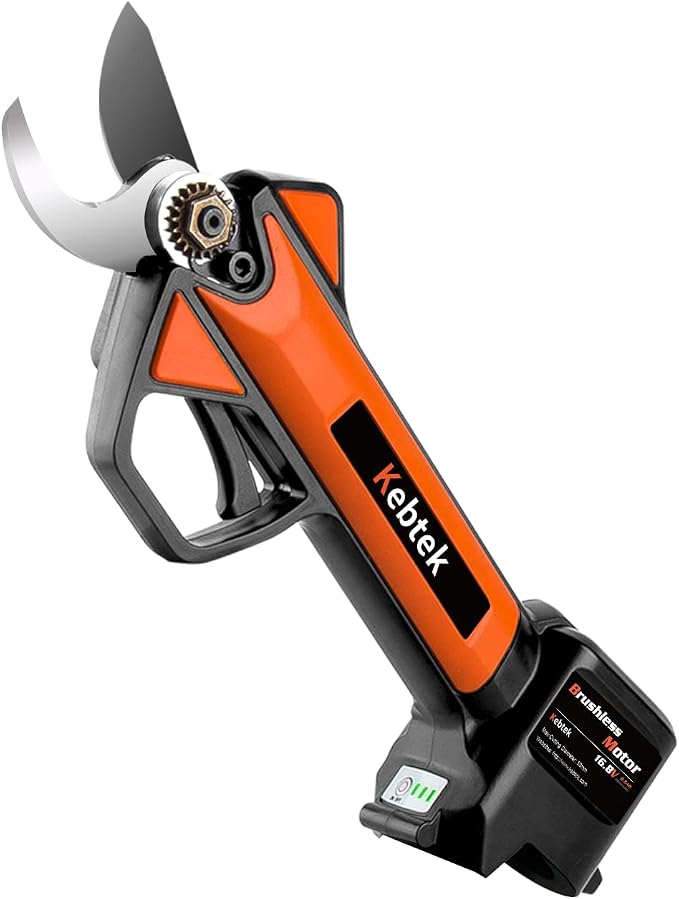
Kebtek KT930 — the best for most gardens
The KT930 arrives in a compact carry case holding two batteries, a twin charger, a lubricant pot and the tool for changing blades. A spare cutting blade is available separately if the edge eventually goes past resharpening.
Build quality impresses on first handling: a non-slip grip, sound ergonomics, and weight distributed evenly between battery, handle and cutting head, so the tool can be steered accurately among branches. At around 900 g ready to work, it sits comfortably in the hand for overhead cuts. The wide jaw opening helps you place awkward, thick branches squarely in the cut, and the pace is quick — a single cut takes about 0.4 seconds. The blade itself is thin, hardened, PTFE-coated steel and slides well through wood.
A brushless motor drives it, fed by a 2.5 Ah, 16.8 V lithium-ion pack of four cells with overheating, overvoltage and overcharge protection built into the electronics. Depending on the wood and how wet it is, one battery will keep cutting for around five hours. In use the motor runs smoothly and precisely, so the force is easy to meter out, and the response is immediate: a pull on the trigger and the blades take hold at once. Nothing else in the field worked as quickly or as pleasantly.
Drawbacks are hard to find. The only real objection is that it is sold solely as a set with two batteries and a charger. Search Amazon UK · Search Amazon US
Worx WG330E — the everyday alternative
The WG330E comes in a plain box with the pruner, a spare battery and a fast charger that fills the 2 Ah pack in around 60 minutes. A bare-tool version is also sold.
With the smallest battery in the maker's 18 V range fitted, the working weight is only about 1.1 kg, and the balance between head, grip and battery is good, which makes cutting at arm's length or overhead easy going. Performance is faultless in practice: a strong brushless motor and titanium-coated blades take it through everything without complaint. The trigger interlock is particularly well placed, sitting directly beneath the start lever and always within reach.
Cutting diameter is 25 mm, enough for thicker wood, although the blades could stand to be a little longer. For running quickly through a lot of thin growth, the jaw opening can be halved to 15 mm. The responsive motor and a light action at the lever give good control, and the cut is fast — the blades close and reopen in roughly 0.6 seconds. Anyone already invested in that battery system can buy the bare WG330E.9 version instead. Search Amazon UK · Search Amazon US
Stihl ASA 20.0 — the best built
Unpacking the ASA 20.0 reveals a graphic quick-start guide printed on the fold, with the key adjustments shown as large pictograms, plus a properly structured manual in a legible type size. The compact 12 V battery charges in a dock with rubber feet that grip whatever surface it is stood on.
In use it performs above its class, despite that nominally weaker 12 V pack in a field dominated by 18 V tools. The bypass blades are extremely sharp and cut all types of wood quickly and cleanly, and the reaction time is remarkably short: there is no perceptible delay between pulling the lever, the motor starting and the blades moving.
Material quality is the other standout. The plastic housing is smooth and solid, edges are meticulously deburred and the mouldings fit together perfectly, which also stops dirt clinging. The rubberised, ergonomically shaped grip holds well even with damp hands. At about 32 cm long, it manoeuvres neatly between close-set branches to reach awkward growth.
A small display is built into the grip, showing charge state, the number of cuts made and the selected jaw setting. Holding the start lever for three seconds halves the opening width of the moving blade, so thin twigs can be worked through faster. The blade can be swapped when it reaches the end of its life, and the tool for the job is stored in the battery compartment. It is expensive, but the professional intent runs right through the product. Search Amazon UK · Search Amazon US
Teeno CD610 — the cheaper surprise
The CD610 ships with a spare battery, a charger, blade-change tools and a simple plastic case. Even at this price, the motor is brushless and durable. The moving blade is carbon steel with enough spread to cut branches up to 25 mm reliably.
Power comes from 21 V, 2 Ah lithium-ion packs, good for up to six hours of use depending on the wood and the state of charge. There is no charge indicator, which is the notable omission. Cutting is surprisingly precise and forceful for the money: the motor responds without delay to pressure on the lever, and the blade's force can be applied delicately, which helps in softer woods. Search Amazon UK · Search Amazon US
What to look for
A pruner cuts rather than tears, leaving a flat, smooth face on the stump, unlike a saw. A sharp blade is the precondition: cheaper models use stamped metal blades, dearer ones multiply hardened, ground steel that holds its edge far longer, and the better tools allow the blade to be replaced. The trade-off is capacity — typical cordless secateurs manage 30 mm at best, and anything thicker needs a saw.
Weight matters: much above 1 kg becomes too much over a long session, and the mass has to be balanced between head, grip and battery. Reaction and cutting times varied enormously across the field.
Compact models often have a fixed internal battery; more powerful ones take removable packs, which allow stronger motors, uninterrupted work by swapping in a charged pack, and replacement when a pack weakens rather than scrapping the tool. More amp-hours means longer running, higher voltage a stronger bite, but the more capable the pack the heavier it is, so about 2.5 Ah is a sensible limit.
Also tested
Swansoft PRU-36 — a professional-leaning kit with a belt-mounted battery and cable bridge; the tool alone weighs 1,160 g, though the empty belt and lead add 620 g and the stiff cable limits arm movement. Cuts wood over 30 mm cleanly, with a quiet, torquey motor and a progressive mode that showed no real practical benefit.
Batavia 18V Nexxcut BT-CPR001 — well balanced and easy to handle, with jaw width reduced by a tap of the start button, but its finger-detection circuit interrupted work constantly on fresh wood while behaving reliably on old, dry wood. Sold under the same product name as its cheaper sibling.
Einhell GP-LS 18/28 Li BL-Solo — thick-walled, solid, 36 cm long and over 1.4 kg; cuts hard and soft wood powerfully but the gearing makes it sluggish, taking 1.5 seconds per cut where most take well under a second. Jaw width adjusts between 14 and 28 mm.
Batavia 18V Nexxcut BT-CPR002 — the budget sibling, supplied without battery or charger; the pack wobbles in its socket and the charge display can only be read from an angle. Cut time 1.1 seconds, fine to 15 mm, but needs several attempts near 30 mm.
Stiga SC 100e Kit — excellent finish and a powerful motor with three jaw settings, undone by an awkward sprung lever in the grip that must be folded over first, and flush touch buttons with almost no feedback.
Bosch Professional GGP 12V-25 — 31 cm, 1 kg with its 3 Ah 12 V pack, superbly finished and quick to respond, but the narrow jaw and strongly curved blades make 25 mm possible only by pressing wood into the opening. The light charger slides about for want of rubber feet.
Dewalt DCMPP568 — a 38 mm cutting width, strong motor and LED work light, but over 1.7 kg with a 2 Ah pack, head-heavy and bulky enough to snag in tangled growth. A sprung toggle must be held to start the motor.
Stanley SFMCPP32M1-QW — heavy and chunky at nearly 2 kg, with a 32 mm cut and outstanding stamina; it went through thick beech and ironwood without complaint, but the bulk tires the arm and the switch under the grip is fiddly at every regrip.
Einhell GE-LS 18 Li-Solo — supplied bare, 40 cm long and just under 1.3 kg, with very sharp, well-made blades and a strong brushless motor; marked down for a sluggish lever response and slow working speed. The built-in belt clip is genuinely useful on a ladder.
Black & Decker BCPP18D1 — the largest and heaviest here at nearly 1.7 kg and distinctly head-heavy, with an excellent grip and thick, replaceable blades. The motor control is sluggish and the real cutting width measured just 20 mm, well below the claim.
Strend Pro NPT 01 — the lightest removable-battery tool tested at 850 g, 33.5 cm long, good for up to 400 twigs per charge; no charge indicator and an exposed charging socket, but it cut 25 mm branches in one pass, more than claimed.
Parkside PAAS 20-Li B1 — 33 cm, just under 1.4 kg, good ergonomics and finish, spoilt by slow motor response and a blade that must complete a full open-and-close cycle each time.
Kärcher TLO 2-18 — bulky at 36 cm and 1.56 kg, with a chunky 18 V pack and a charge display reading in single-point steps; an optional telescopic pole fits via the adapter plate. Rated at 25 mm, but the curved blade and small opening suit thinner wood, and the electronics respond late.
Gardena AssistCut — cut by hand, with a sensor triggering motor assistance when the blade meets resistance; a fixed battery charges by USB-C in about 100 minutes for up to 1,400 assisted cuts. Light and adjustable for two grip spans, but smooth plastic grips and a head-heavy balance.
Bosch EasyPrune — last in the field: one of the smallest jaw openings, rated 25 mm but recommended only to 18 mm after testing, with a weak 3.6 V internal battery, an exposed micro-USB socket and no charger. Lighter than 18 V tools, and the widest handle span here.
How they were tested
Contents were checked first, then the manual, then material and finish — screw fixings, and the size and parallelism of the panel gaps. Ready-to-work weight was measured, since published figures often differ, along with overall length and jaw opening. Practical work followed in a garden, cutting soft and hard woods including spruce, magnolia and ironwood at a range of diameters to judge cutting force and establish the true maximum, with cutting speed timed. Bamboo grasses and photinia shrubs tested blade sharpness.