A cordless chainsaw is the tool that finally made the category approachable. There is no two-stroke mixture to buy, mix or smell, no starter cord, and far less noise in a garden or a wood. What there is instead is a ceiling: a battery holds a finite amount of energy, and a saw that has to shift a lot of timber will reach the end of it. This guide covers 29 cordless chainsaws and the question that decides which one belongs in your shed — how much wood you actually cut, and how thick it is.
What follows is recorded testing, translated. Nobody at Truthful Reviews has cut so much as a log with any of these.
What a battery saw will and will not do
The honest answer from the test field is that these do not replace a petrol saw on a serious job. Felling and limbing five pines of 60 cm diameter is out of reach even for a strong cordless model carried by several batteries, because the run time and the available power both run out first. What they are genuinely good at is limbing in a crown, small-diameter timber, clearing light undergrowth, and cutting boards and beams to length on site — enough to fill a small car trailer without complaint.
Capacity divides on wood type far more sharply than the marketing suggests. Softwood is roughly twice the diameter a saw will take in hardwood: the strongest models here dealt with pine at 35 cm but wanted robinia kept to about 20 cm, while the weakest managed 8 cm of softwood and stalled beyond it.
Bar length, chain pitch and chain speed
A chainsaw is three things: a drive, a bar and a chain. The drive links run in a groove in the bar — 1.1 mm or 1.3 mm on DIY-grade models — and between them sit the cutters, either pointed or broad, and rather fewer in number than the drive links. A sprocket drives the chain round, a depth-gauge lug ahead of each cutter limits how deep that cutter can bite, and tension is set by moving the bar forwards or back, either with an adjusting screw and spanner or with a tool-free wheel.
Bar length follows the job. For wood thicker than 20 cm a bar of 340 to 400 mm makes sense; that length is unwieldy up a fruit tree, so anyone mostly cutting thinner material is better served by 250 to 300 mm. Bars and chains can be bought in other lengths later, so nothing is locked in at purchase.
Chain speed is the clearest performance divider here, and the spread is enormous — from 24 m/s at the top to 3.5 m/s at the bottom. You feel it as the saw either slicing through in one pass or gnawing and stalling; anything under about 6.5 m/s in this field dragged through the cut and had to be fed with a light touch.
Chain pitch decides the finish. A fine 1/4 in chain with small cutters leaves clean, almost unfrayed faces, which is what makes some of these usable for construction timber. A coarse 3/8 in chain removes more material faster but leaves a ragged cut — fine for firewood, unwelcome in joinery.
Two tensioning philosophies are represented. The classic combination-tool arrangement takes noticeably longer, but its fixing screws cannot be nudged loose while you work; tool-free wheels are quicker, though protruding adjusting screws can rub against timber and back themselves off, which happened to one saw during testing. One maker automates it entirely: the screw tensions the chain first, then simply clamps the bar once resistance builds. That worked faultlessly in the test, though how it behaves after wear and dirt is an open question. Every saw carries a small tank of viscous chain oil, pumped through a slot into the bar and along the groove.
Battery systems matter more than the saw
The battery is not an accessory here, it is a large fraction of what you are buying — often something like a third of the outlay — which is why nearly all of these sell both bare and as a kit. If you already own packs from the same maker, the calculation changes completely.
Capacity also changes what the saw can do, not merely how long it does it for. One maker's strongest hobby pack holds 180 Wh against 72 Wh for the smaller ones in the same family, and the smaller packs do not merely run down sooner — the drive makes less peak power with them fitted. The same pattern showed up on the most powerful DIY model in the test, which was mediocre on one battery and genuinely strong on another. Supplied chargers routinely took 1.5 to 3.5 hours, where the optional fast units returned the same packs in 35 to 70 minutes.
The picks
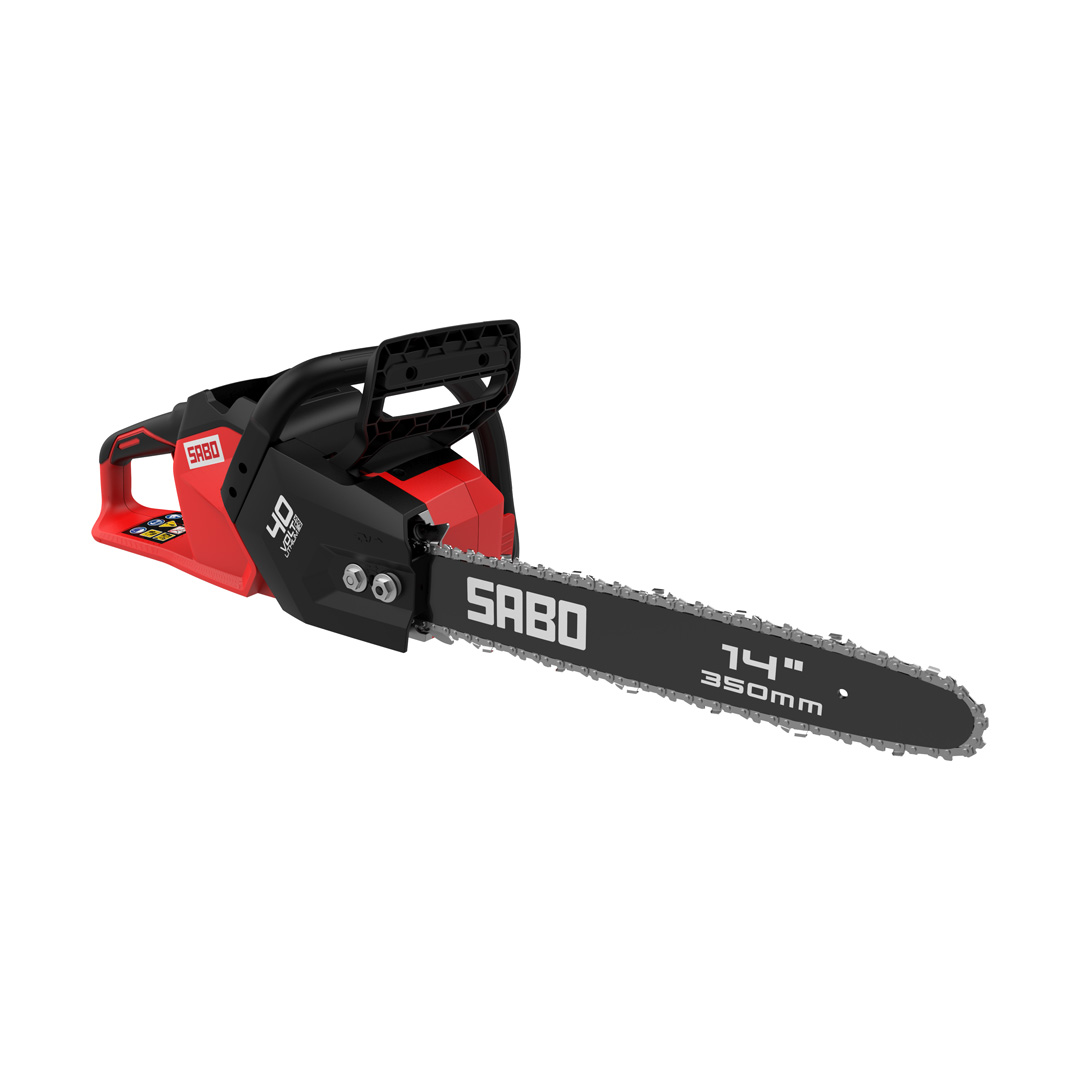
Top pick — Sabo CS-25 Comfort Line
An unassuming saw that turned out to be the best all-rounder here. It arrives with a 350 mm bar fitted and a second 250 mm bar and chain in the box — a genuinely useful pairing, since the short bar suits work up a fruit tree or fine cuts on site while the long one handles the log pile.
Despite a fine Picco chain with small cutters, the long bar bites well, jamming only in timber thicker than 35 cm or when leaned on too hard. On the 5.0 Ah battery it managed 27 cuts through wood of 25 to 35 cm in both soft and hard species. Softwood up to 40 cm is possible before it becomes a slog; hardwood wants keeping to 20 cm if the work is to flow.
The best thing about it is consistency: output stayed level right up to the point the battery gave out, with none of the fading final phase several rivals show. Recharging takes about 1.5 hours.
The chassis is matte hard plastic, simply built from two side shells and a top shell, with screws that are easy to reach for repairs. The bar is secured with the supplied combination tool — a 13 mm socket with a slotted driver — and both bars and the metal holding spikes look solid and long-lived. The small lever declutches the chain mechanically as well as cutting the drive, so the chain comes to a stop at once.
One quirk sets it apart from every other saw here: the chain does not begin to turn the instant the trigger is pressed, but roughly a quarter to a third of a second later. It takes getting used to and can interrupt a rhythm. The manual tensioning will likewise not suit everyone, though it is the arrangement that cannot shake loose. The printed documentation is unusually thorough and well illustrated. As a package with a 4 Ah battery and charger, it undercuts the Stihl MSA 80 C-B.
Search Amazon UK · Search Amazon US
For large quantities — Husqvarna 435i
The pick for anyone thinning trees or working a patch of woodland, where the number of cuts matters more than the weight. It sinks into timber under its own weight without being pushed, soft or hard, thick or thin — a .325 in chain pitch, a high chain speed and a 7.5 Ah battery are the reason.
At 5.6 kg it is considerably lighter than a 14 in petrol saw but sits among the heavyweights in this company. The 35 cm bar and hobby chain suit trunk diameters up to about 30 cm, and the fine chain still produces exact, clean cuts on site. A metal spike bar holds the saw into the wood, and the construction runs to a large internal battery bay and a generous wrap-around handle.
Starting is a two-stage arrangement — a button on the display as well as the double lever at the handle — needed only for the first start, after which the saw stays on stand-by for five minutes. As on the top pick, a very brief press advances the chain only a few centimetres before it runs up properly a quarter of a second later. A chain catcher is fitted, tensioning is the classic combination-tool method, and it cuts out when it meets a nail or gets pinched. It is the most expensive pick here by some margin.
Search Amazon UK · Search Amazon US
The precise one — Stihl MSA 80 C-B
The saw to choose if the cuts need to be clean. A 1.1 mm Picco chain at 1/4 in pitch on a 35 cm bar produces faces with almost no fraying, so beams, boards and planks can be cut to size well enough to save fetching a circular saw. The bar nose is unusually slender, close to carving-saw territory.
It is not a woodland tool — that fine chain removes too little material for sustained heavy work — but it is far from feeble. On 20 cm pine it filled four wheelbarrows with the larger hobby battery fitted, and with a sharp chain it took 10 to 15 cm robinia and birch. The 180 Wh pack is the one to have; the 72 Wh packs cut both run time and peak power.
Build is solid, with a firm wrap-around handle that can nonetheless be swapped, a chain brake lever that is impossible to miss and bites at once, and a clearly visible chain-oil level. Tensioning is tool-free and starting is a two-step action. Against it: no metal spike bar, and the supplied charger needs about 3.5 hours where the premium unit takes 60 minutes.
Search Amazon UK · Search Amazon US
Compact workhorse — Ryobi RY36CSX30B
Short, heavy and surprisingly determined. The 30 cm bar makes it handy in a roof structure or when limbing a felled tree, and the high chain speed parts thick and thin timber cleanly in a single pass, if coarsely enough that construction timber is workable rather than perfect.
Endurance is the headline: on the 6.0 Ah pack it completed roughly 120 cuts in dry split wood, about 45 minutes of intermittent work, or six to seven filled wheelbarrows. The trade-off is bulk — only the 6 Ah battery protrudes from the left-hand side, and the saw weighs 4.35 kg before the 0.68 kg pack goes on. A wrap-around D-handle makes horizontal cuts easy in spite of that.
The chain tensions classically with a socket spanner that stores in a slot in the handle, and the mechanical chain brake engages with a distinct click. Be careful which charger you buy: the plug-in unit supplied is rated at 61 W and takes an age, while the 216 W charger is quoted at 70 minutes for the same 6 Ah.
Search Amazon UK · Search Amazon US
For occasional jobs — Stihl MSA 60 C-B
A handy 30 cm saw for a garden and a workshop where the projects are modest — think 40 to 50 cuts at a time. The 1/4 in Picco chain and a high chain speed give clean, unfrayed cuts, good enough to trim beams or set cut-outs, helped by a bar nose of smaller diameter than most.
It is stronger than its size suggests: over 40 cuts in 20 cm wood including hard heartwood, without sticking under extra pressure. It runs up and stops quickly, the chain-oil level is easy to read, the battery charge shows at the head of the pack, and the battery sits protected inside a polycarbonate frame. A true chain brake stops the drive the moment the guard tips forward, and the chain tensions without tools.
The shortfalls are on durability rather than performance: there is no chain catcher, and the spike bar is plastic where the better saws use metal. The supplied charger takes nearly 2.5 hours; the fast charger does the smaller pack in 35 minutes.
Search Amazon UK · Search Amazon US
Also tested
Husqvarna 340i — sent with an enormous 9.3 Ah pack, it managed 180 cuts in 12 cm pine, helped by an exceptionally sharp 3/8 in chain that threw large chips and cleared the cut fast. A 50 cm pine trunk gave it no trouble. An Eco mode extends things further, though changing mode means shutting the saw down, and the display stays readable in direct sun. Weight is the catch at 5.6 kg, of which the battery alone is 2.0 kg. Pointed metal spike teeth, an aluminium chain catcher, classic spanner tensioning. Search Amazon UK · Search Amazon US
Stihl MSA 220 C-B — the maker's strongest DIY model and the clearest illustration of how much the battery decides. On the smaller 2.6 Ah pack it was weaker than the top pick and stuck repeatedly from 25 cm; on the 2.1 Ah high-output pack it managed 26 cuts through 25 to 35 cm timber. Pine to 35 cm and robinia to 20 cm are sensible limits. Stable housing, metal spikes, a true clutch and tool-free tensioning with a fold-away screw. Search Amazon UK · Search Amazon US
Ego Power Plus CS1610E — a 40 cm bar with a 1.1 mm, 3/8 in chain at 20 m/s, and the run time is the standout: 132 cuts in softwood of 25 to 35 cm, about 70 minutes of stop-start work on a 5 Ah, 56 V pack. Tool-free tensioning via a generously sized wheel, oversized charge LEDs, and a mechanical clutch that engages with a clear click. Search Amazon UK · Search Amazon US
Cub Cadet LH5 C60 — a 60 V machine with real muscle and the most precise tensioner here: a fold-out wheel drives a worm, so a full turn moves the bar only slightly and coarse hand movements still give fine adjustment. It took a 50 cm trunk without stuttering, but thick wood empties the pack fast — three 50 cm discs on one 2.5 Ah, seven with two. On lighter work, 42 cuts in 10 to 25 cm pine on a single pack; hardwood to 35 cm. Long and big-handled rather than a fine-work tool, with a solid chassis, fold-out hook and integrated spirit level. The battery sits open with no bay, and the teeth are plastic rather than metal. Search Amazon UK · Search Amazon US
Worx WG385E — 18 m/s on a 40 cm bar, running at 40 V from two of the maker's 20 V packs, so existing batteries can be pressed into service. Hardwood to 25 cm and 19 cuts in 25 to 35 cm timber is a strong showing for what it costs. Below 20 per cent capacity it drops to thin material only, and the dual charger takes two hours. Long, positive clutch travel; the automated tensioning worked faultlessly, with a question mark over the long term. Search Amazon UK · Search Amazon US
Makita DUC353Z — an all-rounder at 35 cm, good for 20 cm hardwood, with roughly 100 cuts in 12 cm softwood. Two 18 V packs run in series for 36 V and it will not start with one fitted. Cutting 30 to 35 cm pine discs it repeatedly shut down briefly on battery overload, showing empty before recovering after about ten seconds; thin wood never provoked it. Durable chassis, well-judged flip-lever chain fixing, readable oil level, and chain lubrication among the best here. Search Amazon UK · Search Amazon US
Stihl MSA 200 C-B — light at 5 kg with the 6 Ah pack fitted, of which the battery is 1.8 kg; bare it is 3.4 kg. The 1/4 in Picco chain gives tidy cuts but removes little material, so it managed 70 to 80 cuts in 8 to 10 cm wood and should not be asked for hardwood beyond 8 cm or softwood beyond 15 cm. Tool-free quick tensioner, though the adjusting wheel is tiny. Search Amazon UK · Search Amazon US
Husqvarna Aspire C15X-P4A — a 25 cm entry saw with a fine 1/4 in cut that copes with soft conifer and struggles the moment knots, heartwood or hardwood appear, shutting down as the battery collapses. 28 cuts in 20 cm wood, and anything past 15 cm is close to too much. Notable at this weight: a metal chain catcher and metal spike, tool-free tensioning and a sturdy hanging hook. Search Amazon UK · Search Amazon US
Kärcher CNS 36-35 — a bulky 35 cm saw for rough work, solidly made and easy to guide in thick timber, but the power is not there: it jams often, and 21 m/s does not rescue it. The real irritation is a thermal battery cut-out that triggered after only five trunks of 20 to 30 cm at an ambient 15 °C, then held it out of action for minutes. Search Amazon UK · Search Amazon US
Atika KSC 40-35 — a 36 V entry model better on stamina than assembly quality: 25 to 30 minutes of work, up to 150 cuts in brash of 8 to 10 cm, and wood to 20 cm without fuss. The chain fixing and tensioner do not feel built to last, the clutch is wobbly, and the metal spike lacks points so it bites poorly. Oil level invisible from outside; battery LEDs unreadable in bright sun. Search Amazon UK · Search Amazon US
Einhell GE-LC 36/35 — a simple but stable chassis with a firm handle and tool-free tensioning, long enough to guide well in thick wood and awkward among branches. The bar flexes slightly and the clutch lever's travel is too short for clear feedback. Softwood to 30 cm, hardwood to 10 cm; the two 18 V packs halve after a few cuts in hardwood, and charging is slow. Search Amazon UK · Search Amazon US
Stanley Fatmax SFMCCS730 — an 18 V saw on a 30 cm bar, and the low 6.5 m/s chain speed tells: it drags coarsely, sometimes judders, and takes only light pressure before the cutters snag. A 4 Ah charge covered just 22 cuts through 20 cm spruce, with a two-hour recharge. In its favour, a solid grippy housing with an unusually thick handle and heavy rubber padding. Watch the suffix — one part number is the kit, another the bare tool. Search Amazon UK · Search Amazon US
Worx WG350E — a handy all-rounder for the smallest quantities of firewood. The 20 V platform is limited but copes with 10 to 15 cm diameters and with boards, and the metal spike holds the saw steady. One charge returned 72 cuts at 10 cm and ten at 15 cm. Search Amazon UK · Search Amazon US
Wolf-Garten PS 20 eM — a pole saw rather than a chainsaw: an 18 cm bar and 3/8 in chain on a fixed 160 cm shaft that also houses the battery. It limbs reliably at height, holds oil in a 60 ml tank with a visible level, and is quieter than the full-size saws — as is its 5 m/s chain. Up to 6 cm is comfortable in a crown, 8 cm harder but possible. It cannot be used without the pole, which makes ground-level work awkward, and the plastic teeth grip poorly. It does not replace a normal chainsaw. Search Amazon UK · Search Amazon US
Stihl MSA 140 C-B — a light 4 kg including battery, aimed at pruning and garden care, with power to match: 10 cm softwood and 5 cm hardwood. Tool-free tensioning as on the bigger model but notchy, and the test sample dripped from its oil tank. The spike bar is plastic. Search Amazon UK · Search Amazon US
Bosch UniversalChain 18 — not a chainsaw in the ordinary sense but a motorised hand saw with chain lubrication. A cap over the bar nose means the tip cannot enter the wood, so cutting happens only along the flat and the maximum cut is 135 mm on a 200 mm bar. At 4.5 m/s it is slow, taking 8 cm softwood or 5 cm hardwood. Under light load the 2 Ah pack lasts well — two wheelbarrows of 4 to 8 cm firewood. No clutch or lever-operated motor brake; what resembles one is a hand guard. Search Amazon UK · Search Amazon US
Einhell GE-LC 18/25 — the single-battery 18 V version of the same maker's 36 V model, weaker again at 4.3 m/s. Twelve cuts in 10 to 25 cm was the limit and 15 cm is optimistic. It does have a true clutch, albeit with very short travel, on a 25 cm bar. Search Amazon UK · Search Amazon US
Einhell Fortexxa 18/30 — an 18 V saw for light pruning. 8 cm goes well and 10 cm is the ceiling. The tensioner is nicely done, but the build is no better than adequate, the wrap handle is loosely mounted and the motor runs up slowly. Search Amazon UK · Search Amazon US
Fuxtec FX-E1KS20 — 3.4 kg including its 2.0 Ah battery on a very short 25 cm bar, which at least makes it manageable on a ladder. A slow chain start, no chain clutch at all — the lever only cuts the motor — and 5 m/s paint an underpowered picture. The battery covers 36 cuts in soft wood, barely a quarter of an hour, and the coarse 1.3 mm, 3/8 in chain leaves a ragged finish. Search Amazon UK · Search Amazon US
Black+Decker GKC3630L20 — a 36 V pack and a 30 cm bar ought to add up to more. At 5 m/s at idle the chain runs up sluggishly, anything past 10 cm is beyond it, and stalling was constant. No clutch — the apparent brake lever is a hand guard — and the round handle wobbles. Search Amazon UK · Search Amazon US
Litheli U20CS00-0U220 — white gloss plastic on round battery packs that are slippery to hold but double as power banks out of season and charge from any USB-C or USB-A supply, so no charger is included. None of that offsets low power, short run time and poor tensioning: one wheel both clamps the bar and sets the tension, and the chain kept going slack until it was hauled up far harder than should be necessary. No metal spike, no chain catcher. Search Amazon UK · Search Amazon US
Black+Decker GKC1825LB — the weakest here at 3.5 m/s on 18 V. Softwood has to stay under 8 cm or the motor gives up, and nine cuts through 15 to 20 cm came only with a struggle. No clutch, and a flexibly mounted round handle betrays the build. Search Amazon UK · Search Amazon US
How they were assessed
Twenty-nine cordless chainsaws were obtained from a range of manufacturers, covering the DIY end of the market rather than professional forestry kit. The practical work used pine as the soft species and robinia as the hard one, in diameters from 10 to 40 cm, with the number of cuts per battery charge recorded throughout. Most of the cutting was done in timber of 25 to 35 cm; saws not built for that were assessed instead in wood of 5 to 20 cm.
Ergonomics carried real weight, because limbing involves many movements from constantly changing positions: how the saw sits in the hand, whether the wrap and starter grips are rubberised, and how easily the lever falls to hand. On construction, the assessment covered the robustness of the plastic housings, how the handle is attached, how the chain is tensioned and fixed, and how the chain oil goes in. The supplied documentation was reviewed for thoroughness, and value came into the final judgement, weighted by the fact that batteries and chargers frequently account for more than the saw itself.
The short answers
Which cordless chainsaw is the best? The Sabo CS-25 Comfort Line. It has the output, it comes with two bars of different lengths, and it is not the dearest way in.
Can you really make firewood with one? Within limits. A strong model plus a spare battery will fill a small car trailer, but none of them will fell and limb several large-diameter pines in a session — run time and power both give out first.
How thick a trunk will they take? Far less in hardwood than in softwood. The strongest models handled pine at 35 cm and one dealt with a 50 cm trunk, but hardwood should be kept to around 20 cm even on the best of them, and entry-level saws are limited to 8 to 15 cm.
Does the battery really matter that much? More than almost anything else. Two saws here were mediocre with a small pack and genuinely strong with a larger or higher-output one, because peak power falls along with capacity.
Is a bigger bar always better? No. A 340 to 400 mm bar suits timber over 20 cm, but it is clumsy up a tree, and 250 to 300 mm is the better answer for mostly thinner wood.