Flow rate, head and hoses
Makers quote litres per hour, and what matters alongside is the lift. Most submersible pumps manage only 5 to 7 metres of head, and quoted flow falls away sharply as it rises: one maker's own curve shows 14,000 litres per hour with no height difference and 10,000 at four metres.
Throughput also depends on the outlet. The widest hose is usually 38 mm, with dirty-water models sometimes offering 42 or 48 mm threads. Almost every pump ships with a stepped spigot cut back to the diameter needed, prepared for 25, 32 and 38 mm. The pump's own thread is usually 42 mm, occasionally 46. Adapters down to half-inch garden hose exist, and the throttling is severe: a pump delivering 245 litres per minute through 38 mm drops to 70 through half-inch. Woven or PVC hose beats spiral hose, and every bend costs throughput.
Automatic or manual
In manual mode the pump runs the moment it has power. In automatic mode a float or water contact set at a chosen height starts it — say at a 15 cm level. The weak point is switching between them: a pump sunk in a two-metre shaft has to be hauled out to flip a switch or lock the float horizontal. Two pumps avoided that, one with the switch built into the mains plug, one with a pull lever reachable on a cord.
These pumps are built to stay submerged and the mechanism is maintenance-free, but the inlets and any integrated float need occasional cleaning, particularly in continuous dirty-water duty where leaves and small sticks block the foot cage. That cage comes off if debris reaches the impeller.
The picks
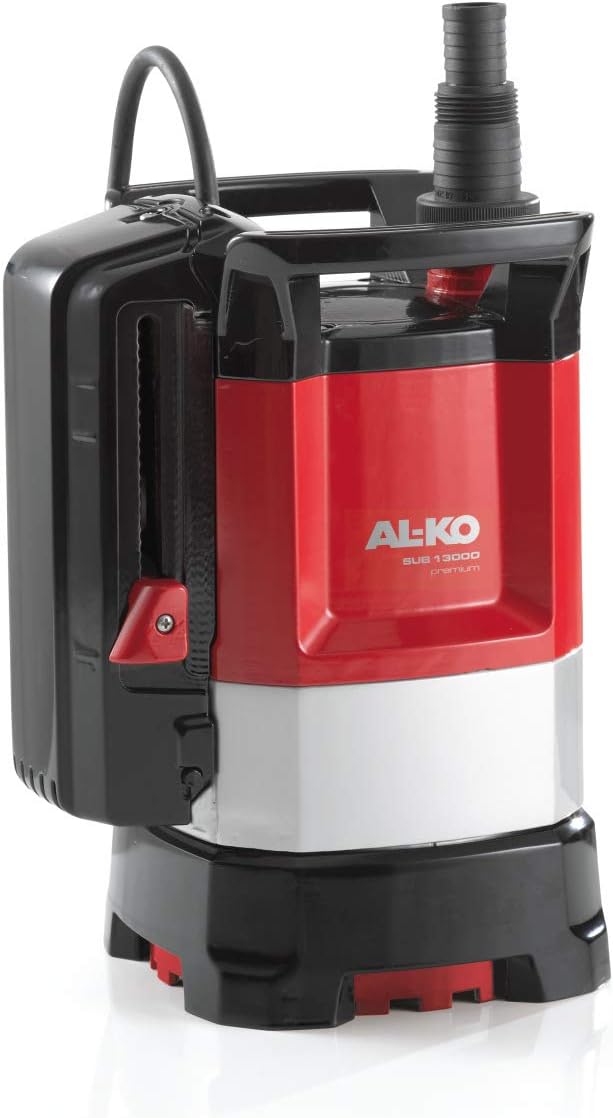
Top pick — AL-KO SUB 13000 DS Premium
The fastest clear-water pump in the test, and the one that leaves the least behind. Measurement put it at 22 seconds to empty a 90-litre barrel completely — four litres a second, 245 litres per minute, 14,700 litres per hour — with only 2 mm of residual water standing.
It is narrow for its output, a shade under 23 cm across, so a 24 cm shaft is enough, helped by an outlet at the head rather than the side. The foot turns to two positions: flat suction to 2 mm, or raised to pass debris up to a 38 mm grain size. Hoses of 19, 25, 32 and 38 mm all work, the last only via the 42 mm internal thread, since the supplied spigot tops out at 32 mm.
The important detail is the surface. Rivals that suck this flat pull soft pool liners and rubber barrel bases against the intake, throttling the flow; this one managed 2 mm on rubber as well as tile and concrete. It has the thickest cable in the test alongside its sister model, and submerged it is barely audible. Drawbacks are minor: it is one of the pricier pumps here, and the supplied spigot needed an aftermarket adapter to take 38 mm hose.
Search Amazon UK · Search Amazon US
The fastest — Gardena 19500 Aquasensor
Rated at 860 W and a maximum 19,500 litres per hour, this was the strongest on volume: the 240-litre barrel in 66 seconds, a projected 13,091 litres per hour, with the six-metre 32 mm hose filled within a second despite roughly two metres of lift.
It handles both duties, taking particles to 35 mm, and switches to flat suction at a button — the base plate extends and locks, leaving about 8 mm. A sensor replaces the float switch, its active stage shown by LEDs and dry running prevented. The part-clad stainless body is well finished. Against it: the housing is large and heavy, and the smooth handle gives a rope nothing to grip.
Search Amazon UK · Search Amazon US
For dirty water — Kärcher SP 22.000 Dirt
750 W, a quoted 22,000 litres per hour, and among the quickest dirty-water pumps measured: the 240-litre barrel in 74 seconds against two metres of head, a projected 11,676 litres per hour. Both 32 and 38 mm hose can be fitted.
It does not suck flat, leaving 36 mm behind. Venting is very good, so it picks up quickly after standing. A fold-down metal pre-filter cuts maximum grain size to about 5 mm, the quick-connect fitting makes hose changes fast, the ten-metre cable is notably thick, and a rope ties securely to the handle. The housing is bulky.
Search Amazon UK · Search Amazon US
The value combination — Gardena 2-in-1 20000 Basic
A 550 W motor that emptied the 240-litre barrel in 91 seconds against two metres of lift, a projected 9,495 litres per hour, making it one of the most efficient here for water actually moved.
It covers clear and dirty water, but the base plate must be pulled out by hand for flat suction, which works reliably yet is fiddlier than the button on the dearer model. Residual water measured 8 mm. It is compact and light, the float locks for continuous running, and it takes 32 and 38 mm hose. The plastic housing does not match the stainless models for feel.
Search Amazon UK · Search Amazon US
For a fixed installation — Jung Pumpen U3KS
Slight-looking, with a thin four-metre cable, and designed to be built into a shaft rather than carried about. Despite drawing only 320 W it pushed 5,588 litres per hour through the hose, close to the stated 6,500. A robust float arm works more dependably in a shaft than a float on a cable, and guide-rail install kits with a control and alarm are available.
Up to three flushing bores open underneath, costing a little output but stopping solids piling up beneath the pump. A closable vent at the spigot prevents an air cushion forming. Used mobile for clear water with the foot removed, it leaves 5 mm. It will also move warm water, 60 °C for ten minutes or 35 °C continuously.
Search Amazon UK · Search Amazon US
Also tested
Kärcher SP 16.000 Dual — 550 W, quoted 16,000 litres per hour and measured at 8,135; start point adjustable between 22 and 29 cm, particles to 20 mm, but the float trips lazily.
Cleancraft 7014A — 750 W yet slow to build pressure, taking 102 seconds for the barrel, a projected 8,471 litres per hour against a claimed 13,980, and leaving 34 mm.
Wilo Drain TMR 32/8 — 370 to 450 W, barrel in 108 seconds for a projected 8,000 litres per hour and one of the best efficiency figures here; fits shafts from 18 cm, no vent bore, 32 mm residual.
Trotec TWP 11000 ES — 1,100 W and a quoted 20,000 litres per hour, yet only 6,507 measured; six kilograms, a 360-degree quick-connect elbow, particles to 25 mm, 40 mm residual.
Kärcher SP 9.000 Flat — measured at 5,741 litres per hour but flat-sucking to 2 mm, with folding feet to stop it grabbing liner; automatic running leaves 13 to 18 cm, and particles above five millimetres are out.
Kärcher SP 16.000 Dirt — the generalist, moving 7,714 litres per hour while still passing 20 mm particles and leaving only 20 to 25 mm, much the best figure for a large dirty-water foot.
Belko HydroFlat Vario Pro 850W — a projected 8,911 litres per hour, but the frame admits only five-millimetre particles, the foot must be unscrewed to swap, and automatic running leaves 19 cm, starting at 38 cm.
Belko HydroFlat Vario Eco 400W — the 400 W sibling, measured at just 4,961 litres per hour against a claimed 9,000, with automatic start at 33 cm and cut-off at 7 cm.
AR Blue Clean ARUP 250PC — 3,900 litres per hour and less again if the six-metre head is used, though the 250 W draw suits off-grid solar.
AL-KO SUB 8500 Easy — measured at 5,684 litres per hour through smooth 32 mm PVC hose, leaving 5 to 10 mm, with a 25/38 mm reducer included.
Einhell GC-DP 7835 — strong flow for a cheap pump, clearing 90 litres in 18 seconds though 40 mm stands afterwards; 22 cm across, a 46 mm outlet, particles to 35 mm, skimpy manual and a wobbly handle.
Gardena 20000 Dirt Aquasensor — sensors and a ten-second delayed start so the hose can be positioned; 750 W, 90 litres in 18 seconds, particles to 35 mm, five to six centimetres left, 6.3 kg, and a plastic locking clip that will not last.
Makita PF1110 — all stainless, swallowing stones to 35 mm; the rig returned 6,360 litres per hour for 658 W, about 0.1 kWh per thousand litres, and the tack welds look untidy.
Güde GS 1103 PI — the same shape and rating as the Makita with a claim 5,000 litres per hour higher, which testing did not bear out: 700 litres per hour less, at a slightly lower draw, with a marginally better 39 mm residual.
Trotec TWP 4006 E — intakes ending just 6.5 mm above the floor take a pool to the base, at a five-millimetre particle limit; about 4,000 litres per hour on only 242 W, roughly 0.06 kWh per cubic metre.
Einhell GE-DP 18/25 — battery powered, the pack in a separate box with two power levels and a height-adjustable foot passing 25 mm stones, but no float switch, and the twenty-second dry-run cut-out left a puddle.
Gardena 9000 Dirt — the smaller sister at 9,000 litres per hour, clearing 90 litres in 35 seconds and leaving 25 to 35 mm, less than the larger model; its 38 mm thread means at most 32 mm through the spigot.
AL-KO Twin 14000 Premium — as quick as the winner at 23 seconds for 90 litres, with a ten-metre head no other pump matched and the automatic/manual switch on the plug; dual duty costs it flat suction, leaving 15 mm.
Kärcher SP 6 Flat Inox — matches the winner's 22 seconds and reaches 1 mm on a hard floor, with a stainless pre-filter and aluminium pump housing; on rubber the feet must be folded out, raising residual water to 9 mm, and starting in ten centimetres of water was poor.
Metabo TP 7500 SI — compact enough for a 23 cm shaft, with an integrated float cleanable without tools and a lever for automatic or manual that a cord can work under water; 38 seconds for 90 litres, 4 mm residual.
Güde GFS 401 S — flat-sucking to 2 mm, or a good millimetre with the non-return valve fitted, using a water sensor on the cable instead of a float; the 38 mm outlet is wasted on the 400 W motor, which needed 55 seconds.
Einhell GC-SP 3580 LL — the same pump unit as the Güde and near-identical timing, leaving 2 to 3 mm; a conventional float starts it on immersion, but the fragile float holder and thin cable point to modest build quality.
How they were assessed
Thirty-one submersible pumps were tested under practical conditions. Flow was measured with a 240-litre barrel and two metres of head, through a six-metre hose of 32 mm internal diameter, timing both how long the hose took to fill and how long the barrel took to empty, and calculating litres per hour from the two. Power draw at the socket was logged throughout, allowing kilowatt-hours per cubic metre to be worked out. Flat suction was judged by standing each pump in a shallow container and measuring the residual level with no back-flow, then running flat-suction models again in a pool to see whether the rubber floor was drawn against the intake. Handling notes came from lowering the pumps into a 4,000-litre tank.
The short answers
Which is best? The AL-KO SUB 13000 DS Premium: quick, and it leaves very little behind.
Which will empty a shallow shaft automatically? The Gardena 9000 Dirt, which switches on by a level of 40 cm at the latest and leaves 2.5 to 3.5 centimetres.
Can one draw from a well? Yes, within the model's head, counting any parapet. Sand argues for a dirty-water pump with at least seven metres of head — but it produces no pressure, so it can fill a barrel or feed drip irrigation and nothing more.
Are half-inch garden hoses enough? No. The bore is too small and the impeller works against the resistance. Use one inch, or better one and a quarter.