Indoor growing needs light, and in a British winter a windowsill does not supply enough of it. That is what a grow light is for: raising seedlings before they go outside, keeping tender plants going through the dark months, or running a full crop indoors from sowing to harvest. This guide covers a test of 29 LED grow lights, 17 of them still on sale, and the measurements that separate a lamp that grows plants from one that merely looks bright.
What follows is recorded testing, translated. Nobody at Truthful Reviews has grown anything under these lamps.
Lux or PPFD: the number that matters
Lux is the familiar brightness figure, and it measures light as the human eye perceives it. Plants do not respond to that. PPFD — photosynthetic photon flux density — counts the photons in the 400 to 700 nm band that plants can actually use, arriving on a square metre each second, in micromoles per square metre per second. A lamp can post a high lux figure and still deliver very little usable light.
The working bands are straightforward. Raising young plants wants 200 to 600 µmol/m²/s. Growing larger plants on wants 600 to 900. Keeping a houseplant alive through winter on a windowsill needs only 50 to 150.
Spectrum, power and hanging height
Every lamp here is full spectrum, meaning all the light colours are present at once. White supports photosynthesis in every phase; blue is what germinating seed needs; red drives the first leaves and stems, shortens the time to flower and speeds fruiting. A typical full-spectrum LED is 80 to 90% white across 450 to 700 nm, with extra red chips at 660 nm and sometimes UV-A.
Power follows the job: about 20 W for a single houseplant through winter, 50 to 100 W for serious indoor cultivation, ideally daisy-chainable so a large area lights evenly. LEDs were the focus here because they cover the whole spectrum including infrared and ultraviolet, run cool and usually dim. Fluorescent tubes at roughly 5,000 to 6,500 K suit the growth phase and 2,700 to 3,000 K the fruiting phase, cheap to run but weaker; metal-halide and sodium lamps are largely industrial, need a ballast, and each covers only part of the cycle.
Height matters as much as the lamp: 60 cm above the tray at germination with 14 to 16 hours of light, 30 cm in flowering at about 12 hours, and 45 cm in fruiting, also at 12 hours.
The picks
Top pick — Sanlight Stixx 50
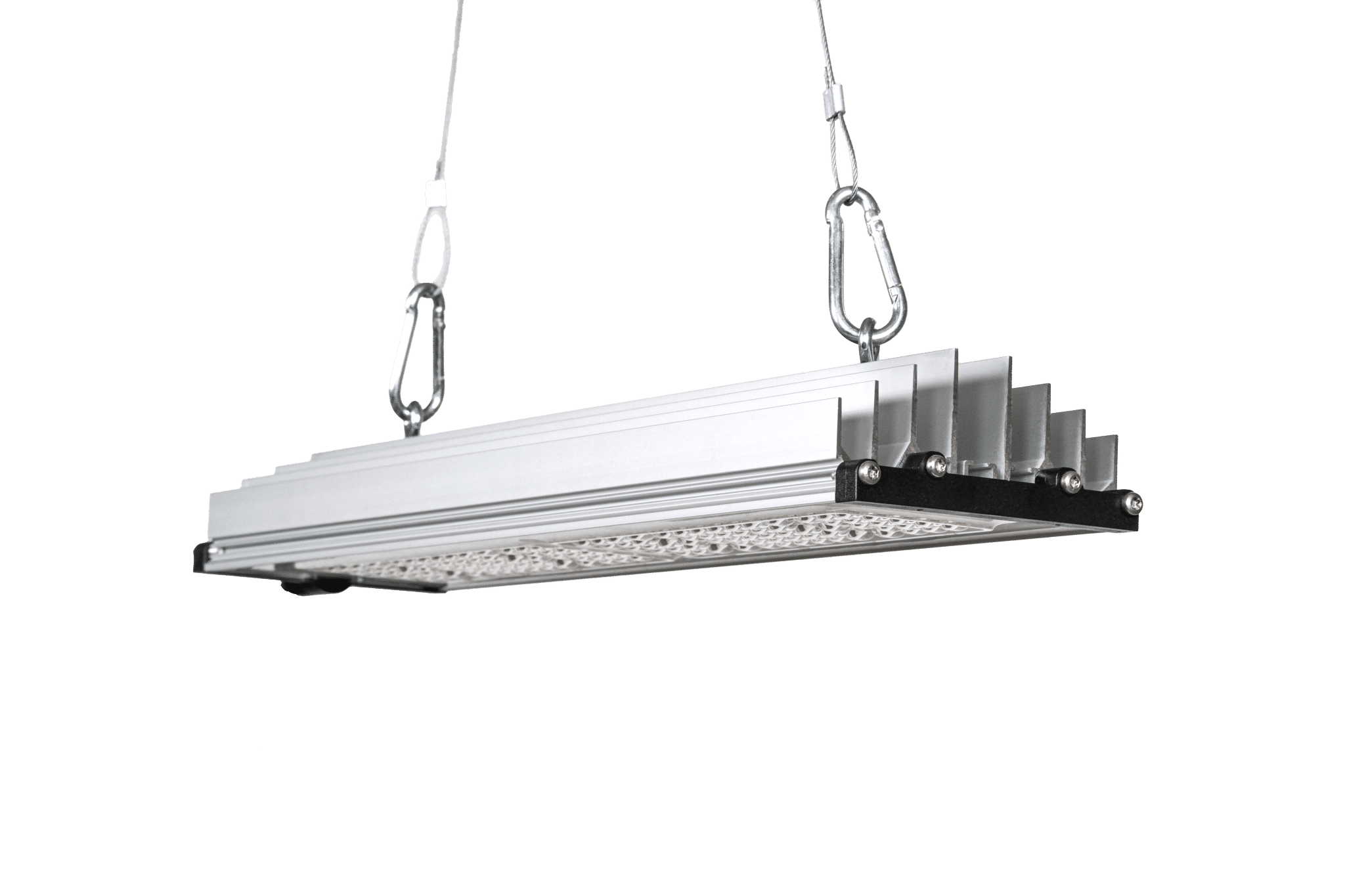
The best grow light for most people. Finish, material quality and light output are all first rate on this 54 W full-spectrum bar, and it covers up to 1 m² — one plant of around a metre in height, or several smaller ones. It carries an IP68 rating against dust and water, and hangs in moments from two sliding hooks.
The measured output is the story: at 40 cm the reading was 438 µmol/m²/s, well beyond seedling territory and into growing plants on. The light field is homogeneous, with no visible or measurable hotspots, which suits small areas of roughly 1 to 1.5 m² where panel LEDs often throw too tight a beam. The ballast box sits about 2.35 m down the cable and must stay accessible, because the dimmer wheel lives there, adjusting output in 20% steps.
Growth results were the best in the test. Seedlings were slow in the first week, because at full output the lamp gives tiny leaves more light than they can use; wound down and hung further away, they took off after about ten days and then pulled clearly ahead of plants under weaker lamps. Lettuce, peppers and tomatoes all came on fast and strong, with good leaf colour and well-rooted pots, and after four weeks the seedlings were robust enough for the garden. At the end of the eight-week test the plants under this lamp were among the largest and best developed, the first vegetables already flowering.
Heat is well controlled: 49.5 °C at the top centre of the housing after a day at full power, and that peak is very localised, the rest of the body well under 40 °C. There is no fan, so it is silent. The one drawback is that first germination phase, where it is almost too strong and gives no better result than a small propagation tube.
Search Amazon UK · Search Amazon US
For large areas — Spider Farmer SF600
A metre long, remarkably light, and the choice for a shelf of at least that width or an area up to about 2 m² — two seed trays lit fully, thanks to a 120-degree beam. Mounting is unusually easy: two steel cables with small wire clamps, no tools, height set and locked at the clamp.
The 384 LEDs are cleanly soldered and the build is good, though there is no timer, dimmer or fan. The spectrum is broadband: 660 to 665 nm and 730 to 740 nm red, plus 2,800 to 3,000 K and 4,800 to 5,000 K white, covering germination, flowering, fruiting and chlorophyll synthesis in mature plants. Despite that output the 75 W lamp does not get warm.
Seedlings came up quickly and grew strongly, healthy and well rooted, fast enough that potting on barely kept pace. Rated life is 50,000 hours, roughly 11.5 years on the test's 12-hour daily schedule. It is one of the pricier options here, to buy and to run, and suits someone committed to the hobby.
Search Amazon UK · Search Amazon US
The budget improviser — Mondlicht LED Feuchtraumleuchte
Not a grow light at all, but a cold-white damp-proof LED batten, included as the low-budget option and a genuinely good one for raising seedlings. It measured 64 µmol/m²/s — the bottom of the band seedlings need, but ample, and results over the 30 × 60 cm area used were excellent, plants coming up deep green, healthy and fast with no stretching.
It is cheap, sold in several lengths, carries an IP65 rating and draws very little power, lighting up to about 1.3 m². Two caveats: it comes without a cable, so a lead and plug must be added, and it needs mounting. It cannot take plants beyond the early growth phase, where full spectrum becomes necessary.
Search Amazon UK · Search Amazon US
Also tested
Cokolila GL-CR600 — a compact, well-made 65 W panel with a front wheel dimming in 10% steps and daisy-chaining for twelve lamps, and growth was as good as it gets, but the cooling fan hums audibly and quieter passive rivals have overtaken it. Search Amazon UK · Search Amazon US
Grün Garten AzureGrow Grow LED Panel 100 W — high material quality, brightness in 10% steps, barely warm at full output and linkable with identical panels, with the test vegetables healthy and strong after about two weeks; the objection is cost. Search Amazon UK · Search Amazon US
Mars Hydro TS600 — a 35.6 × 31 × 3.6 cm panel measuring 1,773 lux, with 660 nm red plus 3,000 K and 5,000 K white, silent and fan-free, giving good growth, but not dimmable and noticeably hot despite the maker's claim. Search Amazon UK · Search Amazon US
Viparspectra P600 — a solid 28 × 30 cm aluminium panel with stepless dimming and silent operation, but at the recommended 25 to 30% germination setting the seedlings stretched, and it runs warm despite the maker's claim. Search Amazon UK · Search Amazon US
Fecida 65 Watt LED Pflanzenlampe — 31 × 21 × 4.6 cm, 1.15 kg, 588 LEDs, stepless dimming, daisy-chaining for eight units and a quiet fan, but it measured 873 lux and the lettuce began to stretch, so it suits undemanding plants only. Search Amazon UK · Search Amazon US
Idudu Pflanzenlampe LED — bare aluminium plates that are awkward to hang level, but the pair measured 65 µmol/m²/s at 40 cm, enough for seedlings or winter support, with average growth, a surface temperature of 36.1 °C and three switchable modes. Search Amazon UK · Search Amazon US
Wolezek BL-J20B — a clip-on 15 W unit with four gooseneck arms covering about 50 × 50 cm, ten dimming steps and a fixed 4, 8 or 12-hour timer; it measured 1,221 lux and seedlings grew well, though it is too weak for larger plants. Search Amazon UK · Search Amazon US
Wolezek BL-T40A — the twin-head version measured just 31 µmol/m²/s between the heads, and growth lagged badly, the plants smaller, weedier and increasingly prone to stretching. Search Amazon UK · Search Amazon US
Sansi C21GL-CE-36W — a 36 W E27 bulb, very well made, mixing every wavelength from 380 to 780 nm from one ceramic-substrate design and rated for 25,000 hours; it measured 3,166 lux and plants grew fast and strong, but a full seed tray wants two. Search Amazon UK · Search Amazon US
Bioledex E27 PAR38 — a 10 W, 25 g bulb rated for 15,000 hours, with no dimming, timer or modes; at 330 lux it is too weak, and the seedlings stretched within three days apart from the three directly beneath it. Search Amazon UK · Search Amazon US
Railee HD-PL-08DC — a 96 W stand with four gooseneck heads extending from 41 cm to 160 cm, four modes, ten dimming steps, a remote and a 4, 8 or 12-hour timer; it lit a whole tray evenly at 1,500 lux with no stretching, but the build feels rattly and its internal timer blocks an external time switch. Search Amazon UK · Search Amazon US
DragonLight BW1000 — light and rattly at 31 × 20 × 4 cm and 875 g, with veg and bloom switches and a 395 to 730 nm spectrum, but only 339 lux at 40 cm, and the seedlings grew sluggishly and poorly. Search Amazon UK · Search Amazon US
Niello TL-HB4 — 20 W strips whose adhesive tape lasted barely 24 hours before the bars dropped onto the seed tray, and the 240 LEDs are not enough either, with seedlings stretching badly. Search Amazon UK · Search Amazon US
Ingarden Starter-Set — a microgreens station with a ceramic tray, steel frame, LED bar, stainless trays and cotton wicks for automatic watering; its 12-hour timer worked faultlessly and a mustard pad was ready seven days from sowing, but it is very small and rated at only 22,000 hours, with a replaceable LED bar. Search Amazon UK · Search Amazon US
How they were assessed
Twenty-nine LED grow lights were tested, with plant development the primary criterion alongside measured light output, installation and heat. The test plants were light-hungry nightshades — pepper, physalis, tomato and aubergine — plus basil, endive, marigold and Californian poppy, all in identical seed compost and identical 6 × 4 quickpot trays measuring 52 × 33 cm.
Lamps hung in heavy-duty shelving with each bay screened so light did not spill into the next, at a room temperature held between 20 °C at night and 24 °C by day. Trays were covered with film for germination and uncovered as soon as the first green appeared, and every lamp ran 12 hours a day on a central time switch. Development was documented for about eight weeks. Brightness was measured at 40 cm with a lux meter rather than taken from the maker's figures, and since the 2025 update PPFD has also been measured with a quantum PAR meter.
The short answers
Which grow light is best? The Sanlight Stixx 50. Its high but adjustable output makes it usable for propagation, full cultivation and winter support; the only caveat is winding it down in the first phase.
What does full spectrum mean? All light colours at once — mostly white across 450 to 700 nm, with added deep red at 660 nm and sometimes UV-A, approximating daylight across 380 to 780 nm.
What do I need for a windowsill? Simple propagation tubes at 5,000 to 6,500 K do the job. Full-spectrum LEDs at 3,500 to 4,000 K are the optimisation, carrying blue for germination and root development and red for leaf and stem growth, typically in a 70% red to 30% blue ratio.