Gravel riding has stopped being a fringe pursuit, and the shoes have caught up with it. In the early days of the boom people rode gravel in walking boots on flat pedals, or in ordinary mountain-bike shoes. Neither is the first choice for most gravel riders now, because the typical gravel rider's profile — and above all where they ride — has drifted a long way from the mountain biker's.
Gravel means bikepacking and adventure as much as it means racing, and that puts a new demand on a shoe: it has to work on the pedal and on foot. Manufacturers answer with specially tuned soles, roomier toe boxes and a lot of adjustability. Ten shoes across every price class were tested at length; what follows is recorded testing, translated. Nobody at Truthful Reviews has ridden or walked in any of them, and this guide makes no claim about health, feet or injury — it describes mechanisms, materials and what the testing observed.
Sole stiffness is the decision that shapes everything
The use case for a gravel shoe runs from commuting through bikepacking to gravel racing, and the big difference between models is the sole. The stiffer it is, the more efficiently the shoe transmits drive to the pedal, so anyone racing should look for a stiff sole. Comfort suffers under a stiff sole, though, both inside the shoe and when walking. If you want a shoe for everyday gravel or for bikepacking, a broader, more flexible sole is the answer.
Until recently most people gravelled in a mountain-bike shoe, partly for lack of anything else, and the two types genuinely do overlap: with both, you want to ride well and walk well. In general, though, a mountain-bike shoe weights efficiency towards riding, and its terrain is more demanding — hike-a-bike sections on very rough, steep or muddy ground. Gravel is more about the forest fire road and the classic bridleway.
Sole: tread and hardness
Gravel shoes have to work on the bike and on the path, which is the clear break from a road shoe. For loose stone and damp woodland floor they need a robust, treaded sole, and it should be broad enough to give a settled footprint. Shoes built for racing or for mountain biking can get away with a slightly narrower sole, because there the point is only to cover a few steps on foot. The sole does at least need to roll well enough that a slightly longer stretch on foot is not a chore.
The other half of the compromise is hardness: the sole also has to be firm enough to drive the pedal efficiently. This shoe type is a synthesis of two demands. For bikepacking, softer soles make sense — not only because there will be sections on foot, but because anyone away for a few days is reluctant to carry a second pair. For an evening wander round a town or a bit of sightseeing at the far end you want a shoe with walking comfort and a relaxed, casual look.
Unfortunately every manufacturer does as it pleases here. There is no real reference point for how hard a midsole with hardness index 6 actually is, so the numbers are not comparable between brands. It usually helps that manufacturers state the maximum hardness in their own range: hardness 6 out of 8 tells you the midsole is on the hard side, while hardness 3 is probably close to an ordinary street shoe. As a rough guide, the nearer the number is to that manufacturer's maximum, the harder the sole.
Closures and sizing
A gravel shoe needs two things for a secure hold: a good fit and a secure, finely adjustable closure. Most manufacturers offer the Boa system or a comparable dial, where a wheel pulls a lace to draw the shoe onto the foot. Occasionally you find that combined with a hook-and-loop strap. Between them, the shoe can be tuned closely to the foot and slackened off a little in places for walking.
A skin-tight fit, of the kind road shoes go for, is not the priority here. At the forefoot in particular a gravel shoe should be comfortable without much play, so that the pedal stroke stays round and the drive stays efficient. The shoe fits properly when there is still some freedom of movement in the toe box. Almost without exception the shoes in this selection come up on the small side.
Clipless or not
Every gravel shoe in the test can be fitted with cleats for clipless pedals, and Shimano's SPD system dominates here as it does in mountain biking. Increasingly, though, people gravel on flat pedals — a concession to the fact that many newcomers arrive from trekking bikes without clipless experience. Whichever route you take, it is worth checking that the cleat sits deeply enough recessed that it does not touch the ground.
Looking after them
Gravel shoes in synthetic materials are easy to care for. Coarse dirt washes off, and a brush will usually clear muck out of the lace guides for the Boa system and the ventilation holes. Clean the inside of any hook-and-loop straps with a clean brush too, or they lose their grip. If the shoes come home wet, crumple newspaper into them and let them dry — not on a radiator. Contrary to some advice doing the rounds, the testing came out against putting gravel shoes in the washing machine: the soles are usually glued, so they are not machine-proof.
Top pick — Scott Gravel Pro
Pick up the Scott Gravel Pro and the soft outsole is the first thing you notice. The sticky rubber tread is almost tacky, feels relatively soft and is broad at the heel in particular, which gives a firm footprint and good purchase on asphalt and woodland floor alike. The nylon–glass-fibre midsole is of medium hardness, index 6 of 9, so the shoe cuts a good figure on the pedal and on the ground. The test winner is a gravel all-rounder with a lot of comfort, bikepacking adventures included.
Slip it on and it is clearly a normal last, though a slightly broader foot still finds room. The Boa closure adapts the shoe very precisely and the lace runs through the plastic guides with very little friction. The inner material is pleasantly soft throughout, and so is the separately stitched upper edge of the breathable tongue — a problem area on some other shoes.
It is not a winter shoe: the upper is too heavily ventilated, with perforations in the material and a small mesh window on the inside face where fresh air streams in unchecked. That nothing else gets in is down to the wraparound, colour-contrasted, very sturdy bumper zone.
The Gravel Pro is a compromise between plenty of comfort and broadly drawn function. If you are not after racer qualities but good all-round ones, and you value comfort on a bikepacking trip, this is the one to try on. There is a women's version as well.
Strengths recorded: a soft treaded sole with good purchase, high adjustability, high-quality construction, very robust bumpers front and rear, and high breathability. Against it: power transfer is only so efficient.
Search Amazon UK · Search Amazon US
The efficient one — Rockrider Gravel Race 900 Habu Fit System
This shoe manages what many of its kind find hardest: it combines comfort with good power transfer. Its most striking detail is a very stiff sole, which allows a strong acceleration and creates a very direct connection between foot and forward drive. It was also the cheapest shoe in the test, and it still offers more than many others — drive that can hold its own in racing, plus a high-tech upper that is not among the most breathable but does keep the warmth in as late as autumn.
Comfort does not get short shrift even so. The slightly angled Habu closure adjusts the shoe well and it sits as if moulded, helped by a thin microfibre upper that hugs the foot. That material knows almost nothing about breathability; the job is left entirely to the strong mesh on the tongue, which is pleasantly padded. Bumpers over the front half and around the heel are not especially hard, but they do protect.
The treaded sole is a gravel compromise: a narrow raised heel tread at the back, while at the front the almost tooth-like lugs are set out to nearly the full width of the shoe. Getting through mud is not a problem. Even allowing that shoes three times the price show finer finishing, and that the Rockrider's footbed really is a little thin, the sheer fun of that strong acceleration makes it worthwhile. The recorded weak points are an insubstantial tongue edging and poor walking.
Search Amazon UK · Search Amazon US
For racers — Northwave Extreme X
The Northwave Extreme X is a shoe for racers. A carbon midsole makes it the performer, and comfort comes second, partly because the last is cut fairly slim. Northwave still wants racers as comfortable as possible, on the argument that comfort is what makes performance possible — and here that means individual adjustment.
The X-Dial SLW3 adjusters stand out. Above these ergonomically shaped discs sit two hook-shaped levers, and unlike the Boa system it is these that release lace tension: press one briefly and the dial turns back a millimetre, which is an elegant way to fine-tune the closure. Lift the lever instead and the lacing releases completely.
That is only one of the shoe's technical features. Another is the elaborately lasered footbed — or rather footbeds, since a standard one 3 mm thick and an extra one at 5 mm are both supplied. The entire heel section is printed with silicone so the heel does not slip out of the shoe, which it does not do even under pull. The rule with the Extreme X is that everything has an individual solution or a replacement when it wears: the removable tread rails, the lugs and the heel piece all come off, and even the narrow strip of tread either side of the cleat can be taken away. It is a product that demands respect for its material and build quality.
The one shortcoming is that you cannot march about in the luxury shoe. Its midsole, at hardness 15, really is too hard for that.
Search Amazon UK · Search Amazon US
Also tested
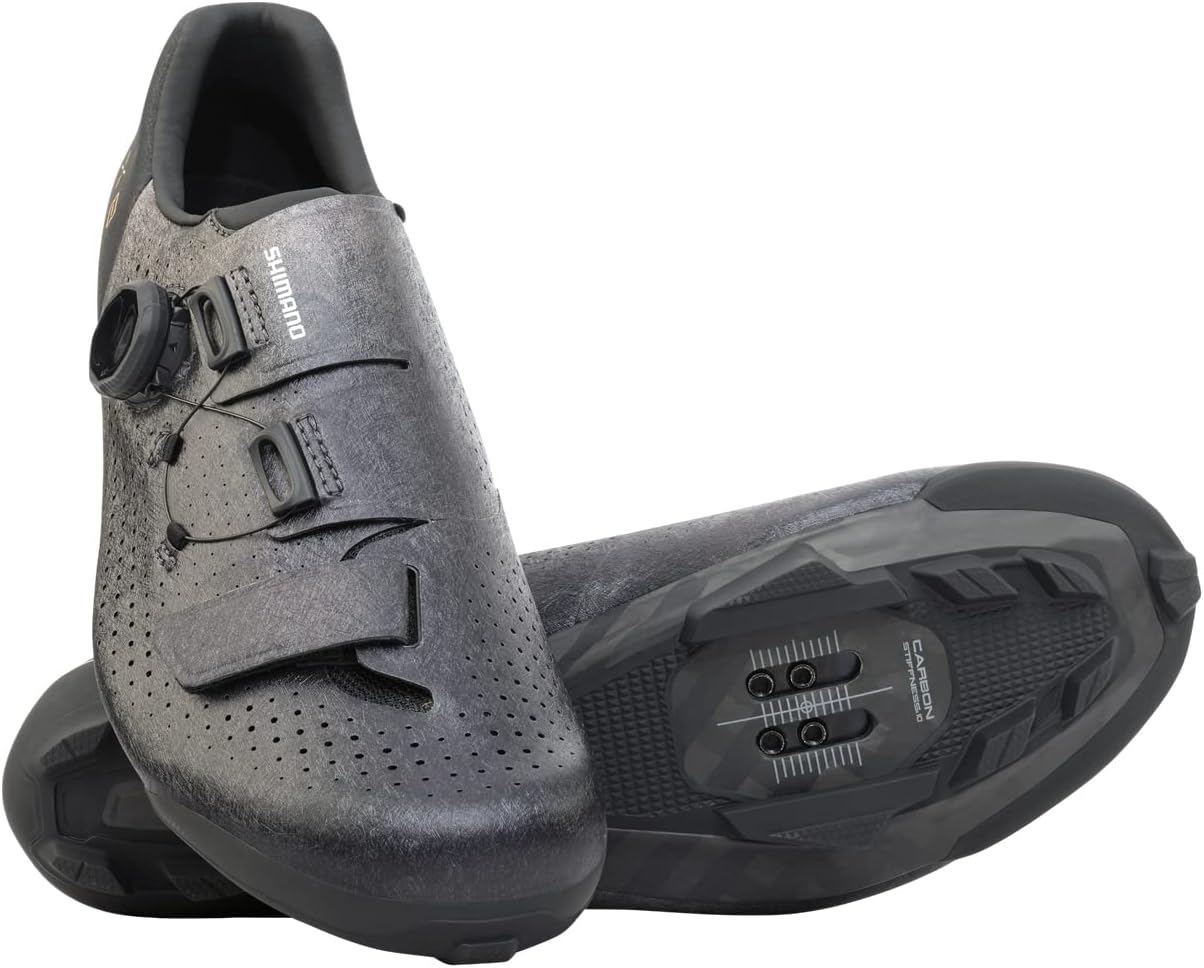
Shimano RX801 — at 633 g per pair the lightest shoe in the test. That and the ultra-hard carbon sole point to gravel racing, alongside very precise adjustment through a Boa dial plus a small and unfortunately slightly fiddly strap, and consistently high breathability from the upper. It has some comfort to offer too: a slightly broader toe box and a robust, antimicrobial footbed, with two inserts of different thickness available. The bumpers front and rear are a little small, perhaps a compromise for weight. It is well enough treaded for short walks in the slime, but the treaded sole is kept fairly narrow and offers little resistance to tipping, and material drawn well down at the ankle does not improve matters. The heel, on the other hand, is well held and padded. The result is not quite a rounded picture: for pure racers the positives may outweigh the rest, while others are better served by a more walkable, slightly higher shoe. Search Amazon UK · Search Amazon US
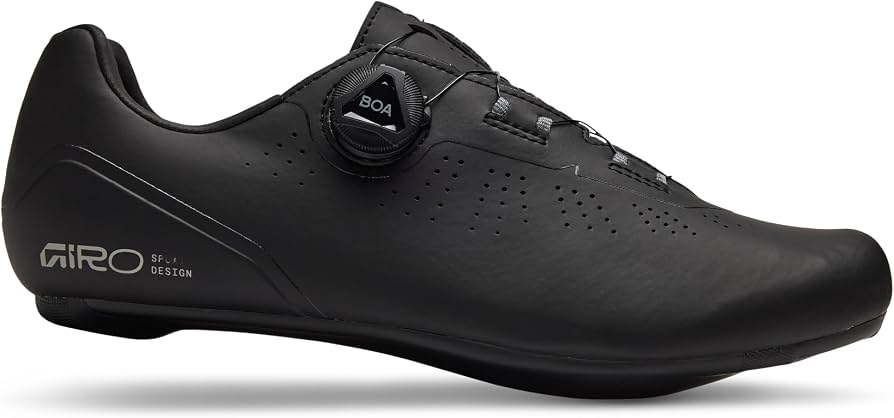
Giro Cadet XC — the manufacturer bills it as a gravel and mountain-bike shoe with performance ambitions; the testing says otherwise, and fortunately so. It is a high-quality build with a medium-soft nylon and glass-fibre midsole that is pleasant to walk on, while on performance it is barely average. The one-piece upper pushes it further towards bikepacking or a relaxed stroll around town at the end of a ride. The treaded sole has come out a little too hard for that, and can slip on smooth surfaces. What appealed was the slightly broader build, for looks and for comfort: a rather more voluminous toe box, with the whole entry and heel region thickly and robustly padded. It is genuinely a shoe that can make mountain-bike rides enjoyable, so long as they are not too ambitious or too technical, and the midsole hardness suits bikepacking and relaxed gravel touring very well. Search Amazon UK · Search Amazon US
Cube Peak — developed for mountain and gravel bikes alike, according to the Bavarian manufacturer. At 840 g in size 46 it has just about the highest weight in the test, which matters because its stiff sole (stiffness index 8 of 10) makes most sense in racing use. The coarsely treaded rubber sole is also relatively narrow, which again points at mountain-bike and race use. The two lugs at the toe are bolted on and replaceable, and large front and heel caps protect the edges reliably. The upper is barely breathable, though in the dark finish tested it makes for a successful design. For bikepacking and relaxed gravel use the shoe is a little uncomfortable, thanks to hard materials and the narrow fit, and you would not want to walk far on the stiff sole. The strap on the test pair was also so long that it projected well past its counterpart into thin air. A Cube Peak Pro version with a twin-dial closure is available. Search Amazon UK · Search Amazon US
Quoc Gran Tourer III — has everything a shoe for gravel touring and bikepacking needs: a walkable midsole in a glass-fibre and nylon blend, a robust treaded sole and a closure with three pairs of eyelets, so it adjusts quickly. All of it is very cleanly made, and summer riders get plenty of breathability from the many perforations in the upper and the tongue. It also looks pleasantly casual. Why it did not make the recommendations: even laced tightly it gave relatively little hold on the pedal in testing, and it comes up wide enough that a sense of real fit never arrived — the soft material and a heel hold that could be better both contribute. People with very broad feet might still get on with it. Search Amazon UK · Search Amazon US
Sidi Asper — insiders know Sidi shoes almost always come up narrow and small, and buy accordingly. Not this one: it comes up about normal in length but is deliberately kept generous front to back for adventure use. It is the only shoe in the test with no Boa-style dial at all, closing instead with three hook-and-loop straps. These feel rather brittle and inflexible and are awkwardly arranged, with two closing to the right and one to the left; anyone used to a dial will find the procedure laborious and impractical. Even opening them does not always work first time, since the straps have no tabs to grip. Otherwise the shoe is sensibly and cleanly built. The upper feels a little stiff but is very well finished, the pleasant padding on the tongue cushions the pressure of the straps, and the broad outsole is relatively soft and so generates plenty of friction on asphalt too. Another distinctive touch is the way the outsole wraps around the functional midsole. None of which counts for much if the shoe does not actually fit, so even broad-footed buyers should try it carefully first. Search Amazon UK · Search Amazon US
Vaude Kuro II — anything but a race gravel shoe, which is exactly why it is the perfect companion for a relaxed gravel weekend. It is designed for bikepacking and all-round use, and even its looks lean towards a trainer, with a finely drawn wraparound bumper. Despite a relatively soft nylon midsole you make efficient enough progress on the bike. Walking feels almost like walking in ordinary street shoes, helped by a pleasantly soft footbed, and the rubber sole's strong tread gives purchase on firm and slippery ground. If you need a very snug fit, pull once at the lowest lace crossing and give the Boa dial another short turn; on the pedal it then feels as settled as it does on firm ground. Around the entry and heel the Kuro II is pleasantly padded. Despite good ventilation it can take a bit of rain, though it would be out of place as a winter shoe. Vaude makes the Kuro II, like the rest of its range, using polyester from recycled plastic bottles. Search Amazon UK · Search Amazon US
How they were assessed
All the shoes were worn on gravel rides in dry, hot and — wherever possible — wet weather. Where wet conditions could not be arranged, the shoes were sprayed artificially and assessed accordingly. Rides were laid out so that pedalling happened at low pressure, at sharply increased effort and out of the saddle, which is how the shoes' efficiency at the pedal was established.
Fouling of the cleat area was also checked, since in extreme cases dirt can stop cleats engaging. None of the shoes stood out as particularly prone to it, and most have a similar tread build-up around the pedal area.
Every shoe was additionally used on foot, on the road and across varied off-road terrain, to establish how well it is laid out for walking. Softer midsoles that roll better walk more comfortably and more efficiently, and on sole hardness a compromise usually makes sense — one that allows acceptable efficiency on the pedal and on the ground. Outsole hardness matters too, for friction on smooth ground. Materials and finishing were a focus alongside fit and adjustability, because they decide how robust and long-lived a shoe is in frequent use, and impractical handling — a closure, for instance — was noted wherever it showed up.
The short answers
Which gravel shoe is the best? The Scott Gravel Pro. It is very well made and comfortable both on the gravel bike and when walking, and despite a flexible sole it still transmits power well.
What matters in a good gravel shoe? A good gravel shoe has to cut a figure off the bike as well as on it. A settled stance, including on poor terrain, is a precondition, as is secure and reasonably efficient power transfer to the pedal.
Can you wear mountain-bike shoes on a gravel bike? If you have well-fitting mountain-bike shoes you can walk in, then technically you are fine on a gravel bike too. A gravel shoe often offers more comfort at the same weight, though, and rolls better when you walk, and its usually broader sole makes for a more stable stance.
Verdict
Decide on sole stiffness first, because everything else follows from it. For racing, stiff; for bikepacking and everyday gravel, broader and more flexible. The Scott Gravel Pro is the pick for most riders: a medium index 6 of 9 midsole, a soft sticky-rubber outsole broad at the heel, a Boa closure that runs with very little friction, serious bumpers and a heavily ventilated upper. What it gives up is outright drive efficiency.
If that is what you want, the Rockrider Gravel Race 900 Habu Fit System is the surprise: the cheapest shoe here, with a very stiff sole, a strong acceleration and an aggressive front tread, at the cost of a thin footbed, an insubstantial tongue edging and poor walking. And for a racer who wants every part adjustable or replaceable, the Northwave Extreme X is in a class of its own — twin footbeds at 3 mm and 5 mm, millimetre-by-millimetre dial adjustment, a silicone-printed heel and removable tread rails, lugs and heel piece — provided you accept that a hardness 15 carbon midsole is not made for walking.
For the rest of the bike, see our bike lock guide and bike phone mount guide.