A day on the trail is decided as much by what's on your back as what's on your feet. This guide covers the four daypack recommendations from a specialist outdoor test (03/2026 issue), in which every pack was loaded identically with six kilograms of day-tour kit and compared for fit, ventilation, handling, measured volume and robustness — with "outstanding" as the highest grade awarded.
The short version
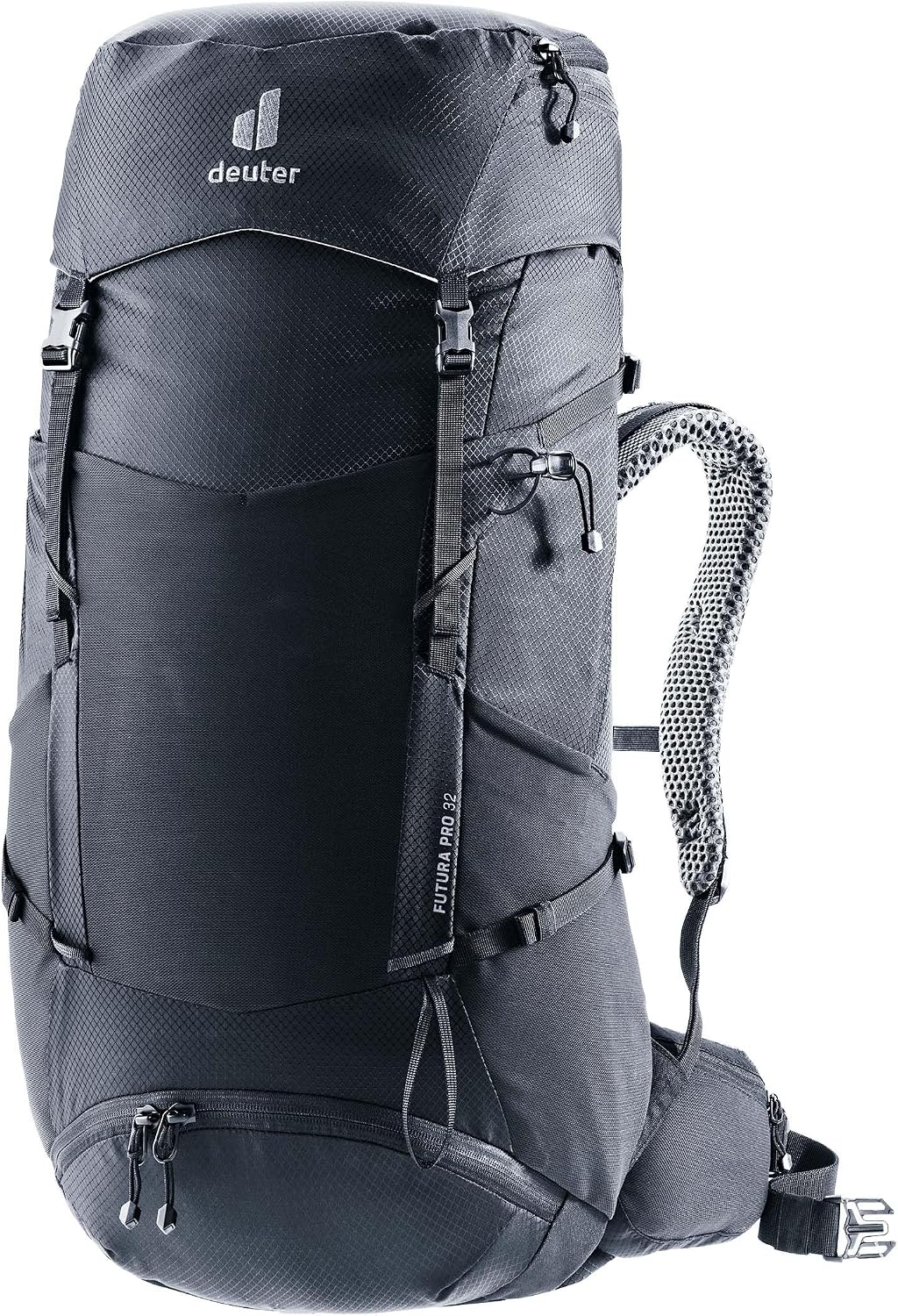
Test winner: Deuter Futura Pro 32
Graded "outstanding", the Futura Pro 32 is the complete daypack: 32 litres of well-organised capacity that spreads loads of up to 12 kg remarkably evenly across the back. The recycled, water-repellent and breathable polyamide build feels high-quality and durable, and the fit range is unusually wide — back lengths from 42 to 72 cm, suiting heights from roughly 1.70 m to 2.05 m.
The signature is the tensioned mesh back panel, which keeps air moving across your back and sweat patches away, helped by a flexible frame, padded adjustable shoulder straps and a padded hip belt. Numerous pockets keep kit orderly, a rain cover is included, and the hydration system takes a 3-litre drinking bladder. All-in weight with the rain cover is 1.58 kg; it measures 67 × 32 × 24 cm.
Price-performance pick: Ferrino Hikemaster 26
The test's value recommendation, graded "very good": a simple, light top-loader — 930 g in the men's version, 940 g in the women's — with padded shoulder straps, a padded hip belt and a rain cover included. Instead of a full mesh panel, two broad padded bands keep air circulating along the back, and loads up to 8 kg distribute evenly.
Capacity is 23 or 26 litres depending on version, plus two more in the lid pocket. The body's flatter curve makes packing easier than more aggressively arched rivals, and the small hip-belt-pocket zips run smoothly. It carries comfortably and leaves plenty of freedom of movement — the pack to choose when you want a dependable carry without paying for a tensioned mesh system.
Best for everyday use: Vaude Wizard 24+4
Graded "very good" and the most versatile of the group: a mesh-back pack of 28 litres across main, middle and front compartments, weighing 1.28 kg, whose back-panel tension is adjustable — flatter for better load transfer and easier packing, more arched for maximum airflow.
A large arched opening, front pocket and front compartment make it as practical on a commute as on a ridge, and a wrap-around zip expands the volume when needed. The PU-coated polyester build includes a rain cover; the only gripe is zips that could be beefier.
Comfort pick: Gregory Alpinisto 30
The second "outstanding" grade, and the pick for counting grams: nominally 1,035 g, the Alpinisto sheds its hip belt, back plate and helmet net to hit a featherweight 700 g — while still swallowing 30 litres and carrying up to 10 kg ideally distributed.
The PFC/PFAS-free synthetic build comes in S/M and M/L sizes; instead of a mesh panel, a close-fitting air-permeable mesh spacer ventilates the back. The deliberately narrow shoulder straps free the arms for scrambling and climbing; the trade-off is the missing lid pocket on an otherwise superb pack.
How the packs were tested
Every model carried an identical six-kilogram day-tour load. The testers compared how closely each pack hugs the back, how it sits in motion, ventilation and climate comfort, and freedom of movement — plus the load weight at which each stays stable, and how well each design copes with the different body shapes of men and women.
Ventilation was checked in practice at the back panel and at every strap contact surface to find heat traps; handling covered pockets, attachment points and how smoothly straps run in poor weather. Measured pack volume (checked with calibrated volume sacks), the pack's own weight, material abrasion resistance, coarse-toothed zips, clean workmanship and environmentally sound materials completed the assessment.
Which size do you actually need?
Packs of 20 to 30 litres — daypacks — are the sweet spot for single-day tours, and everything in this guide lives there. Squeeze your kit and 25 litres even stretches to a weekend with an overnight stop.
Beyond that the categories climb: around 40 litres for hut tours with an overnight stay, 60-plus once a sleeping bag and compact tent come along, and a week-long tour is well served by around 45 litres. Travel packs blend rucksack and holdall — some with trolley functions or detachable daypacks — and ski-touring and climbing packs are their own specialised breeds, the former loaded with attachment points and safety features, the latter built for freedom of movement and hard wear.
What matters when you buy
Try it loaded. A pack only reveals its carry with weight in it — around eight kilograms is a sensible test load, and good outdoor shops provide stuffing material. Only then do shoulder pads, hip belt and back panel show their true feel.
Match it to your back. A pack fits only if it suits your body or adjusts to it: some ranges offer multiple back lengths, shoulder-strap length is normally adjustable, and the back panel's arch sometimes too. Many makers build separate men's and women's models for different shoulder and hip shapes — as with the Ferrino here — though even those don't fit everyone.
Check it stays put. Hip belt, shoulder straps and chest strap fix the pack; test thoroughly that it rides without shifting as you move up, down and across slopes.
Judge the carry system, not the badge. Very cheap packs tend to save on materials, workmanship or an adjustable carry system that actually distributes weight — comfort is usually the first thing missing. Dependable brand models ask meaningfully more, while true luxury models offer few essential advantages over them, a conclusion this four-pack field bears out. No carry system, however good, compensates for luggage that is simply too heavy.
How to pack a daypack
For a day out, more than eight kilograms of equipment and food is rarely necessary — restrict yourself rather than covering every eventuality, and the walking is pleasanter for it.
The centre of gravity should sit at shoulder height and close to the body; put heavy gear in the bottom of the pack and you fight the weight all day. Only in difficult terrain should the centre of gravity sit lower.
Pack for the weather: waterproofs and a rain cover, or sun hat, sunglasses and sun cream. Dry spare socks are worth their space after rain or a sweaty climb. For navigation a smartphone with GPS works, a rugged GPS unit is more dependable, and a traditional map and compass do the job perfectly well. A pocket knife, a torch and a first-aid kit are standard kit; telescopic poles collapse and strap to the pack when they aren't in your hands. Finally, take enough water and food, plus money and a phone for emergencies.
How to clean and store one
Dirt sticks even to dirt-repellent fabrics, and sweat and sun cream leave their own marks. Never put a rucksack in the washing machine — you will damage the pack or the machine. When warm water and a brush aren't enough, soak and scrub it in the bath, avoiding ordinary detergent, which can attack the specialist fibres. A mild textile detergent is acceptable; if you walk often, a proper outdoor functional detergent is the better investment. Once it has air-dried, a re-proofing spray is optional.
For storage, don't crush a pack with a carry system out of shape. Keep it out of direct sunlight and away from temperature swings — a car boot is the wrong place — and store it completely empty in a ventilated room so the material isn't permanently strained.
Frequently asked questions
What counts as a daypack — and what size do I need for day hikes? Packs of 20 to 30 litres. Around 25 litres carries a full day tour's kit with room to spare; every pick in this guide sits in that band.
Are there hiking backpacks specifically for women? Yes — makers account for different shoulder and hip shapes with separate models: the Ferrino Hikemaster comes in men's and women's versions, at 930 g and 940 g respectively. The test also assessed every pack against both body shapes, and adjustable back lengths on packs such as the Deuter cover a wide range of frames.
Which of these takes a water bladder? The winning Deuter Futura Pro 32 has a hydration system compatible with a 3-litre drinking bladder built in.
What's the lightest option here? The Gregory Alpinisto 30: nominally 1,035 g, and with hip belt, back plate and helmet net removed it drops to roughly 700 g — while keeping 30 litres of capacity.
How much should I carry on a day walk? Rarely more than eight kilograms including food and water. That is also the sensible load to try a pack with in the shop.