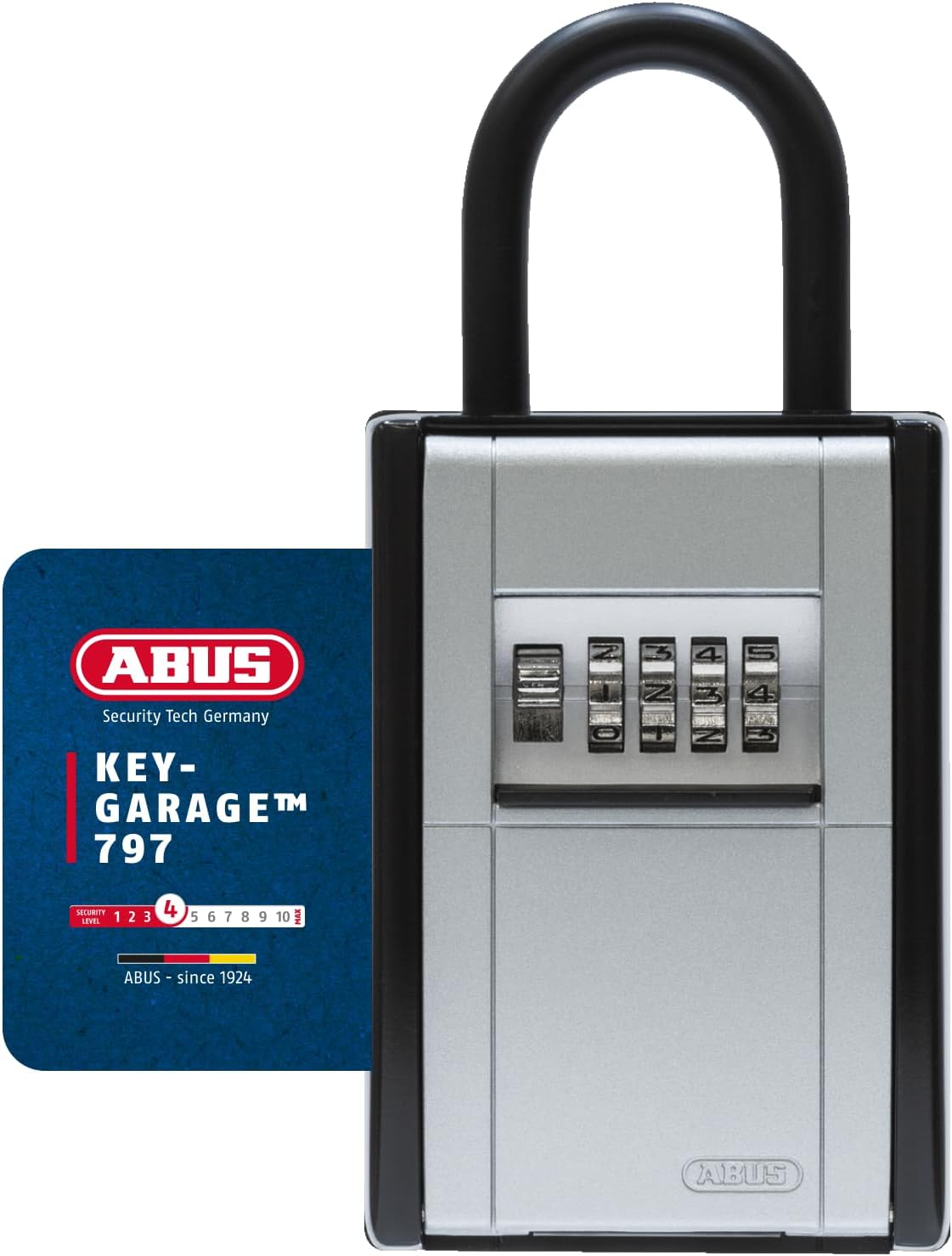
A key safe is a small metal box with a four-wheel combination lock, fixed to a wall or clipped round a gate with a steel shackle, holding a spare key that someone needs to reach without you being there. This guide covers a test of 18 key safes in which every box was frozen, flooded, filled with sand-laden water and then attacked with hand tools until it either held or opened.
What follows is recorded testing, translated. Nobody at Truthful Reviews has fitted or used any of these boxes.
What the testing found
None of the 18 came through faultless. The clearest pattern is structural: boxes hung on a movable steel shackle proved harder to open than boxes screwed flat to a wall, because a shackle-mounted box swings away from a tool instead of resisting it, and a lever bar struggles to find a purchase. Where build quality is comparable, the shackle version wins.
The second pattern is weather. These are simple castings with loose-fitting doors and no seals, so they are neither watertight nor dirt-tight. In the freezer test a large share of the field seized completely: the number wheels would not turn and the latch would not move, and on several boxes five minutes back at room temperature was not enough to free them. A shutter over the wheels is the single feature that most often decides whether a box survives sand and ice.
The third is mounting hardware. Housing holes are drilled for screws of up to 6 mm, but some boxes ship with thin fixings only 27 mm long and 3.5 mm across, which does little once a lever bar is involved.
How the boxes are built
The back plate of a screw-fixed box is drilled four or five times so the fixing pattern can be varied. The front plate hinges at the bottom and carries the four number wheels; on some makes the correct combination drops the flap straight away, on others a small release lever beside the wheels has to be pressed first. Setting your own code is the same everywhere: a small catch inside the lid puts the reset button into its adjustment position, you dial the code, then return the button and the new digits are fixed. Housings are usually a mix of die-cast and solid metal.
Most boxes carry a small shutter in front of the wheels against dirt. The compact ones often leave the wheels open in the lid. Capacity varies enormously: some take a fat car key and a full keyring together, others hold no more than two or three standard keys on a small hook. A mechanical car key with a rigid blade barely fits anything.
The picks
Top pick — Abus KeyGarage 797
Nothing opened it. Screwdriver, chisel, drill and lever bar all failed against this shackle-mounted box, which is the only unqualified result of its kind in the field, and the moving mounting is a large part of why: tools simply cannot be set against a box that swings.
Handling is good. The instructions are clear, the code is easy to set, the metal wheels turn smoothly and the release lever, though small enough to need a fingertip, moves cleanly. A small plastic shutter slides down over both controls against water and dirt. Capacity is very large — keyring and car key together if you want — although there is no hook or other ordering system inside. The back of the housing is rubberised so it will not mark a delicate surface, the large removable shackle is sleeved too, and its internal opening of roughly 50 x 37 mm is well judged. The numbers are less legible than the best here and there is no lamp.
Its weakness is the same shutter. Left open, the box is vulnerable to dirt and ice: after a soaking and a spell in the freezer only the shutter itself would slide, with the wheels and release lever solid, and five minutes indoors was not enough to open it. After the sand-water bath the latch jammed and the door stayed shut until the mechanism had been rinsed through with clean water.
Search Amazon UK · Search Amazon US
The heavy-duty alternative — Advansecure M4
Even with heavy tools and repeated hard blows this one would not open. It is a 1.2 kg zinc die-casting, and the weight tells: the door pivots sit deep inside the housing, invisible from outside, and unlike other boxes here they cannot be levered out of their holes. The turn-latch is buried just as deep and engages behind a very substantial plate.
A screwdriver left it completely unmoved. A chisel widened the gap between door and housing visibly on every side without affecting the hinge or the locking. Only after roughly two dozen blows at various points, plus brute levering with chisel and bar, did the latch bend far enough for the door to open without the code or the emergency key — and the process made enough noise to bring the neighbours out. The drill only bit into the door surface under heavy pressure, and an ordinary cordless machine struggled to supply it.
It came through the water test undamaged, rated IP22 against dripping water, though after the freezing phase the cylinder needed a firm wiggle before the lock would release. The wheels could be grippier, and they are awkward with dirty or greasy fingers. A neat touch is the automatic return to 0000 when the cylinder is opened, so the code cannot be left showing. Fitting is the price of that security: two 10 mm plugs mean drilling the wall, possibly with a hammer drill, and the nearly 70 mm screws with 7.5 mm shanks want a half-inch ratchet with a 20 cm extension to pull up tight. Once those two screws bite, levering is hopeless — no gap could be found and nothing moved. It is the dearest box here.
Search Amazon UK · Search Amazon US
The sensible saving — Burgwächter KeySafe 20 SB
Simple tools got nowhere. Screwdriver and club hammer were resisted; the box only gave in to heavier gear and a drill. Capacity is very large, enough for big keyrings and a stack of plastic cards, with a small magnet inside for a bit of order where a hook would have been better. The four number wheels are very large, grippy and turn without snagging. There is no cover flap over the mechanism — a small, cheap part the maker left out.
Four rather short and thin screws hold the housing, with the lid closing right over the screwed base plate. A thick rubber backing pad with a full lip takes up some unevenness in the wall, keeps off a little rain and makes it harder to get a tool in at the side of the lid.
The plain, electronics-free mechanism was unaffected by an intensive water bath — wheels and lock worked perfectly afterwards — and it was equally reliable after a night at deep-freeze temperatures, with every moving part still working as it should. The zinc die-casting was less impressive against the drill: no hole could be made right beside the wheels, but a little further down the lid face a metal bit went through easily, and two or three quick holes would make a slot big enough for a lever. With chisel and club hammer, three firm blows on one corner of the housing popped the lid: the latch and the small lip it engages behind look a shade too shallow.
Search Amazon UK · Search Amazon US
Also tested
Enoneo CH-910 — the biggest box in the field with the largest capacity of all, two key hooks, a full plastic front flap and four LEDs that light the wheels for about 13 seconds; it shrugged off sand-water but froze solid, and six chisel blows at the latch opened it. Search Amazon UK · Search Amazon US
Burgwächter KeySafe 10 — the smallest box, holding no more than three standard keys on a very small ring, with unprotected wheels that failed completely after both freezing and sanding; screwdriver and hammer failed, but two chisel blows underneath opened it. Search Amazon UK · Search Amazon US
Abus KeyGarage 787 — the screw-on version, well handled but with jagged, hard-to-read digits and a double key hook that eats the space; the wheels froze and the mechanism stalled after sand-water, and the chisel eventually blew a complete side wall off. Search Amazon UK · Search Amazon US
Diyife Apex G10 — rudimentary, with no shutter and no release lever, so the door can spring open and drop the contents; usable after sanding, immovable after hard frost, and six blows with screwdriver and hammer cracked the thin cast door above the hinge. Search Amazon UK · Search Amazon US
Zhege ZGD002 — a screw-mount box closely related to the Grifema, Amazon Basics and Nestling designs, with good handling, clear digits, a small shutter and large capacity; it opened stiffly after sand-water, froze solid, and a few blows with screwdriver and hammer cracked it. Search Amazon UK · Search Amazon US
Grifema GA1004 — mountable either on plugs and screws or on the supplied shackle, with a visibly reinforced housing top for the shackle; it survived the sand bath, froze unusable, and screwdriver, hammer and a few blows were enough to open it. Search Amazon UK · Search Amazon US
Amazon Basics SW-KS01-B — clear instructions, an easy code, a shutter over the wheels and large capacity; heavy soiling barely troubled it but a wet mechanism below freezing put the key out of reach, and four blows with screwdriver and hammer opened the door. Search Amazon UK · Search Amazon US
Masunt KS 1120 E — a very large stainless box with battery-powered release and online code issue, whose electronics survived 12 hours submerged despite no IP classification and whose three long thick screws held fast, but the big flap in 2 mm material can be bent open with a stout screwdriver. Search Amazon UK · Search Amazon US
Masunt KD 420 M — robust stainless steel with grippy wheels that scramble themselves automatically and very large capacity, good after frost and immersion with no IP rating, but the flap's inset hinge pins push straight out of their holes and a screwdriver alone was enough. Search Amazon UK · Search Amazon US
Ibergrif MA201 — medium capacity taking a smaller keyring, a not-too-large car key or a card, unharmed by plenty of water and frost down to -18 °C, with a hard surface the drill struggled with, but the casting broke away widely under screwdriver and hammer and the thin short screws gave the crowbar an easy time. Search Amazon UK · Search Amazon US
Grifema GA1003 — through water and frost without trouble and good to handle, but tight on space, taking either a slim keyring or a folding car key; a well-placed screwdriver and four heavy blows opened the flap with casting breaking out, and the drill went through the flap easily. Search Amazon UK · Search Amazon US
Abus KeyGarage One 787 — batteries, Bluetooth, a useful app and a lit keypad, undermined by a keypad that is easy to destroy, flat batteries and a door motor that froze in the cold; capacity is very large, but six firm and fairly quiet blows with hammer and chisel on a corner separated lid from base, and three thin 45 mm screws gave a long lever bar little trouble. Search Amazon UK · Search Amazon US
Abus KeyGarage One 797 — the shackle version of that model and the better of the two, its bare shackle only just 8 mm thick but hardened well enough that a simple bolt cutter's blade partly broke on it. Search Amazon UK · Search Amazon US
How they were assessed
Key safes live outdoors, so beyond general handling and code setting each box faced up to seven trials. Boxes were flooded with tap water, briefly drained and frozen for 12 hours, then checked to see whether shutters, wheels and latches still moved. They were then put through a sand-water bath, the dirty water stirred hard for a minute so it worked its way in, with any shutter deliberately left open.
The break-in sequence ran in stages. First a screwdriver and a 1,650 g club hammer, with at most 12 blows aimed at the hinge, the latches or the housing. If that failed, a 16 mm chisel replaced the screwdriver at the same points. If the housing still held, a cordless drill and a sharp 5 mm bit went after the weak points. Last came a lever bar with a 60 cm arm, used to pull the box off the wall, prise it open or break the shackle. Separately, the removable shackles were attacked freehand with a simple bolt cutter on 45 cm arms; none of the five shackle boxes gave way, the 7 mm shackles all holding.
From the 08/2026 update the weather trials were eased slightly: boxes are now frozen dry for 12 hours and then checked, and separately immersed for 12 hours before every moving part is tried again. Where a maker states an IP class, or has declined to state one, the immersion is still carried out, and a poor result there no longer counts against the box in its category. The break-in stages are unchanged.
The short answers
Which is the best key safe? The Abus KeyGarage 797, because it resisted even the heavy attacks, and because its shackle lets it go on gates, railings and fences without a drill coming out at all.
Are key safes waterproof? Not as built. The doors have too much play in the housing and there are no seals. A zip-lock freezer bag around the contents is the practical answer, and it is also the sensible way to store a modern electronic car key, which these simple boxes are otherwise poorly suited to.
What should you look for? A shackle rather than a screw fixing where the location allows it, because shackle boxes move at the mounting point and duck the force a tool applies. Then a shutter covering the number wheels and any release catch, since that is what keeps dirt and ice out of the mechanism. Then capacity: check that what you actually want to leave inside will fit.