The most useful finding in this category is a direct contradiction of how video doorbells are sold: the winner has the lowest resolution in the field — 1.3 megapixels — and produces the clearest picture. Meanwhile a 5-megapixel rival delivered by far the worst image of any model tested.
Here is why that happens, and the three doorbells worth fitting.
Resolution is the wrong number
Testing showed that the software processing of what the sensor captures matters more than the resolution itself. Makers compete on megapixels because digital cameras taught us that more pixels mean better quality — but every recording has to be compressed anyway, because file size drives transmission speed, and you want the app to show what is at the door the instant you accept the alert. Data transmission also drives power draw, so high-resolution images are actively bad for battery-powered operation.
The label to look for instead is HDR. High Dynamic Range combines several exposures taken milliseconds apart at different sensitivities, producing a dynamic range that renders a dark foreground and a very bright background — sunlight behind a caller — clearly in the same frame. That is precisely where doorbells fail: strong backlight, where competitors regularly let the background drown in white.
Power: battery or wired
Most tested doorbells run either on battery or hard-wired into an existing bell system — check the specifications for compatibility with the wiring you already have.
Wired has one decisive advantage: no charging to think about. On battery, expect to recharge every few months depending on how much traffic your door sees, either by taking the whole unit off its bracket or by removing just the battery and charging it over USB. Note that none of these doorbells uses replaceable AA cells — which keeps them compact but means an aged battery cannot simply be swapped out.
Battery wins on installation: screw on the bracket, insert the device, set it up, done. The catch is the chime — the indoor bell unit, usually plugged into a socket and paired through the app. Alexa and Google Home devices can use the smart-home hub instead. A wired installation rings your existing bell, and does so without the delay a pure Wi-Fi installation apparently cannot avoid — and keeps working if the home router has a problem.
Storage: the recurring-cost decision
Manufacturers diverge sharply here, and it is worth deciding whether you want recordings saved at all before you buy.
Some doorbells have built-in storage or a microSD slot, which makes you completely independent of subscription fees. The alternative is the cloud: every detected event uploads to the maker's servers and is kept for a limited period, downloadable to your phone if you need to keep it as evidence. Cloud plans can run to a substantial annual cost, and most brands offer cloud as an option even alongside local storage — worth having if the concern is the unit being stolen off the wall or failing outright. For cloud storage, check where footage is held, how long it is retained, and how easily it can be exported or deleted.
Before you drill: the privacy question
Position the camera to minimise coverage of neighbours' homes, gardens, shared areas and the street. Use privacy zones where available, tell affected neighbours what the camera records, and check current local rules plus any tenancy, lease or building permissions before installation.
The picks
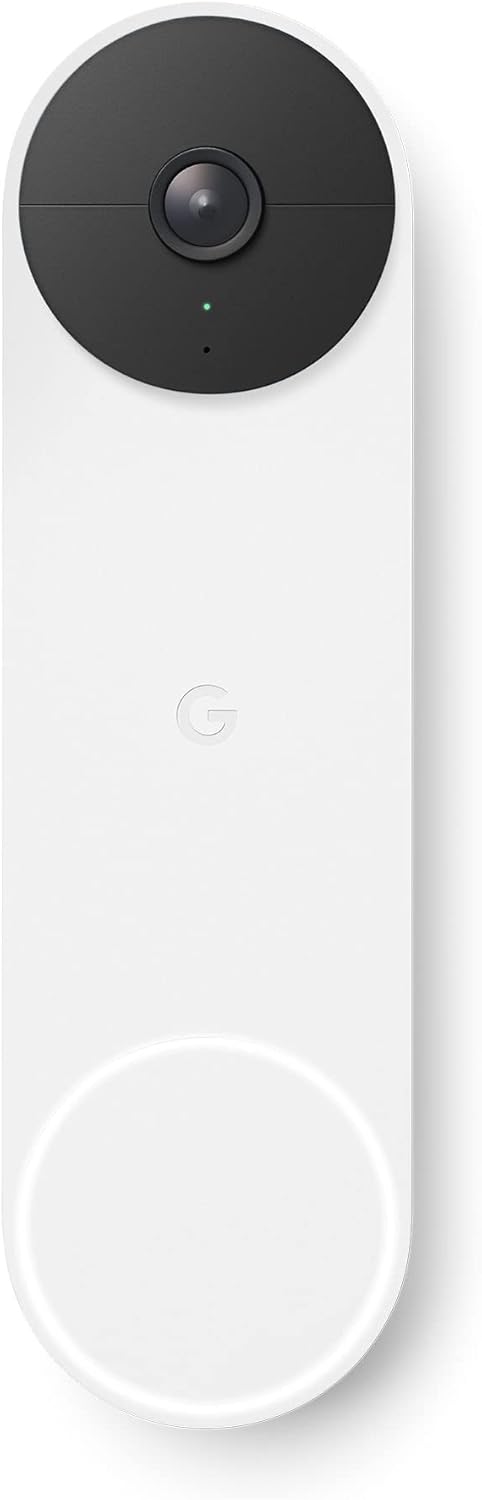
Best overall — Google Nest Doorbell (battery). The lowest-resolution camera in the test and, thanks to HDR, the clearest image under difficult light — it handles strong backlight where rivals wash out. At night it switches automatically to infrared for a black-and-white picture, and the quoted 3-metre night-vision range looks almost understated in practice. Two-way audio is genuinely good: the connection builds pleasantly quickly when you accept a call, and speech lags minimally — noticeably less than several rivals. Motion alerts are configurable, including firing only when you are out, detected by location or Google Home sensors, and you can mark zones where people, packages, animals or vehicles should be recognised and recorded. AI-based familiar-face recognition worked flawlessly in testing, though it needs a Nest Aware subscription — there is a free 30-day trial to establish whether it earns its keep. The box includes the doorbell, bracket, a 20-degree wedge for angled mounting, fixings, a USB-A to USB-C charging cable, bell-wire connectors and a small release tool. Do not lose that tool: on battery you need it every few months. On storage, the free tier keeps event-based video history in the cloud for 3 hours before automatic deletion; a 30-day history needs the Nest Aware subscription, and the Plus tier extends that to 60 days. Useful in an outage: the doorbell records detected events locally for up to an hour if the Wi-Fi drops. No chime is included, and none is currently available as an accessory — on battery the alert reaches you as a phone notification or via a Google Home hub, so wired installation is the way to ring an actual bell.
Closest rival — Ring Battery Doorbell Pro. Operating on a level with the winner: installed in moments, with very good image reproduction and audio optimised by noise suppression — valuable if you do not live somewhere quiet. It adds pre-roll recording, capturing the 4 seconds before a detected motion event, and a high-grade image sensor drives a dusk optimisation mode that keeps colour in fading light. The costs are structural: storage is cloud-only, there is no event history without a subscription, so budget for the recurring fee, and voice reproduction lags slightly.
Best value — Tapo D235. Cheaper than the competition and fitted with a microSD slot, which spares you both the purchase premium and the running cost of cloud storage. A mobile chime is included — you need only find a suitable socket — along with detailed motion-zone configuration and tamper protection. Two real compromises: it is nowhere near as quick to respond as the winner, and there is no HDR optimisation for difficult light, which the section above explains is the specification that matters most. Elsewhere in the wider tested field, local storage is becoming common — one rival ships a 32 GB card in the box, another carries 8 GB of internal memory that makes cloud subscriptions unnecessary altogether alongside a 2K camera.
Before you buy
Four questions. HDR or megapixels? The winner settles this: HDR, every time. Wired or battery? Wired means no charging and no chime problem; battery means a five-minute installation. Local storage or subscription? One pick here has a card slot; one is cloud-only. And is the weather rating enough? — look for IP65 or IP66; IP54 covers only harmful dust ingress and splashing water from any direction.
For wider coverage, our best security cameras guide covers the garden, and our best smart plugs guide the rest of the smart home.
Research sources
Sources recorded for this page are linked below. Reported third-party testing belongs to the original publisher; it is not testing performed by Truthful Reviews.