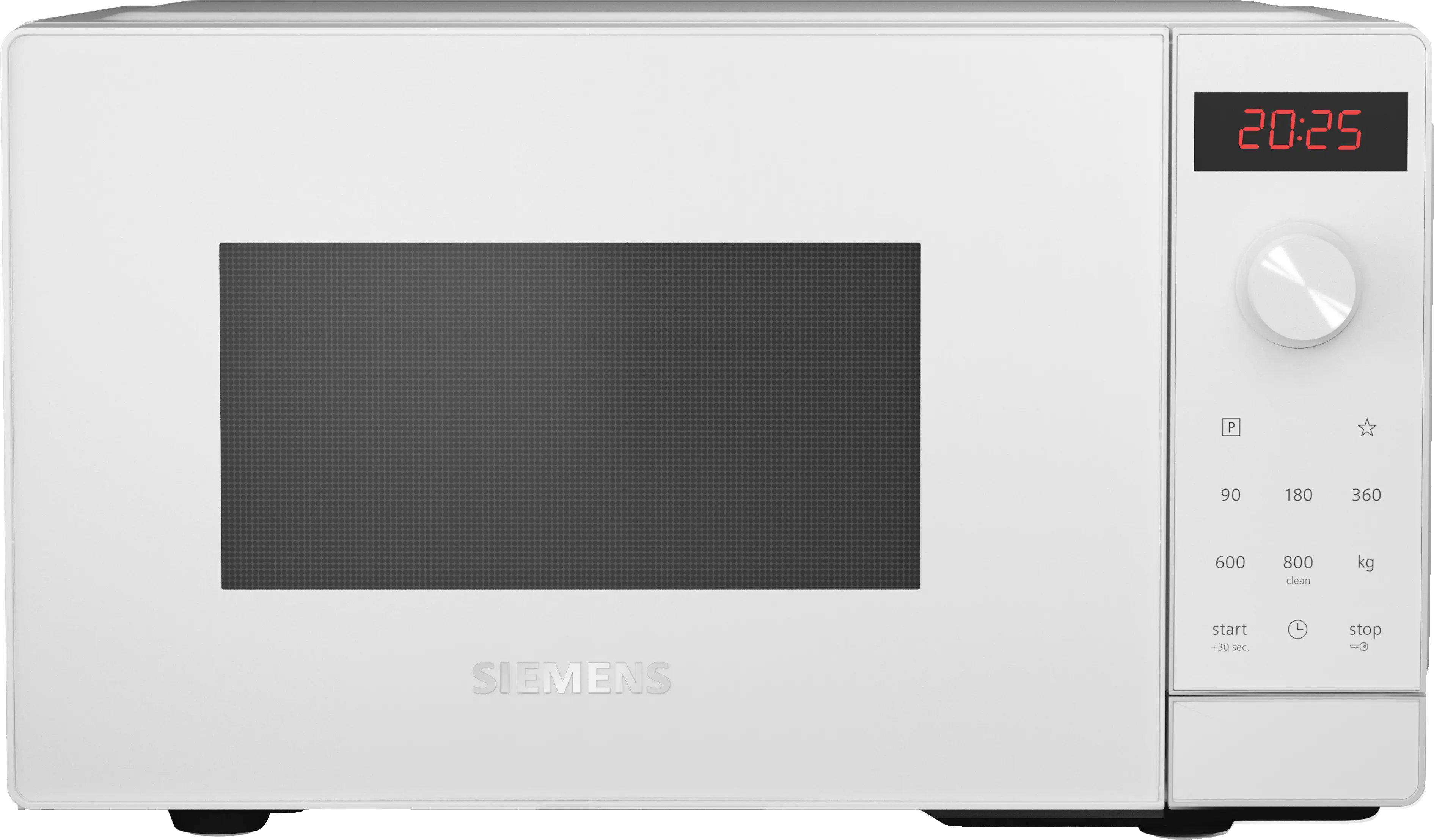
Microwaves are bought on price and forgotten about, which is why so many kitchens contain one that heats a bowl of soup to scalding at the rim and cold in the middle. That difference is measurable, and it is what separates the machines below. This covers 56 microwaves from a single test, from a six-kilogram model built for a camper van to a combination oven that replaces a conventional one.
Every verdict here comes from hands-on testing rather than specification sheets. Each machine ran the same tasks under standardised conditions, with temperatures measured afterwards rather than estimated.
The Short Version
Best overall: Samsung MG23T5018CW — the simplest machine to live with, and still capable when you ask more of it.
Best oven replacement: Samsung MC32DB7746KDE1 — excellent baking and grilling, poor plain reheating.
Best large solo: Panasonic NN-SD36QSEPG — no grill, no oven, lots of room, even heating.
Best without a turntable: Severin Solo MW 7782 — a flat glass floor, and more even than that usually implies.
Best compact: Cecotec Proclean 2010 Inverter — the smallest and lightest machine tested.
Best Overall: Samsung MG23T5018CW
The pick because it does the ordinary thing brilliantly without giving up the harder ones. Reheating a cup of tea takes two clicks on the way past. When more is needed, the automatic programmes listed inside the door frame cover chicken, meat, cheese and fish — the sort of cooking that otherwise means guessing at combinations of grill and microwave power. Those combinations are available manually too, but the programmes get better results with less practice.
The control panel is a seamless touch surface in a hard, scratch-resistant material — a plastic made to look like glass rather than glass itself — with no seams to trap grease, so it wipes clean in one pass. It responds to very light contact, noticeably more sensitive than some rival touch panels. Setting a time without a dial is quick: rest a finger on the pad and the clock winds forward fast.
The details are sensible. It is compact, the rear heat shield stays at a maximum of 73°C, and the clock and display can be switched off entirely. Measured power draw peaked at 2,078 W running grill and microwave together, comfortably inside the declared 2,300 W.
The one criticism is the eco button, which drops standby draw from 0.7 W to 0.3 W — a saving too small to matter. "Display off" would be a more honest label. Note also that the earlier version with a crisp plate is no longer available.
Search Amazon UK · Search Amazon US
Best Oven Replacement: Samsung MC32DB7746KDE1
Not really a microwave so much as a compact oven that also does microwaving, and it should be judged that way. Build quality is high: a modern, homogeneous glass front with the touch controls set flush into it and a single dial breaking the surface. The door and control panel hinge forward together, which means you can only operate it with the door shut.
It needs room. At roughly 50 cm deep and 33 cm high it looks oversized under a typical 30 cm wall cupboard, leaves little space in front on a 60 cm worktop, and needs generous clearance above and to the sides for its waste heat. What you get back is 32 litres and a 34.5 cm turntable.
In plain microwave use it disappoints. In the soup test after two minutes the spread was severe — 28°C in the middle against 87°C at the edge — and despite 900 W the tea-water test reached only 90°C after three minutes, below average.
In combination it is a different machine. Chicken comes out evenly browned and juicy on the programme, needing only a time adjustment. The grill produces very good results on rolls and toast with one turn. The hot-air function heats quickly and genuinely widens what the machine can do, air frying included.
Two practical warnings. Measured draw in combination mode exceeded 3,160 W, close to the limit of a typical 16 A household circuit, so it wants a socket to itself. And cleaning is the usual combination-oven chore, though the grill sits three centimetres clear of the roof so you can wipe underneath. The manual is weak: the Auto Cook programmes are not explained, the in-machine labelling is English, and the only labelling sticker supplied is Polish.
Search Amazon UK · Search Amazon US
Best Large Solo: Panasonic NN-SD36QSEPG
A purist's machine — no grill, no oven — that spends its budget on space and controls instead. 29 litres with a 29 cm plate, in a classic silver body that is 39 cm deep with the dial, which is bulky. Build quality gives nothing to complain about, down to the feet, the dial and the thick mains cable.
Control is by buttons with a real pressure point plus a dial: the dial sets time or weight, the buttons set power levels and modes, and either can drive the eleven AutoCook programmes. Those are explained graphically in the door frame, which matters because the numbers one to eleven mean nothing on their own. The result is a machine you can use without reading the manual — though the manual should have explained the AutoReheat and Beverage modes, which are left to guesswork.
The timer is unusually flexible: a delay of up to 95 minutes and a run of up to 95 minutes, and the dial can lengthen or shorten the time at any point during a cycle. The new wheeled turntable support is fixed to the drive, so the plate simply sits on top with nothing to click into place.
In practice, tea water boils in three minutes — so the 1,000 W rating buys no speed over a 700 W machine — and soup heats evenly in two minutes, 67°C at the rim against 73°C in the centre. The interior light is weak. There is no clock, and the blue display shows a permanent zero that cannot be turned off, costing 0.8 W on standby.
Search Amazon UK · Search Amazon US
Best Without a Turntable: Severin Solo MW 7782
A small 20-litre solo machine that concentrates on essentials. Build quality is average but sound — nothing rattles, the door sits properly, the dials feel durable — with no pretence at premium materials. At about 35 cm deep and 26 cm high it is a standard compact shape, but the inside is not: instead of a turntable there is a flat glass floor, which frees up usable space for bowls and dishes and makes cleaning much easier.
Operation is restful. Two dials handle power and time, and the 30-minute timer can be wound back mid-cycle without interrupting anything. Six power levels including defrost sit on a self-explanatory scale. When time runs out it pings and settles at 0 W. The weak point is the light, which is feeble whether the door is open or the machine is running.
The results are solid rather than quick. In the soup test after two minutes at full power it reached about 84°C in the centre and 59°C at the rim — remarkably even for a machine without a turntable, and without the overheated edge that usually comes with one. Tea water shows the leisurely character: after two minutes only about 71°C at the top and 57°C at the bottom of the cup, reaching roughly 93°C and 88°C after three. Losing the turntable also changes the sound — no rotation noise, but a constant hum slightly louder than most.
Search Amazon UK · Search Amazon US
Best Compact: Cecotec Proclean 2010 Inverter
The smallest and lightest machine in the test field: 24.5 cm high, 31 cm deep and 6.1 kg, with a 24 cm glass plate that will not take much more than a dinner plate. That makes it the format for a small kitchen or a camper van.
Functions are rudimentary — no programmes, no clock. Rotary controls set five power levels and a run of up to 30 minutes. You will need the manual to learn that "M Low" is the defrost setting and that the small numbers beside the time scale are weights in kilograms. Once you know, the electronic timer is a no-brainer: set the time and it starts. The door can be opened at any point and the timer resumes on closing. Because the timer is electronic rather than a ticking mechanical one, it draws 0.6 W whenever the plug is in.
In testing, tea water heated quickly — 98°C at the top of the cup after three minutes, though only 73°C lower down. Soup was less successful: two minutes at the full 700 W gave 74°C in the centre against 53°C at the rim, which turntable machines manage more evenly. The interior is lit only while running, and poorly, so you load and unload in the dark.
With no grill or other obstructions it is easy to clean. The case feels solid, the door barely moves and the panels do not drum, but the glossy front and control panel hold fingerprints and the dials wobble noticeably. The source gives its capacity inconsistently against those external dimensions, so no litre figure is quoted here.
Search Amazon UK · Search Amazon US
How the Machines Were Tested
Fifty-six microwaves were tested, supplied by manufacturers or bought at retail.
Build quality was assessed first — material quality, evenness of panel gaps, and the stability of the door, dials and buttons — along with external dimensions, since depth and height decide whether a machine fits a normal kitchen at all. Running noise was judged for fan, turntable and casing.
Everyday operation came next: how intuitively power levels, cooking times and defrost programmes can be set, whether direct functions such as a quick start are sensibly implemented, and whether automatic programmes are legibly labelled and actually useful. Signal tones and display legibility counted too.
The practical tests were identical for every machine. Cold tap water was heated for three minutes at maximum power and the temperature measured at the surface and at the bottom. In the soup test, using a deep, wide plate, the highest and lowest temperatures were recorded to judge how evenly heat was distributed. Ready-made rice dishes, chicken or chicken legs, and bake-off rolls followed, assessed on how evenly they heated or browned and whether grill and combination functions produced usable results. Automatic programmes were checked for reliability in real use. Finally the manual was assessed, along with interior lighting, running power draw and standby consumption.
Interval, Inverter or Flatbed
A microwave does not heat food from the outside like an oven. A magnetron generates high-frequency electromagnetic waves that set the water molecules in the food moving, which is what produces the heat. Because the food warms from within, the method is well suited to defrosting, is relatively gentle, and uses less electricity than a hob because no pan or ring has to be heated first — only the food.
Conventional machines regulate power by switching the magnetron on and off in a rhythm of a few seconds. The ratio of on-time to off-time produces the power you asked for, but it also means the food is briefly exposed to very high output, which can cost delicate items such as fish in flavour and vitamins.
Inverter machines control the magnetron's anode current electronically instead. Cooking takes a little longer, but constant output and a floor-mounted antenna heat food more evenly and more gently, and the technology often uses less energy and lasts longer because it avoids constant switching.
Flatbed machines are an inverter sub-category that solves the hot-spot problem more elegantly, replacing the turntable with a rectangular plate. They manage it through a microwave tube or variable energy pattern, or reflective walls, often with sensors measuring heat distribution and correcting for it. Beyond easier cleaning, it also lets dishes fit that a rotating plate would not.
Reading the Wattage
The power class quoted on a microwave — 700 W, say — is the maximum output of the magnetron, and 700 to 1,000 W is the normal range. The machine's nominal rating is higher than that figure, because more power goes in than comes out: a 900 W microwave has a nominal rating of about 1,050 W. Grill and hot-air functions are added on top, which is how combination machines reach 2,000 W and beyond.
Do You Need a Grill?
For Sunday rolls, yes — a plain microwave will not get you far. Every machine tested without a hot-air function needed the rolls turned to stop them burning; models with hot air are generally better at baking off.
Simple grill models have no hot-air function, so a grilled chicken browns only from above and unevenly. If you grill meat often, choose a machine with fan assistance. Better still are machines with top and bottom heat, which always have hot air as well and can brown a chicken evenly from both sides — laid on the rack, it does not even need turning.
Steam is less of a differentiator than the marketing suggests: any solo microwave can steam, given a separate steaming container. A dedicated steam function is not required.