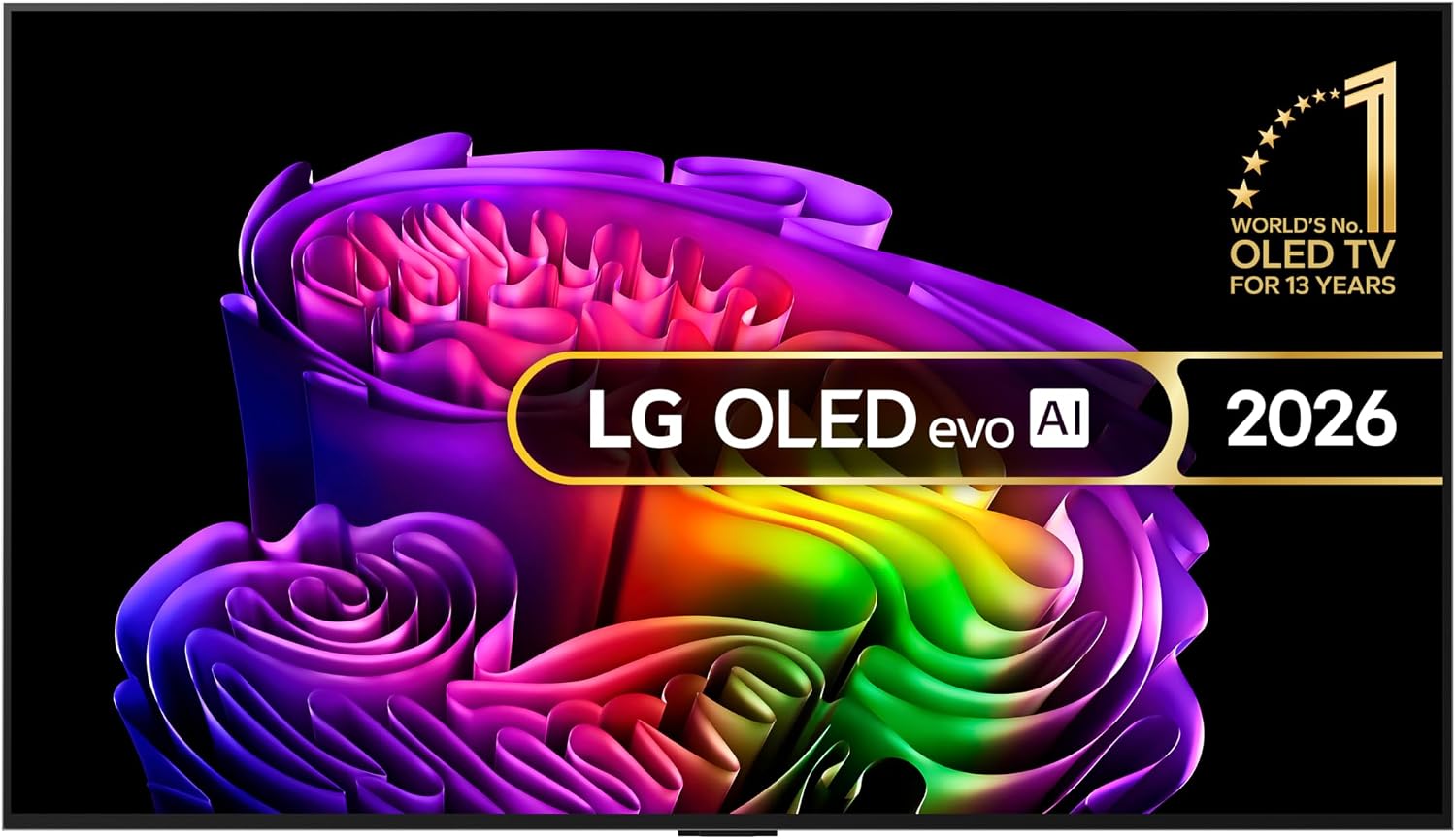
OLED's advantage over LCD is structural rather than a matter of tuning: it controls brightness at pixel level, so individual points can be switched off entirely, which is what produces its black levels and contrast. An LCD works from a large backlight, with or without dimmable zones. In a dark room the difference shows even against top-class LCD sets — above all in visually complex scenes where bright and dark areas are closely interwoven, which is exactly what HDR films are made of.
The short version
- Top pick: LG OLED 55G6 — the overall test winner, rated very good, with over 3,400 cd/m² measured. Search Amazon US
- Price pick: Samsung S90F — QD-OLED at 55 inches, 96 % DCI-P3 and 144 Hz. Search Amazon US
- Premium for less: LG OLED 65G5 — tandem RGB OLED, over 3,000 cd/m², and unusually efficient. Search Amazon US
- Best alternative to the winner: Samsung S95F — 77 inches, full DCI-P3 and 165 Hz. Search Amazon US
- Best budget OLED: LG OLED 42C5 — 42 inches, very high contrast, all the interfaces you need. Search Amazon US
- The Ambilight flagship: Philips 65OLED959 — a 5.1.2 sound system and multi-layer Ambilight. Search Amazon US
Top pick: LG OLED 55G6
Rated very good overall, with picture quality itself rated very good and the highest marks of any set here.
The picture is the reason. Maximum brightness measured at over 3,400 cd/m² in the test laboratory, and the output stays strong even in cinema mode. The DCI-P3 colour space is covered almost completely, and in the wider BT.2020 space the G6 still reaches a good 80 %. The 4K panel is excellently anti-reflective.
For gaming it runs at a smooth 165 Hz with only 11 ms of latency, and all four HDMI inputs are fully specified. Features are rated good, with only small things missing; the weak spot is power consumption, which is only satisfactory.
Price pick: Samsung S90F
A thoroughly sound 55-inch set, rated good overall with very good picture quality.
Its well-anti-reflective QD-OLED panel gives crisp colours and covers 96 % of the DCI-P3 space that matters for HDR, and it gets properly bright at over 2,100 cd/m². The built-in speakers sound solid.
Gamers do well here: up to 144 Hz and a low 10 ms latency at 1080p60, with a generous port count — four HDMI 2.1 inputs among them.
Premium for less: LG OLED 65G5
Rated very good, and the set that best handles a bright room. Its tandem RGB OLED panel is exceptionally bright, measuring over 3,000 cd/m² in places.
What distinguishes it is that the screen surface does not get anywhere near as hot in continuous use as some rivals — and efficiency benefits accordingly. Power draw runs from around 90 W in SDR to just under 220 W in HDR.
The second generation of LG's Alpha-11 picture processor makes motion handling near-flawless, even when upscaling broadcast HD.
Best alternative to the winner: Samsung S95F
At 77 inches, this QD-OLED impresses with radiant brightness — not only in specular highlights but sustained across the picture.
It covers the DCI-P3 space completely and pushes beyond it towards the limits of the larger BT.2020 space, particularly in greens, so colour reproduction is excellent. Detail resolution is close to pixel-perfect in bright and dark passages alike.
Gamers get 165 Hz and extremely short lag, with only the most minimal motion artefacts, and the anti-reflective treatment is excellent. Sound quality is rated very good.
Best budget OLED: LG OLED 42C5
At 42 inches this shows the qualities of LG's mainstream series in a compact size, and is rated very good with very good picture quality.
Brightness is only a good average, but contrast is very high and it covers the HDR colour space practically completely. Motion handling is flawless bar minimal double contours, and detail resolution is very fine.
The integrated 2.1 sound system is enough for a room and stays clean and clear almost to maximum volume. It has only a triple tuner, but otherwise every interface you need, and webOS comes with the usual streaming apps installed.
The Ambilight flagship: Philips 65OLED959
This 65-inch set impresses with more than its exorbitant peak brightness. Sharp contrasts, strong colours and near-flawless motion set the bar higher for everything else here, and the multi-layered Ambilight plus adds a spectacular light show.
Sound is a genuine strength rather than an afterthought: a 5.1.2 speaker system built into the front frame, rated very good, and features are rated very good too. Standing on a single leg, it is a design statement as much as a television.
The cost is efficiency — power consumption is only satisfactory.
How the sets were tested
Picture quality accounts for 60 % of the final grade, making it much the most important category. Testers record maximum brightness, contrast rendering and the largest reproducible colour space, and measure how closely white reproduction holds to the reference and how evenly pure white and near-black surfaces are lit. Performance at an off-axis viewing angle counts too.
Objective measurement is followed by subjective assessment, looking at detail in very dark scenes and in bright highlights, in both HDR and SDR.
Features are the second most important category at 25 %, covering the number and specification of connections and what the set actually offers.
Frequently asked questions
Which OLED TV should I buy? The LG OLED 55G6 is the overall test winner, with over 3,400 cd/m² of measured brightness, near-complete DCI-P3 coverage, 165 Hz and 11 ms latency.
Why choose OLED over LCD? Because brightness is controlled per pixel, so individual pixels switch off completely for black level and contrast. LCD sets light a large backlight instead, with or without dimming zones. The gap is most visible in a dark room and in complex scenes mixing bright and dark — which is what HDR material is full of.
Which is the best value? The Samsung S90F, a 55-inch QD-OLED covering 96 % of DCI-P3 at over 2,100 cd/m², with 144 Hz and 10 ms latency.
Which is best for gaming? The LG G6 at 165 Hz and 11 ms, or the 77-inch Samsung S95F, also 165 Hz with extremely short lag and minimal motion artefacts. The Samsung S90F offers 144 Hz and 10 ms at 1080p60 for less.
Is there a good small OLED? The 42-inch LG OLED 42C5 — average brightness but very high contrast, practically complete HDR colour coverage and a 2.1 sound system that is clean near maximum volume.
Which has the best sound? The Philips 65OLED959, whose 5.1.2 system is built into the front frame and rated very good, ahead of the built-in speakers on any other set here.
What does the testing actually weigh? Picture quality at 60 % of the final grade and features at 25 %, with objective laboratory measurement followed by subjective viewing in HDR and SDR.
Research sources
Sources recorded for this page are linked below. Reported third-party testing belongs to the original publisher; it is not testing performed by Truthful Reviews.