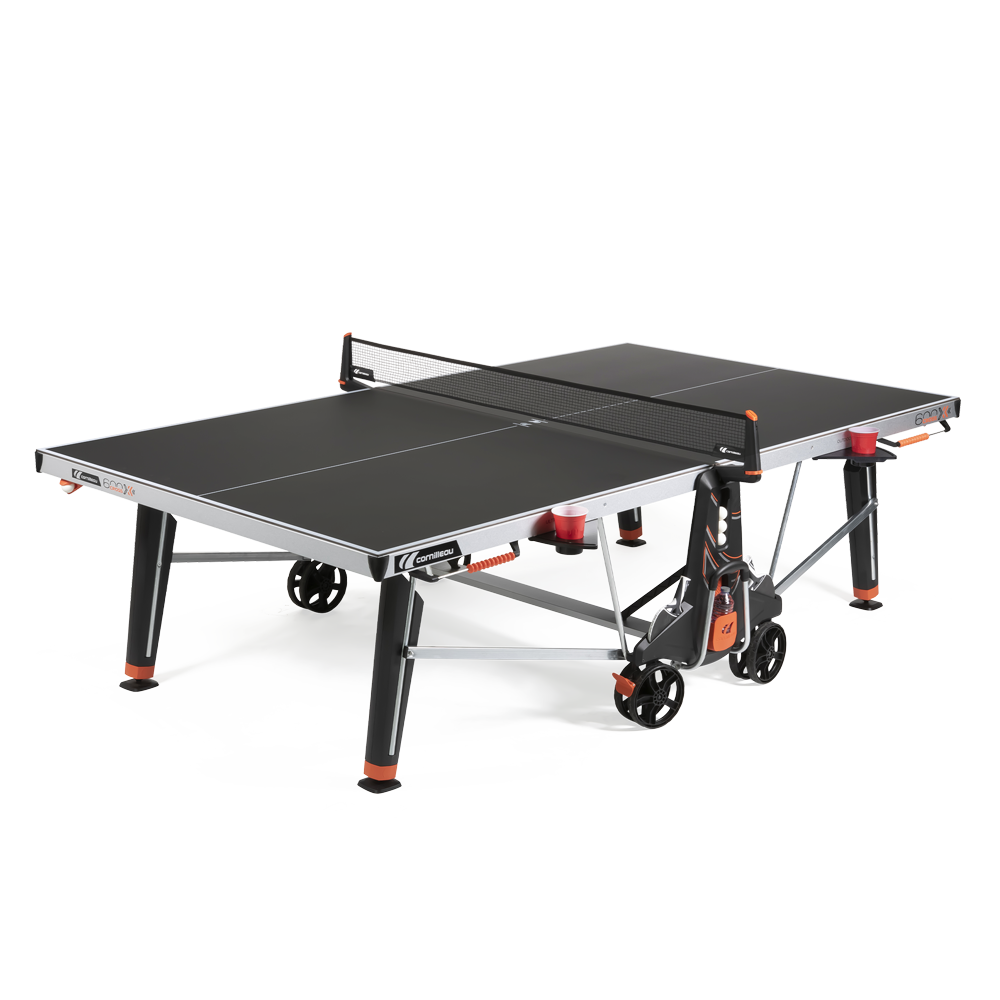
Ping, pong, ping, pong. It is the sound of summer in every park, and the obvious upgrade is to have it in your own garden instead, where the table is never already taken. The temptation is then to buy the first thing that comes up. That is certainly one way to spend a lot of money, but it is not a clever one, because between melamine resin, aluminium composite and a thicket of manufacturers' acronyms, the category gets confusing quickly. Six outdoor tables were tested, and two of them stood clearly above the rest.
What follows is recorded testing, translated. Nobody at Truthful Reviews has played on any of these.
What an outdoor table actually is
The tables you meet in parks, on sports grounds and in school playgrounds are usually polymer concrete on massive legs, often with a metal "net". Unlike ordinary concrete they have a pore-free surface, and their enormous weight makes them close to indestructible. Nobody wants one of those on a patio, however good it plays, which is why mobile outdoor tables exist, and they are what this guide covers.
These weigh a comparatively modest 75 kg in the mainstream, with budget models starting around 45 kg, and they fold up and roll away. Visually they are much closer to their indoor siblings. Look more carefully, though, and the differences between them turn out to be decisive.
Playing-surface size is not one of those differences. Every table tested is built to the full competition dimensions: 274 cm long, 152.5 cm wide and 76 cm high to the top edge.
Is your garden big enough?
For games to run without compromise, the garden should measure at least 7 by 4 metres. That works out at roughly two to 2.5 metres front and back and one to 1.5 metres left and right. Anyone who likes playing round-the-table should allow a bit more buffer. With less space than that, a mini or midi table is the better answer.
Folded, things shrink considerably. Width drops to around 70 cm, while length and height are each about 170 cm. Deviations in every direction are possible, depending on how far the legs splay, how close to the ground the playing surface sits, and whether wide net installations or bat holders are part of the specification. Small cellar or garage doorways spoil the fun fast, so measure the frame and check the folded dimensions against it before buying. The most space-efficient designs are the two-part tables, whose separate halves are joined only by the net in use: folded, they can be pushed into one another or stored in two different places, and there are no fixed net posts to work around.
Melamine resin or aluminium composite
The high-quality standard today is melamine resin. Strictly speaking that is only the synthetic resin itself, which soaks through many layers of special paper during production; enormous pressure and high temperature then produce a top that stands up to weather and everything else.
The cheaper alternative is an aluminium composite top clad in aluminium. These used to arrive with a comparatively thick chipboard core; the core is now usually plastic instead, a decision in favour of resistance and against playing feel. That means not just a poorer ball bounce but a different sound: aluminium composite tops give off noticeably brighter, more metallic tones. On top of the base material, manufacturers like to add coatings, for reduced glare or for durability.
Thickness is the number to watch. A melamine resin top should be at least 5 mm thick. 6 mm is enough for the upper middle of the market, while 7 mm and 8 mm are genuinely premium territory. The frame is responsible for stability and for an even bounce, and 50 to 60 mm of frame height is ideal; anything under 35 mm is not enough.
Wheels, brakes and feet
A garden table does not stay in one spot forever, so the wheels matter. If difficult ground is never going to be on the agenda, small plastic wheels will do. Otherwise large single or double rollers are the safer bet, with diameters running from a little over 10 cm to a hefty 25 cm.
How it stands afterwards deserves just as much attention. Not every manufacturer fits a brake to every wheel, and some leave brakes off entirely. Adjustable feet, on the other hand, belong on every table. Ideally their shape allows corrections with the table opened out, and just under 3 cm of adjustment is usually enough. On uneven ground, models offering a full 5 to 6 cm come into their own.
Locking mechanisms and folding
The mechanisms hiding behind cryptic names — DSI on one brand, SMS, the "Smart Manual System", on another — are the ones that impressed in testing. In both cases you pull a single handle to free the table for movement, and the halves then lock again in both the playing and the stored position.
Better still are the designs that also catch part-way. Let go of the handle while opening or closing and the half does not drop; it stays hanging in mid-air, and it cannot then be forced down — you would move the whole table first.
Weaker are the mechanisms you have to release manually at two separate points, by hand or foot, before the half will come to horizontal. That can be awkward, not least because the top has to be supported at the same time, and it is more awkward again when joints under the playing surface then have to be straightened. At least on closing, those tables latch by themselves once the half is back upright.
Weight is a double-edged thing. An 80 kg slab usually stands more solidly, but it is that much harder to handle. Edge protection is sometimes overlooked too: only selected models have rounded corners or protective rubber elements on them.
The extras that decide it
Small things end up being decisive. Playback mode, for solo practice with one half folded up as the opponent, is particularly popular. Most models offer it, but not all. The same goes for ball and bat holders, which are worth checking for if you would rather not store bats separately.
Ball dispensers, carrying handles, drinks holders, score counters — imagination is the limit on the rest. Far more relevant is the net. Is it fixed, or does it fold away automatically? A net that is not permanently tensioned lasts better. Being removable is an advantage when every centimetre counts in the folded position, and the better versions can be re-tensioned and adjusted for height.
Assembly
Depending on brand and model, assembly can take anything from half an hour to a whole day; largely pre-assembled two-part tables go faster. Just as often you are faced with 100 parts or more. Tools are required: two sets of ring or open-ended spanners are the sensible minimum, because screws regularly have to be worked from both sides with the same size at once. A ratchet makes it easier still. Screwdrivers and hex keys may be needed on top.
The best for most gardens — Sponeta S 5-73 e
Sponeta probably still sits in the shadow of bigger names among casual players, and the S 5-73 e shows how unfair that is. Several apparent rivals are built by the same long-established company, and under its own brand it convinces all round.
Where other tables in this bracket still use aluminium composite, there is no sign of cost-cutting here: the playing surface is 6 mm melamine resin. There is nothing whatsoever to criticise about the ball rebound, and in the simplified test run the readings were remarkably consistent. Alongside a solid 50 mm frame height, the sheer flatness must have helped: a spirit level said the same thing wherever it was placed — completely straight.
Setting it up is about as simple as it gets. The 2.5 cm of height adjustment feels entirely sufficient, especially as the wheel can be turned with the table opened out. The product description claims 3 cm, which cannot be right in practice, since the whole screw is exactly that long.
The absence of brakes turns out to be an advantage in some situations. Yes, the table can be pushed around comparatively easily on smooth floors. In exchange, opening it involves less drama: pull at the top without operating the handle and the S 5-73 e simply rolls sideways.
The handle could not have been better positioned. Opened out, it still protrudes very slightly from beneath the playing surface, so it does not have to be hunted for; it also sits exactly right for one-handed operation and does not demand much force. Let go of the top prematurely and it does not slam down but stops roughly half way, provided it has already reached a certain height.
Rain looks like a non-issue. Under a pressure sprayer the table gave nothing away. It dries quickly and, before that, plays without problems thanks to its rough finish. Not even water marks show up. Rust on the underframe? None: the powder-coated tubes make a solid impression.
Thoughtfully designed bat and ball holders are included, with easy retrieval. Any compromises are likely to register only with players of above-average demands, and the features that matter escaped the cost-cutting, which is why this table offers such strong value. There is a large family to choose from, too: the same model comes as the S 5-70 e and S 5-72 e with grey and green playing surfaces respectively, and the practically identical Donic Style 1000 Outdoor is worth taking depending on the offer.
It is not the last word, and a few details are worth knowing. The compact wheels are average and could struggle on difficult terrain. The rather cheap-looking side covers and the lubricant residue on underframe components do not quite match the rest of the build quality, though the residue wipes off easily — just do not assemble it in your best clothes. In a perfect world there would be proper edge protection, better spare-part availability, and no need to lift the table briefly at the net when setting it to play.
Search Amazon UK · Search Amazon US
The luxury pick — Cornilleau 600X Outdoor
The technical data already hints at what this is: a 7 mm melamine resin top and 60 mm of frame height. Cornilleau has managed to build a top-tier table that is genuinely at home outdoors.
That starts with a construction built for uneven ground. It has four double wheels of a huge 20 cm diameter each, half of which lock rock-solid, and a substantial transport handle for getting over a step. Once the spot is chosen, a few movements settle the table: the well-judged adjusting rings on each leg do not sit directly on the ground, so they turn effortlessly, and they will go up to a full 6 cm. The moveable foot plate then compensates for any remaining slope.
Walk round it and a whole run of extras appears. The fold-out score counters and drinks holders are genuinely useful. Anyone wanting to stow a bottle rather than a glass uses the generous side compartment down at the base, with space for three balls directly above it. More convenient still are the ball dispensers, one fitted under the playing surface at each short end, holding four more balls each so a game can carry on seamlessly. The bat holders look almost unremarkable by comparison, but they strike the perfect balance between good grip and easy retrieval.
The playing experience is the spectacular part. A large share of that comes down to the Mattop coating, which absorbs noticeably more light than the competition, so playing in full sun still works. In exchange you accept a few more fingerprints, which wipe off without trouble. The robust construction and high-quality surface deliver a ball bounce consistently beyond the 20 cm mark.
Opening and closing is genuinely easy, and the locking mechanism engages reliably every time. Should your hand slip off the ergonomically placed handle half way, the half simply blocks at 65 degrees; you can then pull at the top as much as you like and you will move the whole product before that half opens. There are no sharp areas to be found — instead there is rubber edge protection at every corner. In the playing position the halves occasionally need a slight lift at the net, but after that nothing wobbles.
The height-adjustable net is a special solution of its own. It is a little louder, but the posts fold in automatically on closing, which is kinder to the material. The manufacturer also runs its own spare-parts shop, with parts meant to stay available for 20 years, and a full 10 years of that is covered by warranty.
Given all that, the slightly more complex assembly is easy to forgive. It pays to follow the instructions closely, so that the adjusting rings go on correctly and the legs are fitted in the right orientation straight away. Beyond that, you cannot go far wrong with it — if it fits the budget.
Search Amazon UK · Search Amazon US
Also tested
Kettler K10 Outdoor — the iconic Kettler aluminium-composite tops are history; the brand lives on and Sponeta now handles production, which shows. The switch to a 6 mm melamine resin top may even be cause for celebration, but the steep premium is hard to justify given how modest the differences are against cheaper models. Height adjustment is more laborious, because the table has to be lifted for every correction or the small threaded roller will not budge; it does offer 3 cm of range. The reward is a perfectly flat playing surface with a bounce more than sufficient for leisure play, and neither sun nor water caused any problem in testing: the rough top allows few reflections and no bothersome water marks, and powder coating protects the 50 mm frame and underframe from rust. There are four wheels, only two of which lock. The mini wheels have rubber treads and glide precisely and near-silently on smooth floors in shopping-trolley fashion, though 10 cm of diameter will tell on rougher ground. Rain drains off or evaporates promptly. At this level, the crookedly cut rubber on the underside and the low-grade side covers cannot be waved through; those flexible plastic panels, which also hold the ball holders more badly than well, cost it points for looks. The SMS mechanism does its job faultlessly, and the red handle is ergonomically shaped and exactly where it should be, so the whole process takes a few seconds. A small deduction for needing to lift at the net occasionally. The Primus 4.0 net set is solid and the top carries a full 10 years of warranty; spare parts look weaker. Search Amazon UK · Search Amazon US
Joola Outdoor J500A — started strongly and fell away badly. Assembly is child's play, literally four steps: fit the wheels with brakes to the legs, then attach the legs to the prepared underframe. That is possible because of the two-part construction familiar from indoor tables, with two separate halves held together in play only by the net. The same design pays off in storage: push the two parts together offset and you get record-worthy dimensions of 170 × 60 × 157 cm. From there it goes downhill. Transport is passable thanks to eight double wheels, though each half has to be moved separately. Joola still fits an aluminium composite top with enclosed plastic, which shows in a mediocre rebound that falls away further towards the baseline, and every contact between ball and surface sounds noticeably higher and duller than on better rivals. Scratch resistance is a real problem: after a few rounds the top is already covered in small marks from every impact, and they cannot easily be removed. Material quality and finish disappoint in several places — listless silicone distribution underneath, and pieces already missing from the merely glued-on side lines, which throw off a biting reflection. The net is passable but fiddly. The locking mechanism, with two metal hooks at foot height, is no fun but does its job; the four joints under the playing surface have to be straightened afterwards, or a small push from the side will collapse the rear half, and the joint has to be bent again before folding up or you lift the wheels as well. Height adjustment could be more comfortable: the conical foot does turn on the ground, but only with difficulty, though its 2.5 cm of range is sufficient. Bat and ball holders would have been welcome. In this bracket there are superior alternatives in every respect other than assembly and compactness. Search Amazon UK · Search Amazon US
Pongori PPT 930.2 — Decathlon makes no secret of this being intended as a leisure table, which is worth bearing in mind; the pragmatic net solution and rounded table edges will remind you anyway. The locking mechanism engages reliably. Four 25 cm wheels, each with a chunky but excellently operated brake, give a solid stance, even though the underframe can be made to wobble fairly easily in the stored position. Opened out, none of that is visible or perceptible, and the table sits right first time, so no lifting at the net. It does drop points on the spirit level: a minimal deviation remains, either front-to-back or side-to-side. The feet are well done, offering a generous grip surface, only slightly stiff when fully retracted. Getting there was a long, nerve-jangling road, despite the handsome instructions and exemplary labelled boxes and bags, with an "L" and "R" discreetly embossed on the legs. The herculean task was seating the tops, or rather the central pivot joint, on the guide tube: attempted by two people as directed, the plastic element promptly broke — luckily in a way that allowed the build to continue. Care is needed tightening screws too; a little figure with a percentage beside almost every step tells you how loose they should still be, and following those notes closely saves having to saw a screw off and find a new one. Otherwise the 930.2 acquits itself well. The melamine resin top is 6 mm thick and the galvanised steel frame measures an above-average 55 mm. Ball bounce averages just under 21 cm, which is strong, though it drops slightly towards the baseline, and on glare it comes close to most of the top models. The handle position deserves criticism: to fold the table your whole forearm has to disappear under the playing surface, which is needlessly awkward. Around water there is one oddity — small amounts collect between tube and leg. On spare parts Decathlon shines, with an overview and helpful illustration on the manufacturer's site, plus a full 10 years of warranty. The playback wall is an above-average 90 cm high, and the ball and bat/bottle holders are decent. The top quality and standing stability convince; the price would need to come down a step to make it a sensible alternative to the established brands, which generally offer slightly more pleasant handling and higher quality in the details. Search Amazon UK · Search Amazon US
Donic Style 1000 Outdoor — the smart sibling of the winner and structurally identical to it, marked out by black components and blue-and-white design elements on the frame and underframe. Assembly threw up no significant stumbling blocks and went through largely without assistance; the video for the twin Outdoor Roller 1000 model was not really needed, though a few hours should be allowed. The heart of it is a 6 mm melamine resin top in grey, surrounded by a 5 cm frame, with 2.5 cm of foot adjustment enough for a level surface. Results here were not uniformly consistent: ball bounce at the baseline fell below the magic 20 cm mark, while nearer the net it was clearly higher. How meaningful that is remains open, but most casual players will notice nothing in practice, especially outdoors, and several test games threw up no unpredictable spots. Sun did nothing to the sample and there were no complaints about unpleasant reflections; the surface feels pleasantly rough and is barely susceptible to scratches or fingerprints. The water test was equally uneventful: liquid drains off and every mechanism carries on working as it should. The locking system earns praise — opening and closing is intuitive and extremely reliable, and once the top has latched in the upper position no amount of pulling will move it. For transport the four small double wheels are sometimes a little stubborn, though with two people that is no issue at all. There are no brakes, which does not hurt stability in play; it simply means the table can be pushed a short distance if you lean on it. The maker advertises "maximum equipment", which is a stretch, but ball and bat holders are indeed included: they look slightly cheap yet do exactly what they should, with a ball always moving into the middle when one is taken, and room for two bats each side. Like the near-identical Sponeta, it is a top table with few weaknesses, and there is a 10-year warranty on the melamine resin top. Search Amazon UK · Search Amazon US
How they were assessed
Every table was examined closely, with the playing itself only one of many aspects. Assembly was assessed first: comprehensible instructions, ideally in video form as well, plus labelled bags of screws and fittings. Bonus points went to manufacturers selling matching spare parts or offering a long warranty.
Once the tables were standing, handling was assessed. Wheels should have adequate diameter, glide as quietly as possible and obey their owner during transport; the easier a table is to move on smooth floors, cobblestones and gravel, the better. Brakes score for comfortable operation and, above all, reliable hold, including with the table opened out. In a tilt test, the tables were pulled at the top in the stored position and the effort noted. On feet, the test recorded whether height was adjustable and, if so, how much range there was.
The locking mechanism had to work without exception and must not release by itself, while being intuitive and forgiving — for instance by catching part-way if the handle is let go too soon.
The dry specifications for top material, thickness and frame height already give a hint, but a ball-bounce test was run anyway. At three points on each table — 10, 70 and 130 cm from the net — a tournament ball was dropped three times from a height of 30 cm, with every attempt filmed on a tripod-mounted smartphone against a ruler in the background.
The playing surface, the underframe including the wheels, and the folding mechanism were then sprayed with water from a garden pressure sprayer. Impaired opening and closing afterwards counted against a table, as did conspicuous water marks, rust or deformation; water should drain away rather than catch between top and frame or around other components.
Glare was assessed in a darkened cellar room, establishing which tops absorbed torchlight best. The goal is blurred outlines rather than a bright, clearly recognisable cone of light. Cleverly implemented extras — bat and ball holders, playback mode and, importantly, a high-quality, easily installed net — earned praise at the end.
The short answers
Which outdoor table is the best? The Sponeta S 5-73 e offers the best overall package. Its high-quality melamine resin top delivers a top playing experience, setting up and folding away are quick, the locking is reliable and the warranty is long. Anyone wanting the full specification will be happier with the luxury pick.
Can you train alone on an outdoor table? Most outdoor tables have a playback function, where one half is folded up and balls bounce back to the player. The angle of that "wall" cannot be adjusted, but leisure players should be perfectly happy with it.
Can an outdoor table be used indoors? Yes. Indoor tables must never go outside, but the reverse is fine — in a garage a weatherproof model is the better choice, since it shrugs off cold, heat and damp. The marginally different bounce behaviour is really only noticeable to professionals. Dirty wheels are the one thing to watch, as they can leave marks on parquet.
How should an outdoor table be looked after? For routine cleaning and most dirt, warm water and a cloth are enough. More stubborn marks give way to mild washing-up liquid or dedicated table cleaners. Aggressive products are off-limits, because at worst they can irreparably damage the coating or the top material itself. Occasionally tighten screws that have worked loose and give the hinges a drop of penetrating oil. The net lasts better if it is not left permanently tensioned, and a good cover helps preserve the colour. If a garage is available, the table can spend the winter there, and the joints and wheels will thank you for it.