Reusable nappies have moved a long way from the boiling pans and folding techniques your grandparents would recognise. Today's versions close with hook-and-loop tape or poppers, come in printed designs children actually ask for, and go in the washing machine every two or three days. Twenty-four of them were tested here, across every system on sale, and the best for most families is the Judes nappy: well made, easy to put on, dependable against leaks and an excellent fit.
What follows is recorded testing, translated. Nobody at Truthful Reviews has used any of these nappies. This page makes no health, hygiene or skin claim of any kind; it describes absorbency, fit, materials, laundering and build quality only.
The jargon, decoded
Anyone approaching reusables for the first time meets a wall of terms. The testers hit the same wall, so here is the short version.
Wrap (or over-trouser). The outer layer that keeps moisture from getting out. Usually made from PUL, a polyester laminate, or fleece. It is combined with an absorbent insert. Without a wrap, a reusable nappy system does not work.
Pocket nappy. An outer waterproof fabric with a second inner fabric, and a pocket between the two into which an insert is pushed for extra absorbency.
Prefold. A flat, multi-layer insert stitched into three panels. Folded up, it is laid or pushed into the wrap. Because it opens out flat again, it dries quicker than most alternatives. Mostly cotton.
Fitted nappy. Highly absorbent, and the pick of the bunch for nights and long outings — but it has no waterproof outer layer at all, so it only works underneath a wrap.
All-in-one (AIO). The closest thing to a single-use nappy: the insert is stitched permanently into the wrap.
All-in-two. A waterproof wrap combined with one or more inserts, which may be laid in, pushed into a pocket or poppered in.
All-in-three. A fitted nappy, a waterproof wrap and an insert. More faff than the rest.
Muslin. Decades old and still recommended for newborns. Folded various ways and laid into the wrap, and useful for other jobs besides.
Booster. An extra layer of absorbency, compatible with most systems and aimed at children who produce more liquid. Soft, and usually cotton, hemp or bamboo.
Nappy liner. A fleece sheet that catches solids and makes disposal simpler. Sold on a roll.
How the systems differ in use
Reusables work on the same principle as single-use nappies: take up as much liquid as possible on the inside, and keep it there. How much they can take depends almost entirely on the insert material.
Bamboo viscose inserts absorb noticeably more than cotton. Cotton absorbs well but does not hold liquid for long. Hemp holds a great deal, but takes it up more slowly than the other two. Several of the best results in the test came from mixed-fibre inserts that combine a fast-absorbing top layer with a slower, higher-capacity one underneath.
The fitting rules matter as much as the fabric. The nappy has to be the right size, with the leg cuffs sitting close and no gap; the wrap must not be too loose around the bottom, because its job is to hold the insert against the body. The insert must be completely enclosed by the wrap — any part of it peeping out is a leak waiting to happen — and it sits best about 1 cm clear of the waist seam. Where poppers are used to size the nappy down, the resulting fold should be tucked upwards. Reusables generally need changing more often than single-use nappies, roughly every two to three hours. And the standard check once the nappy is on is two fingers into the front of the waistband: that tells you whether it is neither too tight nor too loose.
How many you need
There is no fixed number, because it depends on the system. Nappies with the insert sewn in need more units in circulation than systems where the inner nappy is swapped and the wrap reused. As a working estimate, plan on 20 to 30 nappies and around 25 inserts. The sensible route is to try a system before committing to a full set, which is why most manufacturers sell trial kits containing one of everything.
Washing is straightforward. Most of these go through the machine at 40 to 60 °C depending on what the maker specifies, every two or three days, with a wet bag or a lidded bucket for storage in between. Bleach, perfumes, fragrances and fabric conditioner are best left out of the detergent drawer, and line drying is preferred to the tumble dryer.
The picks
Top pick — Judes nappy
The best reusable nappy for most families. It is a two-part system and only works as a pair: an inner nappy takes up the liquid, and the wrap stops any of it reaching the outside world. It arrived beautifully packaged, and the wrap turned out to be not just good-looking but soft, thin and unusually light.
The inner nappy is the clever part. It is exceptionally well finished and thinner than most of the inner nappies in the test, built from 12 very thin layers, and in practice its absorbency was very good despite that slimness. Both parts close with hook-and-loop tape; the tape on the inner nappy is well made and quick to work. The leg cuffs are gathered, which is what stops leaks escaping sideways, and soft gathers on the back of the wrap leave room to move. A great deal of effort has gone into keeping both parts slim, because a bulky nappy bottom is exactly what many parents object to — and this one is notably trim under clothes.
Across repeated runs, in which the nappy was worn and washed several times, both liquid uptake and leak resistance were very good. For nights, extra boosters go in easily; two inserts is the recommendation. The wrap can be used three or four times before it needs washing, provided it is aired briefly after each change, while the inner nappy goes in the wash every time. Those inner nappies take a while to dry, so you need enough of them in the pile.
Wrap, inner nappy and boosters all wash at 60 °C and can be line dried or tumbled. Sizing runs to two sizes for both parts, with the wraps additionally offered in a long list of colours, and the range extends to booster inserts, a nappy bag and the maker's own paper liners for solids. Order a trial pack and there is a satisfaction guarantee: send them back within the first 100 days if they do not suit. Returned nappies are reconditioned and resold second-hand rather than binned.
The one structural drawback is that the wrap and the inner nappy only function together — this is not a system you can mix and match your way out of.
Search Amazon UK · Search Amazon US
Best fit — Kniti nappy wrap
The Kniti goes its own way. Visually it stands apart: a soft fabric back panel, a very thin outer shell, and an insert — the Kniti Core — that is the heart of the brand. The Core is wide, long and knitted by an unusual method, made under a patented textile technology to be absorbent and thin without chemical superabsorbents.
Getting it right takes a little practice. On the first attempt several adjustments were needed before it sat properly and stayed sealed: the hook-and-loop has to be stretched a touch firmer and closed so that nothing stays slack at the back. A rubber adjuster under the yellow tray of the outer nappy sizes the whole thing down, and the supplied guide explains how — it ran slightly large on the test baby. Once the knack is there, it goes on quickly.
Its real advantage is how slim it keeps the nappy area. Bodysuits and trousers go on far more easily, and it simply looks better. For nights, two Cores went into the inner tray and even then the profile stayed pleasantly thin, so the baby could move freely. It convinced across every run, standing out for that slim fit and for high absorbency, and the top layer of the insert is 100% cotton.
Two caveats. The inserts take a fairly long time to dry, so keep plenty in rotation. And this is the top of the market: outer nappy and insert together cost well above the average here, which the maker attributes to the Core being manufactured in Germany at higher production and labour costs. A trial set is available if you want to find out first.
Search Amazon UK · Search Amazon US
Best all-in-one — Lybbie nappy
The best all-in-one in the test. It was tried as a set of four, which makes sense: AIO nappies have to be washed after every single use and then need time to dry. The set also arrived with a roll of liners and a wet bag, both genuinely useful.
Build quality is the first thing you notice — the seams are faultless and the hook-and-loop is clearly a good grade. Designs run from plain colours to prints of flowers, lemons and autumn leaves. The nappy is light and compact but feels somewhat stiff, which comes down to the stitched-in insert: fairly large, wide and firm, made from several layers of bamboo weave for high absorbency, and the test runs bore that out. The leg cuffs are gathered but not doubled.
Handling is self-explanatory: put it on and go. The wide hook-and-loop closure makes that fast and secure, which counts for a lot with a wriggling toddler, and the whole thing is an easy way into reusables for a beginner. It did leak on the very first run — the leg cuffs had been left slightly too loose — and once the fit was corrected it worked perfectly, which is a reminder that fitting technique, not the nappy, decides most leaks.
Before washing, the insert is pulled out of its flap and the hook-and-loop closed; the nappy then goes in at 60 °C, stored in the supplied wet bag until then. It takes longer to dry than a plain wrap or a thinner insert. It sits above average on price, though with the insert already integrated that is defensible. Various sets are sold, including a trial pack.
Search Amazon UK · Search Amazon US
Natural materials — Windelinge wool wrap
The pick for parents who want to nappy without plastic. This wrap dispenses entirely with a waterproof membrane such as PUL. To make it hold moisture back, it is lanolised before use — soaked in a lanolin bath for at least four hours and then dried. That sounds more complicated than it is, and a clear instruction sheet comes in the box.
The finish is excellent and the design particularly attractive; the test model was mint green, and the range runs to muted prints and animal motifs. It was tried over several runs with a variety of inserts, including the maker's own. The best of those was the hemp-structure insert used as the bottom layer, because hemp holds liquid for a long time, with an organic-cotton insert on top to take it up quickly. The wrap did not leak once, absorbed very well, and the inserts inside it did not shift about as they did in some other models.
It also needs washing less often than a PUL wrap, which has to go in after three days at the latest. Once it is properly soiled it obviously goes in the wash too, and wool is normally cleaned by hand or on the machine's hand-wash programme. The inside is 100% new wool.
Sizing is the question mark. The test child weighed just under 13.5 kg, and the maker states the wrap fits from 6 kg to the end of nappying; the testers doubted it would stretch that far, and for sturdier children it may become tight. A Plus size covers 12 to 20 kg. Without an insert it is one of the dearest items in the test.
Search Amazon UK · Search Amazon US
Best value — Littles and Bloomz reusable nappies
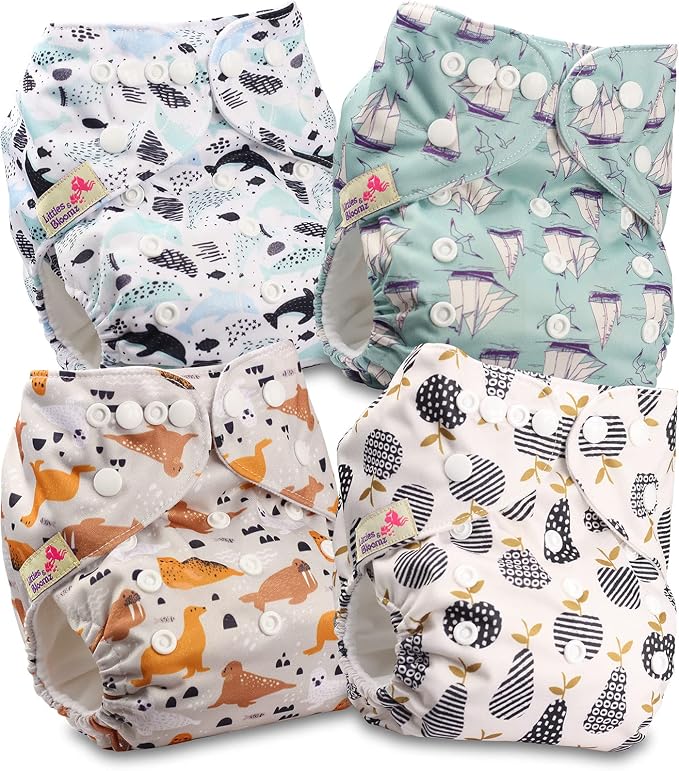
For a good reusable nappy at a keen price. A set of four arrived, all of them pocket nappies, and expectations were modest given how little they cost — wrongly, as it turned out. They are well made and they cover the essentials: leak-resistant, and compatible with every type of insert. Extras they do not have.
They come in a great many designs, and this was the point at which the design mattered most to the child in question: the watermelon nappy was the one demanded, and afterwards it was hard to get off again. A popper system sizes the nappy to fit and lets it grow with the child.
Tested with the maker's own bamboo inserts, and with others pushed in as well, they impressed. The bamboo inserts were among the best in the test — very soft and enormously absorbent, so they suit long intervals such as car journeys or overnight, ideally topped up with something containing hemp for storage. Their one drawback is a long drying time; the nappies themselves, by contrast, dry very quickly and come back into rotation fast. A nappy liner was used at every change to catch solids.
Value is the headline: quality does not suffer for the low unit cost, and buying a large rotation of these represents a substantial saving over the rest of the field. Inserts are extra, but you choose which ones.
Search Amazon UK · Search Amazon US
Also tested
Hinzling Onesize wrap — an all-in-two, tested in the Boho Lines design, which the child liked enough to start requesting striped clothes. Quality is high: no loose threads anywhere, sound-feeling poppers and soft flaps inside that stop the inserts wandering. It has one adjustment no other model in the test offers — leg elastics inside on both sides that set the cuff size. Simple and clever, though it takes a little trial and error; once set, nothing escaped, and the fit is otherwise faultless. The wrap works well with every insert tried, with the maker's all-round insert and booster on top because organic cotton takes up liquid faster. The one complaint is that the inserts take a while to dry. Made in Europe, sold with a quick-start and washing guide, and available in trial sets. Mid-range on price. Search Amazon UK · Search Amazon US
Bambino Mio Revolutionary Reusable Nappy — a capable complete nappy, easy to handle and a good starting point. The outer fabric is 100% polyester laminated with a PUL layer; the sewn-in insert is 86% bamboo viscose on the outside with 100% polyester inside, a combination that took up a lot of liquid quickly in practice. It is both an AIO and a pocket nappy, and pushing the insert into the pocket worked better than laying it in because it shifted less. Two closure types are offered: poppers, which size it down, and a very wide, flexible hook-and-loop tape which proved the more useful of the two with an impatient toddler. It is a one-size nappy, claimed to fit from birth to the end of nappying. Doubled leg cuffs, a waisted cut and a mesh inner — the only mesh design in the test — stood out, and the cuffs sit close without restricting movement. Tested repeatedly, including overnight, with nothing leaking and a great deal of liquid absorbed, though fitted nappies remain the better option for nights. Washes at 40 °C, can be stored up to three days, air dries best, tumbles at low heat, and dried quickly with no loss of quality. Against it: a long delivery time from the UK, the need for more nappies in circulation than a swap-the-insert system, and a unit cost that is not cheap, albeit with a booster included. An extra booster came in the box, which is welcome as the stitched-in insert could be a touch thin. Search Amazon UK · Search Amazon US
Sumo nappy — a unique, print-free design and outstanding workmanship; soft, thin and beautifully stitched. Sold in several sets, including a tester set, in several sizes and colours, with the smallest usable from 2 kg. The fit is good and it does not build a bulky nappy bottom. It closes with buttons and ties, which was new to the testers and not ideal with an impatient child — hook-and-loop or poppers are quicker. The outside is not PUL, which made the first run interesting, but with two narrow-looking boosters inside nothing leaked in any run and the wrap stayed dry throughout. Lyocell, a fibre made from natural raw materials, is part of the reason; the booster itself is multi-layered, taking liquid up quickly, spreading it evenly and storing it in the spaces between layers. Wider or additional inserts went in for nights. One of the dearer models here, with inserts sold separately and a tester kit comprising an outer nappy and two inserts. Search Amazon UK · Search Amazon US
Bambino Mio Miosolo Classic — an all-in-one from the same maker as the Revolutionary, and it only just missed a recommendation; the details and easier handling of the Revolutionary won out. Still a good entry point because it is so close to a single-use nappy in use, and a sensible choice for anyone who handles reusables only occasionally. It takes a very long time to dry. Search Amazon UK · Search Amazon US
Juicy Bumbles set of 6 reusable nappies — six nappies, six inserts, a roll of liners and a wet bag, at a very low cost for the bundle. The wet bag is genuinely useful, since storing used nappies without one is awkward. The nappies themselves are simply made with no real distinguishing features and a plain design. Poppers size them and hook-and-loop closes the wings, but that tape is not well finished or robust enough, and small bits of dirt lodged in it after each wash. The leg openings are relatively large, and it leaked on two occasions; an extra insert helps, though the supplied inserts shift about. Room for improvement. Search Amazon UK · Search Amazon US
Kolo washable nappy set — a good solution for beginners and very good value including the insert, which is perfectly sound. Easy to handle. What it lacks is the extras: no doubled leg cuffs, a fabric that feels rather stiff, and a fairly tight gather at the back. A softer outer fabric would be welcome. Search Amazon UK · Search Amazon US
Petit Lulu Fluffy Organic — the only fitted nappy in the test, which was spotted just in time to pull a wrap over it; fitted nappies are not waterproof and do not work without one. Particularly absorbent and soft, living up to the name, with a poppered-in insert of bamboo and cotton that holds a lot of liquid for a long time. It proved the best option in the test for nights. The colour faded somewhat after several washes. The catch is everything else you have to buy alongside — a wrap for every change and several inserts — so a system built purely on fitted nappies was not judged worthwhile, even though they are the best answer for long intervals. Search Amazon UK · Search Amazon US
Close Pop-in — the coloured inserts are unique here and immediately catch the eye; the animal-motif design came with yellow inserts. They are very soft and highly absorbent, thanks to a mix of 70% bamboo viscose and 30% cotton. A large, thick booster and a smaller, thinner insert both attach with poppers, and because they are removable they dry faster. It works well with plenty of other inserts too, which simply lay in. Two small criticisms: the gathers at the back and on the leg cuffs are stretchy but feel rather firm and stiff at the legs, and the hook-and-loop tab is a little small. Search Amazon UK · Search Amazon US
Hahago pocket nappy — a set of four at a comparatively low cost, with a cute animal motif and otherwise plain styling. The special details found on the winner and the other recommendations are largely absent, and the workmanship did not fully convince: the poppers in particular are hard to open and not of good quality. Two inserts were used at a time because the nappy is fairly thin. Nothing leaked in any run, but it would not be a first choice for nights without several inserts. It dries relatively quickly, and the large number of poppers means it can be pulled in around the waist, so it suits slimmer children. Search Amazon UK · Search Amazon US
Babylove nappy set — bought in a high-street chemist, and also sold online. The set contains a wrap with a waterproof PU coating and an insert of 100% organic cotton. The single size M is intended for 3 to 15 kg, but it has only one size-down setting and is cut relatively narrow: on the 13.5 kg test child it only just fitted without pinching, and it is unlikely to last to the end of nappying. The doubled leg cuffs and wide hook-and-loop closure are good. It is below the average price. Overall it did not convince: the insert takes longer to dry and shifted on occasion, and quality is below average. Search Amazon UK · Search Amazon US
Avo+Cado One Size wrap — tested with a multi-layer prefold and several of the maker's boosters. The design is striking, a glossy copper-red printed with pampas grass, and the doubled leg cuffs and stitched-in flaps front and back are a plus. Quality is not: threads hang out in places and the poppers are hard to open. Multi-stage size adjustment let it be fitted to the test child perfectly, with no unnecessary bulk, and the wrap is thin and very light, taking any insert. The 100% organic cotton prefold worked well by day with a change after a few hours, absorbing quickly, though it draws together somewhat, which affects comfort. Prefold and boosters both take a long time to dry. Search Amazon UK · Search Amazon US
Windelinge PUL Onesize — tested in a hedgehog print, from a large and colourful range. An all-in-two, tried with the maker's cotton flat insert and a hemp-structure flat, the latter for longer intervals because hemp stores a lot of liquid. Soft fleece flaps inside hold the inserts in place, and the popper system sizes the wrap — with one novelty, an inner popper row that simply folds over to size it down, a simple alternative to the usual method. Quality is high and the price reflects it: one of the more expensive wraps here without an insert. Search Amazon UK · Search Amazon US
Bärenkind wool nappy — one of the two models in the test that must be lanolised before use, ideally twice before first wearing and then every four to six weeks depending on soiling. Made in Germany to a very good standard, and notable for its cuffs, which are there for comfort and leak resistance. The handmade insert from the same maker was one of the best inserts in the test, thanks to a mix of bamboo, cotton and hemp: very soft, absorbing excellently and holding liquid over long wear. It did not leak once, even with several inserts or a booster, though with several layers of fabric inside it sits somewhat tighter — no problem on a slim child, but sturdier children may find space for extra inserts limited. The cuff fabric is soft and stretchy and sits comfortably on the thighs without restricting movement. Clearly among the pricier nappies here, and it has to be hand washed, with a fair amount to keep in mind on care. Search Amazon UK · Search Amazon US
Bambino Mio Mioduo wrap — a light but adequately robust all-in-two wrap, easy to care for, that takes any type of insert. It is 100% polyester with a waterproof outer layer, and two flaps inside hold the inserts. The doubled leg cuffs are a match for the Revolutionary's and, as expected, nothing escaped in testing. It feels very light but the fabric is somewhat stiff, and the hook-and-loop is a little too firm. The maker's own insert integrated better than any other tried; a booster was added for nights and that combination worked well. It sponges clean easily and dries quickly after a machine wash. Fairly priced for the standard of finish, and reusable for a second child. Search Amazon UK · Search Amazon US
Ohalea One Size nappy — the best of the also-rans for nights. Tested as a trial set of a wrap, a fitted nappy, a booster and liners, in an animal print, from an unusually broad design range. The wrap is on the firm side and not as soft as some, but it is very well made, with doubled leg cuffs and a wide hook-and-loop closure, and it keeps moisture in when used with the maker's fitted nappy. That fitted nappy is 100% organic cotton and slips on easily once the poppers are set, though the poppers are somewhat hard to open. The booster — 55% hemp and 45% cotton — was the highlight, and it is highly absorbent; on very small babies it may be too big at first. Search Amazon UK · Search Amazon US
TotsBots Bamboozle — the Bamboozle Wrap is 100% recycled polyester and takes inserts, prefolds, muslins or fitted nappies. It is ultra-light, soft, with a wide hook-and-loop closure, poppers for sizing, and gathers at the legs and back that keep liquid in, plus two generous flaps inside. It was tested with the Bamboozle Stretch fitted nappy, which is 80% bamboo viscose and 20% polyester outside and superbly soft, with an integrated insert that fixes in with two poppers; several inserts are worth using at night. The fitted nappy is washed after every change while the wrap can be reused until soiled. Easy to handle and versatile, which suits beginners — but expensive for a plain wrap, and combined with the fitted nappy it lands at the very top end of the test. Search Amazon UK · Search Amazon US
How they were tested
24 reusable nappies were tested, chosen to cover the full spread of systems and materials, with the inserts selected on the same basis. The first round was carried out on an 18-month-old child, and because so many models grow with the child and adjust through different closure systems, fit was documented systematically.
Later rounds added further models, including wool wraps, which were lanolised before first use according to the maker's instructions. Every nappy was washed and dried several times as the maker specified, and inserts were washed repeatedly before use so that they reached maximum absorbency.
Each nappy went through at least four test wearings and was never worn longer than three hours, to keep conditions comparable. In some rounds one or sometimes two extra inserts were added, which proved necessary for nights in particular. All-in-two systems were additionally checked with different insert combinations.
The short answers
Which is the best reusable nappy? The Judes nappy. It is easy to handle, enormously absorbent and fits very well, with a number of useful extras — but there are several very good alternatives here.
How do reusable nappies work? Much as single-use nappies do. They take up liquid and stop it getting out: a waterproof wrap keeps it in, while an insert inside absorbs and stores it. In some nappies the insert is sewn into the wrap; in others it is laid in or pushed into a pocket.
How many do you need? It depends on the system. Nappies with the insert sewn in need a larger rotation; systems where the insert is swapped need fewer wraps but more inserts. As a rough estimate, 20 to 30 nappies and around 25 inserts.
What are the advantages? They are used again rather than thrown away, they grow with the child through their size adjustments, and in most cases they can be passed on to a second child. Over a full nappying period they also work out considerably cheaper than buying single-use nappies, once the initial outlay is behind you.
How are they washed? Generally between 40 and 60 °C, following the maker's instructions, every two to three days, with a wet bag or a lidded bucket in between. Skip bleach, perfumes, fragrances and fabric conditioner, and dry them outside where you can.