Start with the question the marketing skips: do you actually want the camera?
For a long time video baby monitors were more gadget than instrument, and the reason is simple physics. A nursery is dark when a baby is asleep, and that is precisely when you want to look at it. Picture quality improves in daylight — but babies rarely sleep long in bright sun, so the conditions where video works best are the conditions you least need it.
There is a practical problem too. Getting the camera positioned so it genuinely sees inside the cot usually means mounting it on the wall and running a cable long enough to reach, which is a job. An audio-only monitor you simply put down. Camera models also cost more, and in this category price tends to track video quality quite closely.
None of that means don't buy one. It means buy one knowing what it is for. From a tested field of 31 video monitors, here is what actually separates them.
Range is the specification that decides it
Treat the manufacturer's range figure with suspicion. It is almost always measured under ideal conditions — no walls, no objects between transmitter and receiver — which is why the number is usually quoted as "X metres outdoors". Your home has walls.
Two things follow. First, think about your actual home before the product: a small flat or a large house, thick walls, high ceilings, and where the nursery sits relative to where you will be. Second, know that video monitors generally have noticeably shorter range than audio-only ones. The camera costs you reach.
The underlying technology matters more than the brand:
- DECT reaches roughly 300 metres and is the longest-range option — but it carries no video at all.
- FHSS reaches roughly 250 metres and transmits on 2.4 GHz, the same band as most home Wi-Fi. In practice that means interference: performance degrades where many Wi-Fi networks are active nearby, which describes most flats and most cities.
- Wi-Fi models route through your home network. These were popular a few years ago and are less common now.
If you live in a block of flats, the 2.4 GHz congestion point is the one to weigh, because it will not show up in any specification.
Radiation, answered properly
This gets discussed more than almost anything else in the category, so it deserves a straight answer rather than reassurance.
Digital baby monitors do emit electromagnetic waves — all of them, whether they use DECT, FHSS or your Wi-Fi. That is simply what operating a radio transmitter involves. The relevant fact is regulatory: a baby monitor is permitted to emit only a quarter of the radiation allowed from a mobile phone.
Independent testing has been reassuring. A February 2022 consumer-association test concluded that parents need not worry about electromagnetic emissions from either analogue or digital monitors, and that every device tested came in well below the statutory limits for electric field strength.
If you would still rather minimise it, four measures actually help:
- Use a low-emission analogue monitor — accepting that audio transmission will not always be interference-free.
- Unplug it when it is not in use. Switching off is not enough; the power supply continues to emit.
- Keep the transmitter away from the child's head, follow the manufacturer's stated minimum distance, and put as much space between cot and unit as the room allows.
- Turn off range control if your monitor has it. This is the least obvious and possibly the most useful: range control exists only to confirm the radio link is still alive, and to do that the device transmits continuously.
VOX mode is the feature you will actually use
VOX is the mode that keeps the screen dark until sound in the room crosses a threshold, then wakes it. It is the core of how a video monitor is used day to day, and the thing to check is the sensitivity steps.
More is not better. Some tested devices offer five or more sensitivity levels; three is plenty — and the important part is whether the steps are honest. On the pick below, the manufacturer states that low, medium and high trigger at 75, 65 and 60 decibels, and testing confirmed the thresholds behaved exactly as stated.
How wide is the spread? Across the tested field, the threshold at which a monitor alarms on its most sensitive setting ranged from about 55 dB at the good end to nearly 80 dB at the bad end. A monitor that needs 80 dB before it reacts is not doing the job you bought it for. Others land in between: one reacted reliably at 64 dB on its highest setting and around 76 dB on medium.
Over-sensitivity has its own failure mode. One device's cry detection triggered at roughly 67 dB of actual crying — which is what you want — but also alerted at 80 dB of jazz playing in the room, which is not.
The other thing to check is whether an audible alert exists at all. On the winner, VOX wakes the screen and blinks an LED but produces no acoustic alarm — which for some households is fine and for others is the whole point of owning one. It is the sort of omission that is very hard to discover before buying.
The picks
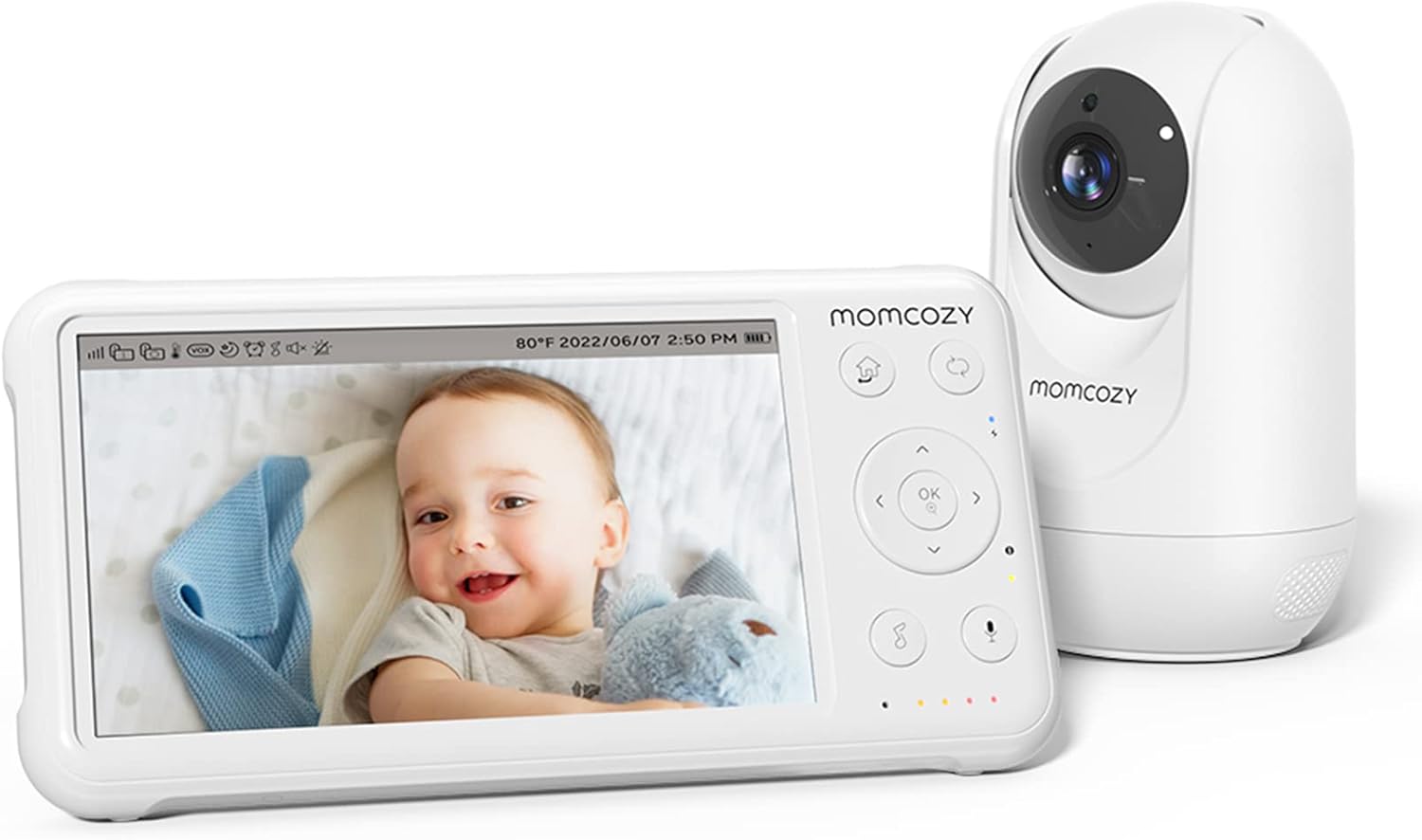
Best overall — Momcozy Baby Monitor BM01. It wins on the fundamentals rather than the feature list: good picture and sound quality, very easy to operate, and strong range. It is deliberately not overloaded with functions, but it has everything a baby monitor actually needs.
The parent unit's colour display is a relatively generous 5 inches at 720p, and picture quality is good, though colours are not always exact. Alongside VOX it offers lullabies and a feeding alarm you can set to repeat at 2, 4 or 6 hours.
On range the maker quotes nearly 300 metres outdoors. Tested through an actual building rather than open ground, it held a solid connection across every room on the same floor, stayed good one floor up in an older building with 2.5-metre ceilings, and even survived going outside the building. It finally dropped two floors up. That is a realistic picture: fine for a flat or a normal house, marginal across three storeys.
Its VOX implementation has the three sensitivity steps described above, verified at 75, 65 and 60 dB. The missing audible alarm is its one real omission.
In the UK it is listed as the 5-inch model with a non-Wi-Fi camera. Note that the retail listing advertises the screen as 1080p where the tested unit's display is 720p — retailer titles in this category routinely conflate camera resolution with screen resolution, so treat the screen figure as unconfirmed. There is a two-camera version of the same monitor as well as an add-on camera sold separately — worth knowing if a second child or a second room is likely.
Also recommended from the tested field: the Babysense MaxView Pro, the Béaba Video Zen Premium and the Reer IP BabyCam Move Smart. Babysense is straightforward to buy here and sells the MaxView range along with add-on cameras and multi-camera bundles. Béaba and Reer are French and German brands respectively, and we have not verified current UK availability for either, so treat those two as tested rather than as recommendations you can act on today.
Screen size and battery, briefly
Two numbers worth checking on the parent unit, because the range across this field is enormous.
Screen. The pick's 5-inch 720p display sits at the usable end. At the other, compact units drop to 2.8 inches and even 2.4 inches at 480p, which leaves so little viewing area that the camera stops being informative — the thing you bought it for.
Battery. VOX is what makes battery figures liveable, because the screen is off most of the time. In the tested field one monitor stretches the parent unit to 20 hours in VOX; another manages 12 hours with video running and up to 19 hours in audio-only mode; a third gives 10 hours in full video and 15 hours in VOX. If you intend to leave it unplugged overnight, this is the specification to read rather than the headline range.
A note on the non-Wi-Fi choice
The winner being a non-Wi-Fi model is worth dwelling on. A monitor that does not join your home network cannot be reached from outside it, which removes an entire category of risk that comes with internet-connected cameras in a child's bedroom. The trade-off is that you cannot check in from work. Which of those matters more is a genuine judgement, not a technical question — but it should be a deliberate choice rather than a default.
Before you buy
Four questions. Do you need video, or would audio be easier and longer-range? Where is the nursery relative to you, and how many walls and floors are in between? Do you live somewhere with heavy 2.4 GHz congestion — if so, weight range and interference resistance heavily. And do you want an audible alarm? — because not every video monitor has one, and you will not find out from the box.
If you are looking at cameras for the rest of the house rather than the nursery, our best security cameras and best video doorbells guides cover those instead.