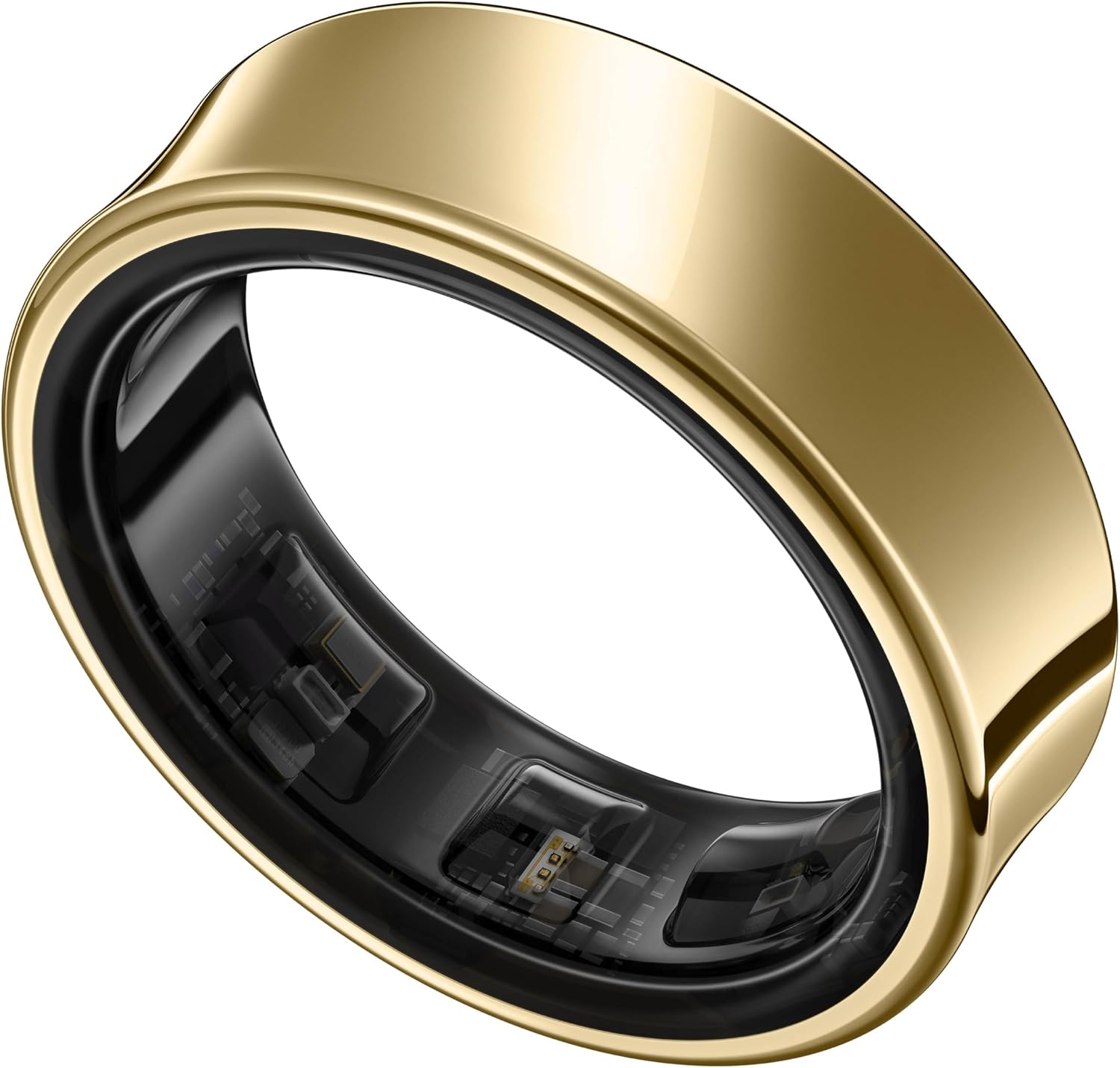
A smart ring is a shrunken fitness tracker you wear on a finger instead of a wrist. On the inside sit the usual sensors for heart rate and, in most cases, blood oxygen, plus an accelerometer for step counting. The miniature construction imposes limits — there is no room for a GPS sensor and the battery can only be so big — but the payoff is discretion: a ring is far less conspicuous than a watch and comfortable enough to wear around the clock, including in bed. Thirteen models were tested for features, operation and battery; these are the six worth knowing about, with UK prices checked on 2 August 2026.
The Short Version
- Best overall — RingConn Gen 3. Top marks in every category and 11.5 days of battery, with a charging case in the box.
- Best value — newgen medicals ZX-5545. Touch control on the ring itself and always-on temperature measurement.
- Best premium — Oura Ring 5. Barely distinguishable from a normal ring, with the most thorough analysis — behind a subscription.
- Best for Samsung owners — Samsung Galaxy Ring. Slots into Samsung Health, 10 ATM water resistance, no iPhone support.
- Best cheaper option — Amazfit Helio Ring. Sleep apnoea detection and a very accurate step counter, but only three sizes.
- Cheapest — newgen medicals ZX-5687. Nearly nine days of battery, but sharp edges and very limited features.
Best Overall: RingConn Gen 3
Technically very mature. The sensors on the inside still sit classically in a raised section, so the titanium case is a little thicker, though the weight stays low. Ten ring sizes are available at purchase, and you can request a sizing kit to determine the right one. The sensors measure pulse, blood oxygen and body temperature, and the app adds further metrics including a blood-pressure trend — no measurement takes place there, only an analysis. Endurance capacity is determined, sleep is monitored precisely, and the app warns you when vital signs deviate. Period prediction is possible.
The ring now gives vibration signals for warnings, reminders or a low battery. The choice of sports is limited to seven standard activities, some of which are detected automatically, and it can be worn while swimming. The app works with both Android phones and iPhones, and a lost ring can be traced by location, Bluetooth or a light signal. Battery life on the size 10 tested is a strong 11.5 days, and a transport box with charging function is included. It was £309.00 on Amazon UK on 2 August 2026 — note that each size and colour is a separate listing at the same price. Check the price on Amazon UK or search on Amazon US
Best Value: newgen medicals Fitnessring ZX-5545
Alongside app control this one offers touch control directly on the device, which is practical. The sports functions are very restricted, though. The app installs on Android or iOS, and there are no features for locating the ring by Bluetooth or GPS. The step counter at least measures fairly accurately, and battery life of around 5.5 days is satisfactory on the size 11 tested. A matching charging case is not included in the accessories and is not offered separately either.
There are five ring sizes at purchase, and the manufacturer does not offer a sizing kit. The ring has sensors for pulse and blood oxygen measurement and offers active temperature measurement at any time, not only during sleep. Sleep analysis, on the other hand, is rather imprecise where sleep phases are concerned, though breathing is at least monitored. Menstrual tracking is not available. It can be worn while swimming, with water protection to 5 ATM. It is not sold on Amazon UK, so the links below run a live search. Search on Amazon UK or search on Amazon US
Best Premium: Oura Ring 5
The compact Oura Ring 5 is barely distinguishable from a non-smart ring. It weighs little and the sensors on the inside are integrated flat into the titanium case. It is available in eight sizes and six colours each, and the sizing kit helps find the right model. The sensors measure heart rate, blood oxygen and body temperature, which makes extensive analysis possible in the app: early warning of illness symptoms, endurance capacity, and period prediction. Sleep is monitored precisely, including breathing. Step counter accuracy convinces and the ring can be worn while swimming.
The app carries a large choice of sports for tracking, and standard activities are detected automatically. It is compatible with both Android and iOS. For full functionality a paid subscription is necessary. If the ring is lost it can be located by position or Bluetooth. On the size 10 tested, a charge lasts around ten and a half days, which is fine. There is a transport box with charging function, but it has to be bought separately. The silver size 10 — the size tested — was £399.00 on Amazon UK on 2 August 2026; gold listings were £499.00. Check the price on Amazon UK or search on Amazon US
Best for Samsung Owners: Samsung Galaxy Ring
This one fits seamlessly into the Samsung universe. It is controlled with the Wearable app and Samsung Health, so plenty of sports functions are available, and paired with a Samsung phone there are extra functions such as gesture control. A lost ring can be tracked by GPS location or made to flash remotely. It is not compatible with iOS.
Eleven ring sizes are available, and the right size can be determined with the sizing kit. The step counter works extremely accurately and the body-analysis sensors convince too. Sleep analysis showed precise results, and breathing and body temperature are monitored during sleep, though active temperature measurement is not possible. The ring withstands water pressure of 10 ATM while swimming, which is excellent. The unit tested, in size 10, reaches a battery life of around 4.5 days — satisfactory, but it could happily be more — and charging takes about 2 hours. A storage box with charging function is included straight away, which makes the ring last considerably longer between mains charges. It was £218.99 on Amazon UK on 2 August 2026. Check the price on Amazon UK or search on Amazon US
Best Cheaper Option: Amazfit Helio Ring
The Helio Ring has a lot to offer and is comparatively inexpensive, but only three ring sizes are available and only one colour, and Amazfit does not offer a sizing kit. Anyone who does find a well-fitting size gets the standard body-analysis sensors for pulse and blood oxygen. Sleep analysis could be more precise but is usable; breathing and body temperature are monitored, and the ring can even detect sleep apnoea. Active temperature measurement is not possible.
Water pressure of 10 ATM does not trouble it, so it can be worn swimming, and the built-in step counter works extremely accurately. It is controlled with the Zapp app on Android or iOS devices, though the choice of sports functions is not especially large. The app can trigger a light signal so the ring can be found if lost. The battery lasts only about 3.5 days in use on size 10, which is tight, and no charging case is available to extend that; direct charging is quoted at 1 hour 40 minutes. Amazon UK lists only the sizing kit and the separate Helio Strap, not the ring, so no price is quoted here. Search on Amazon UK or search on Amazon US
Cheapest: newgen medicals Fitnessring ZX-5687
This one is extremely cheap, and that made itself noticeable in a lot of places. The sharp edges of the ring were an irritation. The features are quite restricted: there is no body-temperature measurement and no monitoring of breathing during sleep, and sleep analysis itself proved very imprecise. Menstrual tracking is not available. Only the standard sensors for pulse and blood oxygen convince. It is suitable for swimming, with permitted water pressure of 5 ATM.
The manufacturer provides no sizing kit and there are five sizes to choose from. Operation is passable: the QRing app for Android and iOS offers a large number of sports functions, and the ring can be told to give a light signal so it is easier to find. Step counter accuracy is satisfactory, though variation between individual measurements is quite high. Battery life of nearly nine days is excellent on the size 11 tested. A charging case is not included but can be bought as an accessory. It is not sold on Amazon UK, so no price is quoted. Search on Amazon UK or search on Amazon US
How Much Should You Spend?
Smart rings have been on sale for several years, so alongside the top models there are now cheap alternatives, some for very little indeed. Those entry-level devices are distinctly limited, both in build quality and in features. For a smart ring with at least good overall performance you have to spend meaningfully more, and above that the ceiling is open: there are excellent devices in the middle of the range and premium models above them. Even at the top the differences show up mainly in the feature set.
What a Smart Ring Cannot Do
The heart of a smart ring is the optical sensor. It measures pulse and detects blood oxygen saturation, but it also uses that data to determine breathing rate and calorie consumption and to estimate stress level. If accuracy falters, the app's conclusions are less reliable — and some manufacturers themselves say the pulse monitor in a smartwatch works more accurately than the one in a ring.
In practice the results were satisfactory overall: the Galaxy Ring's pulse measurement sat only marginally away from the measurement taken by the matching Samsung smartwatch. Tracking body functions can help spot health irregularities early. For professional athletes, though, a ring alone is probably not enough.
Every fitness ring can track the basic sports, but how far the sports functions go depends on the app. Some rings allow recording of more than 30 different activities — running, walking, swimming and so on — while others manage only three. In both cases only the standard data is provided: heart-rate curve, step count and speed, plus calories burned. Whether you also get an assessment of training performance, the recovery you need or how your stress is developing varies from app to app. The Galaxy Ring uses the usual Samsung Health app that pairs with the company's watches, so most sports modes are available with the ring too; most other rings have a standalone app from their own maker. At least the data from most smart ring apps imports easily into Apple Health or Google Fit.
Who Should Buy One?
For all its technical finesse, a smart ring cannot deliver the same performance as a fitness tracker or a smartwatch. For amateur athletes in particular it is no replacement for a device on the arm, because the choice of available sports and the analysis of activity data are often restricted, and measurement at the finger is not as exact as at the wrist. Combining a smart ring with a smartwatch is not the answer either, since the two devices fundamentally do the same thing and the watch does it better.
The great advantage of the ring is its inconspicuousness. On some models it is not even obvious at first glance that this is a smart device rather than an ordinary ring. If you do not want to wear a watch for aesthetic reasons, or dislike the feeling of a tracker on your wrist, the ring is a practical alternative — it does not draw attention, can even be a fashion accessory, and still allows analysis of your body's functions.
That is why most makers do not put sports modes at the centre of their pitch, but see constant health monitoring as the main job. During sleep especially a ring disturbs less than a wrist-worn tracker and can gather a great deal of data overnight: sleep phases, breathing rate, body temperature. Choosing a ring over a watch is therefore a question of personal preference. Technically much argues for the watch; for some people the discreet ring is exactly right day to day.
What to Check Before You Buy
Size. Unlike a watch, a ring has no adjustable strap, so it has to fit the chosen finger perfectly from the start. Makers generally offer several diameters using the US ring-size scale. If you do not know your size, some will send a sizing kit with dummy rings so you can pick correctly before ordering. Think about which finger you intend to wear it on, too, since fingers differ in thickness — makers usually recommend one, though the rings worked similarly well on all fingers in testing.
The app. Control happens mainly through the phone. Pairing generally works with both Android and iOS, but there are exceptions — Samsung's ring does not support the iPhone. Check which system versions the app supports, because without it the ring cannot be controlled at all. Apps differ in the body data, sports, alarm functions and much else that they offer.
Finding a lost ring. A ring can disappear faster than a watch, even if it has only fallen down the back of the sofa. A locating function in the app is genuinely useful: some rings emit a light signal on command, some can be traced over the Bluetooth connection, and if the ring is further away the last recorded GPS position of the paired phone may help. Most rings do not offer all three, and some offer none.
Battery and charging case. Space inside is at a premium, which is why larger ring sizes carry larger batteries and last slightly longer. As runtime usually stretches over several days, the difference is not dramatic. A ring normally comes with a base station charged over USB, but a storage box with a charging function is the practical extra — it is a good place to keep the ring and it extends runtime away from home. Sometimes you have to buy the case separately.
Sensors. There is not much variation, because size constrains what fits. Makers leave out GPS and NFC to concentrate on the essentials: heart rate, blood oxygen and the accelerometer for step counting. Most rings can also measure breathing and body temperature at the finger, though the latter often only passively during sleep recording. Extra functions vary and are usually advertised prominently — sleep apnoea detection, for instance, or extended features for women's health.
Working Out Your Ring Size
Makers use the US and Canadian scale of 1 to 14 for their size figures, which differs from the UK's letter sizes and from continental European numbering. If you know your usual size you can convert it — comparison tables are on most jewellery websites. You can also try measuring with a tape measure, though that can go wrong. Easiest by far is a sizing kit where the manufacturer offers one: it arrives in advance, you pick the right size with the dummy rings, and the correct model is then shipped.
Frequently Asked Questions
Which smart ring is best overall? The RingConn Gen 3. It scored top marks for features, operation and battery, runs 11.5 days on a charge in size 10, and includes the charging case rather than selling it separately.
Do I need a subscription? For the Oura Ring 5, yes — full functionality requires a paid subscription. The RingConn Gen 3 and the Galaxy Ring do not ask for one.
Will a smart ring work with my iPhone? Most will. The exception here is the Samsung Galaxy Ring, which is not compatible with iOS at all.
How accurate is the heart-rate reading? Good enough for health tracking, but not equal to a wrist device — some manufacturers say so themselves. In testing, the Galaxy Ring's pulse reading sat only marginally away from the matching Samsung watch.
How long does the battery last? Between about 3.5 days on the Amazfit Helio Ring and 11.5 days on the RingConn Gen 3. Larger ring sizes hold larger batteries, so your runtime depends partly on your finger.
Can I swim in one? Yes. The Galaxy Ring and the Helio Ring are rated to 10 ATM, and the two newgen medicals rings to 5 ATM.
Should I buy a ring or a smartwatch? Technically the watch wins on sports tracking and accuracy. Buy the ring if you want round-the-clock health and sleep monitoring in something nobody notices you are wearing.
Every pound figure above was read from the retailer's own listing on 2 August 2026 and is recorded in this page's verification evidence. Three of these rings are not sold on Amazon UK, so they carry search links rather than prices. Smart rings are sold as a separate listing per size and colour, so check you are buying the size you measured.