Buying a smart speaker looks like an audio decision and isn't. Before you compare drivers, you are choosing a voice assistant — and with it an account, a companion app, and the set of things the speaker will ever be able to control. From a tested field of 57 smart speakers and displays, that choice does more to determine whether you like the result than the speaker itself.
The assistant is the real decision
Three assistants matter, and the useful rule of thumb is short: Alexa is the most widespread, Google holds the most general knowledge, and Apple pays the most attention to privacy. If you already pay for one company's music or video streaming, its assistant is the obvious starting point, because that is where the voice control will work best.
They differ in small practical ways too. Alexa's default wake word is "Alexa", but the app also offers "Amazon", "Echo" or "Computer". Google's is "Ok, Google" or "Hey Google". Siri answers to "Siri" or "Hey Siri".
The important qualifier is one people discover after they buy: in the smart home, the quality of the app matters more than the quality of the voice service. Voice is a convenience layer over a full control system that you set up and manage on your phone — Google Home, Apple Home, or, for Amazon, the Alexa app. Even if you end up issuing Alexa commands through a Sonos speaker, the actual configuration still has to be done in Amazon's app first.
Historically that determined which brands you could buy: Alexa and Google talked to most manufacturers through cloud interfaces, while Apple supported considerably fewer devices, because the certification process was expensive and demanding and Apple insisted on local operation. The shared Matter standard has been narrowing that gap.
What you are signing up for
There is no anonymous option. A smart speaker requires an account — Alexa needs an Amazon account, Google Assistant a Google account, Siri an Apple ID — and what you say is collected into a profile tied to it. You are handing personal information to a company that intends to make money from it, not only from the hardware.
Apple has made privacy a more credible part of its brand than the other two, and its business does not lean on advertising and shopping data in the same way. That is a reason to prefer it, not a guarantee: you cannot verify how any of them handle your data, so a degree of trust is required either way. All of them let you mute the microphones — and cameras, where fitted — with a button, and signal listening with an LED.
Set expectations on the conversation, too. These assistants are still literal-minded. In practice you get the best results from short, unambiguous commands, one instruction per request, repeating the wake word each time. Genuine back-and-forth conversation, with references to earlier remarks and changes of subject, is not what they do yet.
The standout: Amazon Echo Studio (newest generation)
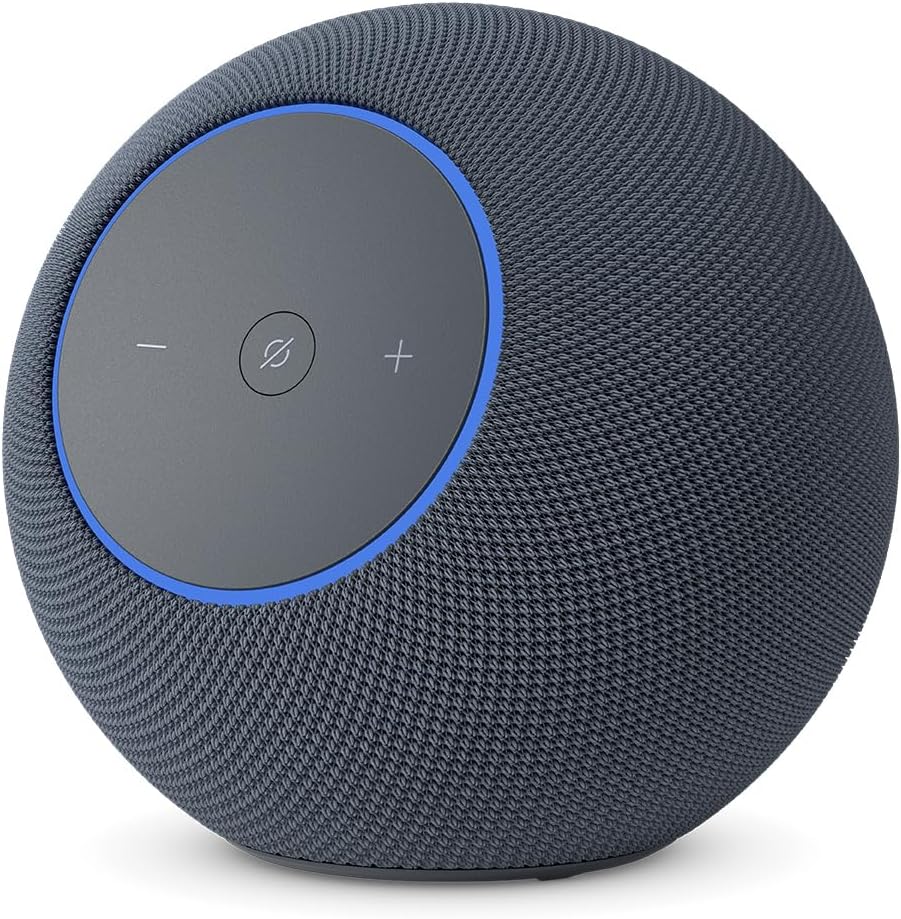
The best all-rounder in the field. Amazon shrank the first Studio's tall cylinder into a compact sphere roughly 15 cm in height and diameter — about a third lower and a quarter slimmer than the original — which makes it far easier to place on a shelf. It comes in black or white, in a coarse-weave fabric, with three buttons on an angled cut face and Alexa's LED ring moved up from the underside. There is a tripod thread underneath for a stand.
The driver count went down to make that possible: one of the five was removed, and three mid-range drivers plus a tweeter became three combined full-range drivers. The subwoofer stayed.
It doesn't sound compromised. Bass is powerful, precise and controlled, mids and highs are clear and detailed, and the impression holds up at higher volumes — with the caveat that on brightly mixed tracks the treble can turn slightly sharp, and the very finest quiet percussion detail isn't quite perfect. For its size it is surprisingly spatial, and two can be paired into a stereo pair, or up to five devices combined into a home-cinema system for a Fire TV Stick.
One genuine loss worth knowing before you buy: the original Studio's 3.5 mm and optical inputs are gone. The new one has a power connector and nothing else. If you only ever feed it over Wi-Fi and Bluetooth you won't notice; if you meant to connect it to something, you can't.
Larger alternatives that rely less on digital processing — Apple's full-size HomePod among them — render voices and acoustic instruments a little more naturally, but you would generally only hear that in a direct comparison.
If you want both assistants: JBL Authentics 200
The one to look at if the Echo's looks or its single-ecosystem approach put you off. It supports both Amazon and Google assistants, which is unusual, and it has a wired LAN port and manual tone controls — a physical bass dial ringed with an LED — rather than app-only adjustment. The styling reads as 1970s until you turn it up.
Note the range: the Authentics 300 is the portable model and the 500 is the larger hi-fi one. They are different products, not colour options.
Apple households: HomePod mini
Small, well designed, good 360-degree sound, and it works as a HomeKit hub, which is the real argument for it if you are building an Apple-based smart home. It does stereo pairing and multiroom, and the Intercom function is genuinely handy.
The trade-offs are clear-eyed: Siri is not as capable as its rivals — Apple's stated justification is privacy — the cable is permanently attached to the speaker, and setup and control require an iPhone.
Sonos: check which generation you are buying
This is where UK buyers need to be careful. The Move 2 replaced the original Move, and the changes are narrower than the price gap suggests. Battery life roughly doubles, from about 11 hours to 24. A second tweeter improves the stereo effect but barely changes what you hear. Sonos Voice Control is added, which works without a cloud connection, and Bluetooth audio can be reshared over Wi-Fi.
Against that, the Move 2 dropped Google Assistant — the original supports both Alexa and Google — which is hard to explain away and is a downgrade if you use Google. On the tested merits the older model is the better buy.
The complication is availability. On Amazon UK the current listing is the Move 2, at a substantially higher price, while the original Move now appears mainly as marketplace or renewed stock. We don't recommend renewed or unidentified-seller listings, so the practical position is: if you find the original new from a seller you trust, the reasoning above still favours it; otherwise you are buying the Move 2 and paying more for a longer battery.
Both are also heavy and awkwardly shaped for genuinely portable use, whichever generation you get.
Google's line has thinned out
Worth saying plainly, because the Nest Audio still appears in a lot of recommendations: it no longer has a clean first-party listing on Amazon UK. What comes back is the smaller Nest Mini, a renewed unit, or third-party offers well above the original asking price. We won't link those, and you shouldn't buy them. If you want Google's assistant in a decent speaker today, the JBL above is the more reliable route.
If you want a screen: Amazon Echo Show 11
A display changes the product, and the best speaker and the best display are not the same purchase. If you are already inside Amazon's services, the Echo Show 11 is the one to have.
It replaces the Echo Show 10 and the upgrade is mostly about the panel. The diagonal grows to 11 inches (28 cm), resolution goes from 1280 x 800 to 1920 x 1200, and pixel density rises from 149 to 206 ppi — enough that individual pixels are hard to make out even close up, which shows in photographs and text. The screen is fixed to an oval speaker base so it appears to float, with much slimmer bezels than older Amazon devices.
Sound comes from one bass driver and two front-facing full-range drivers. Firing forwards rather than backwards, as earlier Show models did, makes it noticeably less diffuse and muddled. Bass is strong and stays controlled at low volumes, mids carry voices and instruments with detail, and the highs are the weak point — not dull exactly, but short of real clarity and brilliance.
As a smart-home hub it is the most capable device here, acting as a base station for ZigBee, Thread and Matter. It runs Amazon's AZ3 Pro processor, which keeps long menus scrolling smoothly and is intended to support the chatbot version of Alexa — not yet available when the units were assessed. Setup is now done by QR code through the phone app, which beats typing room names on the screen itself.
Two caveats that matter more than they sound. The camera uses digital auto-framing to keep your head centred: effective, but it is not the motorised swivelling screen the Echo Show 10 had. And there is no mechanical camera shutter — you mute the camera and microphones with a button on the edge, where the older model gave you a physical cover. If a lens you can physically block is part of why you would buy one, that is a step backwards.
Also worth knowing before you commit: the display tilts back steeply, so typing on it while standing over a sideboard is uncomfortable unless you buy the matching stand separately. Calls only reach people using Amazon hardware or the Alexa app. Only Prime Video and Netflix are properly adapted to the screen — YouTube and the rest run in the browser. When idle it will work as a digital photo frame.
The Echo Show 8 (4th generation) is the same device with a smaller screen: 8.7 inches (22 cm), 1340 x 800 and 177 ppi against the 11's 206, so it looks slightly coarser side by side. Everything else, good and bad, carries over. Buy it if space is genuinely tight; otherwise the 11 gives you more screen for the money.
The rest of the Echo range
If you only want Alexa in a room cheaply, the standard Echo Dot does that. The Echo Dot Max is the more interesting one: Amazon enlarged the Dot 5's housing and, with it, the bass, and the result sits between the current Dot and the outgoing Echo 4 — close enough that a Dot can now hold its own against the HomePod mini on sound, which was not previously true. It gets the same modern coarse-weave fabric, in black, white or purple, the same angled control face with the LED ring moved up from the underside, and a much smaller power adapter that actually fits behind furniture. Like the Studio, it takes Wi-Fi and Bluetooth only — there are no other sockets.
The Echo Spot is a bedside device and should be judged as one. Its screen is just 2.83 inches at 240 x 320, nowhere near HD, but for the time, the radio station or the current track it is colourful and sharp enough. Sound is solid for the size without much reach at either end.
Before you buy
Four checks. Which account do you already have? That should decide the assistant more than any review will. Do you need a hub? Some models double as smart-home control centres and some don't. Check the generation, particularly with Sonos and Echo, where old and new sit side by side in search results under near-identical names. And check the exact model number within a range — the JBL 200, 300 and 500 are three different speakers.
If you are actually after portable sound rather than voice control and smart-home duties, our best Bluetooth speakers guide and best large Bluetooth speakers guide cover that class instead.