The honest way to shop for a Bluetooth speaker is to stop comparing them at all until you have picked a size — because a mini speaker and a party box are not competing products, and the sound you get is set mostly by the volume of air the box can move.
That is why this field sorts roughly 300 speakers heard over time into five categories — mini, small, medium, large and party box — and names a winner in each rather than crowning one overall.
The five sizes, and what each is for
Mini speakers are often barely bigger than a bar of soap, frequently shaped like a drinks can. Given that volume, thundering bass is not on the menu — but for casual listening in the bathroom or an audiobook in a hotel room, they are entirely sufficient.
Small speakers still fit in a handbag, which makes them the lido-and-balcony choice, easy to travel with, and good enough to fill a home office or kitchen. This is where progress has been most striking: small speakers have made great strides and no longer sound automatically small, because makers apply a range of psychoacoustic tricks. Done well, the result genuinely astonishes for the size. Done badly, you get a box that mostly makes noise — the category still contains both.
Medium speakers are the popular middle ground: considerably more punch than the small class while staying portable, and the right answer if you might throw a small open-air party by a lake.
Large speakers and party boxes move into mains-adjacent territory, with instrument inputs, lighting effects and wheels appearing at the top end.
The answers to the four questions everyone asks
How long does the battery last? It varies enormously with capacity and, above all, volume. At room volume most speakers run 8 to 16 hours. At full volume many are out of breath after 3 to 4 hours or less. Judge any quoted figure by which of those two situations it describes.
How far does Bluetooth reach? In the open, up to about 240 metres. Obstacles — ceilings and walls especially — cut that down, and around 50 metres is realistic in practice.
Which Bluetooth version do I need? All versions are mutually compatible, so any two devices will connect. Newer versions bring lower power consumption and greater range, but no version locks you out.
What do IPX4, IPX7 and IP65 mean? They are protection ratings. The second-to-last digit covers solid objects such as dust and sand; the last digit covers water. The higher each number, the more robust the device — and an X simply means that aspect was not rated.
The picks
Best mini — Tribit Stormbox Micro 3. Convincing on robustness, endurance and a fresh sound that is genuinely bass-capable for the size — the low frequencies have been properly upgraded over an already good predecessor. Highs resolve well, and the magnetic mount with a strap is a smart touch that makes it easy to attach to a bike or a bag. Operation and functionality are good, and the value case rounds off a very strong overall impression. Technically it steps up too: a new 4.8-cm driver, two passive radiators and 13 watts of power for more pressure, with an XBass function that lifts the low end specifically. Battery life doubles to as much as 24 hours, joined by fast charging and a power-bank function, and it runs Bluetooth 6.0 with AAC and TWS pairing for stereo with a second unit. Ruggedness is IP68 dust- and waterproofing plus drop resistance to 1.22 metres. Two honest limits: no AUX input, and voice reproduction that can turn somewhat harsh.
Best small — Bang & Olufsen Beosound A1 3rd Gen. The same outstanding sound as its predecessor, combined with excellent build and elegant design, in a body compact enough to take anywhere. Solo it is already impressive; pair two for a true stereo setup with surprising stage width. Two things deserve particular note in a disposable category: the design is sustainable and repair-friendly, with a replaceable battery. The iconic bead-blasted aluminium "puck" with its leather strap is unchanged in size, with weight up only slightly to 576 grams, and IP67 certification makes it dust- and waterproof. Underneath it is a genuine two-way hi-fi speaker in miniature: a 3.25-inch woofer and a 0.6-inch tweeter driven by a Class-D amplifier at 2 x 30 watts, with the battery growing to 3,300 mAh for up to 24 hours at moderate volume — where the previous generation managed 18. The obvious cost is that it sits at the premium end of the small class.
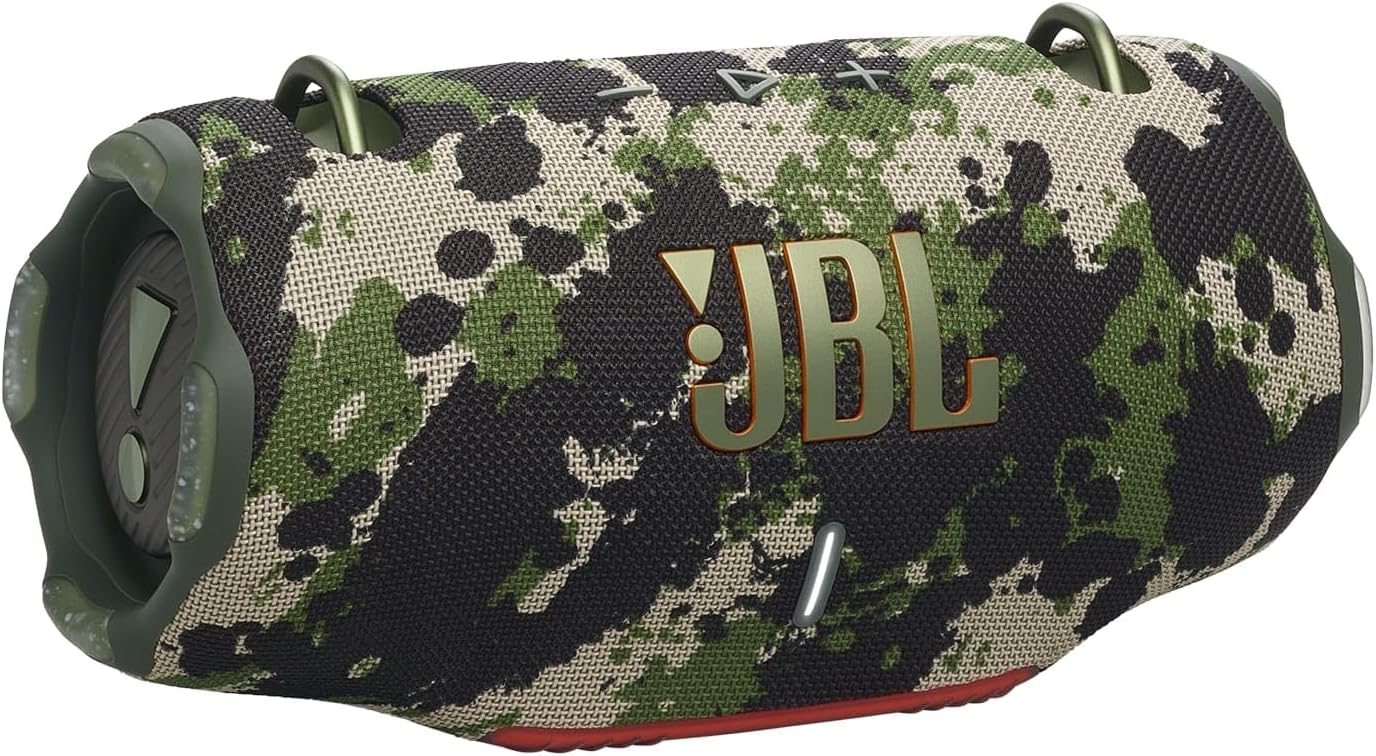
Best medium — JBL Xtreme 4. A well-judged successor to the Xtreme 3, improved on many fronts: very powerful, precise bass, long battery life, a replaceable battery, mains adapter included, Auracast support, and a new AI-driven bass boost that analyses the digital audio signal in real time. The one regression is the loss of the analogue input. The UK listing confirms IP67 waterproofing and an integrated power bank.
Best large — Hama Canton UltiMate Pro. The upset of the field: a first collaboration between the two brands that took the large-speaker win outright, breaking into JBL's phalanx with excellent sound, long runtime and good operation at a competitive price. Deep, very powerful bass and natural voice reproduction are the sonic case; a microphone input, AUX input and power-bank function are the practical one. Its single drawback is weight.
Best party box — JBL Partybox Stage 320. Successor to the popular Partybox 310, still offering 240 watts of power and a maximum playing time of 18 hours. The redesign brings lower weight and transport wheels, and the removable battery with integrated power supply keeps it flexible. Adjustable instrument inputs and an app with sound and light effects plus an equaliser make it a genuine small-event box, and two-stage bass boost gives real punch on rock, pop and electronic material. Push the volume hard, though, and it can turn aggressive and boomy.
How the testing worked
Speakers are assessed under practical conditions — predominantly in real living environments, supplemented outdoors where a portable design demands it — with the aim of reflecting everyday capability rather than laboratory behaviour. The listening test is central, using pop, electronic and acoustic material, and judging natural, balanced tonal character, clear uncoloured voices and clean detail resolution. Bass and dynamics are examined separately: how deep and controlled the speaker plays, how precisely it handles transients, and whether the sound holds together at higher volumes — which is where compact designs reveal how well they were engineered.
Before you buy
Four questions. Which size, honestly? Pick the category first; comparing across them wastes time. Room volume or full volume? That single answer changes expected battery life from 16 hours to under 4. Will it get wet or sandy? Read both digits of the IP rating, not the marketing word. And can the battery be replaced? — three picks here say yes, which is the difference between a five-year speaker and a two-year one.
For home listening, our best soundbars guide covers the television, and our best mini Bluetooth speakers guide goes deeper on the smallest class.
Research sources
Sources recorded for this page are linked below. Reported third-party testing belongs to the original publisher; it is not testing performed by Truthful Reviews.