Modern kitchens install the oven and the hob separately, which means the hob is a decision in its own right rather than something that arrives attached to a cooker. That freedom is why induction has taken over: among electric hobs it is the most efficient type there is, and it can do things a solid plate or a radiant ceramic surface simply cannot. This covers 36 induction hobs, of which four stand out.
One thing to be clear about first. This is an evaluation of published technical data and feature scope, not a hands-on cooking trial — no practical test was carried out. Features that every induction hob has, such as automatic cut-off and a child lock, are largely left out of the reckoning, so a hob can be excellent and still not appear here simply because its strengths are the ones everyone shares. What earns marks is flexible zone layout, bridging zones, genuine boost power, the maximum usable pan size, and pan detection that actually saves you a step.
The Short Version
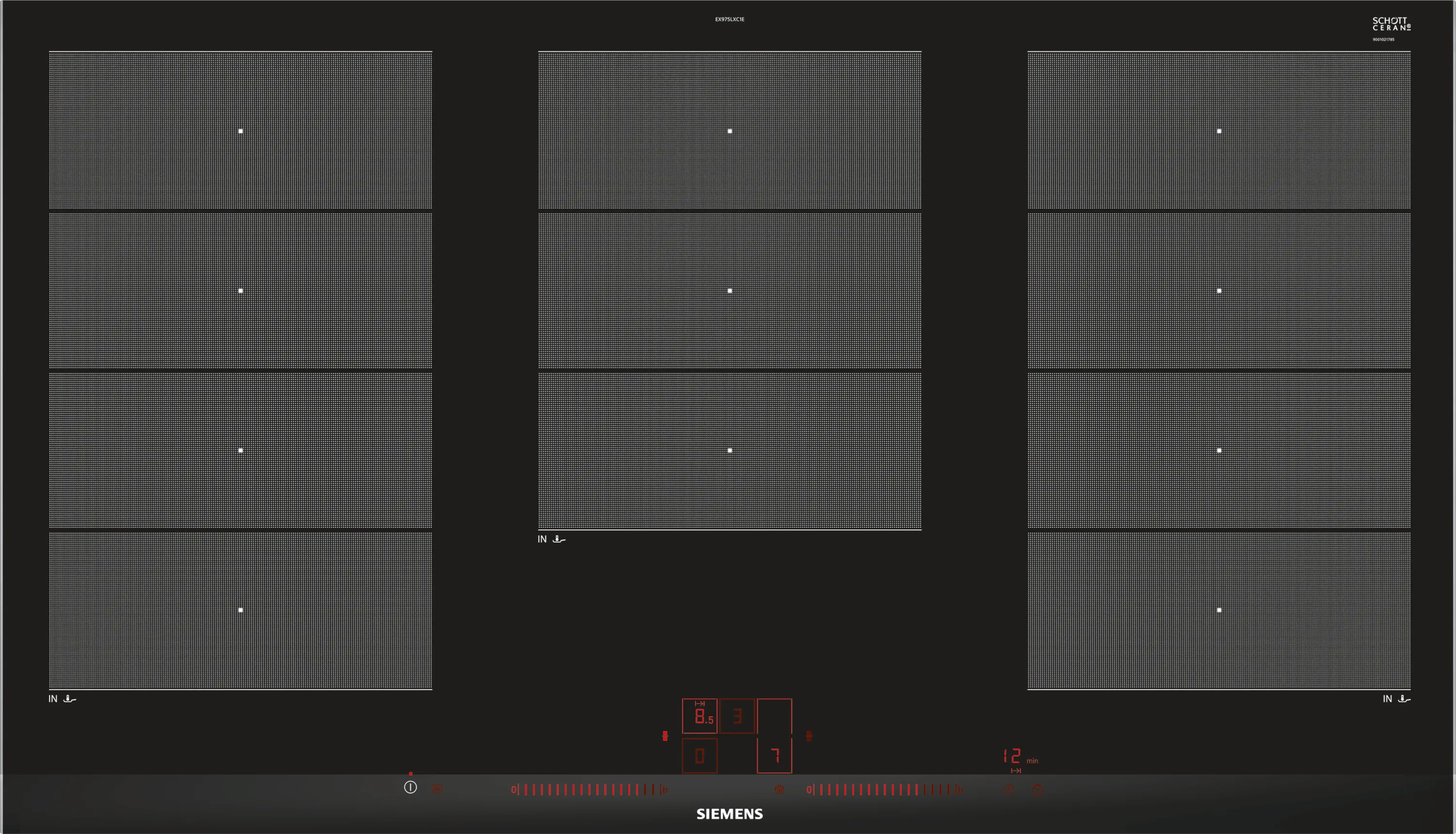
Best overall: Siemens EX975LXC1E iQ700 — five zones or three bridging zones, and the most complete feature set.
The clever interface: Neff T68STV4L0 N90 — 80 cm, up to five pans, Twist Pad and app control.
Most powerful boost: Miele KM6367-1 D FL.BDG. 230/50 — 7.3 kW on one zone, at a price.
Best compact: AEG TO64IA0AXB — just under 60 cm, four zones, and it talks to the extractor.
Best Overall: Siemens EX975LXC1E iQ700
This one has everything a good induction hob should: QuickStart with automatic zone detection, a keep-warm function and a frying sensor. Nothing has been left out, either in luxury or in the practical features.
Underneath the glass are eleven inductors, visible as rectangles, which in theory could serve eleven separate positions. In practice you get five independently operated zones, or three bridging zones. Small pans under 13 cm across sit best centred on a single inductor; pans over 13 cm go centred across two; a large roasting pan can cover up to four. The hob works out for itself which areas are in use. Inductors can be separated or combined, though not addressed entirely individually — the two rear and the two front areas on each side each form one zone, and whether one inductor or both is being used is detected automatically.
The most interesting feature is powerMove Plus, which turns the outer flexible zones into a temperature gradient. With it active, a pan placed on the frontmost zone runs at power level 9; slide it to the middle and it drops to 5; slide it to the back and it settles at 1.5. It behaves like sliding a pan across an old range, except the hob does the adjusting.
Boost comes in two forms. PowerBoost stays on until you switch it off and is meant for large pans of water. ShortBoost is for getting a frying pan up to heat and cuts out after 30 seconds. At 3.7 kW (3,700 W) the boost is mid-range rather than exceptional — the trade-off for having three very large bridging zones.
The frying sensor is the other genuine convenience. With it active, a power level stops meaning an amount of energy and starts meaning a temperature: level 3 becomes 160°C, with each step mapped to its own figure. Nothing overheats, and no more energy is drawn than the pan actually needs.
Search Amazon UK · Search Amazon US
The Clever Interface: Neff T68STV4L0 N90
Not quite as large as the Siemens, but its 80 cm glass ceramic surface still takes up to five pans, pots and roasting dishes at once, and it has a large bridging zone of its own.
Control is by Touch Control plus a Twist Pad — a magnetic dial you place on the glass, and lift off again when you want to clean the surface. It also connects over Wi-Fi to the Home Connect app, so it can be operated from a phone, checked from elsewhere if you cannot remember whether you switched everything off, and set to work in concert with other Neff, Siemens or Bosch appliances. A Home Connect extractor hood will adjust itself automatically to the hob's settings.
It carries the same frying sensor as the Siemens. You set the temperature you want, anywhere between 70 and 220 °C, and the zone holds it — which replaces the usual imprecise nudging of the power level up and down by feel.
Search Amazon UK · Search Amazon US
Most Powerful Boost: Miele KM6367-1 D FL.BDG. 230/50
Expensive, but seriously hot. The boost function delivers 7.3 kW (7,300 W) on a single zone — more power than some entire induction hobs have available across all their zones at once.
That power is divided across three large bridging zones, which can equally be used for six separate pans. The hob detects pan size by itself and adapts. If your objection to induction has ever been how long a large pan of water takes, this is the answer to it.
Search Amazon UK · Search Amazon US
Best Compact: AEG TO64IA0AXB
Small but well judged. At a built-in width of just under 60 cm it offers four cooking zones with more than enough power for everyday cooking. At this price some extras inevitably go — there is no bridging zone, and the overall cooking surface is moderate — but AEG has not abandoned comfort.
Alongside intuitive touch sliders it carries Hob2Hood, which lets the hob communicate with a matching extractor hood so the fan responds to what you are doing rather than waiting for you to reach up and adjust it. There is also a pause function and a safety cut-out.
It is worth noting that this model replaced the AEG IKB6431AXB, the previous value pick, which is no longer available.
Search Amazon UK · Search Amazon US
Boost Is Not One Thing
Every induction hob has a boost function, but the range between them is enormous, and it is the single specification most worth checking.
Each hob is designed around a total power figure, reached when every zone runs at maximum. Often, though, you only need one zone and you want the water in that pan boiling as soon as possible. Boost pushes extra energy to the zone you choose — and because total draw cannot be exceeded, other zones are reduced or switched off while it runs.
The tiers are stark. Cheap hobs manage about 2.2 kW in boost, which is a heat output that better hobs reach in normal operation. Mid-range boost is around 3.7 kW. Genuinely powerful boost is over 7 kW. A hob's boost figure, in watts or kilowatts, is the number to compare.
Pan Detection, Flex Zones and QuickStart
All induction hobs have pan detection: sensors register whether suitable ferromagnetic cookware is on the glass, and if not, that zone stays off and the surface stays cold. Overheat protection, residual heat indicators, timers, child locks and automatic cut-off are equally universal, which is why none of them separates one hob from another.
What does separate them is what the hob does with that information.
Flex induction divides a large usable area into sections and powers only the part actually needed, recognising pan size so you stop hunting for the zone that fits.
QuickStart goes further. Detection on its own only serves safety; some hobs also recognise a pan on a zone that has not yet been switched on. They do not have to, but it is enormously convenient — set the pan down, choose a power level, and the hob works out which zone you meant.
Why Induction Rather Than Anything Else
Efficiency is the headline, even though hobs carry no energy label: choose correctly and induction returns an efficiency of 80 to 90 per cent, the best of any electric hob type. Heat can only be produced when a magnetic object is on the surface: with the hob switched on but nothing on it, no heat develops at all. That is a small child lock in itself, quite apart from the key lock most models offer.
Gas transfers heat more directly than anything else and works with any pan, even a dented one, but it needs a gas supply, is awkward to clean, and consumes oxygen and releases moisture, so the kitchen needs heavy ventilation — which pushes heating costs up in turn.
Solid plates are now rare, and deservedly. A heating wire warms the plate, and the plate's own mass has to be heated before any warmth reaches the pan, losing energy to the room on the way. A pan that does not match the plate exactly wastes more still.
Glass ceramic — widely called Ceran, though that is a manufacturer's brand name rather than the material, in the way Dremel stands in for a rotary tool — barely impedes heat transfer and is easy to keep clean, but it still heats the surface rather than the pan.
What to Look For
- Maximum usable pan size. Pasta needs room, and a zone only 180 mm across makes a properly sized pan awkward. Some hobs cap out at 210 mm.
- Bridging zones, for roasting dishes and fish kettles, are not universal — check rather than assume.
- Boost strength, using the tiers above.
- Zone count against surface width. An 80 cm hob taking five pans is a different proposition from a 60 cm hob taking four.
- Whether pan detection extends to QuickStart, which is the difference between a safety feature and a convenience one.
Common Questions
Which pans work on induction? Because energy is transferred electromagnetically, the cookware has to be ferromagnetic. Steel and cast iron are suitable. Stainless steel, copper and aluminium generally are not, unless the pan was specifically made for induction. A magnet settles it: if it does not stick, the pan will not work. Most hobs will also tell you when a pan is unsuitable.
How much power does an induction hob need? The connected load is predominantly 7.4 kW, supplied as three-phase electricity. Installation is an electrician's job, not a DIY one.
What is a standalone hob? One installed independently of any oven, which is how most modern kitchens are laid out — it lets you position both appliances freely and choose the hob type on its own merits.
A Note on Model Codes
These are the exact hobs compared, under their European model codes. British ranges from the same manufacturers use different codes, and the nearest matches on a UK listing are genuinely different models — a Siemens EH801HFB1E rather than the EX975LXC1E, a Neff T36FBE1L0 rather than the T68STV4L0. Nothing has been substituted here: each entry links to a search for that exact model name, and no price is quoted, because no exact listing was verified. Match on the specification pattern — surface width, zone count, bridging zones, boost figure and maximum pan size — rather than on the code.
For the rest of the kitchen, see our guides to the best dishwashers of 2026 and the best microwaves of 2026.