Wool is animal hair, and that single fact explains almost everything about washing it. Merino, alpaca, mohair, cashmere and lambswool are built largely from keratin — the same protein our own hair is made of — and they behave accordingly. Heat, mechanical punishment, bleach and harsh cleaning agents strip the fibre's natural protective layer and, over time, wreck the garment. A dedicated wool detergent exists to avoid all four. This guide covers 21 wool detergents put through the same wash routine, and the four that came out of it worth buying.
What follows is recorded testing, translated. Nobody at Truthful Reviews has washed a jumper with any of these. This page makes no health or skin claim about any product in it, and none is implied: everything below is about cleaning performance, fibre care, dosing, scent and packaging.
The headline finding is a trade-off that runs through the whole field. Plenty of wool detergents are genuinely gentle, and pay for it with cleaning performance that falls away to nothing. Only a handful managed both.
What makes a wool detergent different
Two things, chemically. The first is enzymes — specifically proteases. Ordinary laundry detergents carry them to break down protein-based stains, and they do that by splitting proteins apart. Wool and silk are protein. Feed a wool jumper to a protease and the result is pilling, felting and a garment that has lost its shape. Proteases have no place in a wool detergent, and neither does bleach or an optical brightener. Other enzymes are a different matter: amylase, mannanase, lipase, cellulase and pectinase act on starch, gums, fats and plant matter rather than on keratin, and several products here use them without any effect on the fibre.
The second is pH. Wool detergents sit low to neutral, where full-load and colour detergents are alkaline — alkaline enough, in the worst case, to put holes in wool.
Then there is lanolin, which is where the buying decision actually sits.
Lanolin: the one choice you have to make
Lanolin is wool wax, the fibre's own grease. Detergents that add it back leave the fibre soft and supple and give it a water-repellent surface, which is useful on anything worn as an outer layer: jumpers, hats, scarves, waistcoats, sofa throws, wool sleeping bags, baby accessories, sheepskins and down.
That same water-repellency is a problem lower down. Wool absorbs up to 33 per cent of its own weight in moisture without feeling wet, which is the entire point of a merino base layer or a pair of technical long johns. Seal the fibre with lanolin and that absorbency goes. So: lanolin for anything worn over the top, no lanolin for anything worn against the skin. Two of the four picks below carry lanolin and two do not, which is why there are four of them.
How often wool actually needs washing
Rarely — realistically only when something has soaked into the fibre that a damp cloth will not lift. Most wool is worn over at least one other layer, and airing a jumper after wearing it is normally enough to keep it fresh. Where a piece has gone a very long time between washes, a lanolin detergent works as a restorative treatment even on unstained wool, renewing the water-repellent layer and keeping the fibres soft and pliable.
When you do wash it, use the machine's wool or hand-wash programme, or wash by hand. A modern machine is usually gentler than rubbing a jumper about in a sink: the delicate programmes flood the drum, and the detergent's foam acts as a buffer so the garments float and touch each other as little as possible. Less friction, less wear. Never add fabric conditioner, fill the drum only to about a quarter, and treat 30 degrees as the ceiling — cold is fine too, and the care label has the final word.
Dry wool flat. Hung up, it stretches and loses its shape. Spread the piece on a towel, press a little more water out if you need to, pull it back into shape, and never wring it. Leave it lying on the towel on an airer. Radiators and direct sun both harden the fibres.
Two odd but source-backed tips: a dash of vinegar essence in the water refreshes faded wool colours, and a few hours in the freezer makes the fibres stand up so the surface looks extra soft.
Rescuing a jumper that has shrunk
If a favourite has been washed too hot and has only shrunk slightly, three household methods are worth trying, singly or together. Rewash it in lukewarm water with a little mild shampoo and a generous amount of conditioner, leave it at least half an hour, then spread it on a towel and ease it gently back to size — weighting the edges helps it dry under tension, or a hanger can let gravity do the pulling. Alternatively, soak it in a bucket of vinegar and water mixed one part to two for at least 30 minutes, rinse, lay flat and pull to size. Or mix two tablespoons of glycerine into a bucket of water and let the garment sit for at least 30 minutes before shaping it flat.
Down and sheepskin
Wool detergents suit down and sheepskin too, and both prefer a lanolin formula — check the packaging says so. Unless the label states otherwise, wash down at 30 degrees on a delicate programme; some feathers tolerate more. What genuinely matters is drying it fully and fast, because damp down clumps and can go mouldy. Tumble down duvets, pillows and jackets with tennis balls or dryer balls, which keep everything moving and beat the down back to full loft. Air-drying does not work. When the cycle ends, air the piece briefly and check it really is dry all the way through; give it another round or two if not.
The picks
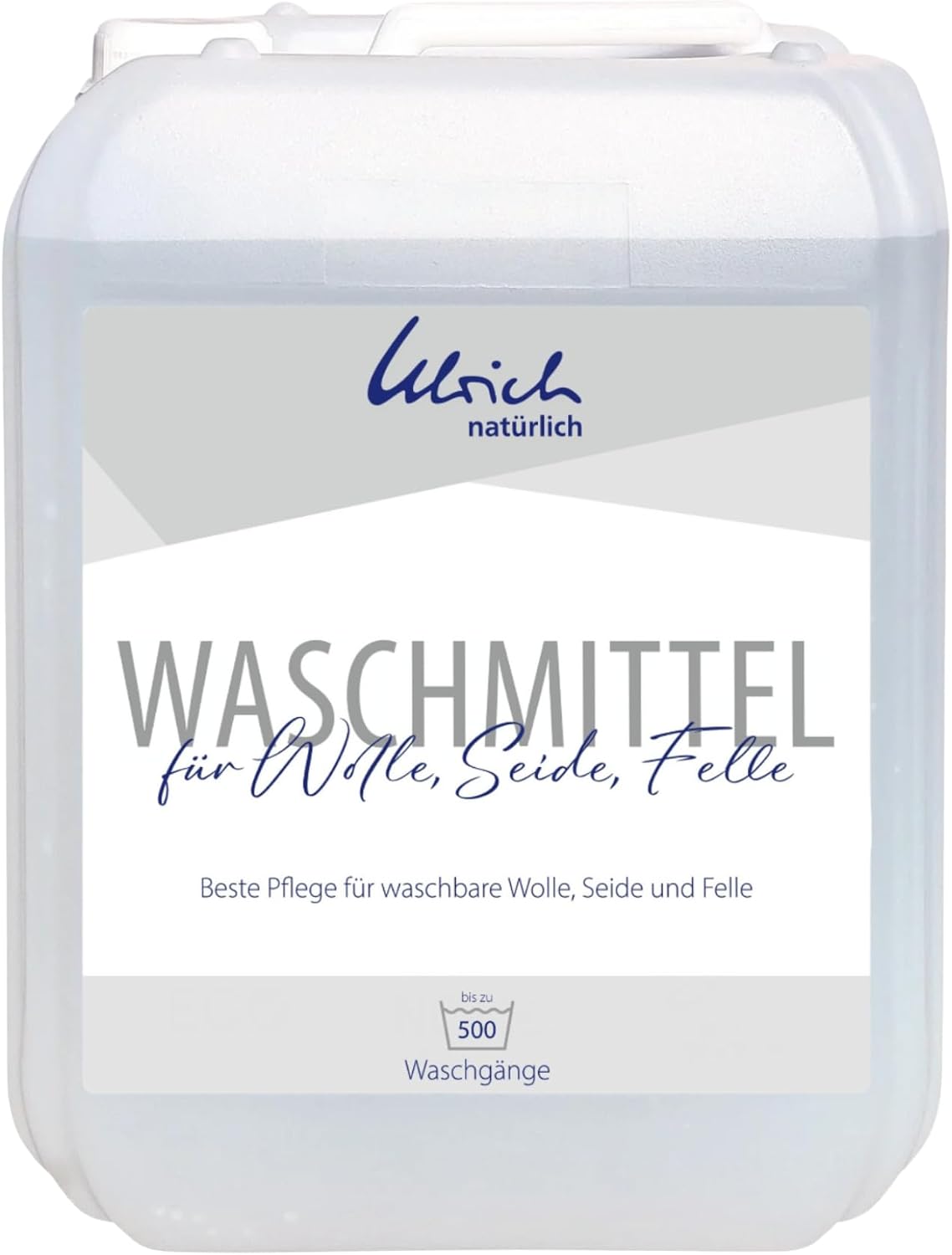
Top pick — Ulrich natürlich Waschmittel für Wolle, Seide & Felle
The best wool detergent for most garments. The packaging is unassuming at best and dated at worst, and none of that matters, because the contents deliver. It is a colourless, near-odourless liquid dosed at 20 millilitres per 2.5 kilograms of dry washing, which makes it relatively economical — a handy 500-millilitre bottle lasts a long time and takes up little cupboard space. Measuring in the cap is not ideal but it is far from the worst here, and no separate measuring beaker is needed.
On the stain set — tomato purée, red wine, mustard, black tea and oil, all left to dry into white knitted wool for several days — every mark came out markedly paler. That puts it level with three other products in the field; only the Cleanatics below cleaned better.
It contains lanolin, so it keeps wool fibres soft and supple and suits everything not worn directly against the skin, along with blankets, wool sleeping bags, baby accessories and sheepskins. The formula has no damaging enzymes, no bleach and no optical brighteners.
The one drawback is that it carries no fragrance at all, so the washing comes out smelling of nothing. If that bothers you, the pricier Cleanatics is the answer. In fairness, most wool detergents leave a far weaker scent than colour, full-load or delicates detergents do.
Search Amazon UK · Search Amazon US
Best cleaning — Cleanatics Spezialwaschmittel Wolle & Kaschmir
If you are fighting stubborn stains, this is the one. At 20 millilitres per load it cleaned better than any other wool detergent in the test: even the dried-on tomato, mustard, tea, oil and red wine were left strongly faded. That makes it the pick for heavily soiled wool — for the moment something lands on an expensive alpaca cardigan or a cashmere throw, where replacing the piece would cost far more than the detergent ever will.
It is the most expensive of the recommendations, and although a load takes only 20 millilitres, the 250-millilitre bottle empties fairly quickly. It is still an easy recommendation for the job it is bought for.
It is also the pick for anyone who misses the smell of clean laundry. Most of the field drops fragrance entirely; this one keeps a little. In the bottle it reads sweet and slightly bubblegum-ish, but on the washing it is pleasant and restrained. Fabric feels notably soft afterwards.
It contains lanolin, which cares for the fibres and closes them against moisture, so it belongs with outer layers and with woollen homeware and baby accessories — blankets and the like.
Search Amazon UK · Search Amazon US
The lanolin-free all-rounder — Ecover Zero Woll- und Feinwaschmittel
Good washing performance from mild ingredients, and the pick for anyone who needs one bottle to cover everything. It is among the cheaper products in the test and has nothing to apologise for: cleaning performance sits at roughly the same level as the top pick's. It is vegan, free of enzymes, free of dyes and fragrance, and comes in a recycled plastic bottle. The measuring aid moulded into the cap is genuinely useful, and while the dose is not minimalist it is still comparatively sparing. Because there is no fragrance, the washing comes out completely odourless.
The important point is what it leaves out. With no lanolin in the formula, it can go on any wool textile at all, base layers included — wool-silk vest tops, long merino ski underwear — without shutting down the fibre's absorbency. Wool washed with it comes out soft and still takes up moisture normally. Down pillows and duvets come back light and lofty with it too. It is also stocked in plenty of supermarkets, which counts for something.
Search Amazon UK · Search Amazon US
Best value — Frosch Fein- und Woll-Waschbalsam
The vegan Frosch balm is a pleasure on several fronts, because the lowest running cost of the four picks comes with real performance and a sensible formula. There is no microplastic, no dye and no aggressive preservative, and it is built on plant-based surfactants of European origin.
That formulation performs conspicuously better than its rivals. Where most of the field settles at "acceptable" on stain lifting, this one makes a visible difference: most of the residue on the test knit came out clearly paler.
The almond-and-marzipan scent is very restrained and barely detectable on the washing once it has dried. There is no lanolin, so it can be used on any garment without reservation, and because it is recommended for 20 to 60 degrees it will also handle delicates that are not especially temperature-sensitive.
The big black mark is the packaging. The flimsy pouch saves up to 70 per cent of the plastic waste a bottle would generate, but it is thoroughly impractical for measuring and pouring at every wash, and there is no measuring cap at all. Decant it into an empty, rigid detergent bottle when you get it home and the problem disappears.
Search Amazon UK · Search Amazon US
Also tested
Haka Wollwaschmittel — jumpers come out of the machine noticeably soft and fluffy, possibly down to the care protein advertised on the pack. Washing is the weakness: where wool had been stained beforehand, it did not get especially clean, and cleaning performance failed to convince even against other mild wool detergents. It also contains liquid polymers despite the sustainable presentation. Search Amazon UK · Search Amazon US
Klar Feines & Wolle — a disappointment on washing performance. Almost every mark on the test textiles was as clearly visible after the delicate wool cycle as before it, which other wool detergents handle far better. The formula itself is beyond reproach, with no fragrance or dyes, and the dosing is exceptionally sparing at just 10 millilitres. Search Amazon UK · Search Amazon US
Sonett Olivenwaschmittel für Wolle und Seide — one of the weaker performers. The re-fatting ingredients are good, but against stains the formula does very little. And while it smells reasonably pleasant in the bottle, it leaves a slightly rancid, musty odour in the dried washing. Search Amazon UK · Search Amazon US
Jean & Len Faserschonendes Feinwaschmittel — made in Germany, supplied in a smart floral one-litre bottle, with a delicate violet-and-jasmine scent. It is one of the few products here that leaves wool smelling pleasantly and gently sweet afterwards — not strong, but perceptible for a while. Cleaning is decent, and the mild vegan formula handles grease marks somewhat better than most. Clothes come out agreeably soft. Consumption is the catch: with harder water and heavier soiling it climbs to as much as 150 millilitres per load, and there is no measuring aid in the cap. Search Amazon UK · Search Amazon US
Denk Mit Fein- und Wollwaschlotion — free of perfume, dyes and preservatives, with a soap component in the formula. On a 30-degree delicate cycle it cleaned only moderately in testing: tomato and oil were dealt with reasonably well, but the rest left darker residues than other products did. The amylase and mannanase it contains support cleaning without troubling wool fibres. The dosing cap makes measuring very easy, and it is one of the least expensive here. Search Amazon UK · Search Amazon US
Gut & Günstig Wolle Feinwaschmittel — washes very cheaply but not very well, and the phosphonates and poorly degradable preservatives are a mark against the formula. Measuring and pouring are simple thanks to the cap aid. After washing, though, most stains had barely faded. It is one of the few here to leave a typical detergent freshness on the fabric. Search Amazon UK · Search Amazon US
Domol Wolle & Seide — an outlier in a field that mostly keeps to comparatively mild ingredients: this one includes phosphonates and two preservatives, methylisothiazolinone and benzisothiazolinone. In exchange it is among the cheapest in the test, and it suits anyone who likes their wool to come out of the wardrobe with a light freshly-washed scent. Cleaning performance landed mid-table. Search Amazon UK · Search Amazon US
Domol Wolle & Seide Ultra Sensitiv — the gentler of the two Domol products, and vegan. It goes without perfume, dyes and preservatives, and the bottle is recycled plastic. The formula uses enzymes to help lift stains, but the manufacturer does not say which, so no firm judgement is possible on that point. Cleaning strength was not evident on the wool cycle: most residues had barely faded afterwards. Search Amazon UK · Search Amazon US
Everdrop Feinwaschmittel — sold under the brand's water-hardness system: you state at purchase whether you need the soft- or hard-water version and receive a product matched to it. The advantage is real. With ordinary detergents, hard water means dosing more of everything — not just more water softener but more of every other ingredient too — whereas here the right amount of softener is already built in, so nothing else gets overdosed by necessity. The powder comes in a cardboard carton rather than plastic, though this particular product does not carry the EU Ecolabel that the brand's others do. In testing, with the wool-safe enzymes lipase, alpha-amylase, cellulase, mannanase and pectinase, it performed moderately: a few stains were marginally paler after the wool programme, but other products managed better. Search Amazon UK · Search Amazon US
Sonett Olivenwaschmittel sensitiv für Wolle & Seide — the surprise of the test update, and a clear step up on the standard Sonett. The vegan formula has no fragrance, dyes, complexing agents or preservatives and is made up entirely of fully biodegradable substances. It made wool perceptibly softer and worked on cashmere jumpers like an instant conditioning treatment. The smell is essentially non-existent: the liquid smells of nothing and the washed garments simply smell of wool. Cleaning is still not among the best — strong residues were visible on almost every stain. It is expensive, and the bottle resembles a washing-up liquid pack with no cap, so there is no measuring beaker. Search Amazon UK · Search Amazon US
Formil Feinwaschmittel Wolle — convincing in several respects, above all stain removal, which is better than most of the field. It is inexpensive per load, easy to measure using the cap — one capful is exactly the fill quantity for normal soiling in medium to soft water — and the textiles smell pleasant afterwards. Against it, the formula contains a great many declarable fragrance compounds and two preservatives, which is why other products get the nod in the recommendations. Search Amazon UK · Search Amazon US
Perwoll Renew für Wolle & Feines — one of the market leaders making life needlessly hard. The packaging carries all the dosing information and the cap has room to measure in, but nowhere does it say how much detergent a capful actually holds, so you have to improvise. A wholly unnecessary irritation in daily use. The bottle is at least 50 per cent recycled material, which is rare among wool detergents. Washing power lags the field, with most stains on the test piece only lightly faded. The restrained fresh scent is pleasant, though like most here it disappears within a few days. Search Amazon UK · Search Amazon US
Coral Feinwaschmittel Wolle & Feines — the complaint is everyday usability: if a product is going to use a large plastic cap, it may as well be one you can measure with. Performance from this enzyme-free formula is mid-table — not the worst washing here, not the best. The fresh scent is pleasantly unobtrusive. Search Amazon UK · Search Amazon US
Burti Spezialwaschmittel Wolle & Seide — among the cheapest in the test and easy to live with: the dosing aid in the cap lets the liquid be measured out and poured in simply, if not with great precision. It handles some stains, tomato among them, well, but overall there are wool detergents that wash better. The restrained scent is pleasant. The overall verdict is satisfactory. Search Amazon UK · Search Amazon US
How they were assessed
White knitted wool pieces were deliberately stained with mustard, tomato purée, black tea, red wine and oil, and the marks were left to dry in for several days. One wool piece per detergent was then washed together with other wool laundry on the machine's delicate cycle at 30 degrees. Each detergent was dosed exactly to its manufacturer's instructions for heavily soiled laundry and for the hard water of the testing region, with attention paid to how easy the correct quantity was to measure out.
After washing, three things were judged: how far the stains had faded, how soft the wool felt, and how the laundry smelled.
Ingredient lists and manufacturer information were then reviewed. The decisive point was that a wool detergent must contain no protease, no bleach and no optical brightener. Formulas avoiding declarable fragrances and dyes scored better, and resource-sparing packaging made from recycled material earned credit as well.
The short answers
Which is the best wool detergent? The Ulrich natürlich detergent for wool, silk and sheepskin. It washes satisfactorily clean, conditions with lanolin and does not cost a great deal.
Why do some wool detergents contain lanolin? Lanolin is re-fatting: it keeps animal fibres soft and supple and forms a water-repellent protective layer against rain and stains.
With lanolin or without? It depends what you are washing. Lanolin seals wool fibres against moisture, which benefits outer layers. Wool-blend underwear washed with lanolin cannot take up sweat, or takes up less of it, so base layers should be washed without.
What should I look for when buying? That there is no protease, no optical brightener and no bleach. If there is no ingredient list on the back of the pack, the manufacturer's safety data sheet on its own website will normally have one.