The iPhone 16e left an open question: would Apple refresh its cheapest phone annually? The answer is yes. The 17e shares a great deal with its predecessor and poses a fair question of its own — whether it genuinely improves on it.
Overview
A year on, Apple has refreshed the most affordable entry in its catalogue with a phone that is clear about its job: opening the door to the ecosystem without treading on the more expensive models.
The recipe is deliberately measured. The 6.1-inch format is carried over from the iPhone 13 and 14 bodies, and the aim is not to reinvent the range but to keep a device that feels current, serious and well enough equipped not to seem a generation behind.
It does not adopt the Dynamic Island and keeps a single 48 MP camera. But it takes the A19 chip, which brings it close to the iPhone 17 in experience, and adds MagSafe/Qi2 wireless charging. It launched with 256 GB of storage where its predecessor offered the same price for 128 GB — a doubling worth acknowledging, and one that places it against the Samsung Galaxy S25 and Google Pixel 10.
Design and handling
Compact by current standards without being as small as the old iPhone SE. At 14.67 × 7.15 × 0.78 cm it reuses the footprint of the iPhone 14 and 16e, which makes it comfortable to handle, including for small hands. At 169 g — 8 g lighter than the iPhone 17 — it feels right.
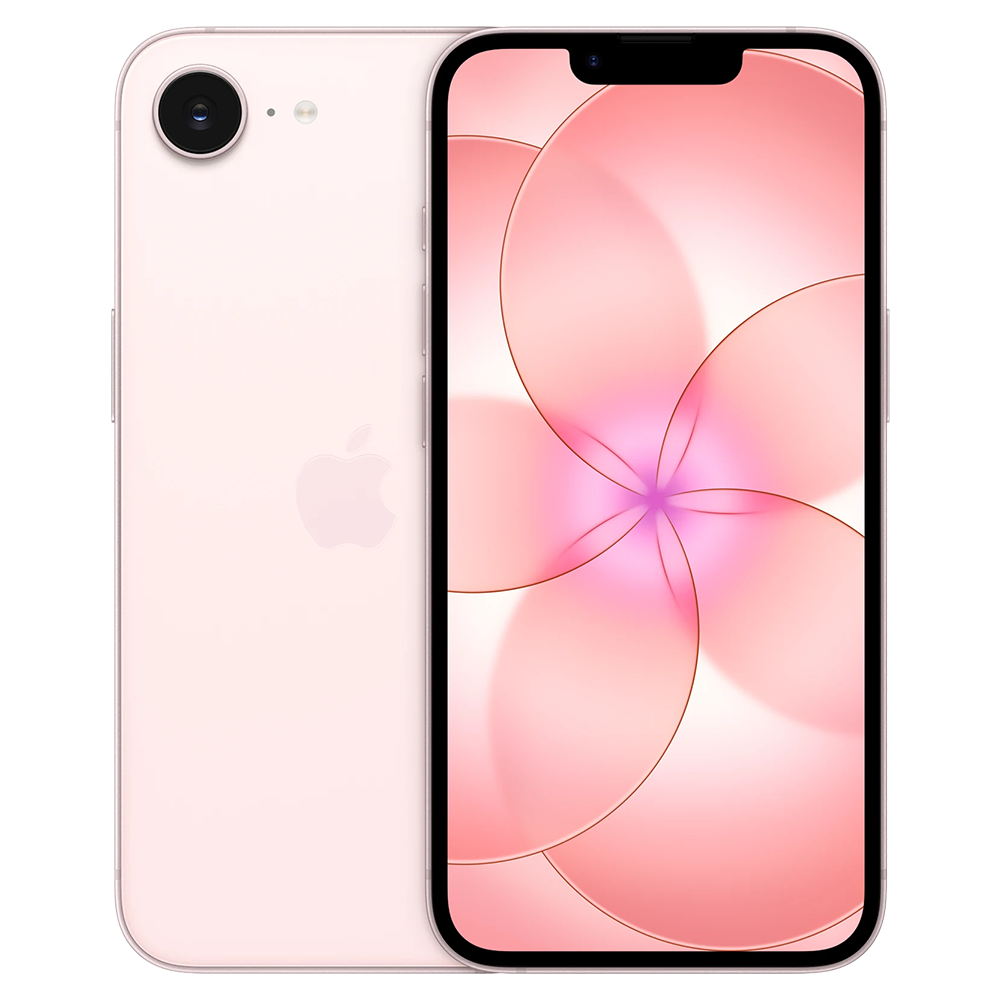
Visually Apple stays on familiar ground: straight lines, flat sides, an aluminium frame with glass front and back. Materials and assembly are as careful as ever. Alongside the traditional black and white there is a very pale pink, which grafts a little life onto an otherwise sober range.
The back reflects the same simplicity — one camera in a slightly raised round module in the top-left corner, with the flash and a microphone beside it. Minimalist and clean, though anyone who likes a demonstrative phone may find it too self-effacing.
Display: accurate, but not the last word
The 6.1-inch screen covers more than 87 % of the front, which means slim bezels and a clear step up from the second-generation iPhone SE. Apple does not move to the Dynamic Island, keeping a notch in the spirit of the iPhone 14 — not a practical problem, but a glance is enough to tell you this phone was not built to look cutting-edge. That notch still houses Face ID.
Screen protection does improve: Ceramic Shield 2, quoted as three times more scratch-resistant than the first generation, alongside the retained IP68 rating for dust and water.
Performance: almost an iPhone 17
The A19 gives a level of power very comfortable for the phone's positioning. Browsing, video, multitasking, moderately ambitious mobile gaming, Apple Intelligence features — it copes without ever seeming to stumble. Apple also uses the update to add Emergency SOS and, in time, Messages by satellite.
In detail the A19 takes the general architecture of the iPhone 17 with a 6-core CPU and 16-core NPU, but the GPU drops to 4 cores instead of 5. In theory that places the 17e a notch below; in practice the gap stays discreet. Responsiveness is excellent, slowdowns are conspicuously absent and graphics performance stays fairly close to the models above. There are some temperature rises when the chip is pushed hard, peaking around 45 °C, but nothing that changes how the phone is used.
Connectivity is coherent for the positioning without being generous: 5G through Apple's new in-house C1X modem, Bluetooth 5.3, Wi-Fi 6 and eSIM. The absence of Wi-Fi 7 may raise an eyebrow given the A19, and the bottom edge carries a USB-C 2.0 port.
Camera: one lens, good execution, obvious limits
Conservative in design and equally conservative in photography: the same rear module as the 16e, a 48 MP sensor with an f/1.6 wide-angle lens equivalent to 26 mm. No new hardware, and no second camera.
You need a good eye to tell 16e and 17e images apart. Photographs are just as detailed and hold up very well for the price. Contrast is controlled without over-emphasis, and colours are vivid — slightly less warm than the 16e, slightly more aggressive than a Pixel 10 — without being excessively saturated. In daylight it takes attractive pictures. Towards the edges of the frame, though, there is some noise and sharpness abandons ship.
In low light the differences are small: slightly better bite at the centre of the frame, at the cost of slightly more noise, and tones a little yellower. Apple is clearly playing continuity.
The front camera is untouched: 12 MP at f/1.9, still good, detailed and capable of lifting backlit subjects. Video records up to 4K at 60 fps front and rear, with Dolby Vision supported on the rear camera.
Battery life and charging
Apple does not revise the battery, keeping the 16e's format and its 4,005 mAh nominal capacity. On the same mixed-use test protocol — browsing, calls and so on — the predecessor managed 25 hours 35 minutes with the A18; the 17e comes in slightly behind at 23 hours 36 minutes.
That is no cause for outrage: it comfortably covers a good day's use. Charging, however, is not fast.
Verdict
The 17e is a careful annual refresh rather than a reinvention, and it is honest about that. The A19 is the substantive gain, the doubled storage at launch is a real improvement over the 16e, and MagSafe support matters more day to day than the specification sheet suggests.
What you accept in exchange is a notch rather than a Dynamic Island, one camera rather than two, Wi-Fi 6 rather than 7, a USB-C port at 2.0 speeds, and a little less endurance than last year's model.
For someone who wants a current iPhone that will not feel a generation behind, and who does not need a second lens, it is a coherent piece of work. For anyone drawn to it purely on price, the question is whether those omissions will still feel acceptable in two years.
Research sources
Sources recorded for this page are linked below. Reported third-party testing belongs to the original publisher; it is not testing performed by Truthful Reviews.