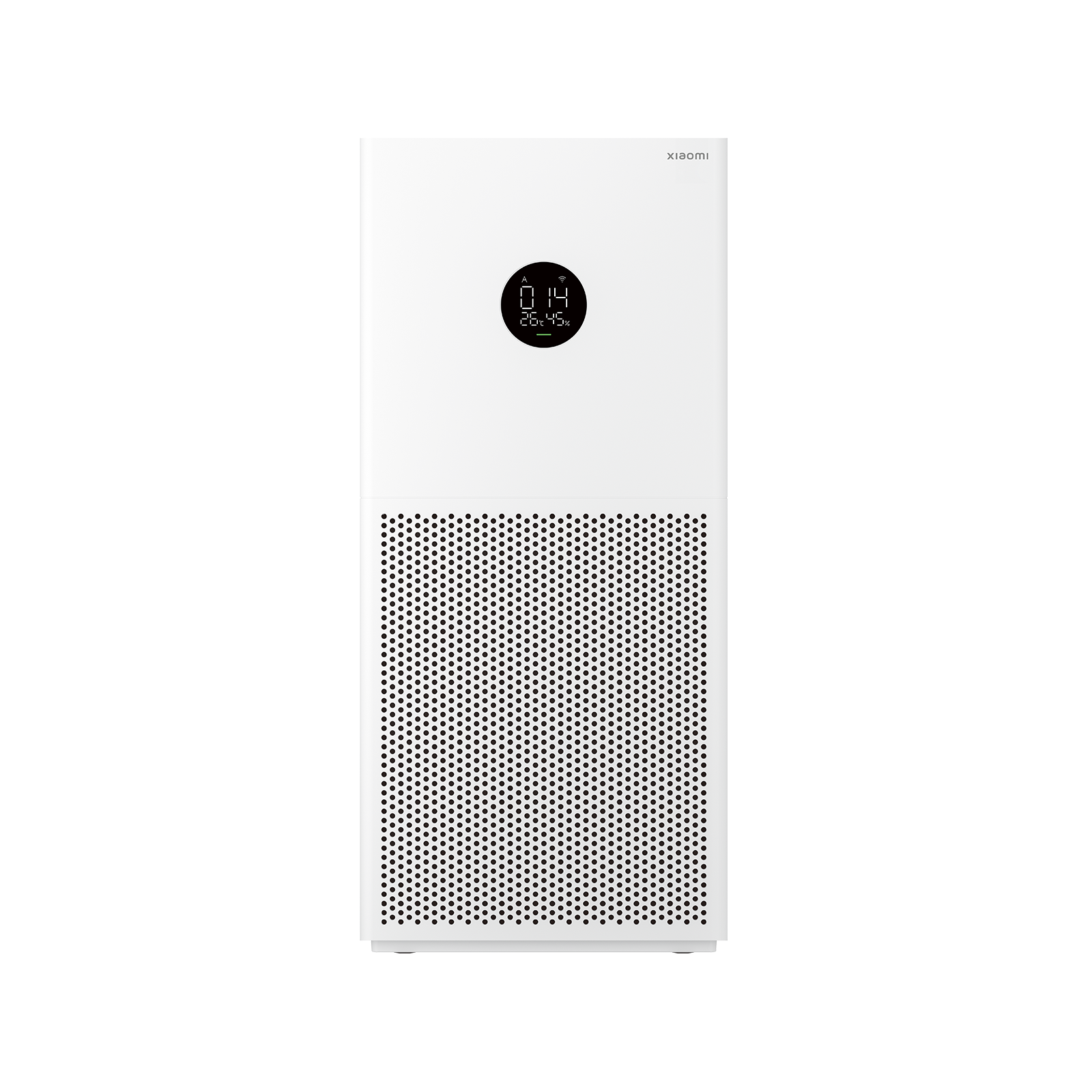
The Xiaomi Smart Air Purifier 4 Lite is the main recommendation in the published 44-model test behind this guide. The Blueair Blue Pure 511i Max is the small-room alternative, the Levoit Vital 100S combines compact dimensions with app control, and the Coway Airmega 150 favours simple controls and a quiet night mode.
This is a source-based editorial guide, not hands-on testing by Truthful Reviews. Measurements and observations below belong to the original publication linked in the Research sources panel. This page makes no claims about health, joints or weight. It compares appliance features and reported test results, not medical outcomes.
What the measurements can tell you
The recorded test used a room of roughly 29 m², with a volume of 71.7 m³. A particle generator and counter were used to follow changes in particle concentration during an hour of operation at maximum power. The publication also measured lower-power or night modes and took a reference measurement without a purifier, because particles can settle without being filtered. These are controlled particle measurements, not evidence of a health benefit.
Noise was measured at a distance of one metre. That shared method makes the reported figures useful within this test, but a manufacturer's noise specification is not automatically the same measurement. Filter replacement intervals were manufacturer estimates: the publication explicitly says that it could not test filter lifespan. Running hours and the conditions in a particular room can change that interval.
The four main picks
| Model | Why it appears here | Main qualification |
|---|---|---|
| Xiaomi Smart Air Purifier 4 Lite | Reported cleaning performance, display and adjustable app controls | App registration; some useful adjustments depend on the app |
| Blueair Blue Pure 511i Max | Compact design and relatively low measured power use | Fixed mains cable; the quoted 18 m² recommendation is for a small room |
| Levoit Vital 100S | Build quality, activated carbon and app control | The source describes fluctuating prices; no current bargain is assumed here |
| Coway Airmega 150 | Simple operation and a very quiet Silent mode | No app, timer or voice control |
Xiaomi Smart Air Purifier 4 Lite
The source favours Xiaomi's combination of reported cleaning performance, build quality and controls. Its 24 × 24 cm footprint and 52 cm height are the dimensions recorded for the 4 Lite. An LED display and a touch button on top handle the main interaction; a separate rear button is used when setting up the wireless connection.
The Xiaomi Home app requires an account. It adds useful adjustments, including control of display brightness and confirmation sounds, and allows the fan output to be set continuously and saved as a favourite. There is an important limitation in the source's description: unlike the older model used for comparison, the 4 Lite does not offer the same preset intermediate fan stages outside its night and maximum settings. Achieving a preferred compromise therefore relies more on the app.
The source describes a nominal 360 m³/h CADR, but also records a reduction in cleaning performance in night mode. Quiet operation and maximum output should not be treated as interchangeable. The replacement-filter interval quoted in the source is approximately 150 days, an estimate rather than a lifespan verified by the test.
An earlier version of this guide incorrectly assigned a 44 dB level-two measurement to the Xiaomi. That figure belongs to the Kärcher AF 30 section of the source, not to the 4 Lite, and is not used as a Xiaomi result here.
Blueair Blue Pure 511i Max
The Blueair combines a compact body with a fabric covering that also serves as a pre-filter. The source describes that textile pre-filter as machine-washable. The underlying combination filter becomes exposed while the covering is removed, and the mains cable is fixed rather than detachable.
The source quotes a maximum CADR of 212 m³/h and a manufacturer room recommendation of up to 18 m². Its assessment is that this is a realistic small-room pairing, rather than a reason to use the appliance across a much larger space.
Recorded noise ranged from 33.4 dB to 56 dB. The lower figure was the test equipment's measurement floor: it is not proof that 33.4 dB is the appliance's exact minimum output. Reported power consumption was 0.7 W in standby, 2.1 W in night mode and 16.7 W at full load.
Two touch controls select power and operating mode. The appliance provides three fan stages, night mode and an automatic mode, but no timer on the unit itself. The app provides scheduling and an air-quality history, with registration required. An initial connection problem reported by the publication was later traced to its own network environment; it should not be repeated as an established fault in the purifier.
Levoit Vital 100S
Build quality is one of the source's strongest observations about the Vital 100S. Its recorded 240 m³/h CADR places it in the small-to-medium appliance class, and its filter includes activated carbon. The source does not position it as a solution for a large room.
The publication describes the night mode as inaudible in its test and records 51 dB on the highest of the three fan stages. These are the Vital 100S findings, not measurements borrowed from another Levoit model. A touch panel sits towards the front of the top surface, with an air-quality indicator that can be switched off separately from the selected fan stage.
The on-device timer offers two, four or eight hours rather than a continuous range. The optional VeSync app requires registration and provides the connection used for Alexa or Google Assistant control. HomeKit was not supported in the source's recorded test.
The source's value judgement depended partly on substantial price changes during its testing period. That is not a current UK or US price claim. The links below are retailer searches, and the available listing and price need to be checked for the exact Vital 100S.
Coway Airmega 150
The Airmega 150 is the deliberately simple option. The source highlights its angular, retro-style body, choice of finishes and very quiet Silent mode. It records a body measuring 16.5 × 34 × 46.9 cm, with the pre-filter removable from above and the other filters accessible behind the front panel.
Three touch controls cover power, operating mode and the coloured air-quality light. A separate indicator signals a filter change. There is an automatic mode, but no app, timer or voice control. That limited feature set is both its appeal and its principal compromise.
The source does not give a confirmed European H13 or H14 classification for this exact Coway filter. We therefore do not assign one by inference. Neither the specifications nor the noise results for the different Airmega 100 should be used to describe the Airmega 150.