Damp is a problem you notice before you measure it: condensation on the window frames in the morning, washing that will not dry, a musty corner behind a wardrobe. A dehumidifier fixes the cause rather than the symptom. Here are the four worth buying, and how to tell whether you actually need one.
The short version
What humidity should you actually be aiming at?
The ideal indoor relative humidity for a comfortable home sits between 40 and 60 per cent. Above that band you are in the territory where condensation, musty smells and mould become likely; the point of a dehumidifier is to bring the number back down into it, not to dry the air out as far as the machine can manage.
Note the word relative. Relative humidity changes with air temperature, which is why a room can feel damp in the evening and fine at midday without any water having gone anywhere.
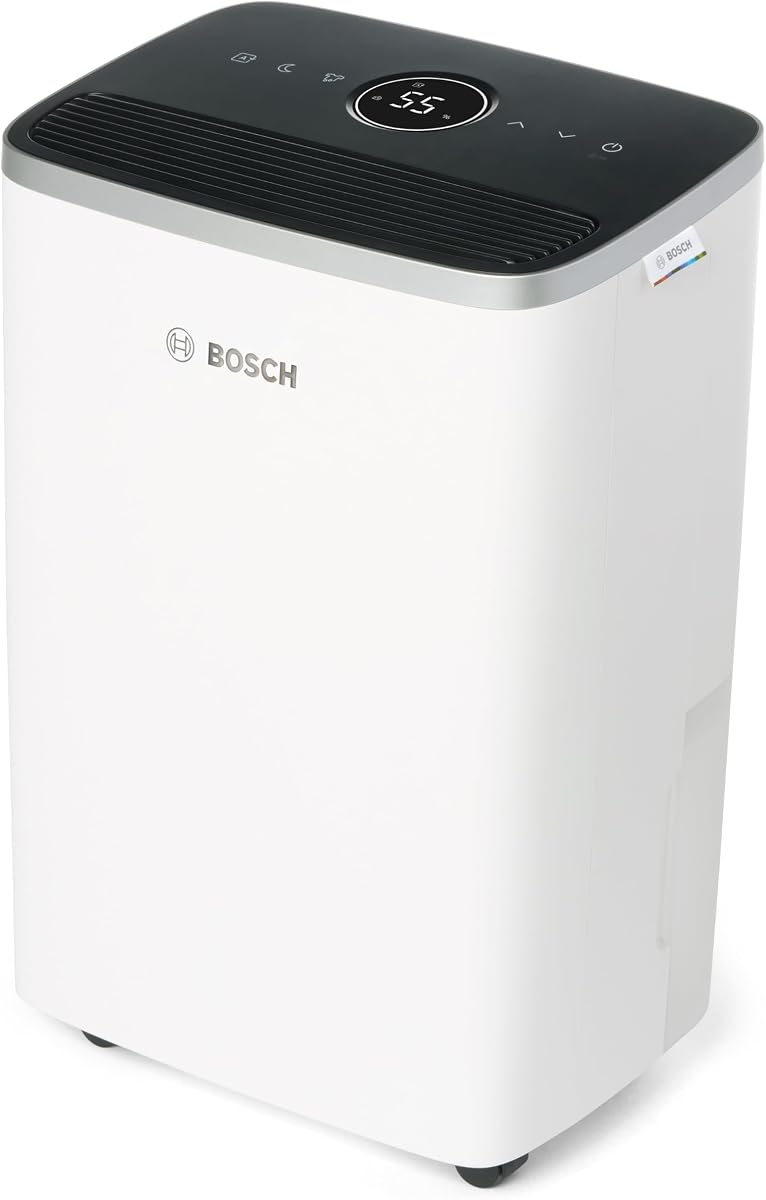
The winner: Bosch Dry 4000
Everything about the Dry 4000 is as simple as the name. There are three basic settings, adjustable a little, and then it gets on with the job — quietly, well and above all efficiently.
Noise. At night it murmurs along at 45 dB, rising to 50 dB in laundry mode. Some machines manage as little as 38 dB in night mode, but plenty of others exceed 60 dB at full power, so the Bosch counts as quiet.
Extraction and efficiency. In the dehumidifying test it is honestly mid-field: 170 ml collected. But more extraction almost always means more energy, and this is where it wins — those 170 ml cost just 258 Wh. That works out at about four hours of running per kilowatt-hour, or roughly 1.5 kWh per litre of water removed, which makes it very economical indeed.
Controls. Six buttons and a central LED display with clear symbols. Power and up/down keys on the right set the target humidity anywhere from 40 to 70 %; three keys on the left select auto, night and laundry modes directly. Night mode also switches the display off and reduces the noise, and auto mode does the same as the reading approaches your target — saving energy and sparing your ears. Laundry mode runs at full power to get washing dry before the room humidity climbs.
The omission is a timer, and an air filter is optional rather than included.
The luxury pick: MeacoDry Arete Two 25L
An app-controlled dehumidifier that pulls in weather data automatically and starts itself when humidity climbs too high. That is the headline, but the Arete Two earns the luxury recommendation on substance too: very good extraction, very low consumption, very quiet running, a HEPA H13 air filter, and both app and voice control over Wi-Fi.
The efficiency figure is the standout. In an hour it collected 234 ml of water for 0.28 kWh of electricity — theoretically 1.2 kWh per litre, which is an extremely good result.
Noise is the trade-off you have to weigh against that efficiency. In night mode, with extraction turned down, it settles at a quiet 44 dB; in laundry mode at full power that becomes a rather less pleasant 57 dB.
The price is correspondingly higher than the other recommendations here, which is the whole trade.
The solid mid-range choice: Trotec TTK 66 E
Few people associate Trotec with high-quality equipment, and the TTK 66 E looks neither smart nor especially well finished. It does its job, though — and it does it very well.
That matters less than it might, because a dehumidifier usually lives in a cooler, less-used room where appearance is beside the point. On function it has nothing to hide: dehumidification to a set value, a continuous mode, and a comfort setting that varies target humidity according to room temperature — sensible, given that relative humidity moves with temperature.
There is no dedicated night mode, though that is partly a matter of definition. Many rivals advertise one and mean nothing more than a reduced fan speed, and the Trotec has exactly that, with three fan speeds in total. It sits in the middle of the market, offers no particular highlights, and permits itself no weaknesses either.
The efficient all-rounder: MeacoDry Arete One 20L
Does high power mean high extraction? Not quite. The Arete One 20L is not among the power-hungry machines and still pulled plenty of water out of the air in testing.
The maker rates it at 14 l per day, or 0.59 l per hour — figures reached only at a suitable temperature and 100 % humidity. In testing it managed 0.19 l per hour, or 4.6 l per day. Factor electricity in alongside that and it looks better still: none of the tested machines was more economical.
It is also one of the few candidates with a HEPA 13 filter, rated to capture 99.95 % of airborne particles. That runs during dehumidification and can also be switched on as a standalone function.
The catch is the interface. Between humidity setting, an air-purification step and a key lock, it works — but only once you have read the manual. It is not intuitive to operate, which is the one thing that keeps it from the top spot.
How the machines were tested
Technical data is recorded first and the machines given an initial inspection — and that alone exposes a problem with the category. Manufacturer room-size claims are largely meaningless. One model rated at 20 litres per day is recommended for rooms up to 40 square metres, while another rated at 14 litres per day claims up to 70 square metres. The numbers are not comparable, so buy on measured extraction and consumption rather than on the square-metre figure printed on the box.
Beyond extraction, the assessment covers comfortable operation, useful extra functions, and how quietly the machine works.
How to choose
Match extraction to the problem, not the room. Ignore the claimed coverage and look at litres per day alongside what the machine actually collected in testing.
Weigh efficiency, because this thing runs for hours. The figure that matters is energy per litre of water removed — around 1.5 kWh per litre for the Bosch, and 1.2 kWh for the Arete Two 25L — rather than the wattage on the label.
Think about where it will stand. In a bedroom, night-mode noise decides everything: 45 dB is liveable, over 60 dB is not. In a utility room or cellar it hardly matters, which is where the plain-looking Trotec makes sense.
Decide whether you want filtration. Both Meaco machines carry HEPA filters and clean the air as they dry it. The Bosch offers a filter as an option rather than as standard.
Consider laundry. A dedicated laundry programme runs at full power specifically to get washing dry before the moisture it releases pushes room humidity up — a genuinely useful mode in a flat without outdoor drying space.
Frequently asked questions
What humidity should I aim for? Between 40 and 60 per cent relative humidity is the comfortable band for a home. A dehumidifier's job is to bring you back into it.
Are wet windows a sign of high humidity? Condensation on frames and glass is the classic visible signal that the moisture in the air has nowhere to go and needs bringing down.
Which is best for most homes? The Bosch Dry 4000: quiet at 45 dB overnight, economical at roughly 1.5 kWh per litre, effective and genuinely simple to operate.
Which is best if I want clean air too? Either Meaco. The Arete Two 25L pairs a HEPA H13 filter with app and voice control and weather-data automation; the Arete One 20L offers HEPA 13 filtration far more cheaply, at the cost of a fiddly interface.
Do I need a night mode? If the machine sleeps in a bedroom, yes — but check what the maker means by it. Several "night modes" are simply a lower fan speed, which is exactly what the Trotec offers without using the term. Where it genuinely counts: the Bosch drops to 45 dB and the Arete Two to 44 dB overnight, against 57 dB for the Arete Two on laundry duty.
How much electricity do these use? Judge it per litre of water removed rather than per hour. The Bosch needed 258 Wh to collect 170 ml, extrapolating to about 1.5 kWh per litre; the Arete Two 25L managed 234 ml for 0.28 kWh, or roughly 1.2 kWh per litre.