Start with the fact that reframes the whole purchase: a fan does not cool a room. It cannot. It moves air around, and the air it moves is the same temperature as the air already there.
What it cools is you. In heat your skin carries a thin film of sweat, and when that water evaporates it draws warmth away with it. Moving air accelerates the evaporation, so you feel cooler while the thermometer on the wall does not move at all. That is the entire mechanism, and two useful conclusions follow from it. A fan pointed at an empty room achieves nothing. And a fan is not a substitute for air conditioning — it is a substitute for feeling hot, which for most British summers is the thing you actually want.
From a tested field of 109 fans, here is what matters.
First decide the body style, because it sets everything else
Pedestal fans are the default for a reason: they move the most air for the money, and the head height adjusts.
Tower fans — sometimes called column fans — are the ones people usually want on looks. They are smaller, less obtrusive and take up less floor space, and they do produce a respectable amount of circulation. But be clear about the trade: their reach is fairly limited, they cost more to buy, and by design they move less air than a pedestal fan because the throughput is lower. They also cannot be adjusted for height at all. Some tilt, or let you change the angle of the outlet vents, but neither is a reliable standard — check the specific model rather than assuming.
Desk fans do a small job well. Floor fans shift a lot of air and are the ones most likely to be genuinely loud.
Ceiling fans are uncommon in northern Europe and much more usual further south, which is a shame, because they are very efficient: they stir the warm air that collects near the ceiling and keep the whole room turning over, so you get constant fresh movement without being blasted directly. That makes them particularly good in bedrooms. The catches are real, though — they cost more on average, and mounting one securely is not a trivial job.
The rotorless designs that changed how all of this looks arrived about a decade ago, when Dyson launched the Air Multiplier.
What actually separates a good fan from a bad one
Speed steps. Regulation matters more than peak power. Three settings is the sensible minimum, so you can pick the middle ground between a faint breeze and a small gale instead of choosing between them.
Blades — count and size. On bladed fans, performance depends on how many blades there are and how big they are. Three is typical; pricier models use four. The counter-intuitive part is what that does to running cost: more blades, and larger blades, need less power to move the same amount of air. A bigger, better-bladed fan can therefore be the cheaper one to run.
Noise. Worth treating as a specification rather than an afterthought, because a fan that is too loud measurably costs you concentration while you work. The quietest models in the field are usable on low right next to a bed. At the top of their range, the loudest exceed 60 decibels.
Stability. A fan must not be able to tip itself over with its own airflow. Check the base.
A guard you can open. The blades need a cage — but you also need to get inside it, because blades collect dust and a fan you cannot clean is a fan that gets worse every season.
Running cost
Most fans draw roughly 30 to 60 watts on their highest setting. There are outliers in both directions: one floor fan in the tested field pulled a hefty 120 watts, though that was very much the exception — and it was also among the loudest, at 57 to 64 decibels. On the whole this is not an appliance that will trouble your electricity bill, which is worth remembering when a listing advertises high wattage as if it were a feature. It is a cost, not a benefit; what you want is airflow per watt, and that comes from bigger blades rather than a bigger motor.
The picks
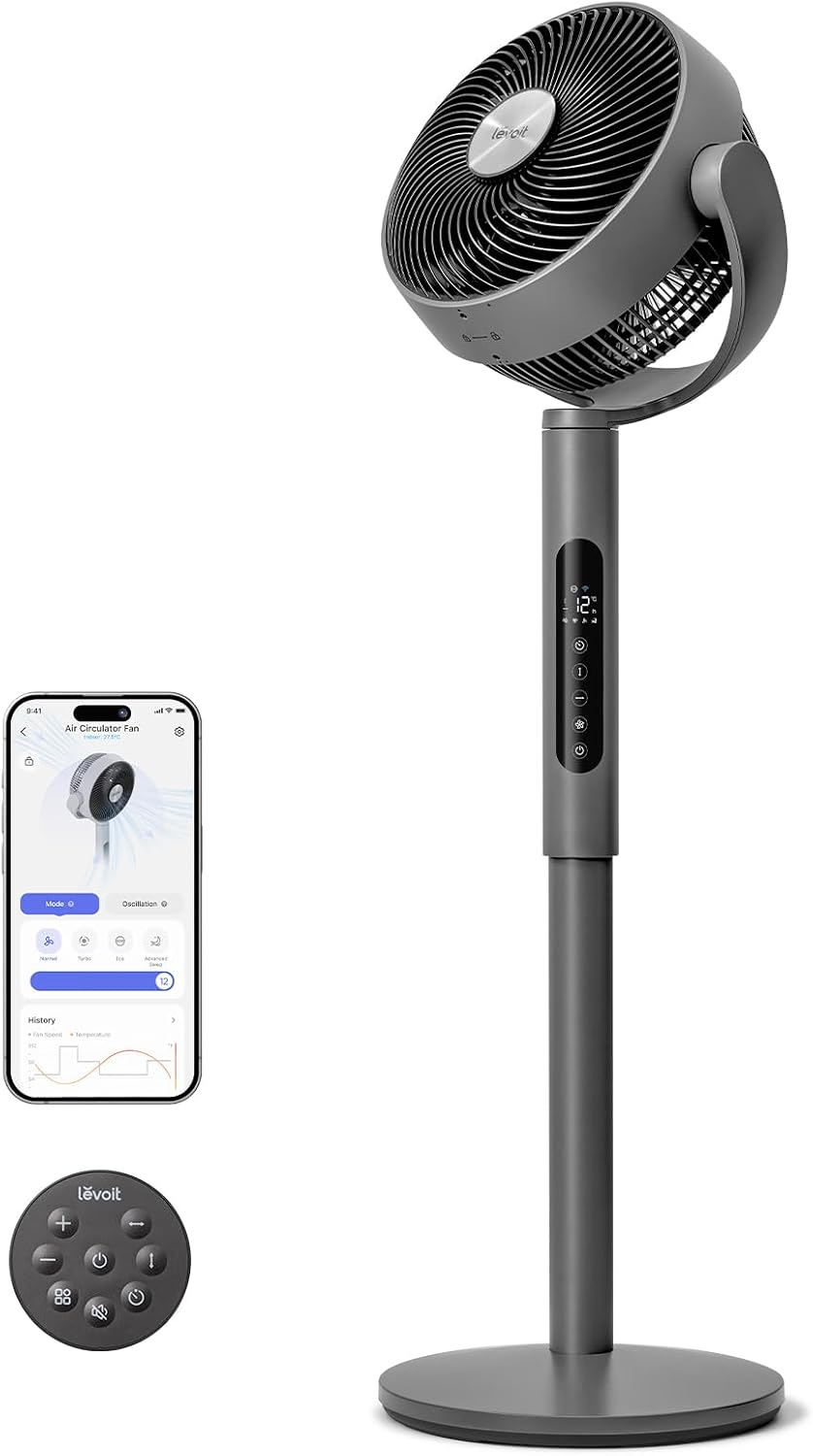
Best overall — Levoit LPF-R432. It wins on the two things that matter most together: the strongest airflow in the field, and a genuinely low noise floor. Measured at one metre it pushed air at 5.3 metres per second — the highest figure recorded across all 109 fans — while registering 57 decibels doing it. That is not quiet in absolute terms, but set against that airflow it is a good result, and the output is finely graduated rather than jumping between blunt settings, so you are rarely forced to run it flat out.
On power it is modest: 28 watts at maximum with oscillation running, and about 0.2 watts on standby. The eco mode is the clever part — it sets fan speed from the room temperature rather than leaving it fixed, so at 27 °C it settles on level 7 and adjusts as the room cools overnight.
The 3D oscillation covers a very large room volume, build quality is faultless, and a remote is included so settings are adjustable from the sofa. It is quiet enough at lower speeds for a bedroom. The one flaw noted is an occasional clicking sound while oscillation is running.
Watch the suffix on this one. Levoit appends a market code to the model number, and it changes by country: the tested unit is the LPF-R432-WEU, while the UK sells the same fan as the LPF-R432-WUK (there is an -AUS variant too). It is the same product with the correct plug, not a different model — but if you search the bare number you will turn up power adapters and remotes for all three regions, so check the suffix on what you are actually adding to the basket.
Best for quiet, and for going outside — Meaco Sefte Pro 10. The standout feature is versatility: it can be set to 60, 82 or 101 cm, so it works as either a desk fan or a pedestal fan depending on how you assemble it. Airflow measured 4.3 metres per second at one metre — below the Levoit but still strong — at 55 decibels, which is about as loud as a washing machine on its rinse cycle. Power draw is 26 watts at maximum, rising to 36 watts while it charges.
The battery is the reason to choose it. It will run anywhere, indoors or out, where nothing mains-powered will follow you, and the manufacturer quotes up to 40 hours away from a socket. Be aware it loses a little power when running on battery alone. Its oscillation reaches almost every angle of a room and it is simple to operate. The honest downside is that it is relatively expensive for a fan.
Note for buyers here: Meaco is a British company and sells this range directly rather than through Amazon, so a marketplace search is the wrong place to look for it.
If you want air purification too — Dyson Pure Cool. Different from a conventional fan or tower unit in both looks and engineering. Alongside the airflow it filters the room air, and it can also release air sideways through the vents, with a lot of functions to choose between and stepless adjustment rather than fixed steps. The cable is generously long. For all the jet-engine styling it is not a loud machine: 48 decibels at its highest setting. Two caveats, and they are not small ones: it is very expensive — enough that the price rather than the technology is the reason to hesitate — and it needs ongoing maintenance in the form of filter replacements, which is a recurring cost a normal fan simply does not have.
Tested, but hard to buy here
Two of the models that performed well are not straightforward UK purchases, and it is more useful to say so than to pretend otherwise.
The Rowenta VU2730 Turbo Silence Extreme+ performed well — enough airflow to compete with full pedestal fans, at 53 decibels — but has no clean UK listing under that model number. Amazon UK carries neighbouring codes — a VU2630 table fan, various VU5000-series spares — and the one stand fan offered under the Turbo Silence Extreme name at the time of checking was priced far above what the range normally sells for, which is a marketplace listing rather than a genuine retail offer. Brandson, meanwhile, is a German-market brand and is not sold here at all.
Neither is a reason to avoid the category. Both are a reason to check the exact model code before ordering, which in fans is unusually important: manufacturers run near-identical numbers across markets and across a range, and the difference between two codes is frequently the difference between a pedestal and a table unit.
Before you buy
Four questions, in order. Where will it stand? That picks the body style, and the body style caps the airflow. Will it run while you sleep or work? If so, noise is the specification to lead on, not power. Does it need to move? A battery model is the only honest answer to that, and there are few of them. And can you open the guard to clean it? — the one check nobody makes in the shop and everybody regrets in year two.
If you are cooling a room rather than a person, a fan is the wrong appliance and no amount of airflow will fix that.