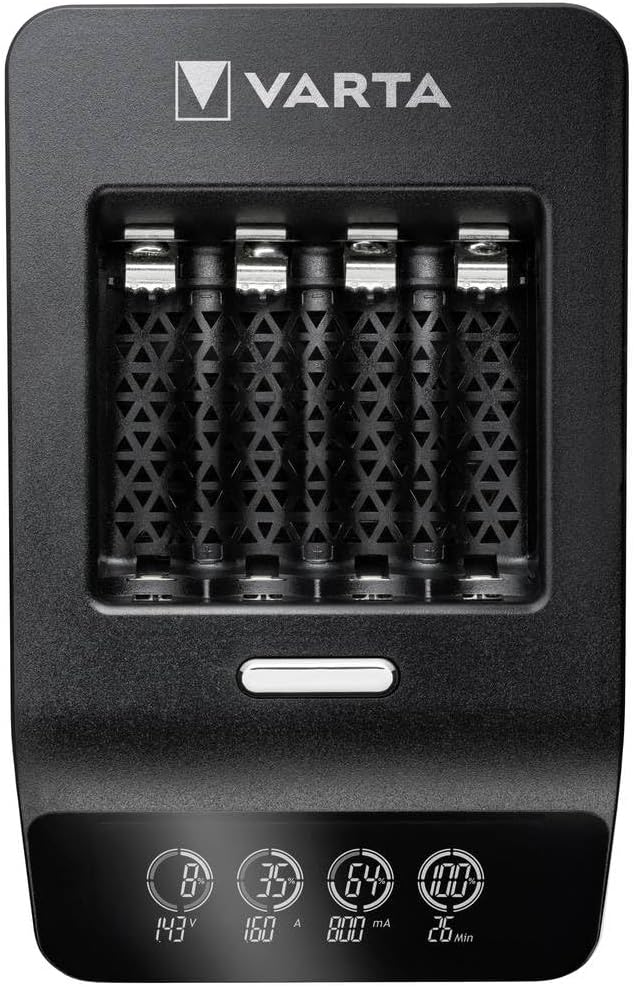
Rechargeable AA and AAA cells still power torches, decorations, toys, controllers and remote controls, but chargers differ much more than their similar-looking slots suggest. Some restore four depleted cells in well under an hour; others need most of a working day. Displays range from genuinely informative to almost unreadable, and several models cut their current sharply once a third or fourth cell is inserted.
This guide compares 14 battery chargers, led by the exceptionally quick Varta LCD Ultra Fast Charger+. The Absina is the practical answer for a large batch, while the Varta Eco Charger Pro is the simpler value choice. What follows is recorded testing, translated. Nobody at Truthful Reviews has used these chargers.
What matters when choosing a battery charger
Start with cell type and size. Most of this field handles rechargeable NiMH AA and AAA cells. A few add 9-volt blocks, the larger C and D sizes, Li-ion cells or the less common LiFePO4 chemistry. That extra range is useful only when it matches batteries you already own; a broad compatibility list does not make an awkward charger easier to live with.
Independent charging channels are more important. A charger that treats each slot separately can accept cells of different sizes, capacities and remaining charge together. Pair-only designs are less flexible: they require two or four cells of the same size and capacity, so a single depleted battery cannot be charged by itself.
Charge time depends chiefly on cell capacity and charging current, although remaining charge, age and ambient temperature also affect the result. In the recorded comparison, the same depleted 2,000 mAh AA cell took from 20 minutes to 510 minutes depending on the charger. Some models halve their current with three or four cells fitted; others deliver the same current to every bay, so a full batch takes little longer than one cell.
A proper display is more useful than a status LED. The better screens show a percentage for each bay and can expose voltage, elapsed time and current. Coloured LEDs usually communicate only broad progress or completion. Refresh, discharge and conditioning modes are secondary: they run additional charge-and-discharge cycles, while the ordinary charge mode remains the one most people will use.
Best overall — Varta LCD Ultra Fast Charger+
The Varta LCD Ultra Fast Charger+ was the clear winner and the fastest model by a wide margin. It is a solid desktop unit with four separate bays for AA or AAA NiMH cells, supplied with four 2,100 mAh AA batteries. Its front-angled LCD shows a separate percentage for every fitted cell; one button cycles through voltage, elapsed time and charging current.
There are standard, quick-charge and refresh modes. With AA cells, the recorded current was 1,600 mA in standard mode and 8,000 mA in quick mode for one or two cells. Inserting three or four halved those figures to 800 mA and 4,000 mA. AAA current followed the same pattern: 800 mA or 3,000 mA, halved for a larger batch.
Those numbers translated into an unusually short wait. One depleted 2,000 mAh test cell reached full charge in 20 minutes in quick mode; four took 38 minutes. A fan beneath the ventilated bays ran throughout, and surface measurements stayed below 40°C, in the same range as much slower rivals. The fan was audible but produced a steady, white-noise-like sound rather than an irregular whine.
The refresh setting can repeat a full discharge-and-charge cycle up to five times, stopping when no further capacity increase is detected. The only meaningful usability weakness was the screen's narrow viewing angle: it is clear from the front but not from every position. Speed, useful information and robust construction make this the best all-round choice here.
Search Amazon UK · Search Amazon US
Best for a large batch — Absina Akkuladegerät 10-Fach
The Absina Akkuladegerät 10-Fach is physically the largest charger in the group, but it has a reason for taking up the space. Its desktop housing accepts up to eight AA or AAA NiMH or NiCd cells, plus as many as two 9-volt blocks. Every main bay has its own current and monitoring, so filling the charger does not trigger the steep slowdown seen elsewhere.
There is no display, only a separate red-and-green status LED for each bay, with the four signal meanings printed on the housing. One contact in the tested unit arrived bent and prevented a cell seating correctly, leaving seven usable AA/AAA bays until corrected. That is a notable quality-control blemish on an otherwise sturdy unit.
AA cells receive 1,000 mA and AAA cells 500 mA. The depleted 2,000 mAh AA took 180 minutes alone and four cells took 195 minutes; because the current remains independent, eight should take broadly the same time. A discharge button processes every inserted cell before charging begins. This is not the quickest charger for one battery, but it is the sensible specialist when a drawerful needs attention together.
Search Amazon UK · Search Amazon US
Best value — Varta Eco Charger Pro
The Varta Eco Charger Pro is the straightforward alternative. It includes four 2,100 mAh AA cells, accepts any mix of four AA and AAA batteries, and monitors each bay separately. The casing is stated as 75% recycled plastic, while the supplied cells are stated as using 21% recycled material; those are composition figures, not a claim about the product's wider environmental effect.
Power comes through a removable USB-C cable, with a required input of 5 V at 1 A; no mains adaptor is included. Four green LEDs are easy to see, though they do not report remaining charge. Current for one or two AA cells ranges from 500 to 2,000 mA, falling to 350 to 1,000 mA with three or four. AAA cells receive 350 to 1,000 mA.
One depleted 2,000 mAh AA charged in 80 minutes, while four took 150 minutes. Both the cells and the bottom of the unit became distinctly warm during the measured run. There are no refresh or discharge controls, which keeps operation simple. It is the pick for buyers who want useful speed and four bundled cells without the winner's more elaborate display and modes.
Search Amazon UK · Search Amazon US
Also tested
Maha Powerex C9000Pro — feature-rich but not recommended after it accepted an alkaline battery: after 10 minutes the cell was extremely hot and blistering at its negative terminal, and the charger then stopped working. It otherwise offers four AA/AAA NiMH or NiCd bays plus Break-In, Discharge and Refresh modes, but demands a manually selected current for nearly every operation. Search Amazon UK · Search Amazon US
Ansmann Comfort Plus — a compact plug-in model for four AA/AAA cells or one 9-volt block with two round cells beside it. It charged AA at 650 mA, AAA at 350 mA and a 9-volt block at 15 mA; one depleted 2,000 mAh AA and a batch of four both took about 4.5 hours, while its discharge mode left more residual capacity than rivals did. Search Amazon UK · Search Amazon US
Panasonic Eneloop Pro Pro Charger BQ-CC65 — a sturdy desktop charger with a large backlit display, refresh mode and a 5 W USB output. Its four AA/AAA bays ran at 750 mA for AA and 275 mA for AAA; one test cell took 1.5 hours, but the halved current with three or four cells extended a full batch to roughly 3 hours. Search Amazon UK · Search Amazon US
Panasonic Eneloop Pro Smartplus Charger BQ-CC55 — a simple four-bay plug-in charger with colour LEDs instead of a screen. AA current reached 800 mA and AAA 300 mA; one test cell took 1.5 hours, four took about 3 hours, and there are no secondary modes. Search Amazon UK · Search Amazon US
Varta LCD Dual Tech Charger — one of two models here that also handles Li-ion cells, alongside AA/AAA NiMH. NiMH current stayed at 500 mA, while suitable Li-ion cells above 1,000 mAh could be switched from 500 to 1,000 mA; one AA and four AAs each took around 5 hours. Discharge, capacity-test, refresh and 5 W USB-output modes add range, but the tiny, angle-sensitive display is difficult to read. Search Amazon UK · Search Amazon US
Varta LCD Universal Charger+ — the broadest Varta option takes AA, AAA, C, D and one 9-volt block, with mixed sizes allowed within the physical limits of its four bays. AA current is 450 mA, AAA 200 mA, and one or four 2,000 mAh AA cells took just under 5 hours; its angled display is much clearer than the Dual Tech's, and USB output reaches roughly 2,400 mA or 10 W. Search Amazon UK · Search Amazon US
Ikea Stenkol — a compact four-bay AA/AAA plug-in charger with one white status LED per slot and no display. Up to two AA cells receive 700 mA each and four receive 350 mA; AAA figures are 400 mA and 200 mA. One test cell took 200 minutes, while four took twice as long. Search Amazon UK · Search Amazon US
Ikea Litosfär — the slowest model, but its lidded case stores as many as twelve loose cells and charges up to eight at once. With eight fitted it supplies AA at 240 mA and AAA at 120 mA; the 2,000 mAh test cell needed 510 minutes, while four did not take longer. Search Amazon UK · Search Amazon US
Duracell HI-SPEED Charger — quick but restricted to matched pairs of AA or AAA cells, with no single-cell option and no display. Two AA cells receive 1,550 mA and two AAA cells 775 mA; two depleted test AAs took 95 minutes, while four took almost 200 minutes after the current was halved. Search Amazon UK · Search Amazon US
Varta LCD Plug Charger+ — another pair-only design, this time with modest 385 mA AA and 155 mA AAA currents. A measured charge cycle took just under 310 minutes, and four cells were no slower because every bay receives the same current; build and status feedback are basic, with no display or extra modes. Search Amazon UK · Search Amazon US
Ansmann Lithium 4 — accepts NiMH, Li-ion and manually selected LiFePO4 cells in AA and AAA sizes, plus as many as two C cells. A single Li-ion or LiFePO4 cell can receive 2,000 mA, dropping to 500 mA with four, while NiMH stays at 500 mA; one or four 2,000 mAh AA test cells took just under 300 minutes. Search Amazon UK · Search Amazon US
How the chargers were compared
All fourteen were assessed for housing quality, the ease of inserting and removing cells, LED clarity, display readability and the information shown. Four new 2,000 mAh Eneloop AA cells were used throughout. First, one fully discharged cell was charged and timed; then four discharged cells were charged and timed. Surface temperature was sampled with a thermometer during the runs.
Those timings are comparative, not universal promises. Battery capacity, age, remaining energy and ambient temperature all change the result. The consistent cells and repeated single-versus-four procedure are what make the unusually wide spread — 20 to 510 minutes — useful.
Verdict
The Varta LCD Ultra Fast Charger+ is the standout: one cell in 20 minutes, four in 38 minutes, clear per-bay percentages and a refresh mode, with the fan and narrow viewing angle as its compromises. Choose the Absina Akkuladegerät 10-Fach when eight independent AA/AAA bays matter more than single-cell speed. Choose the Varta Eco Charger Pro for a simpler four-bay package that still completed one cell in 80 minutes.
For devices that consume those batteries, see our head torch guide. For built-in rechargeable devices instead, our power bank guide explains the larger portable options.