A bicycle bell is one of the oldest fittings on a bike — the first appeared in 1887 — and it is still the simplest way to make yourself heard from the saddle without shouting. It is also one of the few components where a small, cheap part can be genuinely unpleasant to live with: a bell that rings dully, rattles loose over rough ground or will not fit your handlebar is a daily irritation. This guide covers 29 bells, of which 23 were still on sale when the testing was reviewed.
What follows is recorded testing, translated. Nobody at Truthful Reviews has ridden with any of these.
How a bell works, and what to check before you buy
The mechanism is the same idea as any bell. The sound body — the visible outer shell — is set vibrating, and the impulse can come from inside or outside. Traditional bells use an internal striking works driven by a small thumb lever. Most modern bells instead use an external striker on a coil spring, which you push back and release so it flicks against the shell.
That distinction decides where the bell can live on your handlebar. A bell with an external striker works on either side, because the striker meets the sound body whichever way round it is fitted. A bell with an internal striking works may only ring when its lever is pushed one way — usually clockwise — which in practice means it belongs on the left of the handlebar. Fitted on the right, you have to reach round it. A bell that can only be worked with both hands at once, or only with the left, is a poor bell; a good one is workable one-handed, with the thumb, without shifting your grip.
Fitting is normally a matter of a single screw. Slacken it, wrap the bracket round the bar, position the bell next to your hand, and tighten again until it will not creep on rough surfaces. Some bells supply a small hex key; many assume you own a screwdriver.
The last thing to check is bar diameter. The common sizes are 22.2, 25.4 and 31.8 mm, and most of the bells in this field were 22.2 mm fittings, some of them offered in other sizes as well. A bracket built for one diameter only is exactly that: a bell for 22.2 mm bars will not go on anything wider, and no amount of goodwill changes it.
The picks
Top pick — Cateye PB-1000
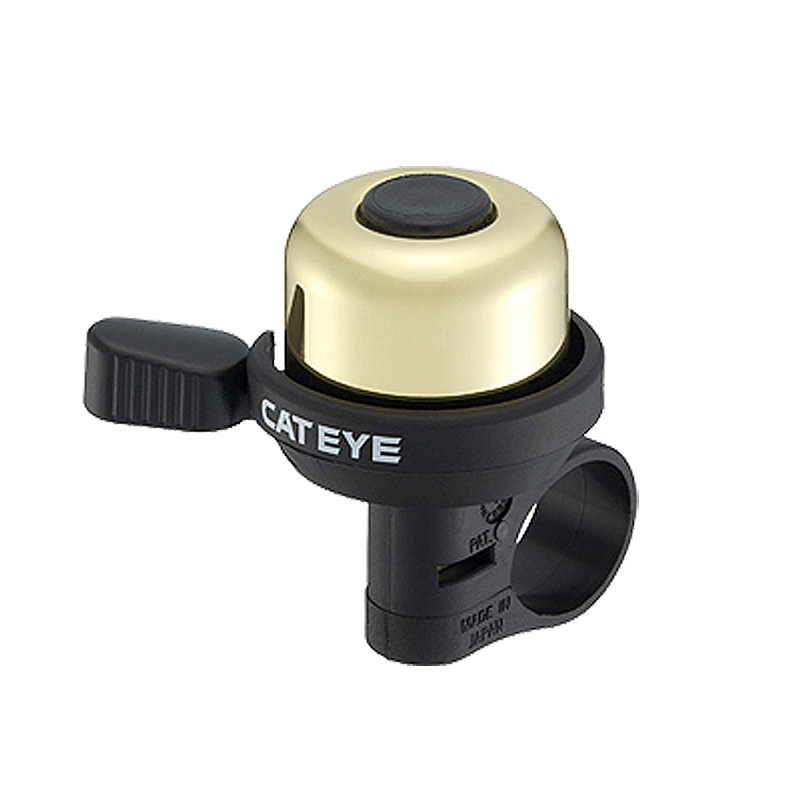
The best bicycle bell for most riders. Press the lever once and the small gold bell rings twice, with a warm, pleasant tone that is still bright and carrying — not shrill, not dissonant, not harsh in any way. The ribbed surface on the side of the lever gives it good grip under the thumb.
Build quality is excellent. It feels expensive in the hand, everything sits where it should, and the little lever that drives the internal striking works moves lightly but never feels flimsy. The finish has clearly had thought put into it: the surroundings reflect in the polished gold shell, the black details keep it from looking fussy, and the large brand mark on the side finishes off a modern-looking piece. A silver-and-grey version is offered alongside the gold and black.
Fitting was completely straightforward. Slacken the screw underneath the bracket, lay the bell round the bar, tighten it up — that is the whole job. The maker quotes compatibility with bars up to 24 mm, and on the 22 mm test bar it sat rock solid. The packaging is worth a mention too, because it avoids plastic altogether where bells are normally wrapped in one or two layers of it inside a card box; this one arrived attached to a single piece of card.
Loudness is where it earns the top spot. Measurement put it at 79 dB at one metre, and it barely drops off with distance: still over 78 dB at three metres, 72.9 dB at six and 67.6 dB at ten.
The one real drawback is the direction of travel. The lever only rings the bell clockwise, so it is designed for the left-hand side of the bar and nowhere else. It would be better if it worked both ways, but that is a complaint at a high level, and no other fault was found.
Search Amazon UK · Search Amazon US
If you want a hiding place for a tracker — AirBell Original
A small highlight for anyone who already owns an Apple AirTag. The tag sits quietly underneath the sound body of this plain black bell, invisible from outside — nothing about the bell draws attention, and only the small screw fitting underneath gives away where the tag is. A separate key comes in the box so you can take the striker off the bell and slide the tag in; it closes up again quickly, and the supplied instructions show the sequence clearly. If your bike goes missing, the tag registers in the phone maker's own tracking app, so the bike can be located as long as the bell is still on the bar.
Otherwise it fits like any other bell: slacken the screw with a screwdriver, wrap the bracket round the bar, tighten. The striker works from the outside onto the rounded shell, and it sits firmly on the silver coil spring, with no wobble and no sign of a poor joint.
The bell tested was the 22.2 mm version and it sat immovably on the 22.2 mm test bar; a larger 31.8 mm variant is also made, so slim and fat bars are both covered. Loudness measured 78.3 dB at one metre, putting it among the louder bells in the field, then 77 dB at three metres, 76.4 dB at six and 69.7 dB at ten. The tone is bright and carrying but stays pleasant.
The single criticism is the cost of the whole arrangement: it is one of the pricier bells here, and the tag has to be bought on top of it. An Android-oriented version is also made, compatible with a different manufacturer's tags and their matching phone-maker tracking service.
Search Amazon UK · Search Amazon US
The loudest, and the easiest to fit — Cateye OH-1400
Impossible to miss. This black bell measured 90.4 dB at one metre in practical testing, and it hardly fades: 88.1 dB at three metres, 86.5 dB at six and 84.4 dB at ten. The trade is the character of the tone, which is extremely bright — bright enough to call shrill.
The rest is the same story as the top pick: flawless build, minimalist black shell with the brand mark on the front, plastic-free packaging. The mechanism is an external striker that gets the shell moving properly, and the shape of the striker follows the thumb, so it does not slip under pressure. Striker, spring and sound body all sit firmly in place, and the bell itself does not creep along the bar even on rough trails.
The strongest argument for it is the mounting. A black strap, closer to a cable tie than a bracket, adapts to any bar diameter and shape, and it goes on without tools at all — the small black wheel takes the place of the screw and holds everything tight. The bell is on the bar within seconds.
The catch is that the tail of that strap protrudes a long way on a slim bar. The short instructions say nothing about trimming it, and there is no channel for the end to disappear into.
Search Amazon UK · Search Amazon US
For a bell with a bit of character — Toptrek Dinosaur Bicycle Bell
A break from the usual row of identical metal domes: a small dinosaur appearing to eat the handlebar, offered in blue, green, pink or violet. It is aimed at children but the design has broader appeal than that.
It is not only a design piece. Measurement across the standard one, three, six and ten metre distances returned 86.2, 83.5, 82.3 and 72.2 dB, so it carries close up and at a distance. The tone is very bright and long — shrill, by the assessment here — and that long decay is the main thing to weigh against the styling.
The build is faultless and the feel in the hand is fine. It fits bars of 22.2 or 25.4 mm thanks to a supplied rubber ring that packs out the slimmer size. Fitting is no great feat but does want a bit of dexterity: on a slim bar you have to hold the bell steady with one hand while the other closes the clamp, inserts the screw and tightens it with the supplied hex key.
Search Amazon UK · Search Amazon US
The sensible cheap one — Decathlon Velo 120
Minimally packaged, offered in white, blue, black and a fluorescent bubblegum pink, and inexpensive. The unit tested was white. It works with a lever that moves clockwise, so like the top pick it only makes sense on the left of the bar — on the right you would have to reach round it.
The appeal is not only what it costs. It rings brightly and cheerfully without being harsh, and it measured 85.4 dB at one metre, 76.4 dB at three, 73.4 dB at six and 69.4 dB at ten. The close-range figures in particular stand up well against far more expensive bells.
Fitting is quick, although you have to fetch a screwdriver, because no hex key or equivalent is supplied — no great hardship, since most households have one. Slacken the screw, lay the bracket round the bar, tighten: a minute's work, after which the Velo 120 does not move.
The limitation to check before buying is the bracket. It fits 22.2 mm bars and nothing else, and no other sizes are made.
Search Amazon UK · Search Amazon US
Worth a look — AirBell Pro
Not a formal recommendation, but the one alternative to the AirBell Original worth knowing about: the bell itself is the tracker, so there is no separate tag to buy. It proved loud enough in testing, goes on quickly, and the supplied instructions explain the setup thoroughly — it paired with the tracking app within a few minutes and located the bike precisely. It is one of the pricier bells here. Measured output was 79.7, 72.7, 68.8 and 65.8 dB at one, three, six and ten metres, and the bracket is 22.2 mm only, with no other size available. A thief cannot pull the tracker out of it, because there is nothing separate to pull out.
Search Amazon UK · Search Amazon US
Also tested
Cateye OH-1500 Nido — faultlessly built, offered in three good-looking finishes, and small, with a handy lever on the back, so it takes up little bar space. It needs a 22.2 mm bar. Fitting is quick with a screwdriver and it did not creep in testing, and the packaging is minimal. Loudness is respectable but short of the recommendations at 74.7, 74.3, 71.4 and 67.3 dB, and the level holds steady rather than collapsing at distance. The tone is very bright and distinctly shrill. Search Amazon UK · Search Amazon US
Hazens Bicycle Bell for AirTag — sportily styled, loud, and compatible with 22.2 and 31.8 mm bars, measuring 85.1, 80.0, 76.4 and 71.4 dB. The tone starts dull and is followed by a very shrill, long decay. Fitting takes longer than the other tracker bells here. Search Amazon UK · Search Amazon US
SachsenRad iTagger — comes with the brand's own tracker in the box rather than requiring a separate tag, so it too makes a lost bike findable. It is very loud and holds its own against the loudest bells here, and the tone is notably bright. Fitting is quick but needs a screwdriver, as no hex key is supplied, and the striker has to be pressed firmly to get the full volume out of it. It fits 22.2 mm bars only, and that restriction plus the price gap kept it out of the recommendations. Search Amazon UK · Search Amazon US
Basil Noir Bell — for anyone who misses the big round bells of the past, and it has one of the most pleasant tones in the field, a soft ding-dong closer to a doorbell or an ice-cream van. The lever moves clockwise only and the bell is large, so it suits the left of the bar. Grey, black, gold and rosé are offered, the thumb pad is generously sized, and it feels solid. Fitting differs from the norm: two screws and a two-part metal bracket, one half fixed to the sound body and the other loose, with the bar clamped between the notched halves — one of the two screws was slow to bite on the test sample. The maker quotes only "one size", and with two separate parts and long screws it will very probably suit any common diameter; on the 22.2 mm bar it fitted perfectly. Two drawbacks: the ring is short, though the lever makes repeat ringing easy, and the level falls away sharply with distance — 74.7 dB at one metre, 73.2 dB at three, then 61.5 dB at six and 57 dB at ten. Up to about six metres it is perfectly clear. Search Amazon UK · Search Amazon US
Rockbros 34210006001/RBS — structurally identical to the Baonuor T22, small-format, offered in red, black and silver with only the top part changing colour. Fitting is easy and it starts loud at 81.8 dB at one metre, but falls to 61.2 dB at ten. The tone is very shrill with a long decay. Search Amazon UK · Search Amazon US
Baonuor T22 — the same bell as the T22 Mini apart from the bracket diameter, and quoted for 22.2 mm bars only. Loud, smartly designed and easy to fit; the tone is the sticking point. Search Amazon UK · Search Amazon US
Jfmall Bicycle Bell — simple, colourful and cheap, in seven bright colours, with an external striker so it works on either side of the bar. Measurement returned 77.9, 74.9, 71.1 and 69.9 dB at one, three, six and ten metres. The size S sample tested suits bars of at most 22 mm — any wider and the bracket screw is too short. Fitting is the usual slacken-wrap-tighten. Search Amazon UK · Search Amazon US
Binudum Bicycle Bell Mountain Bike Retro — the same small, cheap, loud formula as the Jfmall, in gloss black rather than bright colours, with an external striker and a seconds-long fit using a screwdriver. The striker feels marginally firmer than the Jfmall's without being stiff. It measured 78.2, 77.1, 76.0 and 70.4 dB across the four distances. The maker quotes 23 mm bars, but it held firmly on the 22 mm test bar, so the figure is not exact. Against it: unnecessary double plastic wrapping, and light finish marks — several small scratches were already visible on the top face at unboxing. Search Amazon UK · Search Amazon US
Fischer Mini Bicycle Bell 85797 — again the same underlying bell as the Jfmall and Binudum, fixed with a single bracket screw and suited to slim bars of at most 22 mm; the short screw rules out anything wider. It feels well made and looks smart, with a four-leaf clover pressed into the top of the shell. What kept it out of the recommendations is volume: 72.7, 69.6, 67.2 and 60.6 dB, which is quiet next to the rest of the field. Search Amazon UK · Search Amazon US
Knog 11980 Oi Classic AA8 — a particularly space-saving, modern bell, tested in silver and also made in black and in polished brass and copper finishes. Size S suits 22.2 mm bars and size L 31.8 mm. A hex key is supplied and fitting was quick and trouble-free. The tone is very bright but the ring is too short, and repeat ringing is less comfortable with a striker than with a lever, so a short ring counts against it more here. Volume was comparatively modest at 72.8, 72.2, 70.1 and 70.0 dB, and it is expensive next to most of this field. Search Amazon UK · Search Amazon US
Greallthy Retro Bicycle Bell — an old-school design that is more miss than hit. In its favour: many colours, very easy fitting thanks to a hinged section in the bracket, a supplied hex key, and two rubber rings that both protect the bar and pack it out, covering 22.2 to 25.4 mm. Against it: a particularly shrill, unpleasant tone, and a level that is simply low at 71.4, 69.7, 68.4 and 66 dB. It is also dear for what it is. Search Amazon UK · Search Amazon US
Rockbros 15-1BBK — offered in several colours, styled as a hard-edged retro bell, loud, and quoted for nearly every bar width at 21 to 31.8 mm — and disappointing all the same. Fitting is awkward and slow: instead of a conventional screw bracket you get two thin bendable metal rods to lay round the bar and hook into the front and back of the black shell, which takes longer than a screwdriver would. A self-adhesive rubber strip to protect the bar is supplied but was too wide for the 22.2 mm test bar, and the metal rod looks likely to scratch a slim bar. Volume is comparatively high at 80.8, 74.6, 73.8 and 71.3 dB, but the tone can only be described as dissonant, shrill and acrid. It also fails to ring at all if the striker is pushed too far, because it then passes its travel and does not spring back onto the shell. The gold striker cap on the test sample carried light finish marks from new. Search Amazon UK · Search Amazon US
Jateka Mini Bicycle Bell — space-saving and good-looking, for anyone who prefers a striker to a lever and wants a plain, understated shape. Tested in black; blue and red are also made, with only the top metal part changing colour. It suits bars between 22 and 24 mm and went onto the 22.2 mm test bar without difficulty. The bracket's underside hinges open, so you do not have to hold it apart with both hands, and a slim rubber ring round the screw stops it falling out once slackened. The striker sits firmly on its silver coil spring, neither loose nor stiff, and the ribbed surface stops the thumb slipping. The tone is bright and carrying but not shrill, and it measured 77.8, 76, 74 and 69.1 dB. In longer-term use the spring occasionally jumped out of its seat, after which the bell no longer rings; it can be refitted, but it is tiny enough to lose. That is why it left the recommendations. Search Amazon UK · Search Amazon US
Crane Bell Co. Suzu W — a good choice if sheer volume is the priority, at 85.7, 85.1, 76.3 and 72.4 dB. The matt version was tested and a polished one is also sold; both look expensively finished, and with a large silver shell of 55 mm diameter it is a talking point on the bar without being the biggest bell here. The bracket suits 22.2 or 25.4 mm bars, the mounting screw is relatively long and bites well, and the bell sits firmly once fitted: slacken, wrap, hook one of the two holes onto the opposite piece, tighten. The striker works well but must not be pressed too gently or the bell stays silent; once it strikes properly it carries a long way. The tone is bright without being deafening. Search Amazon UK · Search Amazon US
Prophete 5155 — an old-fashioned tone that divides opinion; some testers found it pleasant and others less so, but it is neither shrill nor painful. The feel under the thumb is faultless, it is loud, and fitting is easy. A separate metal bracket with two screw holes means it goes onto any bar up to 50 mm, and a cross-head screwdriver is needed but not supplied. The bell is large and lever-operated clockwise, so it suits the left of the bar; the right is possible but awkward, since you would have to reach round it. It measured 85.8, 82.5, 82 and 81.7 dB. Search Amazon UK · Search Amazon US
Urban Zweirad Big Mama — an XL bell in pastel and bright colours, and certainly an eye-catcher. Its separate bracket with two screw holes fits bars of 20 to 25 mm. A screwdriver is needed and not supplied, and the two screws are best tightened a little at a time in turn so the bracket seats evenly and the bell does not end up crooked; if one is fully tightened first, the second will not bite. It is huge and lever-operated clockwise, so it belongs on the left. The feel is excellent and the tone very pleasant, reminiscent of an ice-cream van — although in traffic that is not necessarily read as a signal. The ring is a little short, but repeat ringing is easy and the lever needs almost no force. Measurement returned 83.9, 82.9, 80.7 and 77.7 dB. Search Amazon UK · Search Amazon US
Knog Oi Prima — expensive, and aimed at minimalists who want as little visible bell as possible on a mountain bike. Tested in black; a silver-grey finish is also sold, each in two sizes, with the size S tested made for 22.2 mm bars. The measured figures are high at 84.1, 81.8, 75.8 and 74.3 dB. Fitting is a little fiddly, because you have to press hard against the bracket for the screw to bite, though the necessary hex key is in the box. A striker taps the half-round shell; the feel is acceptable, but the tone is very shrill with a long, bright decay. Search Amazon UK · Search Amazon US
How they were assessed
Testing began with build quality and appearance across every bell. Because the visual impression is subjective, the emphasis fell on how well each one was made.
Tone character was then judged by ear first, after which loudness was measured with a sound-level meter at one, three, six and ten metres. Several testers were involved so that different perceptions of a given tone were accounted for, and the length of the ring fed into the assessment as well.
Fitting came next: how easily each bell went onto the bar, and whether it stayed put afterwards. Finally each bell was checked for whether it could be mounted on the left, the right or both, and its ringing mechanism was recorded.
The short answers
Which bicycle bell is the best? The Cateye PB-1000, on the strength of its volume, its feel in the hand and what it costs relative to what it does. The tone is neither shrill nor otherwise unpleasant. Several others were convincing too.
Lever or striker? A striker on the outside of the shell works on either side of the handlebar, because it strikes the sound body whichever way the bell faces. A lever driving an internal striking works often only moves clockwise, which ties the bell to the left of the bar. Levers do make repeat ringing easier, which matters on bells with a short ring.
Will any bell fit my handlebar? No. 22.2, 25.4 and 31.8 mm are the common diameters and most bells here were made for 22.2 mm. Some come with a rubber ring to suit two sizes, some are sold in two bracket sizes, a couple use two-part brackets or straps that suit almost anything, and several fit exactly one diameter and nothing else.
Is the loudest bell the best bell? Not necessarily. The loudest here, at 90.4 dB at one metre, is the Cateye OH-1400, and its tone is bright to the point of shrillness. The top pick gives up around eleven decibels at that distance and is far more pleasant to use.