Before recommending a single tablet, this field says something most buying guides avoid: the case for owning a tablet at all has narrowed. Phones have grown to around 6.7 inches, and laptops have become steadily more compact and light — squeezing the tablet from both sides.
What follows from that is the most useful buying advice in the category. Tablets have responded by turning towards productivity, through keyboards and styluses, so that while premium models remain excellent for consumption they are increasingly creation tools. Affordable tablets are best understood as good secondary devices — for films and series while travelling, or for reading an e-book. Buy one for that job and it will satisfy; buy one expecting to replace a laptop and it will not.
iPadOS or Android?
iPadOS is clearly the more polished and richer system, with a larger catalogue of applications that are better adapted to the tablet format. For intensive use, for work, or for creative tasks, it will be the more practical choice.
Android's merit is range: it is available on tablets at every price, and it is amply sufficient for web browsing and media. The trade is the ecosystem — Apple's is closed to Android owners, which matters if the rest of your devices are not Apple.
On reliability, Apple has held the upper hand in this sector for years through the iPad line, and on the Android side only Samsung genuinely rivals it — though Xiaomi and Honor have arrived as serious new entrants, which is exactly why the budget tier is now worth shopping.
What size, honestly
The overwhelming majority of tablets, especially at the entry and mid levels, are 10 to 11 inches — sitting between phones and laptops, which start at 13 inches. Twelve-inch tablets exist, but at that size the honest question is whether you should simply buy a laptop instead. Below 10 inches, long video becomes less comfortable, though an 8-inch tablet is perfect for reading. Define the use, then pick the size.
The refurbished route
Worth considering rather than dismissing: the refurbished and second-hand markets can deliver a cheap tablet that still performs. Tablet prices fall quickly on the used market as buyers shift attention to phones, so there are real bargains — an older iPad Air, for instance, remains findable refurbished. Note that a refurbished purchase is a different transaction from a new one, with its own warranty terms.
The picks
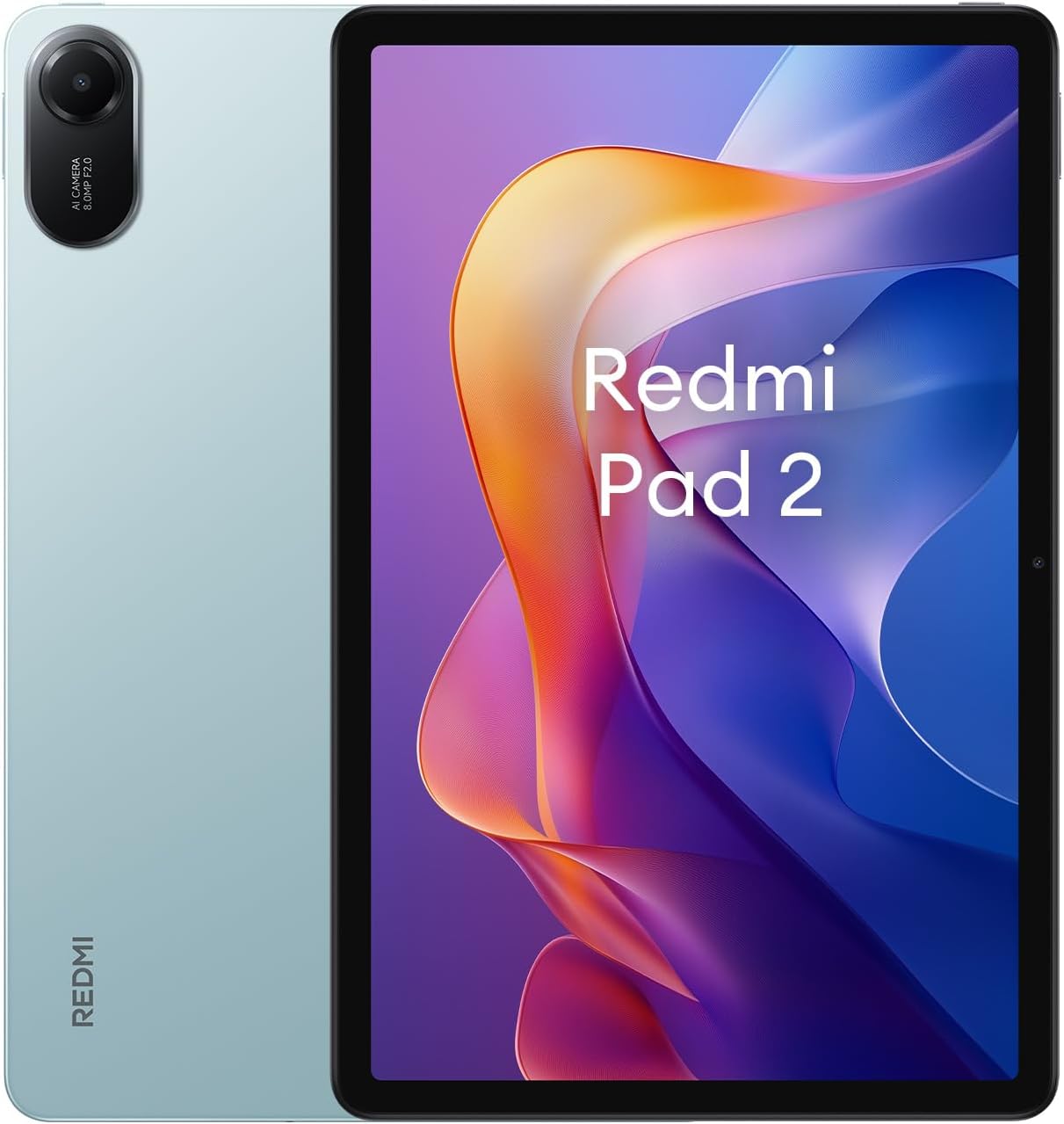
Best value — Xiaomi Redmi Pad 2. A careful continuation of the first generation: a unibody metal chassis gives it a premium feel and good durability, though it is larger and heavier than premium models. The 11-inch LCD IPS panel is well defined and runs at 90 Hz, which makes for a decent experience — the honest limit is brightness, which stays restricted. Its Helio G100 Ultra processor is optimised but shows its limits under demanding use; for browsing, streaming and social media it is entirely adequate. The UK listing confirms the same Helio G100-Ultra chip with an 11-inch 90 Hz 2.5K display and a 9,000 mAh battery.
Best overall — Apple iPad 11 (2025). The recommendation for anyone who wants the more complete tablet experience, and the one to choose if the ecosystem points that way. It is the field's core pick rather than its cheapest.
Best large screen — Honor Pad 10. The big-format option in the budget tier, from one of the new entrants that made this category competitive.
Best all-round Android — Xiaomi Pad 6. A good versatile tablet at home or travelling: a very thin aluminium chassis with slim bezels, an 11-inch LCD at 2880 x 1800, a choice of 128 or 256 GB storage and 6 or 8 GB of RAM, driven by a Snapdragon 870. The screen is balanced, if pulling slightly blue, with brightness sufficient for most uses — and it reaches 144 Hz, a strong point at this level. The chip is very efficient, notably in games, and manages the 8,840 mAh battery well enough for a good ten hours. Charging is 33 W.
Most powerful — OnePlus Pad 2. The performance choice, with a 9,510 mAh battery delivering a full day in mixed use, a premium and robust design, and a fluid 90 Hz screen. Its weak point is the selfie camera.
Best for students — Lenovo Idea Tab Plus. Clean construction with good finishing and ergonomics designed for horizontal use. The screen is the highlight: 12.1 inches in 16:10, up to 90 Hz, with measured brightness of 473 cd/m² and a Delta E of 2.95 in standard mode — genuinely accurate for the money. A MediaTek Dimensity 6400 puts performance on a par with the Redmi Pad 2, which is enough for office work, and it adds a productive PC mode. Performance is the limit, not the display.
Best cheap Samsung — Galaxy Tab S6 Lite. It imposes some compromises but delivers a high-quality cheap Android tablet: a handsome matte aluminium back, comfortable in the hand, and a size that slips into a backpack. There is no OLED, but the 10.4-inch LCD at 2000 x 1200 is well made, and the included stylus handles notes, annotation and drawing. Battery life is comfortable and Samsung's reliability is part of the appeal. The measured flaw: minimum brightness is too high, which tells in a dark room.
Best for entertainment — OnePlus Pad Go 2. More accessible than its near-namesake, with a good feel despite the large format, though it marks easily and carries no particular certification. The 12.1-inch LCD in 7:5 climbs to 120 Hz, with a measured peak brightness of 866 nits and colour temperature of 6,495 K — both coherent figures for this class. Performance is sufficient rather than remarkable, and wired charging is not especially fast.
Before you buy
Four questions. Is this a secondary device? If yes, the budget tier is exactly right; if you need it to be primary, buy up or buy a laptop. Apple or Android? Ecosystem first, then applications — iPadOS is richer, Android is available at every price. What size do your actual uses need? Eight inches for reading, 10 to 11 for general use, and at 12 ask whether a laptop is the better answer. And would refurbished serve? — prices fall fast in this category.
For premium models our best tablets guide covers the full market, and our best e-readers guide the reading-only alternative.
Research sources
Sources recorded for this page are linked below. Reported third-party testing belongs to the original publisher; it is not testing performed by Truthful Reviews.