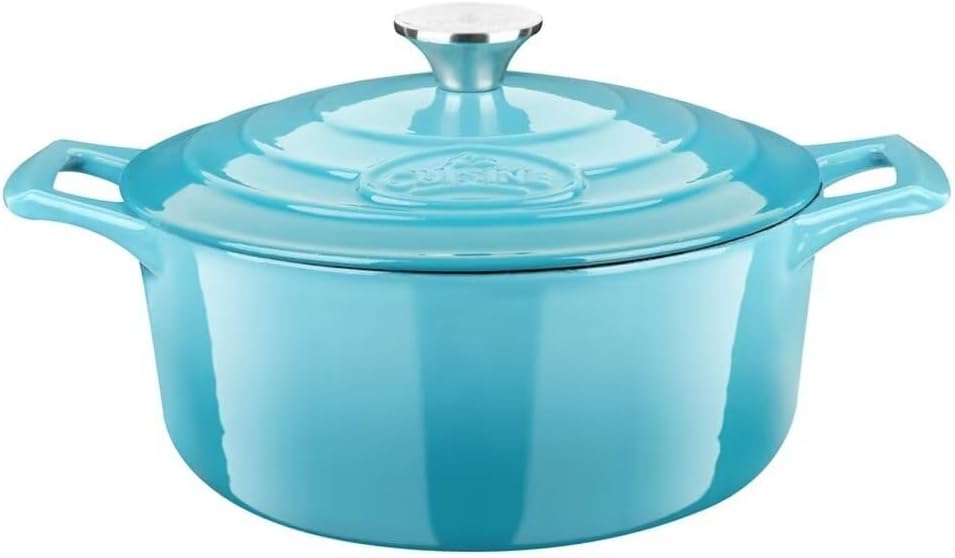
A cast iron casserole — what continental Europe calls a Dutch oven — is one of the few pieces of kitchen equipment that genuinely lasts a lifetime. Solid cast iron stores heat and spreads it evenly, so browning comes out consistent and a stew loses barely any liquid to evaporation while it braises. That evenness is also why the style has become a favourite with home bread bakers: a hot, enclosed pot produces the same all-round heat a professional oven manages. This guide covers 12 cast iron casseroles, tested coated and uncoated, from budget to premium.
What follows is recorded testing, translated. Nobody at Truthful Reviews has cooked in any of these pots.
Coated or uncoated: the decision that matters
Cast iron casseroles split into two families. Uncoated cast iron tolerates higher heat and is the more rugged of the two, which is why it suits outdoor cooking over an open flame; the classic three-legged Dutch oven belongs to this family. Each time it is used, a patina builds on the surface — a natural non-stick layer that also guards against corrosion — though the metal is more vulnerable to acidic ingredients such as tomatoes, vinegar or wine, which can strip that layer back.
Coated cast iron has a glass-powder enamel fired onto the iron. It resists corrosion, copes better with acidic ingredients, and releases cooked-on food more easily than bare iron. What it gives up is some of that ruggedness: the enamel can chip if the pot is dropped, subjected to a sharp temperature change, or scoured with something abrasive. A matte enamel finish, used on several of the models here, resists scratching and cracking a little better than a glossy one and tolerates slightly higher oven temperatures.
Either way, weight is unavoidable: an empty pot in this size class comfortably reaches five kilos or more, all of it in the base and the lid.
Choosing a size
A family of four is usually well served by a pot of five to six litres capacity and around 26 cm in diameter — the size the models in this test were compared at. Anyone who cooks for more people regularly should size up. Most of the pots here are rated for every hob type, electric, gas and induction alike, and for oven use, but the exact ceiling varies by model, so the manufacturer's stated maximum is worth checking against the specification rather than assumed.
A cast iron casserole is a different tool from a cast iron frying pan: a casserole is built for braising, stewing and oven work with the lid on, where a pan is built for shallow, uncovered frying. If a frying pan is what you are after, our cast iron frying pan guide covers that category separately.
The picks
Top pick — La Cuisine for Life 2175MB
The best cast iron casserole for most kitchens. Despite the French-sounding name, the maker is an Irish, family-run business that has sold cookware for more than twenty years, and this pot is available in four colours. Inside is a matte black enamel with no unevenness found on inspection; the matte finish is somewhat more scratch-resistant than a glossy one, and the pot is oven-safe to 380°C. The handles are shaped so a confident, secure grip is possible even when the pot is hot, and the large metal lid knob is easy to take hold of too. The lid itself is domed with a circular ridge structure on the inside, designed so condensed liquid drips back down evenly rather than pooling.
In testing, oil was heated over medium heat and beef goulash browned on all sides, releasing cleanly from the base with an even, attractive colour; diced vegetables browned equally well. With stock added, the lid went on and the pot went into a preheated oven at 150°C. Over two hours the ridge structure kept condensation dripping back in rather than escaping, so no extra liquid was needed. The finished dish came out tender but still holding together, the vegetables moist, and with plenty of sauce left in the pot.
The exterior enamel has small, uneven blemishes in a couple of places, and it is not dishwasher-safe. Against a genuinely strong all-round result, those are minor points.
Search Amazon UK · Search Amazon US
Also strong — Ottia LC
The Ottia LC replaces the Ottia ST26, discontinued and no longer available. It carries a three-layer enamel, hand-applied inside and out: white inside, with six exterior colours to choose between, and — unlike its predecessor — a domed rather than flat lid. It suits every hob type and is oven-safe to 270°C.
Testing followed the same method: oil browned the beef and vegetables evenly, with meat releasing quickly from the base. Braised with the lid on at 150°C, the ridged lid interior circulated moisture well enough that no liquid needed topping up over the two hours, and the result was tender meat in an aromatic sauce. Cleaning afterwards was quick, cooked-on residue lifting easily with warm water, washing-up liquid and a cloth. It is a genuinely convincing pot at a sensible price point — the top pick only just edges it out overall.
Search Amazon UK · Search Amazon US
Luxury pick — Le Creuset LS2501-26716SS
For anyone prepared to pay more for it, the best-known name in cast iron still earns its reputation. This pot has a white interior and a coloured exterior, available in more than twenty shades, with a flawless finish and no unevenness found anywhere on the enamel. The lid closes precisely, and both pot and lid handles allow a confident hold.
Cooking results were the strongest in the test: beef and vegetables browned evenly, and braised at 150°C with the lid on, the dish needed no extra liquid over two hours. A thermal-camera check backed up what the cooking suggested — after 20 minutes on a medium hob setting, the pot reached an even 180°C, the highest of any model tested, and on cooling it held its heat longer than every other pot in the test. The maker rates it as dishwasher-tolerant, though it was hand-washed during testing to protect the finish, and cooked-on residue lifted easily with warm water and a little washing-up liquid.
It is also, unsurprisingly, one of the most expensive pots here, and whether that outlay is worth it will come down to the individual buyer.
Search Amazon UK · Search Amazon US
Also tested
Staub La Cocotte — a matte black enamel rated for grill use, made in France rather than China like most rivals, with wide side handles and an evenly browned result, though it is among the priciest pots here. Search Amazon UK · Search Amazon US
Ikea Vardagen — a compact 20 cm, three-litre pot, simply finished in matte black, that browned food evenly but only lightly, coming out a touch drier with a thinner sauce than the leaders. Search Amazon UK · Search Amazon US
Fissler Moments Collection — a 24 cm, 4.5-litre pot in dark red enamel with wide side handles, even browning and good moisture control during braising, but a solid mid-table result rather than a class leader. Search Amazon UK · Search Amazon US
Flavemotion FM-17 — uncoated and supplied pre-seasoned, with a flat lid whose ridged underside doubles as a grilling surface; browning ran heavier and less even than on the enamelled leaders. Search Amazon UK · Search Amazon US
Kela Calido — matte black enamel inside and out and oven-safe to 300°C, let down mainly by a plain lid with no interior ridge structure to manage condensation. Search Amazon UK · Search Amazon US
Krustenzauber DEHM-300-224 — from a maker that specialises in bread-baking equipment, supplied with a proving basket and recipes, with large, secure handles but only light, even browning in testing. Search Amazon UK · Search Amazon US
Overmont OM-ECI-01BG — supplied with pot holders, a small recipe booklet and a silicone trivet, oven-safe to 260°C and suited to every hob type including induction, with even browning offset by handles on the small side. Search Amazon UK · Search Amazon US
How they were assessed
Twelve cast iron casseroles were tested, coated and uncoated, spanning budget to premium. Each was checked on unboxing for finish and any damage, then prepared as the manufacturer's own instructions specified.
For cooking, every 26 cm pot was given the same quantities of beef, vegetables and liquid for a beef goulash; smaller or larger pots had their quantities adjusted proportionally. Oil was heated over medium heat and the ingredients browned, to assess colour and heat distribution, before stock was added and each pot went into the oven at 150°C, lid on, for two hours, with liquid levels checked partway through. Grip and handle security were assessed throughout.
After braising, testers assessed how tender and juicy the meat was, how much sauce remained, and the overall flavour, along with how easily each pot cleaned up afterwards and what price and extras — proving baskets, trivets, recipe books — came with it.
A thermal camera was also used on each pot: heated for 20 minutes at a medium setting on the hob, its temperature and heat spread were recorded, then it was left for 45 minutes on the switched-off hob to measure how long it held that heat.
Common questions
Which cast iron casserole is best? The La Cuisine for Life 2175MB came out on top, with strong results on both browning and braising.
Will a cast iron casserole work on any hob? Most of the pots tested are rated for every hob type, including induction, but the maximum oven and hob temperatures vary by model, so the manufacturer's specification is the one to check.
Why does cast iron cookware cost so much? These pots are cast from solid, thick-walled iron — comfortably five to six kilos empty — and a good-quality enamel finish adds further to the manufacturing cost. That expense buys durability: a cast iron casserole is built to outlast almost anything else in the kitchen.