Playing your whole library on the sofa, the train or in bed stopped being a fantasy some time ago — the handheld console has become one of the liveliest corners of gaming. In 2026 the choice is genuinely wide, spanning Nintendo's locked-down simplicity, Valve's open SteamOS and the raw Windows power of Asus and Lenovo. Across the six machines that matter, one still sets the standard for most players: the Steam Deck OLED, which blends a lovely screen, a fair price and the most console-like software of the PC-handheld pack. Here are the picks worth buying, and how to match one to how you actually play.
The Short Version
- Best for most people — Steam Deck OLED (512GB). A gorgeous OLED screen, the friendliest PC-handheld software and the same price Valve charges direct.
- Best Nintendo handheld — Nintendo Switch 2. More power, better finish and a sharp 120 Hz Full HD screen, with a dock and controllers in the box.
- Most powerful all-rounder — Asus ROG Ally X (2024). Flagship performance and outstanding battery life for a Windows handheld.
- The big-screen option — Lenovo Legion Go. An 8.8-inch display and detachable pads for people who want to do everything, but UK stock has dried up.
- The value pick — Nintendo Switch OLED. The cheapest here, with an OLED screen and a vast eight-year catalogue.
- The cheaper Windows route — ROG Xbox Ally. Most of the Ally experience for far less than the X.
Steam Deck OLED: Still the Reference
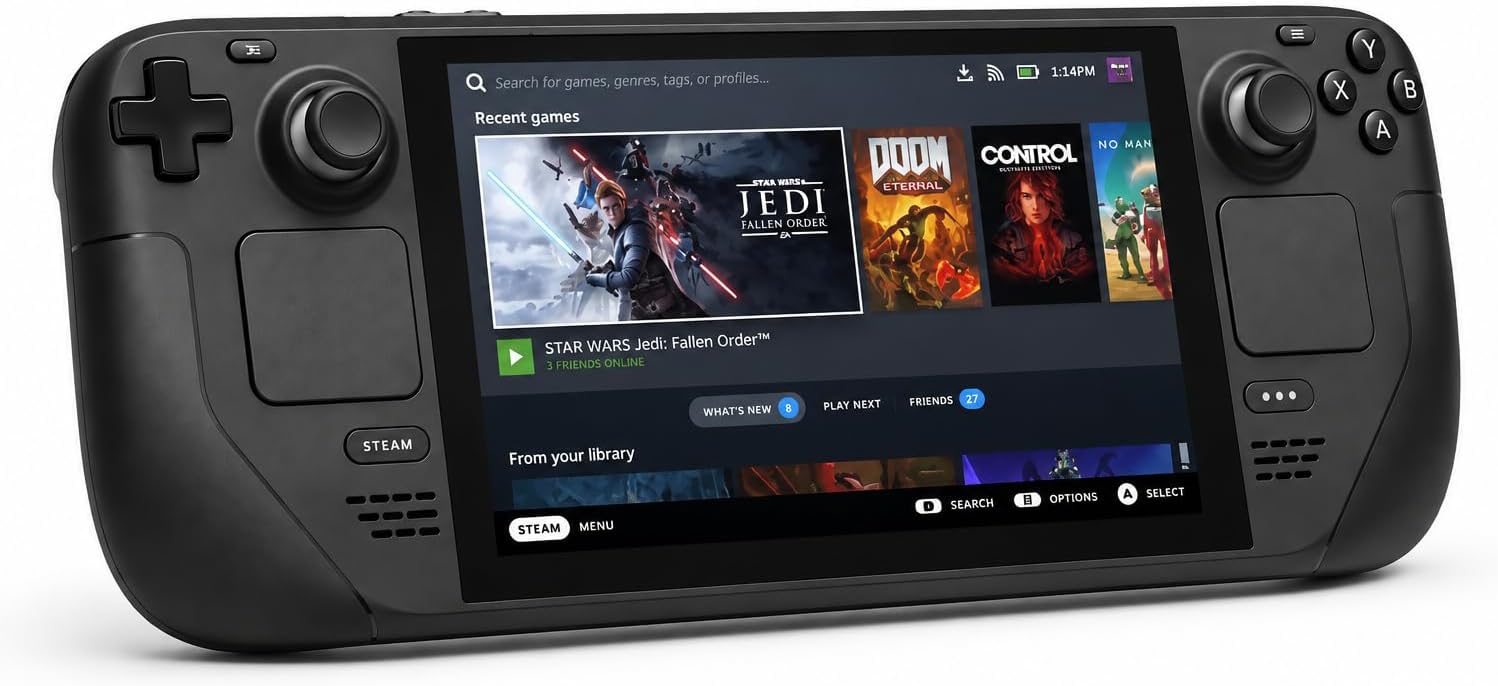
The Steam Deck OLED does exactly what was asked of it — a nicer experience that stays true to the open, versatile spirit of the original. A fine OLED screen, improved battery life and broad compatibility (including some big AAA titles) make it a formidable companion for fans of indies, retro and emulation alike. SteamOS remains the most intuitive interface here, especially against rivals that offer more power but are pricier and fiddlier to live with, and the whole thing lands at a keen price.
Not everything is perfect: battery life, though better, still melts away on the most demanding games, the design barely changes, and the fan is audible even if quieter than before. It also now sits a rung below the fastest handhelds on raw performance. Those compromises look minor against the experience on offer — the ideal version for anyone who hadn't yet taken the plunge. A wireless headset such as the Corsair HS80 rounds it out for late-night sessions. The 512GB OLED was £649.00 on Amazon UK when we checked on 2 August 2026 — exactly what Valve asks on its own store, so the Amazon listing carries no reseller premium. Check the Steam Deck OLED on Amazon UK or search on Amazon US
Nintendo Switch 2: Nintendo's Best Handheld
The Switch 2 keeps what made its predecessor a success and adds what was missing: power, better finish, a more comfortable design and welcome social features such as GameChat and GameShare. There's no OLED panel, but the LCD's Full HD resolution and 120 Hz refresh rate bring real visual comfort. Nintendo is generous with the in-box accessories too — a dock for the television and two controllers — which softens the relatively high starting price. It doesn't play in the same league as a PS5, but among handhelds the Switch 2 has nothing to be ashamed of. Owners kitting one out should see our Abxylute N6 Switch 2 controller review.
The disappointments: battery life limited to around three hours on demanding games, a slightly cold screen calibration, and audio that sits a step back. The launch catalogue is also still thin. Even so, the Switch 2 keeps that unique blend of comfort, accessibility and continuity with the original — familiar ground, modernised — and that alone earns forgiveness for its few weaknesses. The bare console was £365.99 on Amazon UK on 2 August 2026, sold by a marketplace seller rather than Amazon itself, so check the seller and the bundle contents before ordering. Check the Switch 2 on Amazon UK or search on Amazon US
Asus ROG Ally X: Powerful and Long-Lasting
With the ROG Ally X, Asus delivers one of the most powerful handhelds around, and its battery life impresses too — thank the 80 Wh cell — which is remarkable for a machine that runs AAA games on the move. Ergonomics improve with a nicer chassis, the well-calibrated LCD is very legible, and the refinements land: two USB-C ports and a thoughtful overlay menu for tweaking settings mid-game. It sits alongside the brand's other portable powerhouses, such as the Asus ROG Flow Z13 gaming tablet.
The catch is Windows, still poorly optimised for pure console use, and the absence of an OLED screen at this price. The cost is a touch high for the performance, too. Overall, though, this is arguably the best handheld for playing your entire PC library — not just Steam — anywhere, without major compromise. The 2024 model with 24GB of memory and a 1TB drive was £779.99 on Amazon UK on 2 August 2026. Check the ROG Ally X on Amazon UK or search on Amazon US
Lenovo Legion Go: Size Matters
The Legion Go plays the originality card with an XXL format and detachable controllers that strongly recall the Switch. That concept, backed by an 8.8-inch screen and full Windows compatibility, appeals to anyone who wants to do everything on one handheld. In play the performance delivers — well above a Steam Deck and on a par with the ROG Ally — and despite some flaws it is clearly fun to use.
The experience isn't without compromise: battery life suffers from the QHD+ 120 Hz screen's appetite for power, and, more frustratingly for a pricey product, the panel lacks colour accuracy. Windows again proves hard to tame in pure console use, sometimes forcing a bit of tinkering. Even so, the Legion Go is an endearing, ambitious and enjoyable machine that would have gained from being better balanced. One caveat on buying: when we checked on 2 August 2026 no Amazon UK listing for the original Ryzen Z1 Extreme model had a price, and the Legion Go 2 alongside it is a different machine, so we have not quoted a figure. Search the Legion Go on Amazon UK or search on Amazon US
Nintendo Switch OLED: Not Done Yet
Despite the Switch 2's arrival, the Switch OLED is far from shelved. First, the name: its OLED screen remains a real advantage over the newer model's LCD. Second, a gargantuan catalogue built over eight years on sale. Third, an installed base above 150 million consoles that guarantees new games for a while yet before the baton fully passes.
Naturally it suffers by comparison with its more modern sibling — most games look and run less well, and Nintendo will increasingly reserve exclusives for the new machine. But for a family looking for a very good handheld, for anyone who hasn't played all of Nintendo's exclusives and doesn't want to spend more than around £300, the Switch OLED is a fine buy — and the cheapest in this comparison. The white model was £280.00 on Amazon UK on 2 August 2026; ignore the cheaper renewed listings unless you are comfortable buying refurbished. Check the Switch OLED on Amazon UK or search on Amazon US
Xbox ROG Ally: The Cheaper Windows Route
The Xbox ROG Ally undercuts the X edition with fewer cores and therefore less power, less storage and a weaker graphics processor — but a meaningful saving. Where the Ally X is a monster, the non-X still runs just about anything that works on Windows, which leaves plenty to play.
You get the same design, the same connectivity and the same comfort, with a microSD slot to ease the slightly tight storage. Its 7-inch LCD (IPS) has decent contrast but tones that run a little cold and a white balance worth adjusting for better colour. Battery life and charging are respectable. For the money and performance, it is a well-judged mid-range handheld. The Ryzen Z2 A version with 16GB of memory and a 512GB drive was £379.99 on Amazon UK on 2 August 2026 — less than half the Ally X. Check the ROG Xbox Ally on Amazon UK or search on Amazon US
How to Choose a Handheld Console
It comes down to your profile. SteamOS, as on the Steam Deck, is built for gaming — fluid and fuss-free. Windows, on the ROG Ally and Legion Go, offers more freedom but often means navigating menus poorly suited to a console format. Nintendo's interface is ultra-simple, family-friendly and locked down, perfect for those who just want to play. Beyond that, weigh battery life, screen quality (OLED versus LCD), graphics performance and software compatibility — and don't overlook in-hand comfort and controls.
Frequently Asked Questions
Windows, SteamOS or Nintendo — which should I pick?
SteamOS is designed for gaming, with a smooth, no-frills interface. Windows gives more freedom but demands more menu-wrangling in a console format. Nintendo's platform is simple, family-oriented and locked, ideal for those who just want to play without questions.
Can I play every PC game on a handheld?
On a Windows machine, yes — you can install any PC game. On SteamOS you are officially limited to Steam, though tinkering opens plenty of doors. Nintendo's handhelds run only games from Nintendo's own ecosystem.
Which has the best battery life?
It varies enormously by game and machine. Some, such as the ROG Ally X, last more than four hours on demanding titles; others, like the Switch 2 or Steam Deck OLED, sit closer to two or three hours on heavy games.
Do I need to be technical to use these?
With a Nintendo Switch, not at all — everything is simple and immediate. SteamOS is a good balance of ease and flexibility. Windows handhelds, by contrast, ask for a little more computer know-how: drivers, updates and resolution management.
The Bottom Line
Six strong handhelds, one clear order. The Steam Deck OLED is the best for most players thanks to its screen, price and console-friendly software; the Nintendo Switch 2 is Nintendo's finest portable yet; and the Asus ROG Ally X is the powerhouse for running an entire PC library on the move. Choose for how you play — locked-down simplicity, open SteamOS or full Windows freedom — and whichever you pick, the days of leaving your games at home are firmly over.
Every pound figure above was read from the retailer's own listing on 2 August 2026 and is recorded in this page's verification evidence. Handheld pricing moves fast and several of these are sold by marketplace sellers, so confirm the live price and the seller before you buy.