Wireless noise-cancelling headphones are the most contested corner of audio, and the rankings have shifted: a new winner sits on top, one model produced a genuine endurance shock, and two familiar flagships now play supporting roles. This guide follows the current recommendations from a 57-product test field.
The Short Version
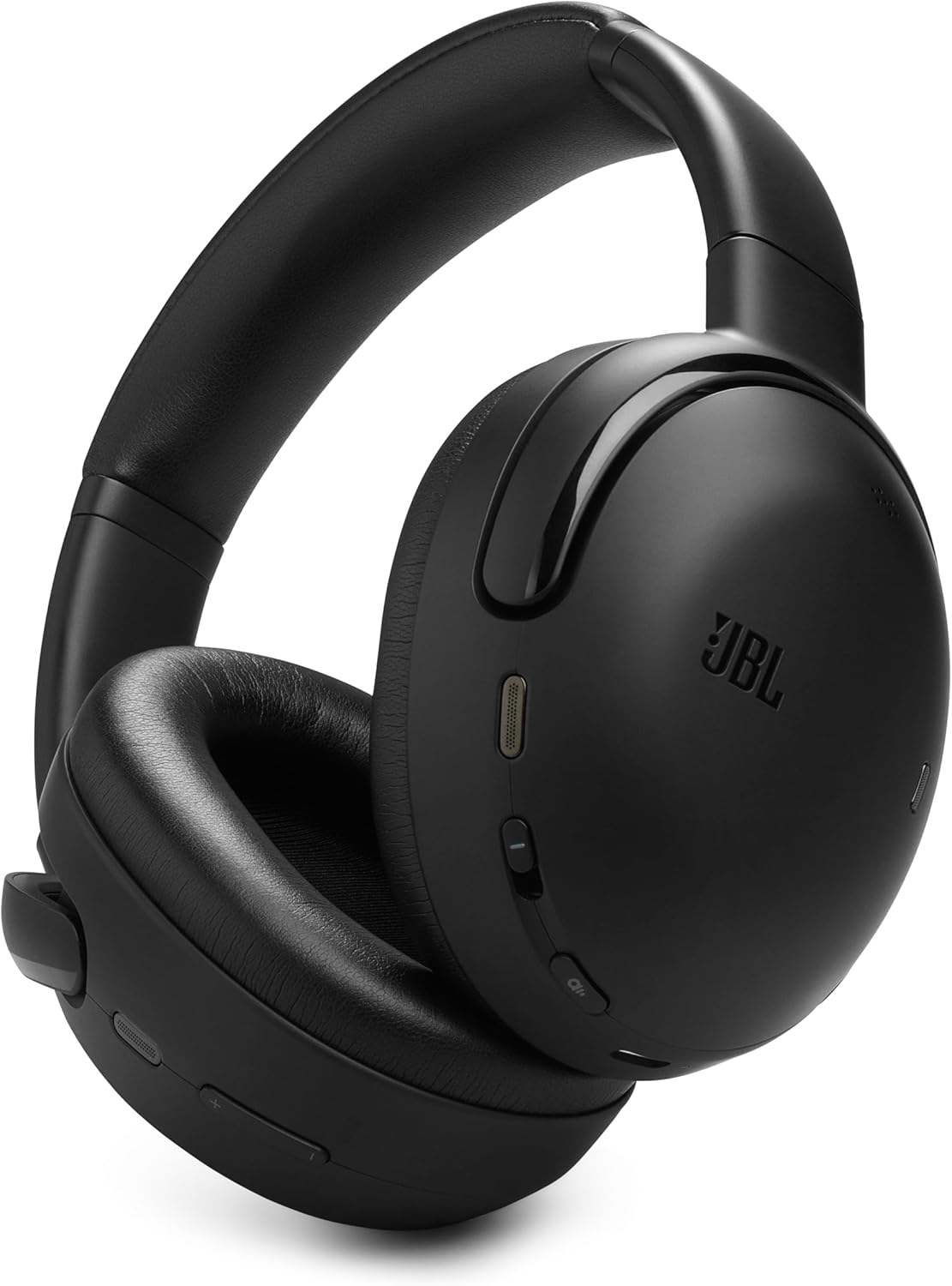
Top Pick: JBL Tour One M3
The Tour One M3 takes the overall crown on balance. Its source grade is "very good" at 1.2, with 1.1 for sound and 1.0 for equipment on the source's lower-is-better scale. The default bass tuning was pleasantly neutral on first listen, highs and mids rendered precisely across a large, open stage, and voices came through clearly. An in-app hearing test can personalise the tuning further.
Comfort held up over long sessions in the high-quality folding frame, although the padding material could feel better. The ANC filtered high-pitched noise and fan hiss particularly well; its weakness was very low frequencies such as aircraft-engine drone.
Battery life is a major strength: 48 hours 52 minutes with ANC from a 1 hour 46 minute charge, 79 hours 49 minutes without ANC, and a 15-minute top-up produced 8 hours 23 minutes with ANC or 15 hours 9 minutes without it.
Endurance Pick: EarFun Tune Pro
The Tune Pro earned a "very good" 1.5 overall. It is a folding, 287-gram over-ear design whose bass and dynamics impressed without equaliser adjustment, though the source found its naturalness and stage width narrower than the leading models.
Four ANC modes cover transparency, wind reduction, comfort and deep cancellation. The filtering was less convincing with higher-pitched tones and did not remove hiss entirely. The endurance figures distinguish it: 102 hours 6 minutes with ANC, 183 hours without, and a 15-minute top-up delivered almost 12 hours 30 minutes. USB-C audio and a 3.5 mm socket complete the package.
The ANC Specialist: Bose QuietComfort Ultra Headphones (2nd Gen)
If cancellation itself is the priority, this was the measured champion. It received the source's 1.0 ANC grade and filtered both the deep drone and high whine of an aircraft engine in the test. Sound was neutral and clean, with balanced bass, uncoloured mids and tidy highs; the relatively narrow stage was the main limitation.
The folding design comes with a hard case, Bluetooth 5.4, multipoint, USB-C and analogue playback. Build quality was good, although the source wanted less plastic and a dedicated ANC button. Battery life reached roughly 61 hours 30 minutes without ANC and about 39 hours with it. Our full Bose QuietComfort Ultra 2nd Gen review covers the model separately.
Best Sound: Bowers & Wilkins Px7 S3
The Px7 S3 received a 1.0 sound-quality grade. The test found it natural across genres, with clear voices and bass that worked particularly well when ANC was engaged. Cancellation was effective, though an occasional high-frequency whistle remained audible.
Materials and comfort impressed, with some warmth from the ear pads. It does not fold, and the hard case requires the headband adjustment to be undone. Battery life was about 28 hours without ANC and 27 hours 30 minutes with it. A 3.5 mm cable allows wired listening.
The Long-Runner: Sony WH-1000XM6
Sony's flagship combines a wider headband, low weight and folding hinges with an exceptional battery result: more than 58 hours with or without ANC. Sound was convincing across genres, with precise bass and a ten-band equaliser for detailed adjustment. The source wanted a little more spatial openness.
The honest weakness was ANC against loud, deep sounds such as jet-engine hum. Controls divide sensibly between a touch surface and separate physical buttons. Read our dedicated Sony WH-1000XM6 review for more detail.
Also Excellent: Sennheiser Momentum 4 Wireless
The Momentum 4 remains a strong all-round recommendation, with clear sound, effective ANC, comfortable wear, wired playback when flat, wear detection and multipoint. It ran for 53 hours 8 minutes with ANC after a 1 hour 58 minute charge; a 15-minute charge produced another 10 hours 11 minutes. The cups swivel but do not fold, and the mostly plastic design looks ordinary beside more luxurious rivals. Our full Sennheiser Momentum 4 review covers it in depth.
What ANC Does — and Its Limits
ANC headphones use microphones to sample ambient noise and generate an opposing signal. Deep, steady noise is generally easier to reduce; middle and high frequencies can survive as a quieter murmur even on strong models. Two findings stand out from this field: effective cancellation is no longer confined to the flagship tier, but getting excellent sound and cancellation in the same pair remains harder.
How to Choose
Decide first whether you need active cancellation or only passive isolation, then whether you prefer over-ear, on-ear or in-ear construction. Over-ear models dominate this guide because they combine large drivers, substantial batteries and a broad contact area around the ear. For calls or announcements on trains and planes, compare transparency modes as carefully as ANC; brands label the same broad idea talk-through, ambient sound or open-mic.
More Headphone Guides
Our on-ear guide covers more compact designs, gaming headsets have their own 140-model field, and our sleep-headphones guide deals with overnight comfort.
Frequently Asked Questions
What are the best wireless headphones in this test field?
The JBL Tour One M3 leads overall, the Bose QuietComfort Ultra Headphones (2nd Gen) leads for measured cancellation, the Bowers & Wilkins Px7 S3 for sound, and the Sony WH-1000XM6 for battery life. The EarFun Tune Pro stands out for endurance.
Does one brand dominate every category?
No. JBL leads this overall ranking, Bose leads cancellation, Bowers & Wilkins leads sound, and Sony and Sennheiser occupy different all-rounder roles.
Do good noise-cancelling headphones have to be flagships?
No. One of the field's clearest findings is that effective ANC now appears below the flagship tier. The expensive part is achieving excellent sound quality and cancellation together.
Research sources
Sources recorded for this page are linked below. Reported third-party testing belongs to the original publisher; it is not testing performed by Truthful Reviews.