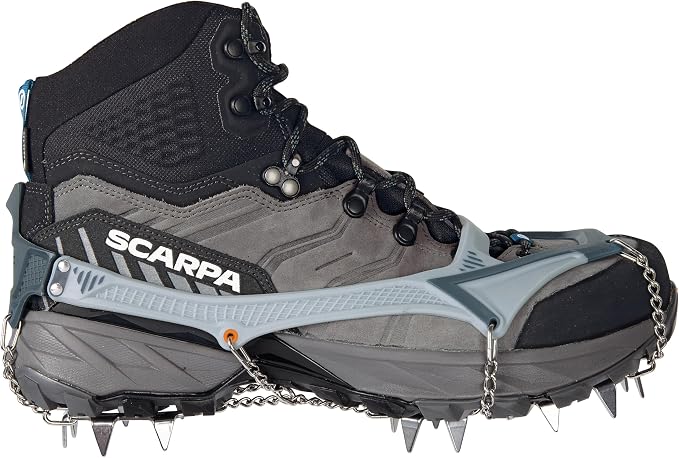
Ice grips are the small elastic harnesses of spikes you pull over an ordinary boot or trail shoe when the path turns hard and glazed. They pack down to nothing, they weigh very little, and they are the difference between picking your way along a frozen track and simply walking it. This guide covers 23 pairs, tested on winter walking boots and on trail-running shoes, and it explains the two quite different designs that get sold under the same name.
What follows is recorded testing, translated. Nobody at Truthful Reviews has walked in any of these. This page makes no safety claim: it describes spike counts, spike lengths, materials, harness construction, fit, weight and how the grips behaved on the surfaces recorded during testing, and nothing more.
One finding shapes everything below. All 23 pairs were of above-average quality and not one of them was a genuine disappointment. They sat very close together on the basics, so nuances decided the ranking rather than gaps in competence.
Traditional grips or spikes
Traditional ice grips are a heavily simplified crampon. In their classic form they carry four to six long points and lash to almost any shoe with a strap system, so no crampon-compatible boot is needed. They do not sit as compactly as a real crampon and they cover only the rear half of the foot, so there are no front points. Because the points are longer, they dig deeper into the ground and hold better in soft going. In exchange, they walk awkwardly and inefficiently, and the points wear quickly the moment you come off snow onto rock and stone. Look at what is actually on sale now and this classic form has gone comprehensively out of fashion — only two pairs in the test field still follow it.
Spikes are the form that has taken over, and in everyday use the two names are used interchangeably. A spike harness pulls on over a ring of elastic silicone or TPE. Roughly 10 to 20 small points, between 8 and 16 millimetres long, cover the whole foot, set under the heel and under the forefoot, and they bite on glazed ice and other smooth surfaces. They are pleasantly light and pack small, which is why they end up in the rucksack as a matter of course on any winter outing. The one thing to watch when buying is size: spikes are always sold to a range of shoe sizes, where traditional grips are usually one-size-fits-all.
For completeness, a full crampon is a different tool again — typically 10 to 12 points including two front points, in a rigid frame or in two halves joined by a connecting bar, covering the whole foot and clamped to a crampon-compatible boot with a heel lever for steep ice, hard firn, glaciers and frozen waterfalls. Neither the traditional grips nor the spikes here have front points or that kind of frame, so their working range is winter walking and trail running rather than steep alpine ground.
How they were assessed
Every pair was tested on real winter ground once the snow reached the mountains. Before that came a bench appraisal: how good the construction looks, how well thought through the whole system is, and a re-measurement of the manufacturer's stated point length and a re-weighing of the stated weight in the test size.
In use, each model was tested with one pair of winter walking boots and one pair of trail-running shoes, so that each could be placed as a walking grip, a running grip or both. Hold on snow and ice was the primary criterion. Alongside it: how easily each pair can be pulled on with cold hands and gloves, and how stably they sit while walking and running — compact on the shoe, no slipping, but no pressure points or rubbing either. Longevity is hard to judge inside a test period, so it was estimated from the components and from a tearing and bending test that loaded the chains and eyelets hard. Weight and packed size were assessed too, along with how easily each pair goes back into its bag and how well that bag holds or sheds moisture. Weight counts twice over: dead weight in the rucksack, and weight on the foot, where every extra gram is felt at each step and costs comfort and stamina.
The picks
Top pick — Camp Ice Master Pro
As ice grips go, these come close to perfection. Great hold, an excellent seat on the foot, strong construction and a quick pull-on: top marks across the criteria that matter most.
The distinguishing feature is the use of two different plastics in the ring. The firmer material at the front and back gives the harness a much more strongly defined shape, so out on the hill, with gloves on or cold hands, they slip quickly over any kind of shoe. That shape also holds the chains — and with them the spikes — perfectly in position. Nothing presses, nothing shifts, and they still sit pleasantly compact on a boot. Where other grips tend to creep at the toe, everything here stays exactly where it was put.
Sixteen points of fifteen millimetres gave plenty of grip on the test route. The spikes sit exactly where they are wanted, no snow packs between them, and it is easy to get weight onto them. The long points mean they still bite in deeper snowfields. Construction is at an excellent level throughout. The chain links look relatively fine and delicate, but they shrugged off the stress tests, so there is no concern there.
Given all that, the surprise is the weight. These are not among the outright featherweights, but among the robust models with long points they sit at the light end, and the packed size is correspondingly small. They travel in a soft case with drainage holes. Unpacking never once produced twisted chain links, and between the moulded shape and the small tab at the heel they go on quickly.
Everything is right here. Anyone spending a little more than the cheap pairs that circulate on the mail-order sites will not regret it — these convinced from the start and impressed more with every step.
Search Amazon UK · Search Amazon US
The all-round alternative — Nortec Nordic
Strong all-rounders with plenty of qualities, and they carried the top spot for a long time before being displaced. Walkers questioned during testing always named the same two priorities: quick to put on, and a good seat over the shoe. Those are exactly this model's greatest strengths.
The highly elastic silicone ring lets them be pulled over a shoe simply and without force. It did not go stiff below freezing, staying supple, so they could be fitted with gloves or with freezing fingers without so much as sitting down in the snow. The ring spreads pressure very evenly around the foot, so no pressure points appeared anywhere. The fit over walking boots and trail-running shoes was equally good, which is where the all-round claim is earned, and they feel agile with it.
Nortec gives each grip 21 points of 8 millimetres. The high count spreads grip evenly, and the forefoot points are angled so that snow does not collect there. In deeper ground the points could stand to be a little longer, though that would cost some of the agility. In calf-deep snow, on slush with ice plates hidden underneath, and in mud, the comparatively short points did a decent job without being outstanding.
Construction is a positive throughout. Chain links and points are stainless steel, the links mesh well and do not jam, so there is no tedious untangling when they come out of the bag. How the chains attach to the silicone ring is more than solid — the system is even patent-pending. There is a top-quality bag as well: an elaborate soft case with a separate sleeve for each grip so they stay apart and need no untangling before use, good padding, an outside carabiner so it can hang within reach on a rucksack, and a small repair kit for replacing a chain link. No other maker supplied anything like it.
Search Amazon UK · Search Amazon US
Very nearly the winner — Kahtoola Microspikes
These were a hair from the top spot and belong among the best models in the test. Handling is exactly what you would wish for: however untidily they have been shoved into the bag, they come out ready to pull straight on with no snagged chains. The very elastic TPE makes that quick even with gloves on.
On the foot they impress with a strong fit. They sit well straight away, there are no pressure points and nothing shifts while walking, and the seat was equally good on mountain boots and on light walking shoes — the TPE reaches a long way over the forefoot, which is a large part of why. Their 10 mm spikes give consistently good hold, including crossing a deeper snowfield. Construction generally is excellent: eyelets, spikes, chains and upper material all feel high quality. They also stay light for how robust they are.
The company counts in their favour too: it donates 1% of annual turnover to environmental and social causes, and is a member of 1% for the Planet, the European Outdoor Conservation Association and The Conservation Alliance.
In the end it was only the distinctly higher price that cost them the win. Anyone untroubled by that, or who finds them discounted, should not hesitate.
Search Amazon UK · Search Amazon US
The workhorse — Snowline Chainsen Pro
Set against the sportier Nortec Nordic, these are more the workhorse. The elastomer ring is tougher, but still pulls over boots or shoes without too much effort. They are built for forestry workers as well, so they are set up for demanding continuous use.
The 10 millimetre points still gave really good hold in deeper going on icy walks — nothing left wanting there. Snowline fits only eleven points per grip, but they are well distributed and bite properly. Points and chains are hardened stainless steel, robust and not prone to jamming, and reinforced eyelets on the rubber ring add to the durability.
On walking boots they sat very well and very stably. On trail-running shoes the seat was good but not quite optimal: the harder rubber and the way it runs produced a slight but bearable pressure point on the midfoot, and there was a little play against the inside of the shoe. That is a placement point rather than a criticism of the grips — for runners, or anyone wanting something lighter, Snowline also makes the Chainsen Light, which could equally have taken this slot had the test not been weighted towards walking.
Search Amazon UK · Search Amazon US
For trail running — Kahtoola Microspikes Ghost
The very high price made these a difficult call for the recommendations, but the highly individual concept paired with high quality settled it, helped by an extremely low weight and small packed size. Runners who regularly do their laps in snow and ice should look at them closely.
Where other makers use chains, Kahtoola works entirely in different plastics to get the spikes under the foot. What sounds more fragile turns out in practice to be possibly the more durable option, and certainly no worse than chain. The plastic principle is not new, but such grips have tended to be bulky when packed; not here. On one run without a rucksack they simply went in a jacket pocket. At around 200 grams they are absurdly light, which means noticeably less effort while running, since weight on the feet counts double.
The plastic construction has a second advantage: they keep their shape. There are no chains to twist and tangle. Pull them out, see immediately which end is which, slip them on and go. On the foot they sit very stably, and again the moulded shape is what does it — compact enough that they do not shift at speed.
The points are relatively short at nine millimetres, but still within reason. For agility and for running on glazed ice that is an advantage, and they still hold up solidly in snowfields and deep slush, though in deep snow the hold is what is missing. On firm winter boots they did not feel optimal; these belong on light walking shoes and trail shoes.
Search Amazon UK · Search Amazon US
Also tested
Kahtoola Exospikes — very well liked for trail running, and probably the best pair here for running directly on glazed ice. The very short carbide points keep you agile and are extremely hard-wearing. They are not the tool for crossing snowfields on a winter walk, and despite the light weight the packed size is relatively large. Search Amazon UK · Search Amazon US
Snowline Hexa — follows the same principle as the Exospikes and shares the same advantages and disadvantages, with nothing to choose between the two on construction either. If the well-seated everyday or winter-running spike is what you want, take whichever of the pair is cheaper at the time. Search Amazon UK · Search Amazon US
Camp Ice Master Run — extremely light, good packed size and fairly short spikes, which makes them ideal for winter running while still doing a respectable job on a walk. Quick to pull over the shoe and supplied with a quality soft case. The seat was not quite optimal, though: they slipped out of position now and then, which was not dramatic but cost marks for comfort. Search Amazon UK · Search Amazon US
Nortec Alp 2.0 — real workhorses, very robustly made. Long spikes mounted on open plates at forefoot and heel dig deep into snow and gave firm hold. Snow collected under those plates more often than on the simpler chain models. A hook-and-loop strap makes them sit more stably still. The catch is a very high weight, which makes itself felt out on the hill. Search Amazon UK · Search Amazon US
Stubai Mount Track — everything said about the Alp 2.0 applies here too. Directly compared they are somewhat lighter, with slightly shorter points. They pull on a little more easily and sit well thanks to their hook-and-loop bridge. Thoroughly sound spikes for winter boots that do nothing wrong and nothing special. Search Amazon UK · Search Amazon US
Edelrid 6 Point Grödel — the best of the classic four-to-six-point designs, and specialists rather than all-rounders. If you want the strongest hold in deeper going on a winter walk, this is where to find it, technically and materially well executed. Anyone who finds the short points of spike harnesses insufficient gets what they are looking for here, at the highest level. Search Amazon UK · Search Amazon US
Grivel Explorer — these would nearly have made the top recommendations had the rigid rubber ring not made them so extremely stiff to pull on. The comparatively long, sharp stainless-steel points, mounted on plates, are otherwise a neat halfway house between traditional grips and spikes. Search Amazon UK · Search Amazon US
Snowline Chainsen Light — the lighter sibling of the Chainsen Pro. Because the testing weighted walking above trail running, the Pro took the recommendation instead, but anyone wanting something lighter can buy these without worry and will not be disappointed. Search Amazon UK · Search Amazon US
Alpen Bears — quick to pull on, decent hold on snow and ice, and a good soft transport case. The quick fitting comes at the cost of the rubber used: it is very soft, so combined with the rather poor hook-and-loop fastening on the connecting bridge they do not sit as stably. The chain links are also more inclined to bend when stressed. Search Amazon UK · Search Amazon US
Climbing Technology Ice Traction Plus — the maker sent the wrong size, so a friend wore them on the walk. Build quality is at a good level and thirteen long points plus two short ones give good hold. The firm rubber makes them somewhat stiff to pull on, but they then hold stably and sit compactly. They are among the heavier models here, which reduces walking comfort — other grips with equally good construction manage to stay considerably lighter. Search Amazon UK · Search Amazon US
Sportneer — not bad for the money, though better grips do not cost a great deal more. They pull on quickly thanks to the strongly elastic rubber, but hold suffers for the same reason: they sit solidly rather than as compactly as one would like. The hook-and-loop fastening on the connecting bridge that is supposed to improve hold is of simple quality, and the chain links are not from the top drawer of materials either. The points are well positioned and, thanks to their length, give a stable footing. Search Amazon UK · Search Amazon US
Salewa MTN Spikes — also a pleasure to use. The very open rubber ring makes them quick to pull on, while a hook-and-loop bridge over the midfoot still gives a stable seat. Many 10 millimetre points and a few of 14 millimetres give good hold on snow and ice, evenly distributed under the foot. They are comparatively heavy, and how well that fastening holds up over time remains to be seen. Search Amazon UK · Search Amazon US
Salewa Pedroc Mountain Spikes — the combination of light weight, good construction and surprisingly stable hold across a wide range of surfaces was the appeal here. Nine points of twelve millimetres bite well without losing agility, and they go on easily. The chains do like to twist a little in the soft transport case if they are not packed carefully. Search Amazon UK · Search Amazon US
The short answers
Which ice grips are best? The Camp Ice Master Pro. They offer excellent hold, sit very stably on the foot and go on quickly out on the hill, with top-quality construction at a light weight. There are other thoroughly recommendable models in the test, though.
Traditional grips or spikes? Most people will be happier with spikes. They are lighter, easier to pull on and more versatile, while still offering enough hold on most surfaces.
How long should the points be? If you move quickly and sportily, choose shorter points of around 8 millimetres. If hold while walking matters more than agility, choose points of at least 10 millimetres.
How do you clean them? Take them out of the bag after the walk and clean the dirt off with warm water and, if needed, soap. Lay them out to dry and only pack them away once dry.