A knife block that advertises sharpening usually does not sharpen. Understanding that one distinction saves both disappointment and a ruined edge, and it is the thing buyers most often get wrong.
Across a field of 35 knife blocks, exactly one turned out to sharpen in the literal sense.
"Self-sharpening" means two very different things
Honing is what most blocks with a built-in sharpener actually do. A ceramic stone or ceramic rods realign the edge, exactly as a honing steel does, taking a blade from blunt-feeling back to sharp. Crucially they remove no material: there is no swarf, no grinding, and a blade that is chipped or damaged cannot be repaired this way.
Grinding is the real thing, and in this field only the Zwilling block does it. Ceramic is worked into the inside of the slots, so the blade is ground every time the knife is used — pulled out and pushed back. The practical result is permanently sharp knives with no technique required of you at all.
The consequence is worth stating plainly: if you already own a honing steel and know how to use it, a block with a built-in honing stone adds very little. It is a convenience for people who do not own one, or who would rather not work freehand against a steel.
How to sharpen a knife with a block
On the Ninja the procedure is fixed and mechanical. The knife goes into the slot until almost half of the handle has disappeared, at which point the block clamps it automatically. You then draw the small slider fully from front to back ten times, and a mechanism rolls the stone along the edge under pressure.
It does not work equally well on everything in the set. On the two long knives it works very well. On the two short knives and the take-apart scissors the stone only travels half the blade unless you press the knife down as you go. The bread knife is not intended for it at all — serrations are not honed this way.
How to clean a knife block
The single feature that decides whether a block can be cleaned is whether the slots run all the way through to the base. Where they do, crumbs and dust fall out rather than collecting, and a brush can reach the full depth.
The method that works: run a dry bottle brush through each slot first to clear debris, follow with a soapy bottle brush to scrub the interior, rinse clear, then leave it to dry thoroughly — and give it longer than you think it needs, because trapped moisture in a wooden block is the actual problem.
One disagreement worth knowing about: Zwilling states that cleaning its block is unnecessary, since dirt falls through the slots to openings in the base. Testing did not accept that. A narrow, flat bottle brush cleans the interior easily, and doing it regularly is what makes a block last.
The picks
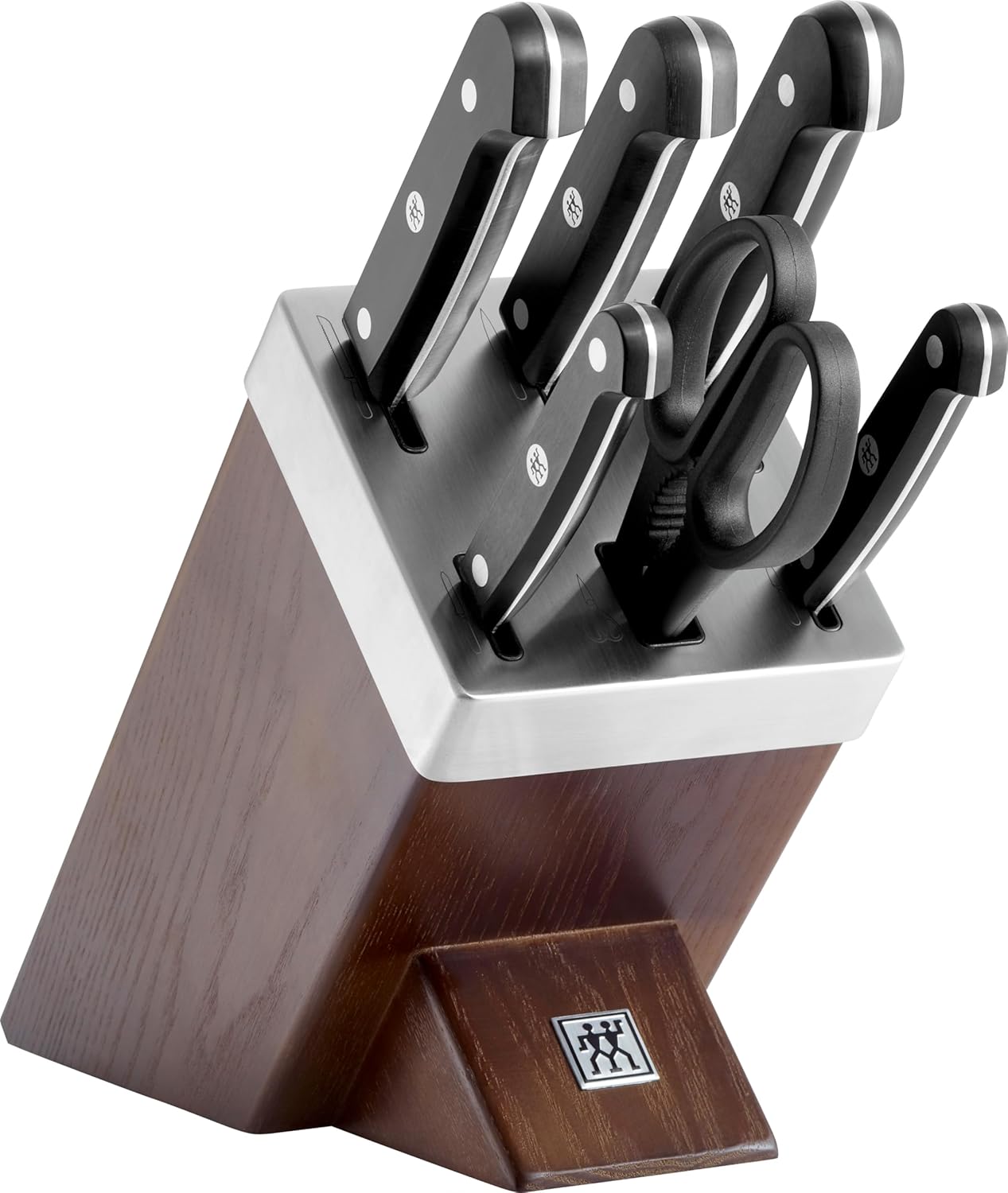
Best overall you can buy here — Zwilling Gourmet self-sharpening block, 7-piece. The luxury option in the test and the only one with a genuine self-sharpening function. The material is finest ash, very firm, very stable and seamlessly finished, with the slots cleanly let into a stainless steel front. Each slot carries a symbol showing which knife belongs in it — far more useful than it sounds, because the handles in most sets are near-identical. The blades use Zwilling's Friodur process, a patented method of hardening stainless steel by cold; they do not rattle and the finish is seamless. Contents are a garnishing knife (10 cm), a utility knife (13 cm), a meat knife (16 cm), a chef's knife (20 cm), a bread knife (20 cm) and household scissors (20 cm). In use the blades are exceptionally sharp through peppers, leeks and carrots, and the bread knife goes through crusty bread without wandering. The honest niggle: pushing a knife back in meets slight resistance and a faint gritty crunch, like sand in a mechanism — that noise is the grinding effect, and you stop noticing it. Anti-slip nubs hold it firmly. It is the most expensive block in the test, and the wood is finished to look untreated, so it suits most kitchens; greyer, white and black variants exist.
Best for honing without a steel — Ninja Foodi StaySharp. A large plastic block lifted by an aluminium finish across the front, standing on flat rubber feet with a wide base — non-slip and impossible to tip. Look and feel cannot match wood, and the block is the weakest part of the package. The knives are the reason to buy it: forged X50CrMoV15 German stainless with good corrosion and wear resistance, carefully made and notably heavy — the chef's knife weighs 248 g, which would place it among the heaviest kitchen knives tested anywhere. A full tang finished in metal balances the chef's and meat knives so blade and handle weigh evenly; on the paring, office and bread knives the handle outweighs the blade. Edge retention is modest at HRC 56, but that is typical of kitchen knives that are easy to resharpen, and the spine is thin at a maximum of 2.5 mm, so hard root vegetables cut cleanly. Tips on the meat and chef's knives are flexible enough for quick fine work. In short: buy it for the knives, and treat the honing function as the bonus it is. The UK sells this as the K32006UK, the counterpart of the K32006EU tested.
Best budget — Amazon Basics knife block set. You can see at a glance that neither the wood nor the blades keep pace with the dearer models, but everything is cleanly finished, and nothing splinters or feels rough. The block is light-coloured wood of a species the maker does not specify, and it looks equally at home in a country or a minimalist kitchen. The set covers a chef's knife (20.3 cm), a santoku (20.3 cm), a carving knife (17.8 cm), a bread knife (20.3 cm), a boning knife (15.2 cm), a utility knife (12.7 cm), a paring knife (8.9 cm) and a 20.3 cm sharpener. Blades are stainless, sharp and properly made — adequate for everyday home cooking, not for a professional. Two genuine irritations: the slots are very narrow, so steering a blade back in takes a moment's concentration, and every handle looks the same, which makes grabbing the right knife mid-cook a lottery.
Also tested — D.Perlla SDWD-S292. A compact, heavy wooden block holding five knives and a pair of scissors, with a matt, easy-care surface. It does not wobble, thanks to plastic feet and sheer mass: 2.26 kg with the knives in, 1.36 kg without. The knives are very good for the price and even carry a decorative etch, with a pronounced finger groove that makes the handle genuinely comfortable; the chef's knife is comparatively heavy at 244 g without being unusual. The steel is X50Cr15 at 55 HRC, give or take two points, which means low edge retention — but that soft steel sharpens easily on a stone or a machine. The chef's knife spine is 2.5 mm and barely flexes; the meat knife at 2 mm genuinely does. Its built-in ceramic rods hone rather than repair. The slot runs through the whole block, so damp knives can drain. UK note: D.Perlla sells a similar seven-piece self-sharpening wooden block here, but the UK listings do not display the tested model code, so treat it as the same family rather than the identical unit.
The test winner, and a UK caveat
The overall winner was the WMF seven-piece block, and it earned it on material quality and value: a slim but heavy rubberwood block with vertical slots that stays upright if you knock into it mid-cook, cleanly milled slots, rubber feet, and a classic design. It arrives with six knives — a chef's knife, a bread knife, a preparation knife (17 cm), a paring knife (6 cm), a larding knife (10 cm) and a vegetable knife (8 cm) — all seamlessly riveted stainless steel with solid plastic handles. Testing rated the blades excellent through vegetables and bread, with the bread knife cutting crusty loaves thinly and squarely, and praised the deliberate restraint of six essential knives rather than a crowded set. Its one real limitation is modest edge retention: ample for normal daily use, unlikely to satisfy a professional or a demanding cook. The slots run to the base, so it cleans easily.
The caveat is availability rather than quality. This is a German-market set, and the UK listings we could verify cover WMF's empty blocks rather than the seven-piece block with knives. If you want a stocked block from a UK retailer today, the three picks above are the ones to look at.
Before you buy
Four questions. Does it sharpen or hone? Only a block with ceramic in the slots grinds; a built-in stone realigns an edge and cannot rescue a chipped one. Can you clean it? Slots that run through to the base let crumbs fall out and let a bottle brush in. Will you find the right knife? Identical handles are a daily annoyance that a symbol on each slot solves. And how hard are the blades? — around 55 to 56 HRC is normal here, meaning modest edge retention in exchange for easy resharpening.
Our best air fryers and best blenders guides cover the rest of the worktop.