There is one number that separates good milk foam from ruined milk, and almost nobody buying a frother knows it.
Across a field of 37 milk frothers, here is how to get it right, and which machines make it easy.
The temperature rule
Milk foam should ideally sit at about 64 to 65 °C. That is the optimum, and every recommended machine here delivers it.
The number that matters more is the ceiling. From 70 °C the milk begins to denature — the proteins change, and with them the taste and the texture of the foam. This is why a frother that simply heats as hard as it can is not the better machine, and why the ones worth buying stop where they should. Some offer an adjustable range, typically 45 to 65 °C, which is genuinely useful if you drink your coffee cooler than average.
So when you read that a machine produces foam at around 63 °C, that is not a failing — it is drinkable and close to target. A machine that sails past 70 °C is the one to avoid.
For reference, the standard used across this testing is ordinary whole milk at 3.5 % fat, so that is the basis on which the foam results below were judged.
How to use a milk frother, and how they differ
Automatic frothers do the work for you: milk goes in, the machine heats and whisks, and you get foam. The whisking almost always happens from the bottom of the jug. The winner here is unusual in doing it from the top, with the whisk fixed to the lid.
Manual frothers need no power at all. You pump a plunger by hand, and with practice you can produce foam of a genuinely high standard — but the practice is real, and the first few attempts will not be your best.
Two practical points that decide day-to-day satisfaction. Capacity per pass is the one people underestimate: a compact automatic frother suits one person or small quantities, and running it twice for two drinks is a nuisance. And cleaning matters more than the marketing admits — some jugs must not go in the dishwasher at all, and milk can settle at the bottom of the container during frothing, which is easy to rinse away if you do it promptly and irritating if you do not.
One modern note: plant milks work. Soy and the rest can be frothed in the machines here, including the test winner — worth knowing given how many households have moved away from dairy.
The picks
Best overall — Philips Senseo Milk Twister CA6500/60. The best value in the test: a compact automatic model in a cylindrical black plastic body, with an elegant look that other makers have visibly imitated. The induction unit and milk container sit together inside the housing as usual for compact machines, but the whisk is fixed to the lid so the frothing happens from above rather than below. Foam quality is where it wins outright — few products anywhere near its position in the market match it. Two honest limits: the cup must not go in the dishwasher, and the foam spiral feels a little flimsy. The bigger constraint is capacity: it will not froth more than 120 ml of milk in one pass, which makes it a machine for one person or small servings. UK availability caveat: the listing we could verify on Amazon UK is the CA6500/63 variant with a non-English product listing rather than a UK-market listing of the tested CA6500/60, so treat it as a reference point and check what you are actually buying.
Best electric you can buy here — Severin SM 3584. Compact, modern stainless steel, very well made, and — a small thing that matters in use — it has a handle. In just under two minutes it produces around 112 ml of foam, which is a cappuccino's worth, and the result is excellent both cold and warm, with the foam pouring freely. It reaches about 65 °C, so it lands exactly on the optimum. Two caveats: milk can settle a little at the bottom of the container while frothing, though cleaning is easy; and at 57.9 dB it is slightly louder than the winner. Neither stops it being thoroughly recommendable, and it is listed on Amazon UK under its exact model code.
Biggest capacity — Severin SM 3587 Spuma 700 Plus. The induction model for households rather than individuals, with a 700 ml fill volume — comfortably the answer if you are making several drinks at once rather than one. It replaced the earlier SM 3585 in the recommendations. UK-listed under its exact model code.
Also tested — WMF Stelio. Worth knowing if quietness is your priority: it produces first-class foam and at 51.9 dB you can barely hear it working, which is markedly quieter than anything else here. It did not earn a recommendation, though, for two reasons — the outside of the unit becomes very hot in use, and the thin milk container did not feel stable, picking up a small edge after a short drop during testing.
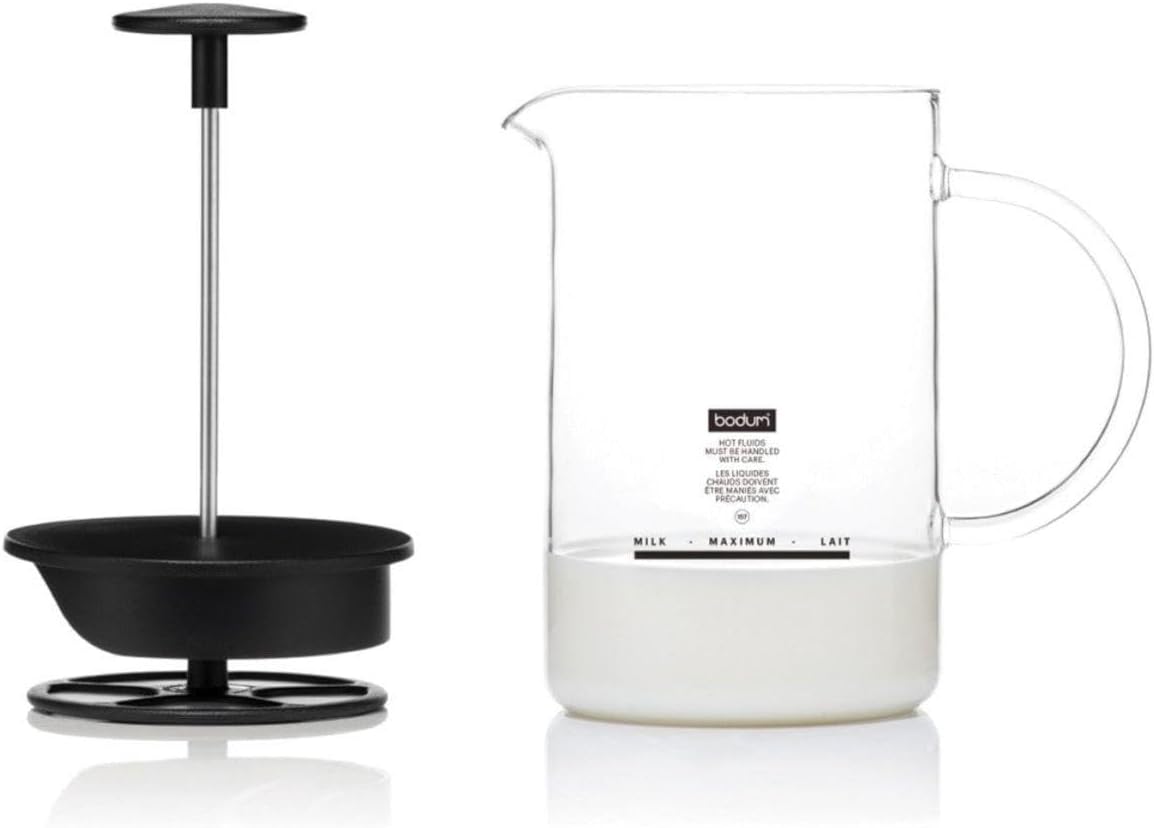
Best without a socket — Bodum Latteo. Foam with no electricity at all: an inexpensive manual frother with a plunger that works entirely by hand. You do need to get the knack, and your first attempts will not be barista standard — but it is worth the practice, and there is no machine to clean, store or plug in. UK-listed.
Before you buy
Four questions. How much foam, how often? The winner caps at 120 ml per pass; the Spuma 700 Plus holds 700 ml. Hot or adjustable? Around 65 °C is the target, and an adjustable 45 to 65 °C range helps if you drink cooler. Will it live on the worktop? Noise and size matter more than spec sheets suggest — there is a measurable difference between the quiet machines and the merely acceptable ones. And do you want a machine at all? — the manual option needs no power and rewards practice.
Our best coffee machines and best bean-to-cup coffee machines guides cover what goes under the foam.
Search current listings
Milk frothers on Amazon UK | Amazon.com. Best electric: Severin SM 3584 on Amazon UK | Amazon.com. Biggest capacity: Severin Spuma 700 Plus on Amazon UK | Amazon.com. Manual: Bodum Latteo on Amazon UK | Amazon.com.
Research sources
Sources recorded for this page are linked below. Reported third-party testing belongs to the original publisher; it is not testing performed by Truthful Reviews.