The promise of a multicooker is that it replaces several appliances. The reality is more interesting than that, and one thing the marketing never tells you is that pressure cooking is not always faster.
From a field of 30 multicookers, here is what actually separates them.
Pressure cooking and slow cooking are opposites
Almost every multicooker does both, plus a keep-warm function, and they are two completely contrary approaches that happen to produce equally good results.
Pressure cooking seals the pot, and with liquid added the machine builds pressure inside. Food cooks faster and more evenly, and vitamins are retained. At the end the pressure comes off either slowly, by waiting, or quickly through the valve.
Slow cooking runs for many hours at low temperature, drawing somewhere between 75 W and 210 W. That makes it genuinely energy-efficient, and it also preserves vitamins. It suits anyone who wants to set food going in the morning and eat in the evening, where pressure cooking suits the person who cooks at night and has no time. Both produce tender meat and both are good for stews, pasta sauces and soups.
The timing claim you should not believe
Pressure cooking does not necessarily beat a normal pan. Every multicooker runs a heat-up phase before the pressure phase even begins, and how long that takes depends on the machine and its wattage. That figure is not stated anywhere, and it varies further depending on whether — and for how long — you seared anything first.
Then there is the other end: letting the pressure down takes time too, especially if you let it fall naturally rather than opening the valve. Add both phases to the quoted cooking time and the picture changes. The practical upshot is that you can never rely on the stated cooking times, and that short jobs — boiling potatoes is the obvious one — are often quicker on the hob.
A useful thing to know once you own one: recipes transfer between machines. An Instant Pot recipe works with the same figures in any other pressure cooker, so you are never limited to the recipes your own manufacturer supplies.
The picks
Best overall — Rommelsbacher MeinHans. The machine with the most functions in the test that is also genuinely easy to operate. It pressure cooks at either 1.4 or 1.8 bar, slow cooks at 80 to 95 °C, and sears and braises at up to 170 °C. Beyond that it does sous-vide, yoghurt, bread and cake — though with cake you should not expect browning from above, much as with a bread machine. A steaming insert is included for the steam programme, and rice, rice pudding and pulses are all catered for. Every programme can be adjusted individually and manual settings are available, along with a 24-hour delay timer and a one-hour keep-warm. Selecting programmes on the rotary dial and adjusting time and temperature are straightforward, and there is a separate button for releasing the pressure. Two honest limitations. It draws only 1,000 W, so the heat-up before the pressure phase takes a while. And cleaning is awkward: none of the parts are dishwasher-safe, the lid is large and heavy to wash by hand, the valves must be unscrewed to be cleaned properly, and a food smell tends to linger in the pot even after washing. One more quirk: the searing temperature cannot be regulated, so fat can spit. In its favour, build quality is high, a second sealing ring is supplied — worth swapping between sweet and savoury dishes — and the maker supplies spare parts through its customer service. UK buyers should note it is sold here as the MeinHans MD 1000, and that its display is German-language.
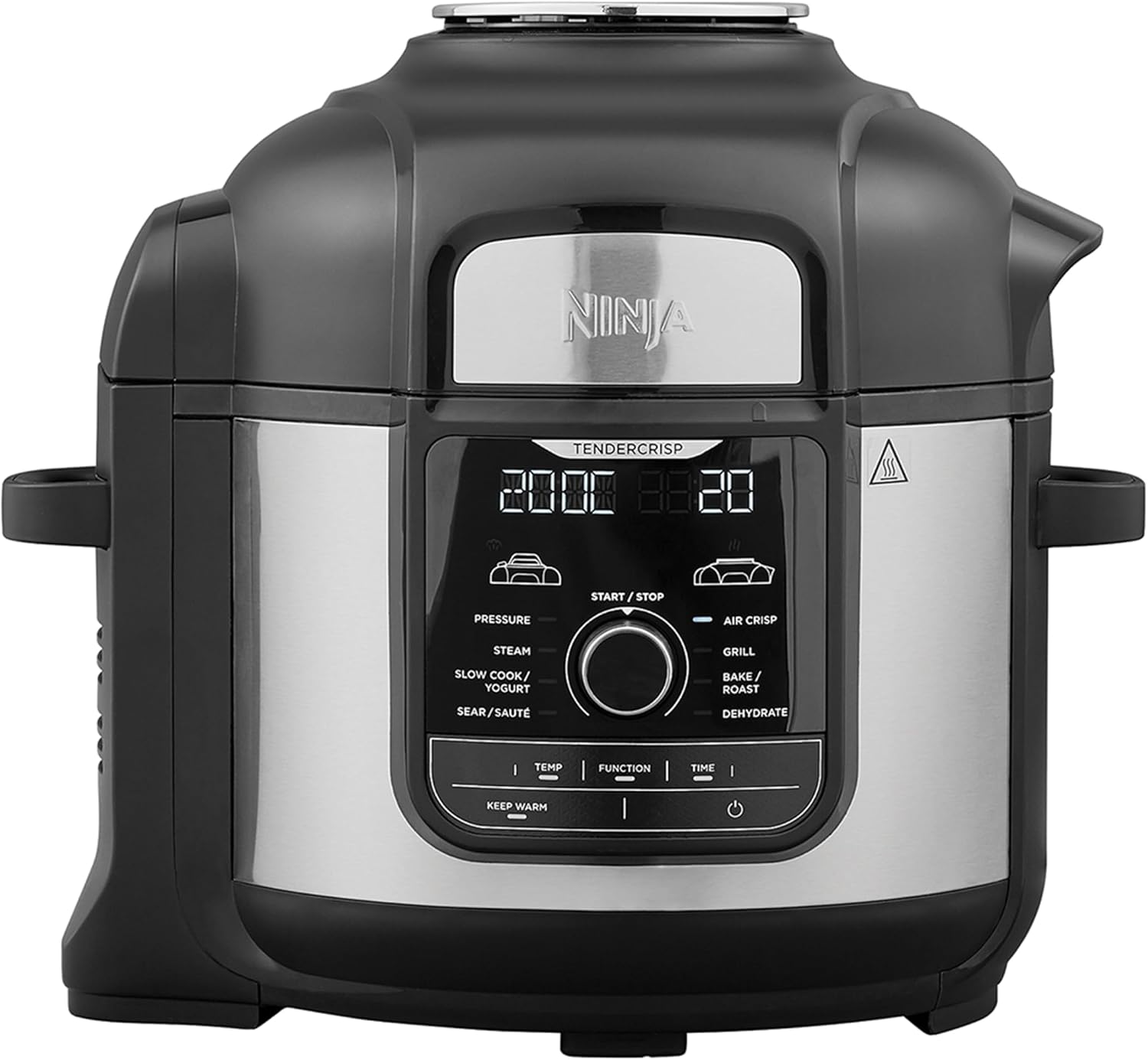
Most complete — Ninja Foodi MAX. Big and heavy, but it prepares a genuinely wide range of food with ease, and the extra lid makes pressure cooking simple. It is very well made from coated stainless steel and solid plastic, and the touch pad — in English — is easy to follow once you have read up. In testing, beetroot came out butter-tender after 20 minutes on the pressure programme. Besides pressure cooking it air fries, slow cooks, steams, roasts, bakes cakes, grills meat and vegetables, makes yoghurt and dehydrates, with a keep-warm function on top. The UK model is the OP500UK, a 7.5-litre, 9-function machine, against the OP500EU tested. Its larger sibling, the Foodi Max OL750EU, carries 14 cooking functions and 1,500 W but weighs nearly 12 kg, takes over ten minutes to warm up and was judged distinctly less intuitive — testers concluded that its weight, size and fiddliness argue against it for an ordinary household, however impressive its range.
Best for a busy kitchen — Crockpot Turbo Express CSC062X. This one shows its hand the moment you unbox it: all 14 programmes are printed on the housing itself, each with its own icon, and you can additionally set time, temperature, a delayed start and the Turbo Pressure function. That last one is optional on many programmes and, according to the maker, cuts cooking time by a further 40 per cent. At 1,400 W it heats up in about five minutes, quicker than most, and there is real power behind it — enough that it steamed broccoli into oblivion even following the manual's own table. The removable lid is smooth and latches well, and steam is let off with a separate rotary knob. Three genuine criticisms: the manual gives too little guidance on which dish suits which programme, so expect some trial and error; the steaming grid is coarse enough that small pieces of vegetable drop through; and the cable is extremely short. Note also that the pot and lid must be washed by hand and are not dishwasher-safe.
Best value — Tefal Turbo Cuisine CY7548. A cool, modern, plainly black design that feels more expensive than it is. The 1,000 W machine covers steaming, braising, slow cooking, soups, rice, yoghurt and porridge, and it also sears, bakes, starts on a delay, keeps warm and offers a freely adjustable cooking mode. The locking mechanism closes easily and beeps twice when the machine is ready — so well, in fact, that lid and pot sometimes stick together when opening. A large rotary control drives symbols on the display, which are not entirely self-explanatory, and a central button on the removable lid lets the steam off after cooking. The real weakness is the manual: readable, but thin on detail about the individual programmes and missing important guidance on quantities, temperatures and cooking times. Anyone with no multicooker experience at all will struggle beyond single vegetables, rice or potatoes. The UK listing is the CY7548, a 5-litre machine with 10 cooking programmes.
The classic — Instant Pot Duo. Handsome, well made, and unusually well documented, with a good manual, a large stock of well-adapted online recipes and its own app. The tested IP-Duo60 corresponds to the 5.7-litre Duo sold here. One thing to know before buying: it comes with a stainless steel pot only, which is dishwasher-safe but which food can catch on; coated pots are sold separately, alongside steaming inserts and spare silicone rings. Larger households can step up to the Duo 80, with a bigger pot and more power, and one or two people are well served by the Duo Mini at 800 W.
One drawback that is not a drawback here
Several machines in this test were marked down for a fault that does not exist for a British buyer: an English-only menu. It cost the Cosori CMC-CO601 a podium place outright, despite a solid ~6-litre, 1,100 W machine with twelve preparation modes, and it was listed against both Ninja Foodi models and the Instant Pot as well.
Read those verdicts with that in mind. For a UK kitchen the English interface is the convenient option, and it is the winner's German-language display that is worth a second thought — which is why the Ninja, Crockpot, Tefal and Instant Pot machines above may suit you better than their placings suggest.
Before you buy
Four questions. Pressure or slow? They are opposite methods and most machines do both, so the question is really which one you will actually use. How much room have you got? — the most capable machines here are also the heaviest, and one is a two-handed lift. Will you wash it by hand? The winner and the Crockpot both require it. And do you need the quoted times to be true? — with heat-up and de-pressurising added, they are not, and for quick jobs the hob still wins.
Our best air fryers guide covers the overlapping function, and our best blenders guide the one appliance a multicooker cannot replace.