A nutcracker looks like the simplest tool in the kitchen drawer, and it is the one most likely to disappoint. The job is not really to break a shell. It is to break a shell and leave the kernel inside whole, and that is a far narrower target than it sounds. Nineteen nutcrackers were put through an extended test. Only a couple of them managed it consistently.
What follows is recorded testing, translated. Nobody at Truthful Reviews has cracked a nut with any of these.
Decorative or functional?
Say the word nutcracker and most people picture the bearded wooden soldier in a red uniform. That figure has been made in the Erzgebirge since the sixteenth century, and it works: a lever moves the jaw, and the jaw cracks the nut. In practice it now lives on a shelf at Christmas. Anyone who actually wants to get through a bowl of walnuts reaches for something else entirely.
The ordinary household nutcracker has nothing to do with that craft tradition. Stainless steel has largely replaced wood, decoration has all but vanished, and the tool disappears into the drawer alongside the other kitchen helpers. Its shape is dictated by function and by ease of use, and nothing else.
The three mechanisms
The pliers type is the most common and the best known. Two arms are joined at a hinge, the nut goes between them, and squeezing the arms bursts the shell. The inner faces are ridged or toothed so the nut cannot slide out as the pressure builds. The important consequence is that all the effort comes from you: the tool multiplies it, but it does not supply it.
The screw type does supply it. The nut is clamped inside the tool and a screw is wound down until the shell gives way. Some screw models sit the nut in a shaped cup. They take most of the work off the user, at the cost of being slower to operate than a pair of pliers.
Beyond those two there are various designs that crack by pressure or by a blow. One tested here uses a metal cup with a lever mechanism, in which the lever's movement is transferred to a spring-mounted metal plate that squeezes the nut inside the cup. Another uses a lever that drives a pin sideways against the nut. Which principle suits you is largely personal preference — all of them will, one way or another, get you to the kernel.
Top pick — Rösle Nussknacker 12781
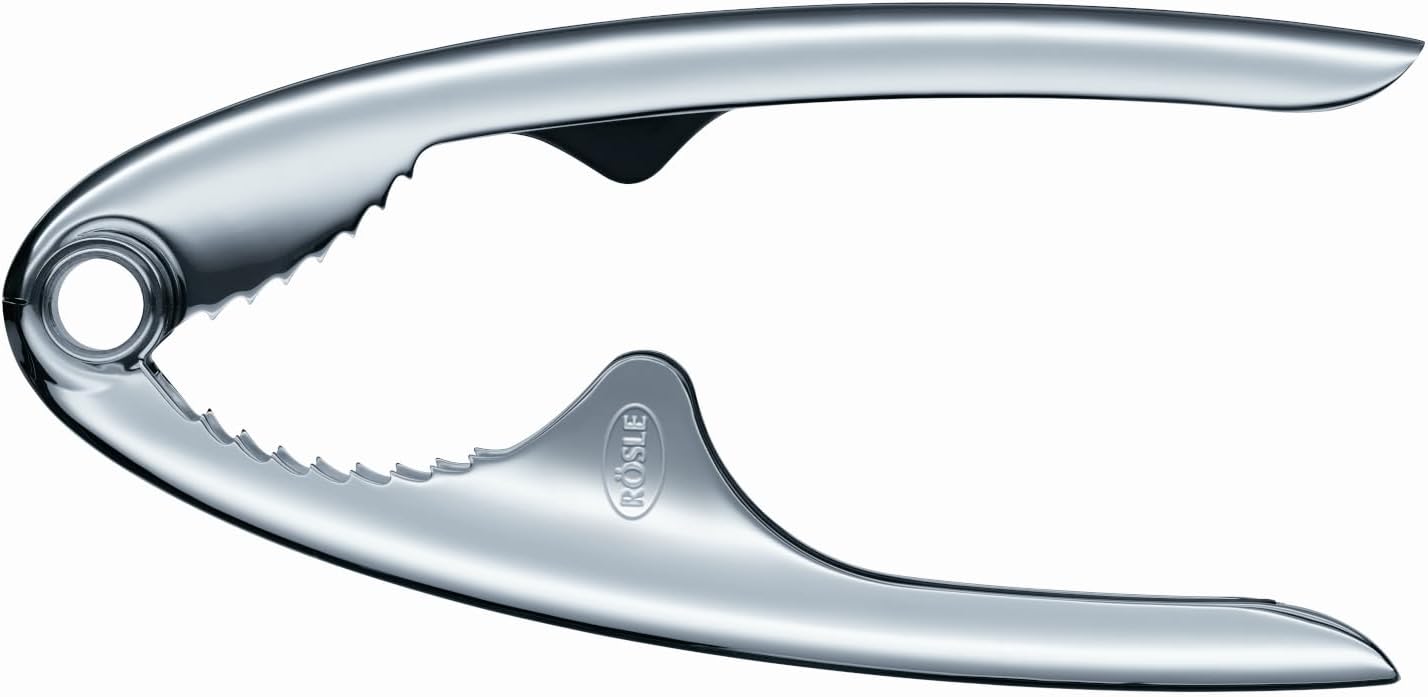
Nuts do not come in one size, yet plenty of nutcrackers are built as though they did. This stainless steel model is not one of them. Rösle uses a C-shaped jaw with heavy serrations along the inner face, which lets it grip a nut properly wherever that nut happens to sit in the curve. A rubberised stopper between the handles limits how far the pliers can be closed. Build quality gives a good impression throughout, and the tool feels notably rigid in use.
Its strength is unambiguously large nuts. Even an oversized walnut is off its shell in seconds, where other models here run out of jaw or run out of grip. In practical use the nut could be positioned exactly where it needed to be and it did not slide out as the handles came together, and the effort required was very low. Small hazelnuts are where it finally struggles: they still get cracked, but they have to be turned once or twice and cracked again until the right angle is found.
Two things to know before buying. The handles are not rubberised, so they are a little slippery, and the bare steel picks up fingerprints instantly — it is worth wiping the handles down with a cloth now and then. The handles also sit a long way apart, so anyone with smaller hands may find them a stretch and may find extended sessions harder work than a narrower tool would be.
None of that changes the recommendation. If you mostly deal with larger nuts and want to put in as little effort as possible, this is the one.
Search Amazon UK · Search Amazon US
The good-looking alternative — Hofmeister Holzwaren Nussknacker Buchenholz
Practical does not have to mean plain. This beech model sits between the household tools and the decorative wooden figures: a screw-type nutcracker in the shape of a mushroom, made entirely of wood. The nut goes into the opening in the lower part of the mushroom and you turn the cap, which drives the screw down, clamps the nut and cracks the shell. It is difficult to imagine a simpler action.
The beech feels robust and solid, it sits comfortably in the hand, and the surface is nicely smooth. The screw mechanism turns smoothly, and the opening is large enough to take nuts of any size — a real advantage over several of the shaped-recess designs further down this page.
On walnuts the result was immediate. Because the only input is turning, no real effort was required, and the outcome was consistently good. The control is the point: with a screw you can feel the exact moment the shell gives, which means you can stop before the kernel is crushed along with it. Hazelnuts came out just as well. The mushroom body also catches the shell fragments as they break away, which cuts down the mess a nutcracker normally leaves behind.
It is a convincing tool. If you want a nutcracker that earns its place visually as well as functionally, this is the pick — and it is one of the cheaper things here rather than one of the dearer.
Search Amazon UK · Search Amazon US
Also tested
Westmark Monopol Edition — a very good, solid first impression: the pliers neither squeak nor catch, and the wooden handles sit well in the hand. Two shaped recesses in the head cover both large and small nuts, though not the smallest — it reached its limit on smaller hazelnuts. Everything else it shelled without complaint. Unlike some models here it has nothing between the handles to limit their travel. A solid tool. Search Amazon UK · Search Amazon US
Fackelmann Nussknacker 48218 — three differently sized recesses in the head, and no shell stood a chance: large or small, every nut cracked without difficulty, with minimal effort and a great deal of control over the process. It sounds excellent, and then the hardware lets it down. The whole thing feels unstable, the handles wobble noticeably and the tool reads as rattly. It is bare stainless steel throughout with no rubberising, which leaves the handles slightly slippery. Better exists. Search Amazon UK · Search Amazon US
WMF Nut Nussknacker — looks high quality at first glance and the rubberised handles are genuinely good. Then it becomes clear how wobbly the tool is. The two shaped recesses in the head do allow both large and small nuts to be cracked, which practical use confirmed, and control was good — every shell was dealt with. The effort required is somewhat higher than other models here. Search Amazon UK · Search Amazon US
Drosselmeyer DR03 — the lever-and-cup design. The cylinder that tapers towards the base is unfortunately a little narrow: large walnuts stick out of the top and have to be turned a few times before a workable position is found. The lever mechanism means almost no effort. The catch is that the shell only cracks in places, so the job has to be finished by hand. Small hazelnuts bring the opposite problem — they go in easily and then lodge at the bottom, and getting them back out is a fight. Crumbs and shell fragments collect down there too, so it needs cleaning regularly. Search Amazon UK · Search Amazon US
Westmark Sieger Nussprofi Deluxe — a pliers type with a round cup at the tip and pleasant wooden handles. Build looks good until you look closely, at which point several scratches in the lacquer show up. It is easy and pleasant to operate, but there is almost no control over the crack: a great deal of force was needed to beat the shell, and the nut then either failed to crack properly or the shell flew off and the kernel was crushed. Small hazelnuts were barely cracked at all. Search Amazon UK · Search Amazon US
Rosenstein & Söhne PE-4874-944 — a retro-look lever design in which pressing the lever down drives a pin sideways to clamp and crack the nut. It feels stable overall, though there are a number of hard product edges. A screw adjusts the distance to the pin so the gap can be matched to the size of the nut. The lever itself sits well in the hand and needs no great effort. Small nuts, though, have too much room and simply cannot be cracked; larger hazelnuts and walnuts work well. Control is limited and the nut is usually crushed rather than cracked, which makes a lot of mess, and the crumbs then lodge in those product edges. Interesting as a design piece, not very practical. Search Amazon UK · Search Amazon US
Goods+Gadgets Retro Nussknacker — there is nothing to add beyond what is said above, because this is the same product. Externally and in use the findings are identical; the only difference found was the missing Rosenstein & Söhne sticker. Search Amazon UK · Search Amazon US
Catalpa Blume Nussknacker mit rutschfestem Silikongriff — another cup-shaped jaw, and it works more badly than well. The tool does not feel high quality, the finish leaves a lot of room for improvement, and it squeaks with every movement. Several attempts were needed before a shell cracked properly. Not convincing. Search Amazon UK · Search Amazon US
Oxo Good Grips — sold for shellfish as well as nuts, and shaped accordingly: a very small, very narrow, very simple pliers form. The jaw is straight, with no shaped recesses for nuts at all, but the inner face is ribbed and grips extremely well, so nuts position easily and do not slip. The effort required is very high — you have to squeeze hard to get a shell to go — and that works best on small to medium nuts. Large or stubborn walnuts are more difficult. Search Amazon UK · Search Amazon US
Fasbet Edelstahl Nussknacker — the poor finish shows immediately: unevenness in the steel, mismatched gaps, and a hinge at the tip that is slightly twisted, so the handles sit offset from one another. The edges around the tool are left square rather than dressed, and the handles are also rather wide, which makes them awkward to grip comfortably. Inside one jaw are two rows of teeth arranged in an X. That holds a large walnut nicely in place, but small hazelnuts constantly slide off the points and cannot be cracked, so each one has to be positioned very precisely between the two jaw faces and squeezed gently to fix it first. Very little effort is needed for any nut in the test and control is good — on the large ones. On small ones the kernel gets crushed along with the shell. Considerably better nutcrackers exist; this one is not recommended. Search Amazon UK · Search Amazon US
Metaltex Nussknacker Zamac Synthesy — a good first impression, a well-finished jaw, and silicone-covered handles that sit very comfortably in the hand. Operation could hardly be simpler, and two differently sized curves in the head handle large and small nuts alike. That part works. What does not is the control: there is almost no feel for how hard the nut is being squeezed, so shells shoot uncontrolled across the room. The cracking results were otherwise fine, but the cleaning-up afterwards costs real time, and that is what keeps it out of the recommendations. Search Amazon UK · Search Amazon US
Thiru Nussknacker mit Holzgriff — a round recess at the front of the jaw takes the nut, and the opening has been made a touch too small: larger walnuts only just fit. Several nuts had to be reseated and turned repeatedly before the shell was fully cracked. On small nuts the concept works very well. Shell fragments lodge inside the recess, which makes cleaning more of a job than on most nutcrackers, and despite the shaped opening plenty of shell still flies around. Otherwise the build is good, which is not quite enough to offset the rest. Search Amazon UK · Search Amazon US
Four further nutcrackers were also tested. None of them earned a recommendation.
How they were assessed
To find out whether these tools actually do what they claim, they were asked to do one thing above all: crack a great many nuts. Hazelnuts and walnuts were chosen so that different sizes and different shell hardnesses were covered. Particular attention was paid to how efficiently the shell was broken — whether the nutcracker really does all the work, or whether you have to finish the job by hand to get at the kernel.
A nutcracker should also not work too well. If too much of the force is delivered into the shell, the kernel is crushed with it, so how much control the user has over the crushing pressure was assessed alongside the raw result. Feel matters too: whether the handles are comfortable, how the tool is finished, and what the materials are like. Cleaning was the last criterion. Most nutcrackers never need cleaning because nothing sticks to them, but a few designs trap shell fragments, and in those cases getting the debris out easily matters.
The short answers
Which is the best nutcracker? The Rösle Nussknacker 12781. It is convincing in use, very rigid, and its rubberised stopper limits how far the handles travel.
Which nuts can a nutcracker handle? Walnuts and hazelnuts were used for the test. Pecans, Brazil nuts, almonds and macadamias can also be cracked with these tools. The harder the shell, the harder the work.
What types of nutcracker are there? Chiefly pliers and screw. With a pliers mechanism, bear in mind that you supply all the force needed to break the shell yourself. The screw mechanism takes most of that work off you, but is slower to operate.
Verdict
The Rösle Nussknacker 12781 is the pick for most kitchens: a heavily serrated C-shaped jaw that grips whatever size of nut you put in it, very low effort on large walnuts, a stopper limiting handle travel, and solid construction. Bare steel handles that mark and sit wide apart are the price.
If the tool is going to live on a shelf rather than in a drawer, the Hofmeister Holzwaren Nussknacker Buchenholz is the better buy and the cheaper one: a beech screw mechanism that does the work for you, a generous opening that takes any size of nut, unusually fine control over the moment the shell gives, and a body that catches the fragments.
For the rest of the kitchen, see our knife block guide and kitchen scales guide.