Manufacturers print the number that flatters them — peak read speed — on the front of the packet. The number that decides whether your camera drops frames is the guaranteed minimum write speed, and it is printed as a small symbol you have probably never looked at.
Here is how to read a memory card properly, and the six models worth buying for 4K video.
The three formats, and which you actually want
"SD card" is shorthand for a whole family. By physical size:
- SD — 32 x 24 x 2.1 mm, about 2 g
- miniSD — 21.5 x 20 x 1.4 mm, about 0.8 g
- microSD — 15 x 11 x 1 mm, about 0.25 g
microSD is now the most common format, because it is the most versatile: it goes straight into a phone, and slots into an adapter for the SD-sized readers most cameras use. Before buying, check the dimensions your device takes and whether an adapter is included — several of the picks below ship with one.
Capacity: SDXC is the only sensible answer for 4K
The letters after "SD" tell you the capacity ceiling, and they are printed on the card face:
| Type |
Standard |
Capacity |
Bus performance |
| SD (1999) |
1.0 |
1 MB to 4 GB |
12.5–25 MB/s |
| SDHC (2006) |
2.0 |
2 to 32 GB |
12.5–104 MB/s |
| SDXC (2009) |
3.01 and 4.0 (UHS-I, UHS-II) |
32 GB to 2 TB |
156–312 MB/s |
Because 4K video is bulky, SDXC is the format to buy. Your device's maximum supported capacity sets the ceiling; within that, the recommendation is a floor of 128 GB for the investment to make sense.
Speed: the classifications that actually matter
This is where buyers get lost, because several rating systems coexist on the same card — and because makers advertise maximum figures, momentary peaks that do not reflect how a card behaves in use. 4K capture demands sustained high write speeds, so trusting the big number on the packaging invites an unpleasant surprise when recording starts.
Speed Class states the guaranteed minimum write speed, shown as a number inside a circle: Class 2, 4, 6, 8 and 10 correspond to 2, 4, 6, 8 and 10 MB/s. Cards carrying only this rating top out at 25 MB/s because of the bus they use.
UHS Speed Class arrived with SDHC and SDXC and their faster bus: U1 guarantees 10 MB/s (theoretical maximum 50 MB/s) and U3 guarantees 30 MB/s (theoretical maximum 104 MB/s). UHS-II Class 3 cards can reach 312 MB/s, though they remain uncommon in microSD form.
Application Performance Class (A1, A2) describes how well a card handles running apps rather than storing footage — random as well as sequential read and write. It matters for phones, not cameras.
Video Speed Class is the one to read for filming. Marked V6 to V90, it maps to guaranteed write speeds from 6 MB/s up to 90 MB/s, with V90 being the 8K recommendation.
The rule in one line: for 4K, the minimum is a Class 10, UHS-I U1, V10 card — and it is worth stepping one rung above that for a slightly higher outlay.
One aside worth knowing if you shoot with a dedicated camera: SD is not the only option. CompactFlash and XQD cards carry higher transfer rates and are expected to gain ground for video recording.
The picks
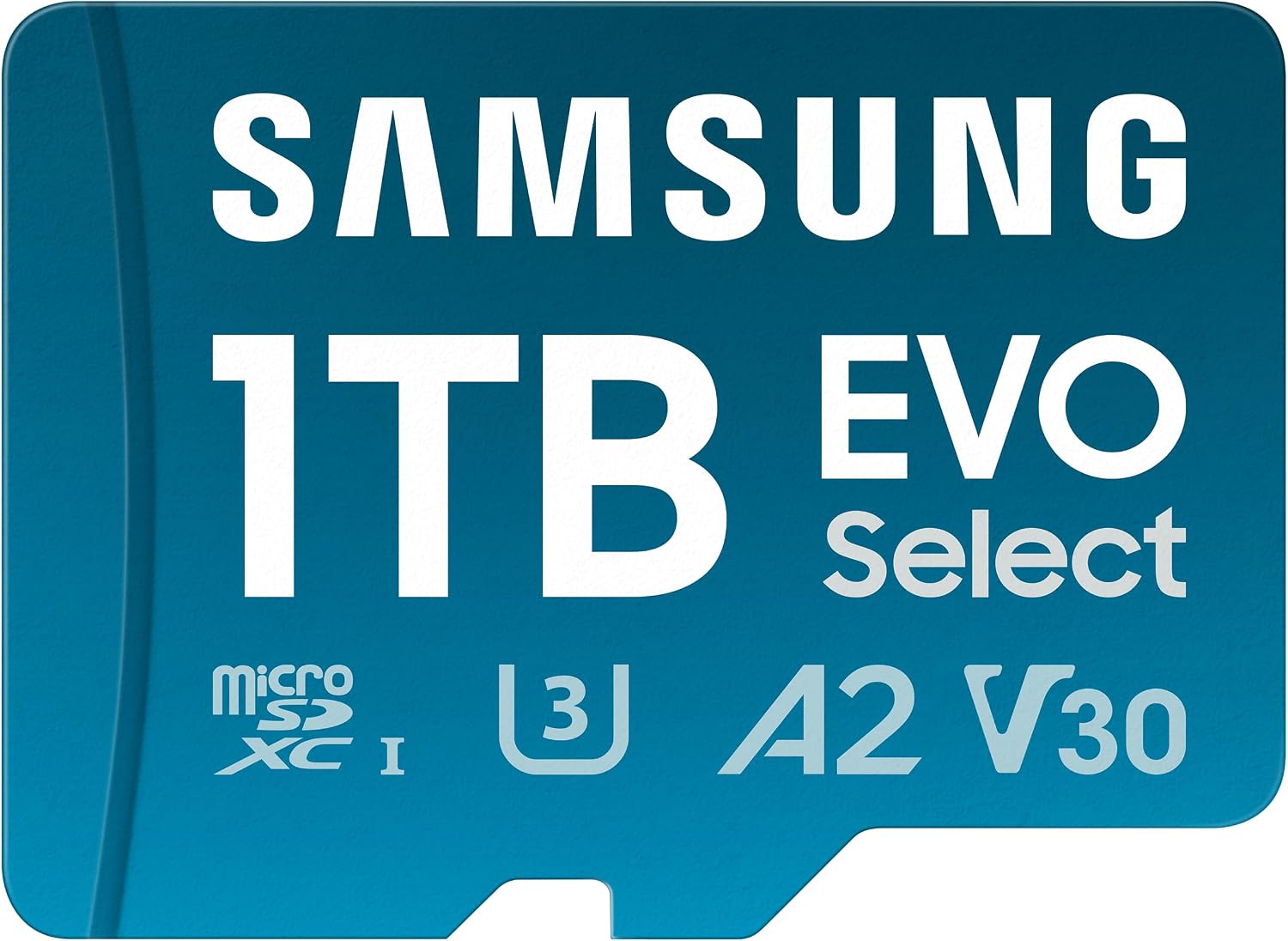
Samsung EVO Select 1TB. A Class 10 card with generous capacity — the choice when you want to stop thinking about space on a phone. The current UK listing is the 2024 revision, rated UHS-I U3 with read speeds up to 160 MB/s, supplied with an SD adapter.
PNY Pro Elite 512GB. Interesting on two counts: the amount of space, and its application performance. It is a Class 10, UHS-I, U3, V30 card and comes with an adapter — the V30 rating putting it comfortably clear of the 4K minimum.
SanDisk Extreme 512GB. The rugged pick: resistant to knocks, water and temperature extremes, which makes it the one for adventurous Android phones. It is a UHS-I A2 card, specifically suited to smartphones and tablets — the A2 rating being the app-performance mark described above.
SanDisk Extreme Pro 512GB. A rung above its sibling: a microSD card of UHS-I A2 type and UHS-I U3, V30 class, with higher read speed than the base model. The current UK listing quotes up to 200 MB/s and bundles RescuePro Deluxe recovery software.
Lexar Professional 1667x 256GB. A different brand from within the same group, certified UHS-II and U3 with Class 10 compatibility and reads up to 250 MB/s — a strong match if the plan is 4K video from a camera. The UK listing confirms the V60 rating and 120 MB/s writes.
Lexar Professional 2000x. The fastest of the set and the one for pulling photos off a camera quickly: UHS-II (U3) V90 with read speeds up to 300 MB/s, aimed squarely at DSLR bodies. The UK listing pairs that with 260 MB/s writes.
Before you buy
Four questions. What is the V rating? V10 is the 4K floor, V90 is the 8K tier — and everything between is a judgement about headroom. SDXC? For 4K, nothing else. Is the adapter included? microSD in a camera needs one. And does your camera even support UHS-II? — a UHS-II card in a UHS-I body runs at UHS-I speed, so the extra buys nothing until the body changes.
For drives rather than cards, our best portable SSDs guide covers external storage, and camera buyers should see our best compact cameras guide.
Research sources
Sources recorded for this page are linked below. Reported third-party testing belongs to the original publisher; it is not testing performed by Truthful Reviews.