The number on a portable SSD's box is a ceiling, not a promise: plug a USB4 drive into an ordinary USB port and it runs at that port's speed, not its own.
From a tested field of 38 external SSDs, here are the eight worth buying — and the decoder that stops the interface names misleading you.
The USB decoder
Portable SSD speed is set by two things: the flash chips inside, and the connection standard between drive and computer. The standards, in descending order of nominal throughput: USB4 at 40 Gbit/s, USB 3.2 Gen 2x2 at 20 Gbit/s, USB 3.2 Gen 2 at 10 Gbit/s and USB 3.2 Gen 1 at 5 Gbit/s. The naming chaos is real but decodable: USB 3.0, USB 3.1 Gen 1 and USB 3.2 Gen 1 are the same 5 Gbit/s port under three names, just as USB 3.1 Gen 2 and 3.2 Gen 2 are the same 10 Gbit/s.
What those translate to in measured practice: around 3,500 MB/s for USB4 drives, upwards of 1,500 MB/s for Gen 2x2, a ceiling of about 1,000 MB/s for Gen 2, and roughly 550 MB/s for Gen 1. The catch is the other end of the cable: your computer must speak the same standard, or the drive drops to the port's speed — and USB4 and Gen 2x2 ports are still far from universal. Check your machine's ports before paying for speed it cannot use.
One measurement worth understanding when reading the picks: sustained writing. A drive's headline write speed often holds only for seconds before thermal and cache limits bite, so the figures below include what happens when a genuinely large transfer keeps running.
The picks
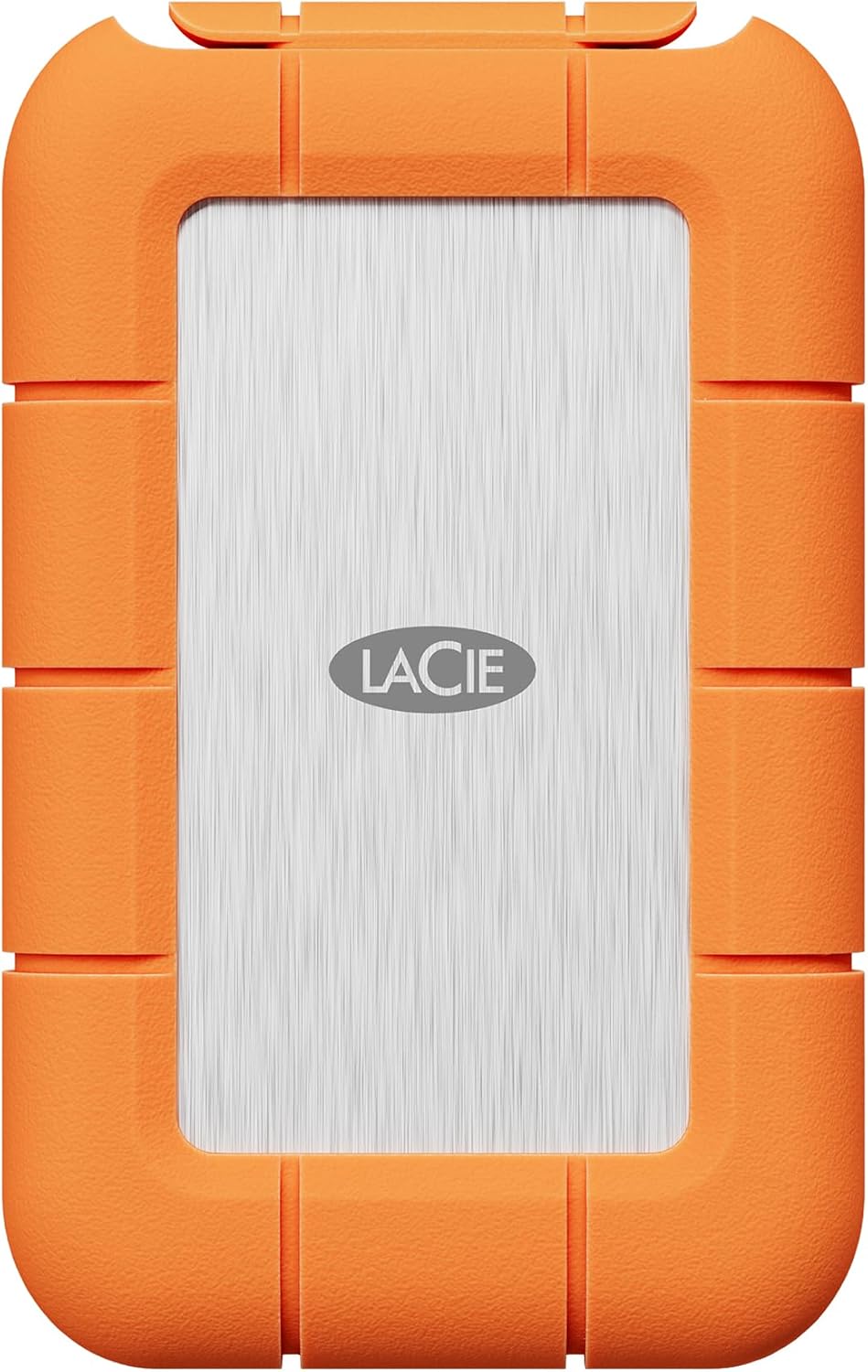
Best overall — LaCie Rugged SSD4 2TB. The fastest complete package of the field: a measured 3,782 MB/s reading and 3,609 MB/s writing over USB4, easing to 1,700 MB/s after 24 seconds of continuous writing and averaging a still-excellent 2,158 MB/s across the sustained test. The metal body sits in the signature thick rubber sleeve, which adds shock and slip resistance and covers the USB-C port; at 108 grams with an IP54 dust-and-splash rating it is built for bags, not shelves. No fingerprint sensor or hardware encryption. Also sold in 1 TB and 4 TB versions, and listed on Amazon UK.
Best value — Kingston XS2000 4TB. The capacity champion of the value tier, on USB 3.2 Gen 2x2: 1,830 MB/s reading, 1,546 MB/s writing, settling around 1,300 MB/s in sustained writing — strong figures that only the top USB4 drives beat. At 44 grams it is genuinely pocketable, and the aluminium body with silicone jacket carries an IP55 rating and a non-slip finish. Its UK part code is SXS2000/4000G. Two omissions: no encryption, and no USB-A cable in the box.
Fastest alternative — SanDisk Extreme Pro USB4 2TB. Measured at over 3,500 MB/s in both directions with barely any dips — among the fastest external drives on the market. The aluminium build with silicone jacket is rated IP65, has a lanyard eyelet for fixing to a bag, and includes a USB-C cable. It runs a little large at 160 grams, and skips encryption and fingerprint security. A 4 TB version exists for bigger libraries.
Same value, smaller — Kingston XS2000 2TB. The 2 TB sibling actually measures slightly quicker — 1,976 MB/s reading, 1,744 MB/s writing — and holds its pace in sustained writing. Same 44-gram body, same IP55 protection, same two gaps (encryption, USB-A cable). UK part code SXS2000/2000G.
Toughest — OWC Envoy Ultra 2TB. The rugged outlier: USB4 with Thunderbolt 5 support and an integrated cable, measuring 3,605 MB/s reading and 2,770 MB/s writing, falling to a respectable 1,717 MB/s across the 100-second sustained test. The aluminium housing is rated IP67 — proper dust and water protection — but weighs 341 grams, up to ten times some rivals, and it ships pre-formatted in Apple's APFS, so Windows users reformat first. No encryption or fingerprint sensor here either.
Best small-capacity — Kingston Dual Portable SSD 512GB. A 13-gram stick measuring 71 x 21 x 8 mm that lives on a keyring: 1,072 MB/s reading, 958 MB/s writing, stabilising at 982 MB/s sustained — and it comes with both USB-A and USB-C connections, the flexibility the bigger picks skip. The metal body is robust but not non-slip, and there are no security features.
Best 1 TB — Verbatim TurboMetal SSD 1TB. USB4 speed — over 3,300 MB/s in both directions — in a quality metal housing with a genuinely quiet built-in cooling fan, at about 136 grams. On very long writes it can shed around a thousand MB/s, and security features are absent, but Nero backup software for Windows is included. Also sold in 2 TB and 4 TB.
Value 1 TB — Adata SE880 1TB. Gen 2x2 pace — over 2,000 MB/s reading, around 1,800 writing — with unusually stable sustained performance that only dips after a very large volume of data. Extremely light and compact, aluminium-bodied and rated IP68, it connects over both USB-A and USB-C. The case is not non-slip, and encryption is again missing.