The action camera market has quietly collapsed into a two-horse race, and knowing that changes how you shop for one.
After boom years the enthusiasm cooled, and the field consolidated: GoPro held its position, and DJI is now the only maker consistently offering serious alternatives — with Insta360 owning the 360-degree niche. That is not a lament; it is useful. It means the accessory question is nearly solved before you start.
The ecosystem fact that simplifies everything
A large ecosystem of mounts, housings and batteries has grown around GoPro over the years — and here is the quietly important part: DJI's mounting system is compatible with GoPro's. Whichever of the two you choose, the same handlebar clamps, chest harnesses and helmet mounts serve. These are also genuinely portable systems, made to travel in one small dedicated bag.
Accessories are not optional garnish in this category: the mount is the use case. Budget for the fixings that match your sport at purchase time, not afterwards.
Resolution, honestly
The top models film 4K at 60 frames per second, and the newest reach beyond; the field's average is closer to 4K at 30. Two practical notes attach to that. Higher frame rates are what let you slow footage down without stutter — the difference between usable and unusable slow motion. And 4K files swell fast: fit an SD card of at least 64 GB, preferably 128 GB or more if you intend to film at length. The card is part of the price of the camera; treat it that way.
The cheap action camera does not exist
Worth stating because the listings suggest otherwise. There was once a genuine budget tier — but its representatives are no longer sold, and today there is no truly cheap action camera that can honestly be recommended. What you will find instead are enticing "4K" promises from more or less opaque marketplace sellers, and the field's verdict on those is blunt: expect disappointment. In this category the floor of the recommendable market simply sits higher than the bargain listings imply.
The corollary is the accessory budget. A camera alone often needs separately sold fixings to be used properly — helmet and body mounts, and protective housings that fend off scratches and add waterproofing where the camera itself lacks it. The initial price swells accordingly, though the spend can at least be staggered.
Cold weather: the battery finding
Action cameras go where batteries suffer, and the field contains one properly useful measurement: GoPro's Enduro battery, designed for the cold, delivers about 40% more runtime in freezing conditions than the standard cell — and proves more efficient in milder temperatures too. It fits the Hero 9 and Hero 10, and costs only a little more than the standard battery. If you ski, board or winter-ride with one of those cameras, this is the cheapest meaningful upgrade available.
The picks
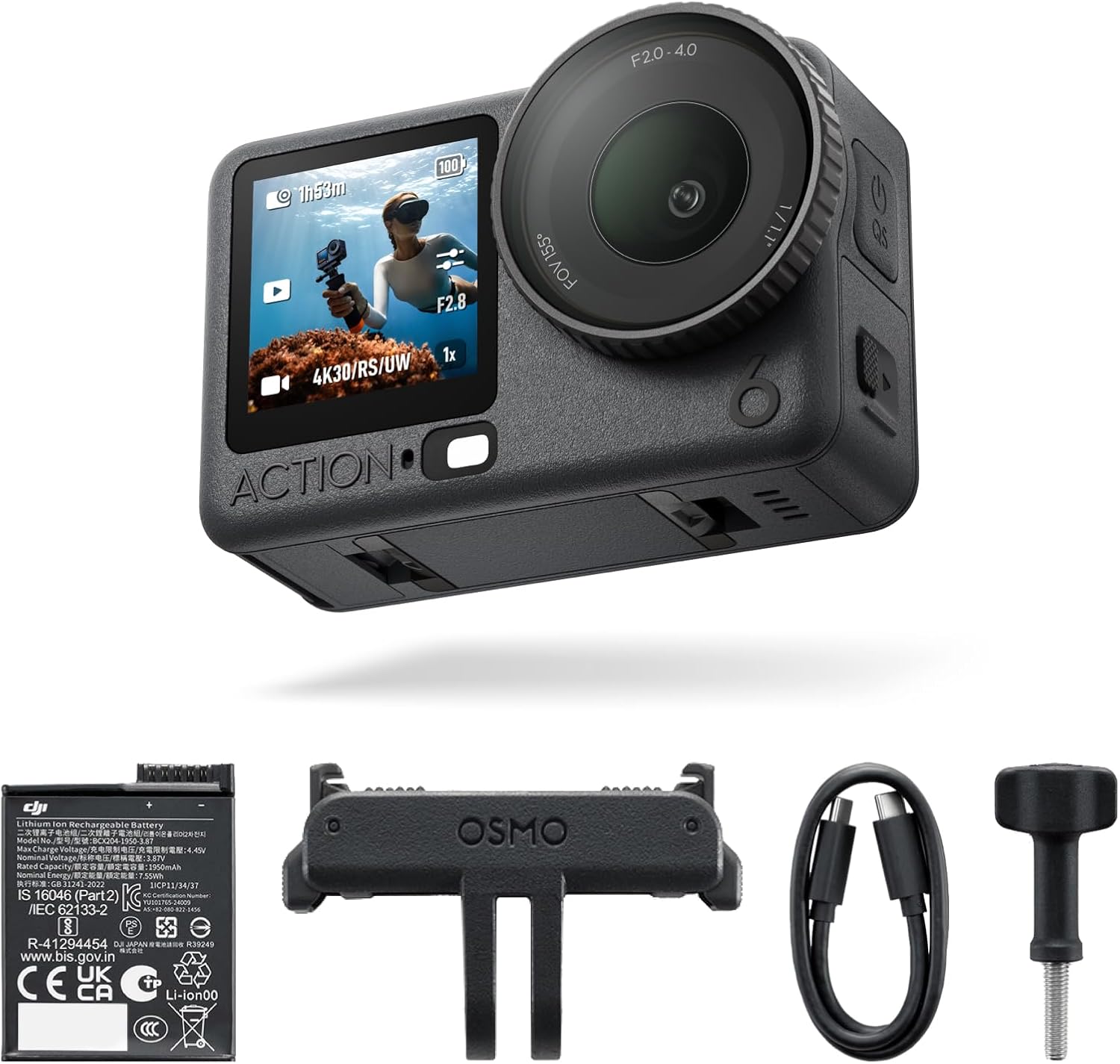
Best overall — DJI Osmo Action 6. The current pick of the whole field, and in the UK it sells in an Essential Combo built around a large 1/1.1-inch sensor — the sensor size being exactly where action cameras have historically been weakest in low light.
Best 360-degree camera — Insta360 X5. The one to buy when the shot matters more than the framing: capture everything, choose the view afterwards. Buy it in a bundle — the invisible-selfie-stick accessories are the point of the format.
The tipping point — DJI Osmo Action 4. The camera where, on image quality, DJI caught and passed GoPro in the testing — thanks to a larger 1/1.3-inch sensor that gathers more light, night shots included, in a construction carried over unchanged because nothing needed changing. It is waterproof to 16 metres and cold-resistant, and its 1,170 mAh battery recorded a measured 80 minutes of 4K.
The GoPro to buy — GoPro Hero 12 Black. Same design as the Hero 11 with one practical addition — a standard screw thread in the body — the same 1/1.9-inch sensor, the same 1,720 mAh Enduro battery with software-optimised endurance, and waterproofing to 10 metres without a housing. No 1-inch sensor and no 8K here; its case rests on the mature ecosystem and reliable results. The Hero 13 Black sits above it for those who want the newest.
Best value GoPro — GoPro Hero 10 Black. The generation where the new processor made everything feel fluid, filming 4K at up to 120 frames per second for genuine slow motion. It looks near-identical to its predecessor — the blue logo is the tell — and its interface remains a little complex. Pair it with the Enduro battery above and it becomes the sensible cold-weather kit.
The pocket gimbal — DJI Osmo Pocket 4. Not an action camera strictly, but the answer when you want stabilised walking footage rather than crash-proof sport footage. The Osmo Action 5 Pro in between remains a strong buy: waterproof to 20 metres with a built-in depth gauge, a 1,950 mAh battery measured at 3 hours of 1080p recording — and nearly 2 hours of 4K at 60 — on the same 1/1.3-inch sensor class. Our DJI Osmo Action 5 Pro review covers it in depth, and our DJI Avata 360 first look covers the flying end of the same family.
Before you buy
Four questions. Which sport, exactly? The mount decides more than the camera — and both big brands share mounts. Do you need slow motion? Then frame rate at 4K is the specification, not resolution. Cold conditions? Budget for the Enduro-class battery. And is the story around you rather than in front of you? — then the 360 camera is not an alternative, it is the answer.
For conventional cameras, our best compact cameras guide covers the pocketable end.
Research sources
Sources recorded for this page are linked below. Reported third-party testing belongs to the original publisher; it is not testing performed by Truthful Reviews.