The obvious question first: why buy a compact camera when the phone in your pocket takes high-resolution photos, has several lenses, and is always with you? The tested field — 24 models assessed — gives an honest answer rather than a defensive one.
Where a phone genuinely loses
In good light, a modern phone is hard to argue with. The gap opens as the light drops.
At dusk, phone sensors run out of capability quickly and images degrade. Some hide this well by capturing many frames and merging them into one low-noise result, which works excellently — right up until the subject moves.
The differences that matter beyond image quality are about control. Phone autofocus is comparatively slow, particularly in burst shooting, and manual settings are limited. Then there is the shutter itself: a phone shutter is not two-stage, so you cannot half-press to pre-focus and then release at exactly the right instant. Anyone who has tried to photograph a moving child or an animal knows what that costs.
None of this makes a compact camera necessary. It makes it better at deliberate photography, which is a narrower claim and a truer one.
Sensor size is the specification that matters
Everything else follows from it. The strongest picks here use APS-C sensors — physically far larger than a phone's — which is what buys the low-light performance and the depth-of-field control.
The trade-off is that a large sensor demands a large lens, and that sets the size of the camera. The test winner is the biggest model in the group and weighs more than 500 g: closer to a proper camera than something that disappears into a jacket pocket. The smallest pick fits an APS-C sensor into a genuinely flat body, and pays for it elsewhere.
Prime or zoom — the decision that picks your camera
Two of the three recommendations have fixed focal lengths and no zoom at all. The third has a zoom but a small sensor. That is not a coincidence; it is the compromise the physics forces, and it is how you should choose.
The picks
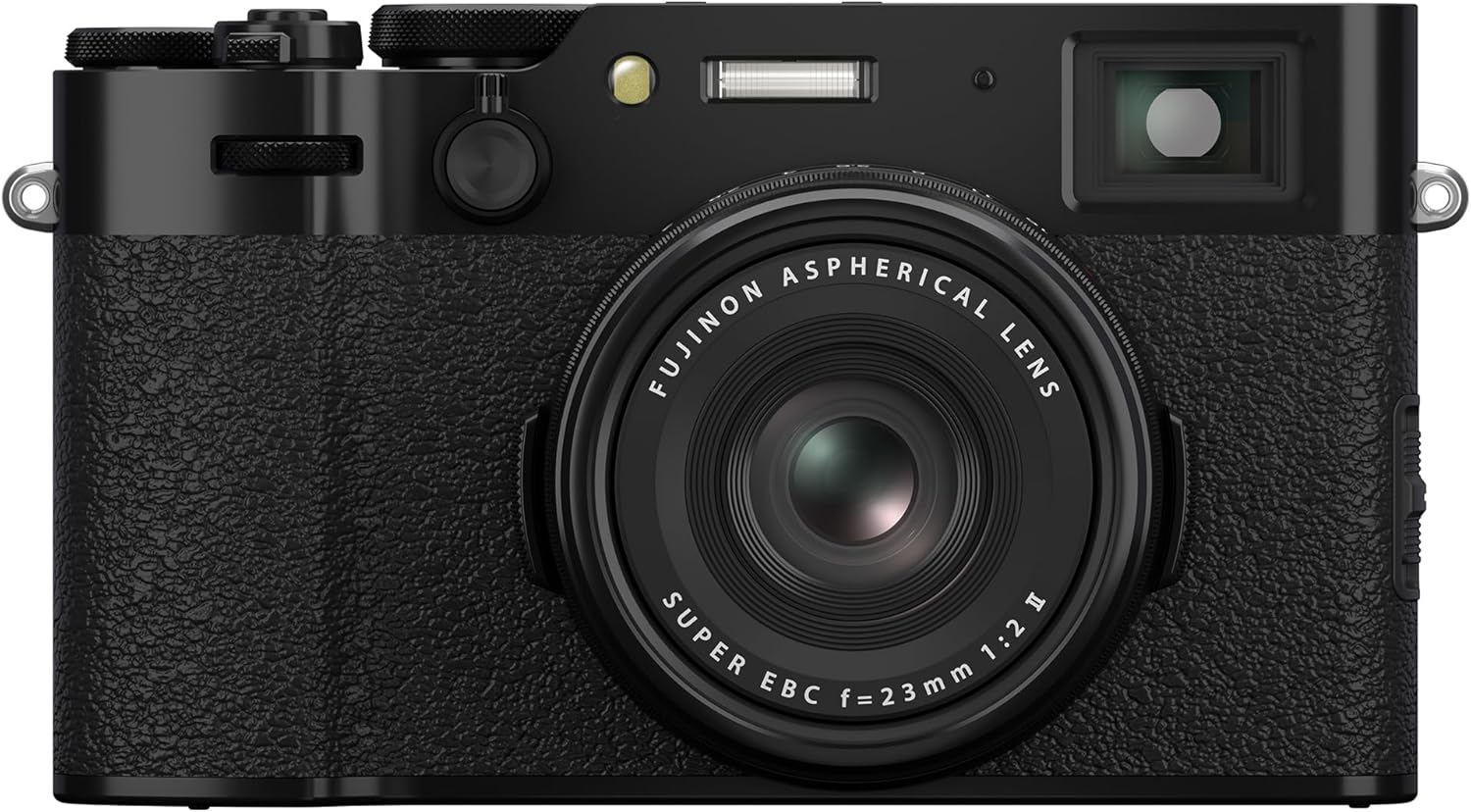
Best overall — Fujifilm X100VI. Clearly the best compact camera in the tested field. A 40 MP APS-C sensor with built-in stabilisation, a good fixed-focal-length lens and well-tuned image processing, so the quality genuinely reaches the memory card rather than being promised on a spec sheet. It is fast, comprehensively equipped, and its video performance is properly good.
Its party piece is the hybrid viewfinder, which switches between a purely optical finder and an electronic one — nothing else here does that. The rear touchscreen measures 7.5 cm diagonally at 1.62 million dots. In testing it reached 89% for image quality and features, and higher again for speed.
The costs are honest ones: it is expensive, it has no zoom, and at over 500 g it is relatively large and heavy. Read our full Fujifilm X100VI review for the detail.
Best for video and wide angles — Canon PowerShot V1. The newest camera in the class and it shows: blisteringly fast autofocus and quick handling throughout. The sensor is 1.4 inches at 22 MP with a crop factor of 2 at 3:2, and the lens runs from a spectacular 16 mm ultra-wide to only 50 mm at the long end — so there is effectively no telephoto reach.
It is marketed at vloggers and equipped accordingly, including a fully articulating monitor and very quiet active cooling for long recordings. Two real limitations: there is no viewfinder, and the burst buffer is very small.
One detail worth knowing before you buy: the aperture ramps quickly. It is F3.2 at 20 mm, F3.5 at 24 mm, and by 28 mm it is down to F4 — a full stop darker than at its widest. If you shoot at the wide end, that matters less; if you live around 28 mm, it matters a lot. Our Canon PowerShot V1 review covers it further.
Best pocketable — Ricoh GR IV. An APS-C sensor and a 28 mm fixed lens in a remarkably small and, above all, remarkably flat body — with image stabilisation fitted despite the size. Modern video is where it concedes: there is no 4K, only Full HD.
The testers were clear that this is not a camera for a general audience. Its features and handling are aimed at ambitious photographers. But if you want excellent image quality in the smallest possible body, it deserves a close look. See our Ricoh GR IV review.
Model names that will catch you out
This category is unusually bad for near-identical names, and two traps are worth stating plainly.
The Ricoh GR IV has variants. Alongside the standard model, UK listings include a GR IV HDF with a built-in highlight diffusion filter and a GR IV Monochrome with a dedicated sensor for black-and-white only. These are different cameras, not colour options — the Monochrome cannot produce a colour image at all.
The GR IIIx is not a GR IV. The GR IIIx is a variant of the earlier GR III fitted with a different, 40 mm lens rather than the 28 mm here. If you want the wider view, the model number matters.
What the wider field gets wrong
Among the models that did not make the cut, the recurring failure is a spec sheet that outruns the results. The camera with the largest zoom range in the group — 15x — was marked down for mediocre image quality. Another offered an 8.3x zoom, a tilting touchscreen and a very high burst rate, but limited 4K recording time, no USB charging and poor battery life. One expensive model with attractive design was judged simply not good enough on image quality for what it asks, and another suffered a strong loss of resolution at the edges of the frame despite an excellent autofocus and microphone.
The pattern: in this class, zoom range and image quality trade against each other, and the numbers on the box tell you about the former only.
Availability
All three recommendations are listed on Amazon UK. Check the exact variant before ordering — particularly for the Ricoh, where the standard, HDF and Monochrome models sit alongside each other in search results.
Search current listings: compact cameras on Amazon UK | Amazon.com. Test winner: Fujifilm X100VI on Amazon UK | Amazon.com. Pocketable pick: Ricoh GR IV on Amazon UK | Amazon.com.
Research sources
Sources recorded for this page are linked below. Reported third-party testing belongs to the original publisher; it is not testing performed by Truthful Reviews.