There is one specification that decides, before any listening, whether a pair of studio headphones will work with your phone at all: impedance. Anything from 100 ohms upwards is excluded from mobile use outright — and it is rarely the number on the front of the box.
From a field of 96 wired headphones tested, 77 of them currently available, here is how the category divides and which models earn their place.
Open, closed or semi-open
This is nearly a matter of faith among listeners, and it describes how the earcups are built. Open designs are known for particularly fine, balanced sound. Closed cups are the precondition for powerful, well-defined bass — but they fight colouration in return. A closed design seals you off from the room, and equally spares the room your listening; depending on the household, that second point may matter more than the first.
The related question is fit. Over-ear (or around-ear) cups enclose the whole ear and rest against the head; on-ear pads sit directly on the ear itself; in-ear designs go into the ear canal. Several makers offer both of the first two, and the difference is not only comfort — it is audible.
The transducer: where the real quality gap sits
Two technologies compete inside the cups.
Dynamic drivers are the common approach: diaphragm and coil form one rigidly joined unit, the coil sits in a magnetic gap and moves in time with the music, and that movement transfers to the diaphragm.
Magnetostatic (planar magnetic) drivers take a different route: the coil windings are vapour-deposited onto the diaphragm itself, making them part of its whole surface, which is suspended between two magnets. Because that diaphragm is considerably lighter than a dynamic system's and is driven across its entire area, it can follow the finest instructions from the coil — and only those, remaining nearly free of the unwanted partial resonances that were never in the music.
The verdict is unambiguous: magnetostatic transducers offer the best sound quality. The catch is that they are demanding to engineer and rarely as cheap to build as dynamic ones. Related electrostatic designs go further still, but some — Stax among them — cannot run from an ordinary headphone output at all and are sold with their own energiser unit.
When you need a headphone amplifier
Any headphone will run from the headphone output of a hi-fi amplifier. A phone is another matter: output power there is usually modest, so it demands an undemanding headphone — which is precisely why the field splits its testing into stationary headphones for home and studio and mobile ones for phones.
If you want to use a hi-fi headphone on the move, the options are accepting lower volume or adding a headphone amplifier between phone and headphone. The same applies to laptops and PCs, where the amplifier also suppresses high-frequency interference.
Impedance is the rule underneath all of this. It is a headphone's alternating-current resistance, and it affects both volume and sound. High-quality home headphones run high impedance and can sound better for it; mobile devices deliver far lower amplifier power and therefore suit lower impedance. Hence the testing's hard line: 100 ohms and above is ruled out for mobile use, as are open designs — outdoors, an open headphone makes undisturbed listening near impossible.
The picks
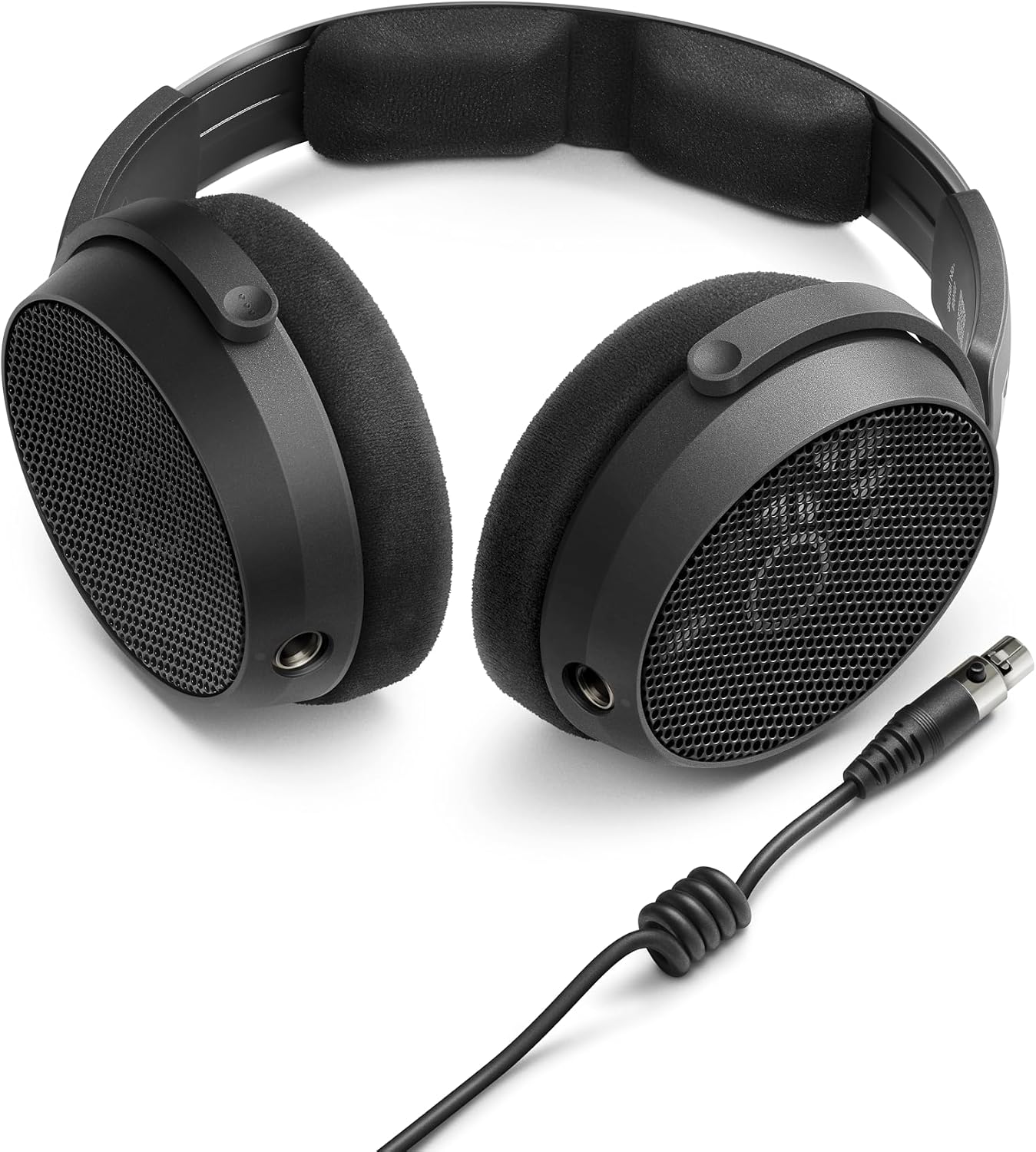
Best overall — Sennheiser HD 490 Pro Plus. Built squarely for studio users and, partly for that reason, excellent on a home hi-fi too. It follows the open principle with drivers angled towards the ear, which adds spatial depth and dodges the in-the-head localisation effect. The listening verdict is the reason it wins: it illuminates a performance into its last corner while holding back enough that the mid-to-high range never turns overbearing — a very natural picture that resists putting an acoustic magnifying glass on a recording's flaws. Against the Beyerdynamic below, its soundstage is even more three-dimensional, while the Beyerdynamic returns slightly more fine dynamics. The kit is lavish: two pairs of earpads (production and mixing), a spare headband pad, 1.8-metre and 3-metre cables, a 3.5-to-6.3 mm adapter, a premium case and a download code for dearVR MIX-SE — a plug-in that simulates monitoring through studio speakers using the headphone's own frequency response. The cable locks into either the left or right cup, whichever suits the desk, and the free socket takes a plug. At about 270 grams it stays comfortable through long sessions — light, in a field where the heavyweight designs below run to 400 grams and beyond. The plain HD 490 Pro drops the 3 m cable and headband pad for a simpler case. Verified as UK-listed.
First alternative — Beyerdynamic DT 1990 Pro MKII. The professional workhorse, open, with the cable plugged into the left cup only — deliberate, so nobody tangles in the studio. It ships with two cables, one straight and one coiled: the straight one tends to lie on the floor and meet an office chair's castors, while the coiled one keeps the run under tension. Manufacture in Germany guarantees it can still be repaired or even restored decades later — sustainable production long before the word was fashionable. The hardcase holds both cables, a screw-on 6.35-millimetre adapter and a second pair of earpads that are not spares but deliberate tonal alternatives. Against its own predecessor, the MKII carries a touch more presence in the upper mids, which makes it sound rounder and more complete, while the peak that used to sit at around 10 kHz has been eased back. The differences from the Sennheiser are audible only in direct A-B comparison, which is exactly why the field advises auditioning both.
Studio value pick — Sony MDR-M1. The lettering on the cups is explicit: a headphone for professional studio work, closed so you can listen to a take undisturbed and nothing leaks out. Thoroughly solid build and high sound quality at close to bargain money make it the field's current value recommendation. The UK listing confirms an unusually wide 5 Hz to 80 kHz playback range.
Best for mobile — Focal Azurys. Closed, and — like its open sibling the Hadenys — not merely designed but manufactured in France. High-grade materials, beautifully finished, with a honeycomb cup cover that keeps the capsule stable and a light aluminium-magnesium alloy frame holding weight to just over 300 grams; with the soft cup and headband padding, comfort is high. It connects by a single-sided cable ending in a four-pole 3.5 mm plug — the fourth contact serving an inline microphone and single-button control for calls. Crucially, low impedance combined with high sensitivity means even a phone with a weak headphone output drives it properly. No 6.35 mm adapter is included, and phone headphone sockets are now scarce, so budget for a jack-to-USB-C adapter.
Mobile value pick — Sennheiser HD 400U. The U is for the USB-C plug it connects through exclusively; with the inline microphone and control button, it is unambiguously made for a modern handset. It sits comfortably over the ears and delivers a sound experience appropriate to its class without major compromise — and despite the tight pricing, a transport pouch is included.
The luxury tier. Three models mark the field's top end. The Hedd Audio Heddphone Two GT, from the Berlin maker, matches its studio sibling in detail but is tuned audibly towards hi-fi — livelier, reaching deeper into the bass, with balanced and unbalanced cables included. Suspending its unusually large, light diaphragm needs a substantial capsule structure, which pushes total weight well beyond 500 grams. The Denon AH-D9200 pairs finest Japanese bamboo cup covers with matte aluminium yokes, headband and even plugs, running closed with two independent detachable cables whose sockets and plugs carry red and white marker rings so the right plug always meets the right cup; at nearly 400 grams it still sits comfortably, thanks to soft ear and headband padding. And the open Fostex TH1100RP uses the maker's own planar-magnetic driver in cups of real maple, blue-lacquered through an elaborate process; at a good 400 grams it is no lightweight, but a finely adjustable, well-padded headband spreads the load. Its closed stablemates take the other route, converting the signal with 50-millimetre dynamic drivers rather than magnetostatic film.
How the testing worked
Every headphone in a round is heard in comparison with the others across common musical genres, with personal preference deliberately set aside in favour of describing sound character precisely. Each gets a short run-in period first — the claim that headphones need days or weeks to burn in is treated as exaggerated, on the logic that a device which changed that much in weeks would also be ageing that fast. Testing runs on a high-quality stereo system and a dedicated headphone amplifier, with the mobile candidates also proving themselves on a portable player and a phone.
Before you buy
Four questions. Phone or amplifier? Impedance answers it: 100 ohms and up is a home headphone, whatever else the listing claims. Open or closed? Open for the finest balance in a quiet room; closed for bass, isolation and anyone nearby. Will you keep it a decade? One pick here is explicitly repairable for decades. And can you audition two? — the differences at the top of this field emerge only in direct comparison.
For wireless alternatives, our best over-ear headphones guide covers the Bluetooth side, and our best wireless earbuds guide the compact end.