An ordinary projector needs two to four metres or more of clear floor to fill a screen roughly two metres wide, and a short-throw model about two metres. An ultra-short-throw projector works from well under a metre, so it can sit on the sideboard directly in front of the screen. That proximity is the point: with the box parked below the screen there is room inside it for a proper soundbar, so these projectors usually sound better than a television, and several carry a full smart-TV system or even a broadcast tuner. This guide covers a test of nine ultra-short-throw projectors.
What follows is recorded testing, translated. Nobody at Truthful Reviews has set up or watched any of these projectors.
How ultra short throw actually works
These projectors need an unusual wide-angle optical block, normally with an extra mirror fold, so that a very short distance still produces a large picture with no geometric distortion. An optical zoom would push complexity up sharply, so they rarely have one, and generally do not need one, because shifting the cabinet by a few millimetres changes the diagonal by several centimetres. Lens shift is absent for the same reason; instead there are height-adjustable feet to bring the picture level. The other constant is light output: a blacked-out home cinema is forgiving, a living room is not, so these machines are built around brightness and around holding contrast when stray light lands on the screen.
The picks
Top pick — Epson EH-LS650
Related Articles
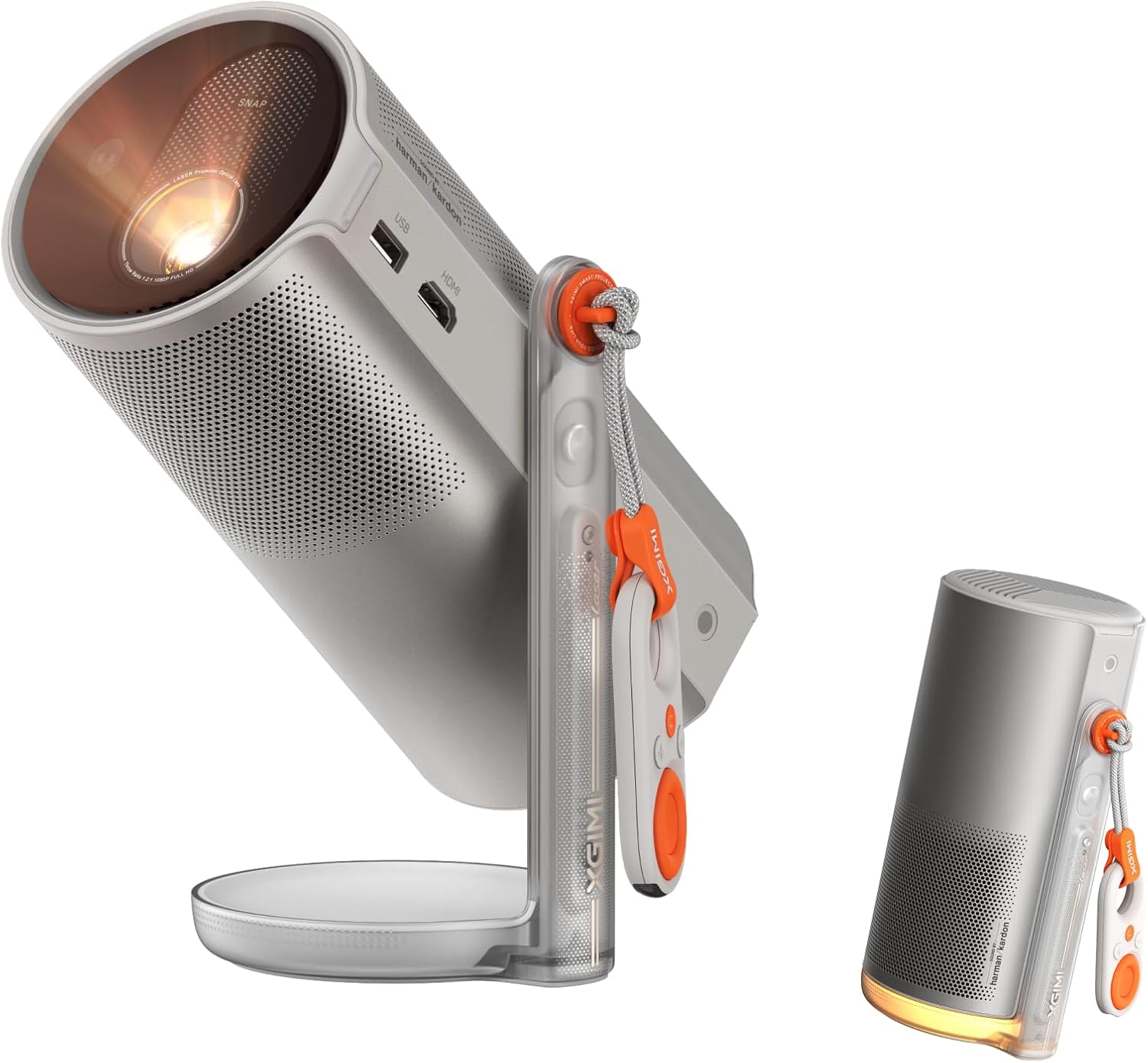
The best ultra-short-throw projector here for most living rooms. It runs an Android-based smart-TV system, and unlike the older EH-LS300B it handles 4K and HDR material properly. The light source is a long-life laser with enough output to hold its own in a bright room. Two finishes are sold: the black cabinet carries a B in the model code, the white one is the EH-LS650W.
As with most of the category the diagonal is set by the distance to the screen and by digital zoom, and digital zoom always costs resolution, so it is best left alone. At roughly 50 centimetres between optics and screen the EH-LS650 throws a diagonal of a little over two metres.
Setup is straightforward: the rear feet twist to tune the tilt, a focus slider sits under a side cover, and final geometry is handled either by a point-and-arc correction that drags four marked corner points into place or by the manufacturer's setting-assistant app on a phone.
Picture quality is where it earns the pick. Pixel shifting puts 4K material on the screen, and HDR is a clear step up on the older model, with either a sixteen-step HDR control or dynamic tone mapping that adjusts contrast to the picture content. Out of the box the vivid colour mode is selected with the laser turned slightly down, so the fan is very quiet; the image is enormously bright but visibly a touch blue. The natural mode brings colour back to standard, and measurement put light output at a high 2,700 lumens even there, so the lower laser setting can stay. Measured colour temperature sat just under the required 6,500 Kelvin, with textbook coverage of the standard colour space; HDR barely changes that, and the wider DCI-P3 space is covered to more than 80 per cent.
Sound comes from a Yamaha-engineered 2.1 system behind the front grille driven by 20 watts in total, with several surround modes and presets modelled on a theatre, a stadium, a studio or plain television sound. Dialogue clarity can be optimised, there is a bass lift, and audio latency is steplessly adjustable to keep lips in sync. The drawback: there is no TV tuner, so replacing a television means adding a receiver — though most rivals are no different.
Search Amazon UK · Search Amazon US
The luxury pick — Leica Cine 1 100″
The Cine 1 comes in three versions, each with optics matched to a picture size of 80, 100 or 120 inches; the 100-inch middle model was the one tested. From 50 centimetres it produces that 100-inch diagonal, about two and a half metres. It is one of very few projectors of any kind with a proper combination tuner for satellite, cable and terrestrial reception, plus a CI+ slot.
The engineering split is visible: the optics and cabinet are the camera maker's contribution, the VIDAA smart-TV system and most of the electronics its television partner's. Build quality is the standout, and switching on slides a cover back to reveal the elaborate mirror optics. A 50-watt sound system uses the cabinet itself as a soundbar, so the sound arrives from the same direction as the picture.
Once it is squared up — automatic keystone correction and autofocus make that quick — it behaves like a television with a soundbar built in. Measurement confirmed complete coverage of the BT.709 broadcast colour space and adherence to the required gamma curve. HDR switching is automatic from a streaming app or over HDMI, at which point it moves to the BT.2020 space, not a given in this category, and tracks the steep reference gamma almost exactly.
For a room that cannot be darkened, a screen with an ALR coating is the usual companion: it reflects the projector's light back while absorbing ambient light, lifting contrast because the surface reads grey rather than white.
Search Amazon UK · Search Amazon US
The portable pick — LG PU615U
Related Articles
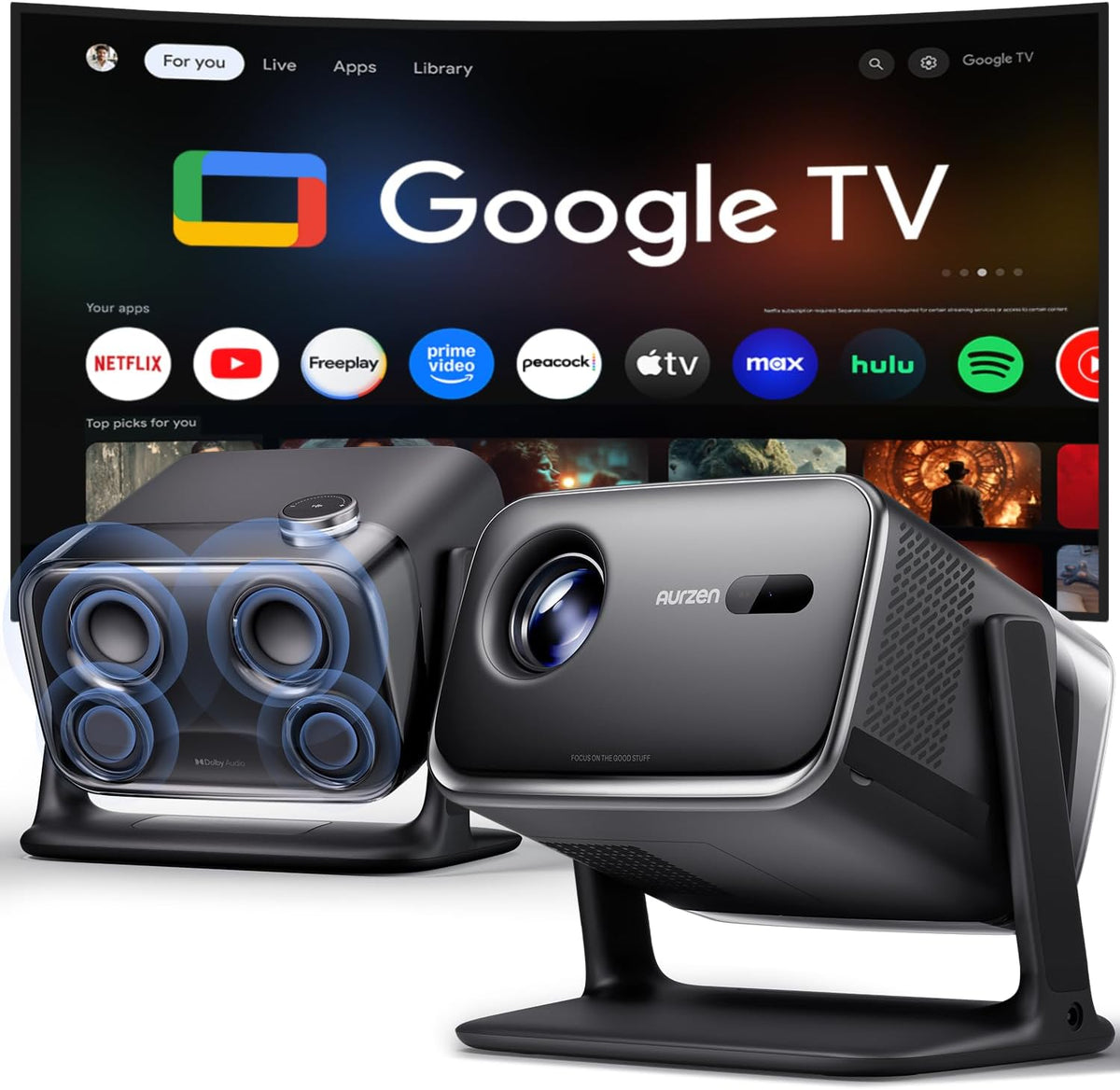
Also sold as the CineBeam S, this is one of the first ultra-short-throw projectors in a genuinely transportable mini format. A long-life laser supplies the light and a diagonal of about 80 inches needs only a few centimetres of standoff. With a footprint of 11 × 16 centimetres and a weight under two kilograms it goes almost anywhere; a tripod thread in the base and the option of running it from a power bank over USB-C widen that further.
It runs webOS 24, the same smart-TV system as the brand's current televisions, and the integration is noticeably more seamless than the Android-derived interfaces elsewhere here. Direct keys cover the main streaming services plus a free service with more than fifty genre-sorted channels.
Brightness is where the compromise sits. Of the 500 lumens claimed, measurement recorded a good 340 lumens in the cinema mode with natural colours at a picture 1.5 metres wide, rising to 410 lumens in the brighter standard mode at the same width. Darkening the room pays off accordingly. Two speakers driven by four watts each are built in and it decodes Dolby Atmos; it cannot conjure real three-dimensional sound, but its position near the screen means the audio comes from the right place. Latency is low enough, with the right settings, for gaming.