The brightness figure on every projector box is measured in absolute darkness. That is why it tells you so little: the same number can be plenty or hopeless depending on the room you put it in.
The field states the consequence bluntly — 400 lumens from a small portable can be more than enough, while ten times that can be too little. So the useful question is not "how many lumens?" but "how much light is in the room?"
The brightness ladder
Match the projector to the lighting where it will actually live:
- Absolute darkness — 100 to 200 lumens suffices in a windowless room with no light source at all.
- Heavily darkened room — 200 to 400 lumens at night, or in a dark room with very little light leaking in.
- Passive light — 400 to 600 lumens where only minor ambient lighting is present.
- Heavily dimmed room lighting — from 600 lumens the picture survives room lights that are warm and dimmed.
- Dimmed ceiling lighting — from 800 lumens a moderately bright ceiling light stops being an immediate deal-breaker.
- Warm room light — from 1,000 lumens the projection stays visible with the ceiling light on, provided it is not glaring.
- Full, cool-toned lighting — from 2,000 lumens a fully lit room becomes plausible, as long as the light does not fall on the screen.
- Daylight indoors — from 3,000 lumens a projector works well in daylight, though not with light falling directly on the screen.
Two honest limits close the ladder. No projector in the tested field is bright enough for a sunlit screen — that needs expensive professional projection equipment. And none produces a good picture outdoors in broad daylight; the strongest models manage shaded outdoor surfaces during the day.
The types, and what each costs you
Stationary projectors always need a socket but draw on full power for brightness and everything else. Portable models run from a battery or power bank, and pay for it in brightness and resolution.
On imaging technology, DLP dominates smart projectors at over 90%, with LCD far less common — though LCD has a real advantage, showing none of the distracting DLP rainbow effect. On light sources: laser DLP projectors produce strong colours across the whole image without darkening at the edges, and usually cost more than LED; LED is often cheaper but frequently comes with fluctuating brightness and soft image edges, with high-quality LED models the clear exception.
Throw distance splits three ways. Standard distance aims straight at the screen and needs plenty of room for a big image — but that image gets very large. Short throw projects at an angle and needs less distance, at the cost of a capped maximum size. Ultra-short throw fires upward from a TV unit at an acute angle from minimal distance, and is more prone to image errors.
Throw ratio: the number that decides if it fits
The throw ratio expresses projection distance against image width. A figure of 1.2:1 means 1.2 metres of distance yields 1 metre of image width. Where the ratio is much smaller than the width achieved — say 0.4:1 — you are looking at a short-throw design.
This matters more than the headline maximum size. Claimed diagonals reach 300 inches, about 7.5 metres, which fits no normal living room and is realistically achievable only outdoors or in a sports hall. For fixed-focal-length projectors at standard throw, the depth of your room sets your image size, full stop.
Resolution, honestly
4K and UHD are the same thing and the highest relevant tier. UHD is long since standard even on cheap televisions, but UHD projectors remain markedly more expensive than Full HD models. The bigger the image, the more a 4K projector distinguishes itself, since it shows four times as many pixels over the same area.
The catch is content. Genuine — not upscaled — UHD costs more than the projector: Blu-ray discs and high-quality streaming series are only available in UHD on premium subscription tiers, or on 4K Blu-ray bought individually.
Full HD is the most common resolution on affordable projectors, and small battery models stay there even with a laser light source. Most available content tops out at Full HD anyway: regular broadcast TV carries no UHD at all, and pay-TV needs additional hardware. So is Full HD a free lunch? Not entirely — AI upscaling performs considerably less well than on 4K projectors, and perceived sharpness degrades from around 120 inches upward. If a large outdoor screen is a regular event, Full HD is stretching its pixels.
The picks
Best overall — Valerion VisionMaster Max. An absolute force: hefty weight, hefty price, and gigantic home-cinema quality in every respect. From build quality through technical specification to picture and sound, the luxury projector shows even the strongest competition a thing or two. The caveat is honest — that performance needs a correspondingly large stage to be worth it. If you have a small hall for your home cinema, this is exactly right; for a normal living room, look at the alternatives below.
Best value — Aurzen Boom Mini. A home-cinema projector that leaves few wishes unmet: a large Full HD image bright enough for rooms with some residual light, and impressive sound you can literally see — four sound drivers displayed on its back, which removes the need for a soundbar in smaller rooms. Google TV as the interface frees it from most connection constraints, with Netflix and thousands of apps already aboard, and the important physical ports are present despite the plastic build. It is generous with accessories too: a lens protector is included and the fan filters are easy to change. Bigger, sharper and brighter images exist elsewhere — sometimes at ten times the outlay.
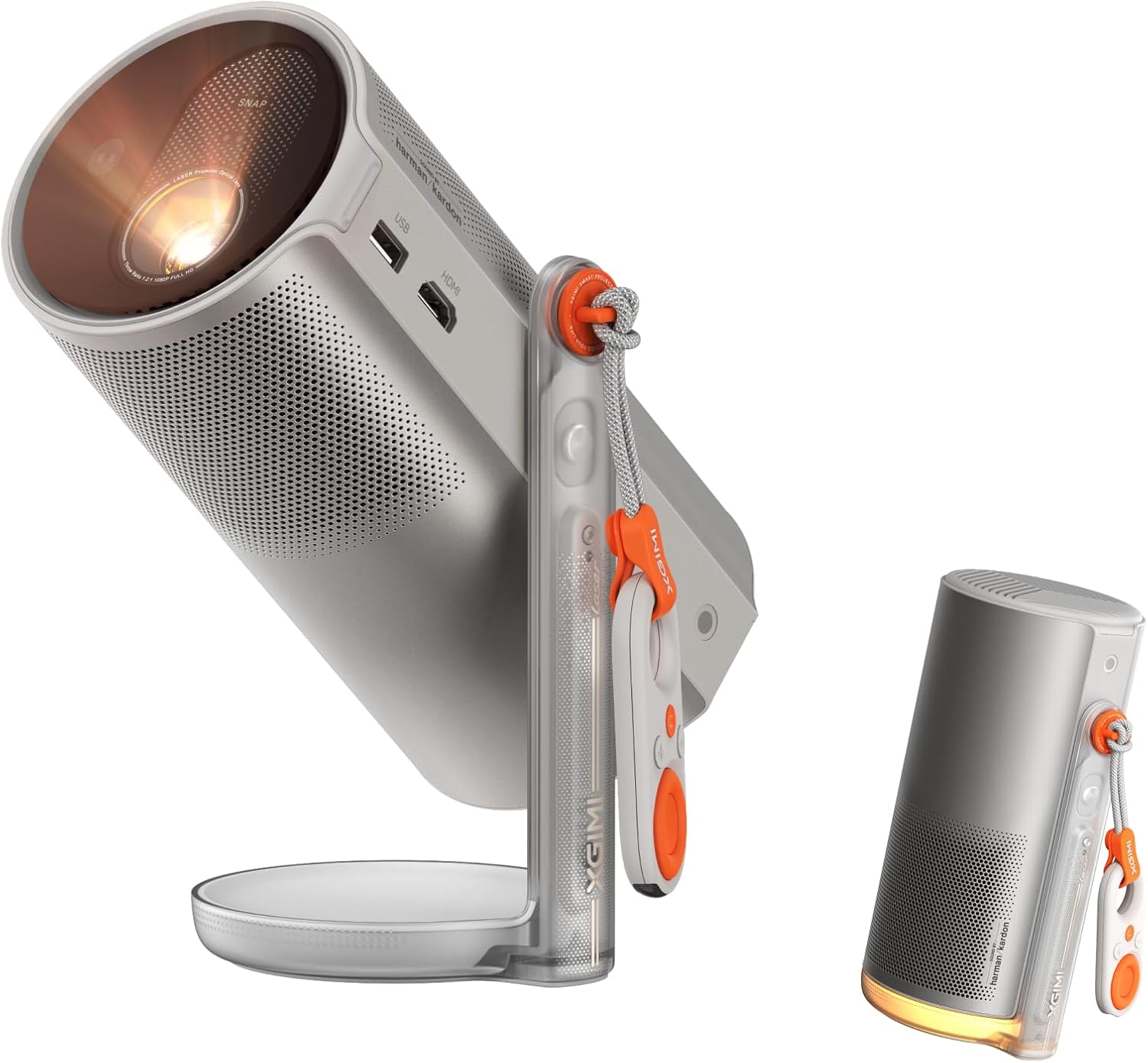
Best battery projector — Xgimi MoGo 4 Laser. The portable pick, and bright enough to clear the "heavily dimmed room lighting" rung of the ladder above. The UK listing quotes 550 ISO lumens, a 360-degree built-in stand, a built-in battery and four filters.
Best for gaming — Xgimi Horizon 20 Max. The gaming choice at the bright end of the field — though as the ladder makes clear, even ten times a portable's output can disappoint in the wrong room.
How the testing worked
Manufacturers flatter their projectors' performance, so measurements follow practice-oriented international standards under identical conditions regardless of projector type or light source. Brightness is not measured at the lens: it is measured on a neutral screen as luminance in candela per square metre, averaged from nine point measurements because distribution fluctuates, then expressed as ANSI lumens — with peak HDR brightness measured too. Contrast is measured as native SDR contrast, white and black points within the same checkerboard pattern to the ANSI standard, because most published contrast claims are endlessly massaged. Colour is checked with a colorimeter against Rec.709 for SDR and DCI-P3 for HDR, reported as Delta-E deviation and percentage coverage. Beyond the laboratory, trained testers watch for edge softness, colour casts, fluctuating brightness and artefacts, and untrained participants attempt setup, connection and Wi-Fi pairing — which is where many projectors lose points, especially when menus demand logins and the remote is unlit.
Before you buy
Four questions. How much light is in the room? Use the ladder; it matters more than any other specification. How deep is the room? With the throw ratio, that sets your maximum image, not the claimed 300 inches. Will you actually feed it 4K? Genuine UHD content carries its own recurring cost. And battery or socket? — portables trade brightness and resolution for going anywhere.
Our best OLED TVs guide covers the fixed-screen alternative, and our best soundbars guide the audio most projectors still need.
Research sources
Sources recorded for this page are linked below. Reported third-party testing belongs to the original publisher; it is not testing performed by Truthful Reviews.