A sofa collects everything: spilled coffee, muddy paws, a dropped slice of cake. A damp cloth usually spreads the mark rather than lifting it, which is what an upholstery cleaner is for. It sprays water and cleaning solution into the fabric, a brush works it through the fibres, and the machine then draws the water back out with the dirt in it. This guide covers a test of 12 upholstery cleaners, all put through identical conditions, and the measurements that separate a machine that pulls water out of a cushion from one that merely wets it.
What follows is recorded testing, translated. Nobody at Truthful Reviews has used any of these machines.
Suction is the number that matters
These are not everyday appliances, and it is worth thinking carefully about when and where to use one, because moisture and thick padding are an awkward combination. Water sinks deep into upholstery and takes a long time to leave it again. A day or two out of action is no hardship for an armchair; a mattress is a different proposition.
That is why suction, not spray, is the figure to judge a machine on. Strong suction does not just skim water off the surface, it pulls it back out of the depth of the padding, and the fabric then dries far faster. Warm, dry surrounding air helps too, which makes winter a better time to clean indoor upholstery than summer: cold air is extremely dry, and once it is warmed indoors it will absorb a great deal of moisture. Ventilate hard afterwards and swap the warm, damp air for fresh cold air.
Upholstery cleaner, carpet cleaner or wash vacuum?
The categories blur, not least because makers keep folding several machines into one — plenty of upholstery cleaners double as steam cleaners. The umbrella term is the wash vacuum: a machine that sprays water so that a brush can wash the fibres, much as a washing machine does, and then, since a carpet cannot be spun dry, sucks the water back out again.
Size is what separates the types. Carpet cleaners carry wide nozzles or work as floor machines with rotating brushes. Upholstery cleaners use small nozzles and suit sofas, chairs and at most a small rug. Both approaches were represented in the wider test; the small portable machines are gathered here because they are what most people are actually shopping for.
What you can and cannot clean
Anything upholstered in a fabric that could in principle be washed can be cleaned this way. Delicate materials — velvet, velour, silk, strongly dyed fabrics — need a gentle approach, and it is worth trying an out-of-sight patch first.
Leather and imitation leather are the clear exception. They absorb almost no water, and the dense surface simply seals the suction opening of the nozzle. Leather can also dry out and turn brittle. A damp cloth does a better job.
The other limits come from drying. Cold-foam mattresses soak water up very quickly and give it back very slowly. So do deep-pile rugs and very fluffy fabrics, where moisture sitting at the base of the pile is hard to draw out again. And whatever the fabric, avoid using one of these machines on a rug or textile lying directly on wood: the moisture travels into the timber, dries slowly and can make it swell. If a small rug on laminate has to be cleaned wet, put a sheet of plastic or another waterproof layer underneath it — better still, let it dry outdoors.
Tank size and cleaning solution
Portability is the point of these machines, so the clean- and dirty-water tanks are necessarily modest. That is less of a limitation than it sounds. Cleaning upholstery uses comparatively little water, and two litres of clean water is plenty. The dirty-water tank is usually a little smaller, because some of the water stays behind in the padding and never comes back.
Ordinary household cleaners are a poor match. Washing-up liquid, all-purpose cleaner and similar products make the water foam, and foam in the dirty-water tank tells the machine's sensor that the tank is full when it is not, while also eating into the usable capacity. Only a purpose-made non-foaming solution should go in. Every machine in the test arrived with a sample, or rather more than a sample, of the maker's own solution.
The picks
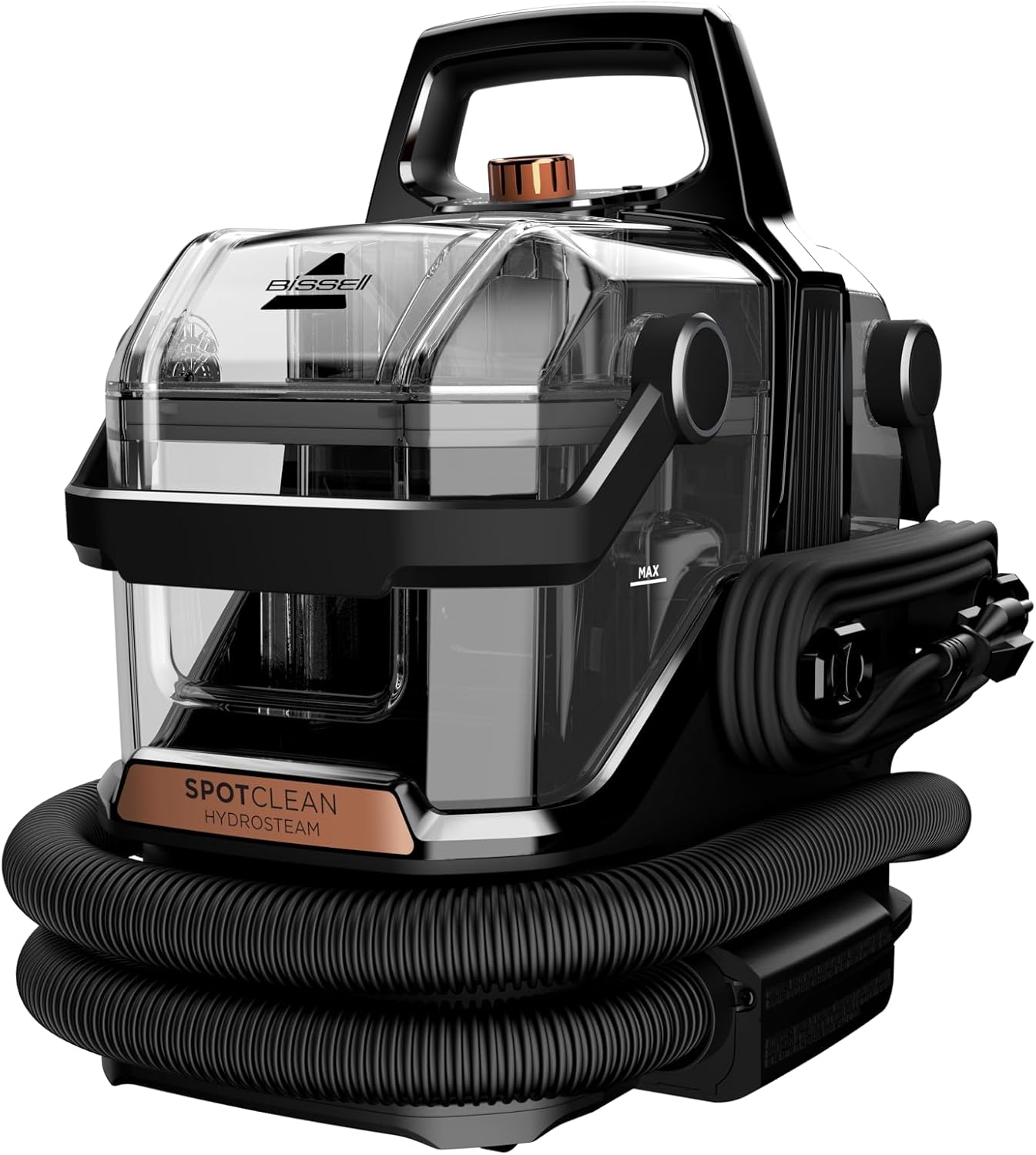
Top pick — Bissell SpotClean HydroSteam Pro
Bissell has been putting steam into a lot of its cleaning machines lately, and the case for it here is thin: the steam function needs extra space, extra energy and adds weight. The HydroSteam Pro won this test in spite of that feature rather than because of it. What it won on is the layout, which is close to perfectly resolved, and suction that is startlingly good for a machine this small.
The design is simple and near-symmetrical. A large carrying handle sits in the middle with a water tank on each side, one clean and one dirty, each with its own handle for lifting out. On the dirty-water tank that handle does a second job: rotate it past its stop and it unlatches the lid, so the tank opens completely and can be rinsed out properly.
Steam can be used on its own or combined with water, and the combination gave the best results. Used alone the steam never penetrates far enough into padding to be genuinely effective — the equivalent of cutting weeds off at the surface and leaving the roots. Combined, it produces a warm moisture that cleans better than cold water does.
The test piece was a sofa with coffee spilled on it. The brown mark was obvious, and so was the brown water the upholstery nozzle drew out of the fabric. Two passes and the recovered water ran clear; once dry, the stain had gone entirely. Suction is good for the compact size without matching a full-size wash vacuum, which would be asking a lot — the upholstery is still fairly wet afterwards, dries over the course of the day and is ready to use again the next.
Several nozzle sizes are supplied, and small marks on fitted carpet are within its range, but it is best understood as an upholstery machine. Two variants exist alongside it: the Pro with an additional attachment, and a Select version with a wider nozzle. The drawbacks are the two the layout implies — a very high power draw and considerable weight.
Search Amazon UK · Search Amazon US
The sensible saving — Shark StainStriker PX200EUT
Genuine bargains are hard to come by here, because good suction needs good engineering. The StainStriker is the cheapest machine in the test that asks for no compromise on either performance or equipment.
At first glance the mix of black, white, blue and transparent plastic looks chaotic, but every container turns out to have a purpose and the controls are obvious. There is not much to operate: clean-water and dirty-water tanks, a third container for cleaning solution — so the dilution is handled for you, which is a real convenience — and a single red button for on and off, with no power adjustment.
The mains lead could stand to be longer, though a shorter cable does wind onto the integral reel more quickly. The suction hose is likewise wound around the body and, at 1.26 m, is not generous. In practice that barely registered: an upholstery cleaner is used on one piece of furniture at a time rather than carried around the house.
The accessories are the highlight. The two bottles of solution are certainly needed and the two upholstery nozzles of different widths both make sense. The nozzle with the debris separator is harder to justify, since liquids are drawn in anyway and lumps can be picked out by hand first. Working with no nozzle fitted is possible too — a very small shoe brush can be used, and water can still be lifted — but the large opening builds little vacuum and only takes water off the surface.
In use it is thoroughly convincing. Water leaves the nozzle with enough pressure and spreads evenly, and that holds for every nozzle. Suction differs: it is strongest through the narrower 8 cm upholstery nozzle, and what that pulls out of the fibres is genuinely impressive, beyond what some larger wash vacuums manage — on a maximum power draw of just 450 W. Testing was done partly on a doormat rather than a sofa, to get an even test surface, which is why the contents of the dirty-water tank look as alarming as they do.
Emptying is easy. The dirty-water tank lifts off by its handle; fold the handle the other way and the lid releases and rises slightly, coming away complete with the float unit. Tip, rinse, rinse again, done. The nozzles clean up just as well: the clear upper section comes off so the suction channel can be brushed or wiped, and the brush underneath — which has two cleaning faces — detaches too.
Beyond the automatic solution dosing there are no special features, and the tanks, cable and hose all run a little short. It still does a good job, pulls water out strongly and stays frugal.
Search Amazon UK · Search Amazon US
Also tested
Kärcher SE 2 Spot Care — nothing to fault in suction or spray and the hose winds neatly around the body, but there is no cable reel and no brush on the nozzle, so a second hand and a separate brush are needed; measured 80 dB. Search Amazon UK · Search Amazon US
Rowenta Clean It Compact — a much reduced power draw with slightly smaller tanks to match, suction indistinguishable from the Kärcher when the two were run against each other, and a crevice nozzle and slim wand added, though one recess in the dirty-water lid cannot be reached for cleaning. Search Amazon UK · Search Amazon US
Rowenta Clean It IN5020F0 — very close to the Shark, slightly ahead on hose length, noise and tank size, with a good accessory set including a small bag, but a higher power draw. Search Amazon UK · Search Amazon US
Bissell SpotClean C5 — well made and good for spot work, with small 0.8 and 1 litre tanks, only a small upholstery brush supplied, and a decent vacuum from a 400 W draw that would reach its limit with wider nozzles. Search Amazon UK · Search Amazon US
Bissell SpotClean Pet Pro 15585 — compact and easy to store with both cable and hose reels, but the hose is only usable over about a metre and at 92 dB it is louder than most cylinder vacuums while lifting little; the wider separator nozzle left most crumbs behind and barely any water was recovered. Search Amazon UK · Search Amazon US
Eureka NEY100 — handy and cheap with a hose reel, a small bottle of solution and one small nozzle, drawing 400 W and measuring 82 dB with its exhaust directed at the floor, but suction does not reach deep and the spray loses pressure after the first burst, so upholstery needs longer to dry. Search Amazon UK · Search Amazon US
Kärcher SE 3-18 Compact — a genuinely likeable battery machine, a simple rounded box with two easily removed, fully opening tanks and just an on and an off function, but the battery runs down quickly and suction cannot match the corded machines. Search Amazon UK · Search Amazon US
Vacmaster EasyClean SCA0801 — outstanding to put away, with full-length cable storage, a hose channel and a clip for the handpiece, and an 800 W motor giving good suction from large tanks, but the hose feels cheap, the dirty-water tank will not open fully at the top, and after the noise test the machine refused to restart, then ran without its pump before the pump returned at very low pressure. Search Amazon UK · Search Amazon US
Tineco i Carpet Spot — built to the brand's usual standard but very small, with 1.6 and 0.8 litre tanks combined into one awkward-to-fill assembly and a 300 W motor that leaves upholstery wetter than far cheaper machines do. Search Amazon UK · Search Amazon US
Primavella Percy — suction is solid and the job gets done, but the kit is spare, with a single 8 cm upholstery nozzle plus a squeegee and crevice tool, the accessories feel flimsy under brushing, and the dirty-water tank needs a hand inside it to extract the internals, which shed thin seals as they come. Search Amazon UK · Search Amazon US
How they were assessed
Technical data was recorded and compared first, with particular weight given to suction and tank capacity, and dimensions and weight treated as supporting figures. After unpacking, build quality was checked, accessories logged, and the controls, the layout and the way the hose fixes to the nozzle all assessed. Cable length was only partly counted, since these machines work on a sofa rather than across a whole flat.
The practical test began with water distribution, where nozzle design decides a great deal: some models lay water down precisely, others spread it unevenly or spatter it. Recovery was then judged on how thoroughly dirt came away, which transparent nozzles make directly visible — stronger machines visibly pick up more, weaker ones work only at the surface. Residual moisture was assessed with a blotting-paper test, and because that is a judgement made partly by feel, machines were also run against one another to see whether one could still draw water out of a surface another had already given up on.
Cleaning the machines themselves closed the assessment, with importance attached to emptying the dirty water without direct contact and to a tank whose internals lift out with the lid and need only rinsing.
The short answers
Which upholstery cleaner is best? A hard question, because the differences between these machines are not large. Good suction is the thing that matters, so that as much water as possible comes back out and the upholstery dries sooner. The Bissell SpotClean HydroSteam Pro stood out, and it also uses steam to reinforce the cleaning.
What is an upholstery cleaner? It works like a wash vacuum or carpet cleaner — water and cleaning solution are sprayed through a nozzle, the surface is brushed, and the water is then drawn back out with the dirt in it. Extracting the water means less of it has to evaporate, so the upholstery dries faster.
What solution can I use in one? Only a purpose-made non-foaming product. Ordinary cleaners foam heavily in the dirty-water tank, which cuts the usable capacity and confuses the level sensor. Most machines come with the maker's recommended solution in the box.