Let us start where the tested field starts, which is more honest than most buying guides manage: you probably do not need a handheld vacuum. The jobs they do — the grit walked in on shoes, the rice that escaped a split bag, a knocked-over glass — can mostly be done with a dustpan and brush. A handheld replaces neither a floor vacuum nor a broom.
What it does instead is make those jobs quick enough that you actually do them. It is small, stores easily, is ready in seconds, and it is genuinely good at two things a full-size vacuum handles awkwardly: upholstery, and getting dirt out of crevices. It is also the sensible tool for cleaning a car.
So the question is not which is best in the abstract, but whether the convenience is worth it to you — and if it is, which of two decisions you are really making.
Decision one: whose battery are you buying into?
This is the point that matters most in the UK, and it is easy to miss.
The two strongest picks in the tested field are built on power-tool battery platforms — Einhell's PXC system and Bosch's 18 V system. If you already own tools on either, the vacuum is a cheap addition and the battery you have does the work. If you do not, you are buying into an ecosystem, and the tool alone will not clean anything.
That distinction is not theoretical here. Both are listed on Amazon UK as bare tools — Einhell's as the "Li-Solo" version, Bosch's explicitly "without battery" — so the battery and charger are separate purchases. Check what is in the box before ordering, because a bare tool at an attractive figure is not the same product as a complete kit.
The alternative is a handheld with its own built-in battery and charging station, which is simpler and self-contained but ties you to that manufacturer's runtime and replacement policy.
Decision two: accept that it will be loud
Every handheld is louder than a full-size floor vacuum, and most produce an unpleasant whistle. This is physics rather than poor engineering: the compact body leaves no room for sound insulation, and a small motor has to generate its suction through high revolutions. The testers were clear that large differences in noise between models are therefore not to be expected.
The measured spread across the whole tested field bears that out: from 71 dB at the quiet end to 84 dB at the loud end, with most models clustered between 76 and 81 dB. That is a narrow band for a category people assume varies wildly.
The most instructive data point is a well-known compact model that runs at 72 dB on its first setting — genuinely quiet, and at that setting it will not lift a crumb. Its second setting is properly powerful, but then it registers 80 dB and the battery is flat after six minutes. Quiet, powerful and long-lasting are three things you get two of at most.
The winner is honest about which two: it hits 80 dB on its first suction level, and the testers judged that liveable given what it does. Its closest rival reaches 84 dB, as does the winner at full power — so neither is the quiet option. One model that is relatively quiet at 77 dB spoils it with a whistling tone, which is the other thing to listen for.
For context on how much has changed: floor vacuums once needed at least 1,300 W to clean properly, whereas today well under 1,000 W is ample and performance has improved regardless. Wattage stopped being a proxy for suction some time ago.
Runtime and weight
Battery life across the recommended models is better than the category's reputation suggests. One runs over 30 minutes on its higher suction setting; another managed 21 minutes before shutting down. Either is far more than a handheld job needs — these are tools used in bursts.
Weight is the other comfort factor, and the platform batteries are not the penalty you might assume: the winner was tested with a 4 Ah battery weighing 588 g, which the testers described as pleasantly light and compact.
The picks
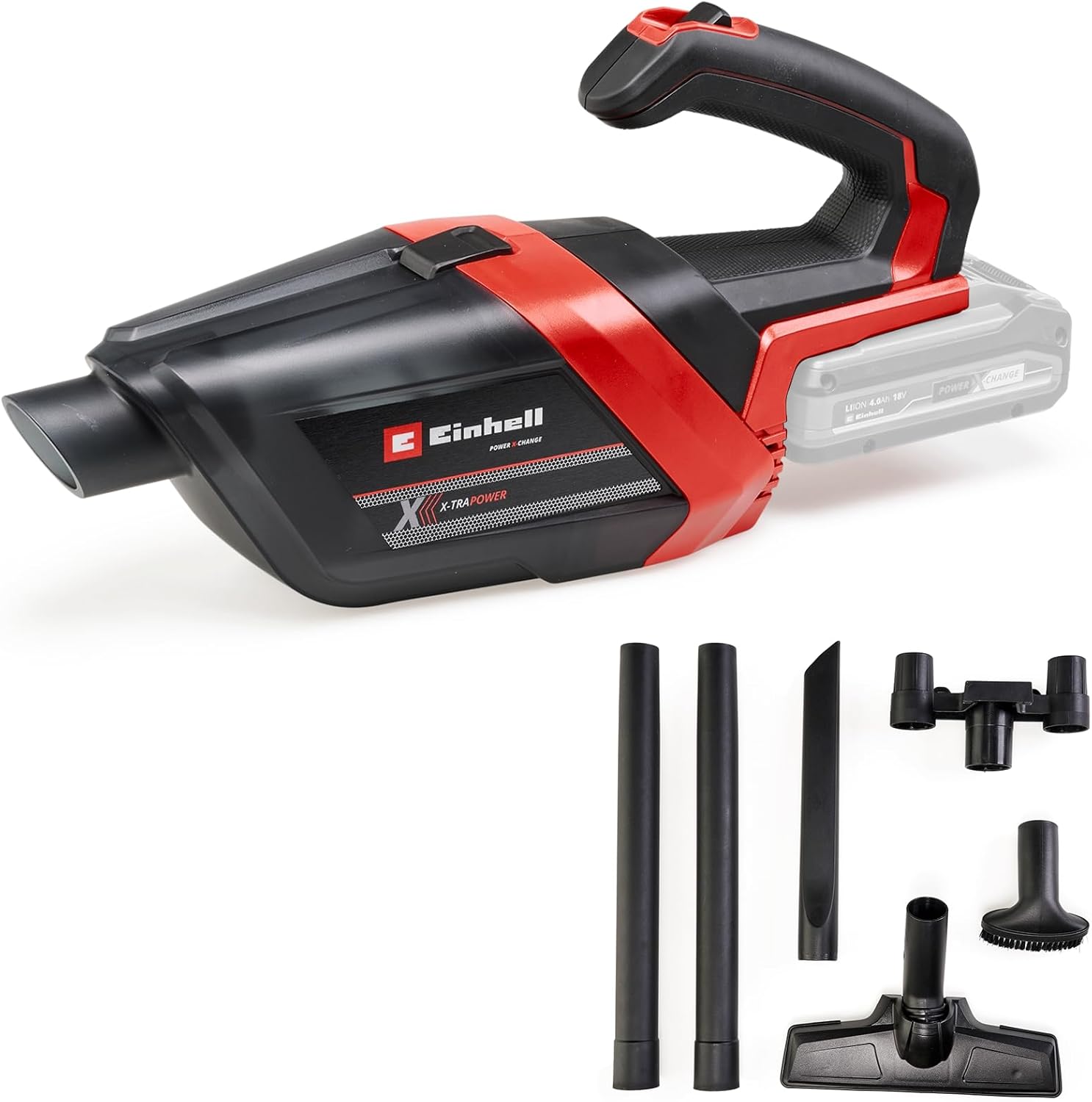
Best overall — Einhell TE-HV 18/06 Li. Originally a workshop tool, and it shows in the suction: exceptional power, long endurance, and it converts into a floor vacuum with the supplied extensions. The wall mount is genuinely useful because it holds the vacuum and all its accessories together rather than leaving attachments in a drawer. It runs on Einhell's PXC battery system and the accessory set is very good: a crevice nozzle, a furniture brush and two tube extensions of 32 cm usable length each. At full power it picks up anything within about 13 mm of the nozzle. Against it: somewhat loud, and there is no charging station. UK availability: listed on Amazon UK as the TE-HV 18/06 Li-Solo — the bare tool, battery not included.
Best if you already own Bosch tools — Bosch UniversalVac 18. A strong-suction handheld on Bosch's 18 V platform, supplied with extensions that turn it into a floor vacuum. The logic here is straightforward: if your drill and driver already take these batteries, this is the cheapest capable handheld you can add. Against it: loud, and the filter is not washable, which is a running cost rather than an annoyance. UK availability: listed on Amazon UK, explicitly without battery.
Best all-rounder with its own battery — Severin HV 7146. The most complete package of the group: a strong balance of battery life, suction and — unusually for the category — pleasant noise levels. It is slightly larger, and it brings a motorised upholstery brush that the testers rated as competitive with some full-size vacuums. It ships with a charging station. Build quality is not the very best in class, but no real faults were found. UK availability: not listed on Amazon UK; the UK catalogue carries other Severin handhelds, including the HV 9589 and a 4-in-1 car model, which are different products.
Best value — Severin HV 7144. It will not win design awards, and the build is described as somewhat rattly. It is recommended anyway, because it cleans well — including liquids, which it removed immediately and without residue — has good battery life and is simple to use. Parts of it are awkward to clean. UK availability: not listed on Amazon UK.
Choosing
If you own Einhell or Bosch cordless tools, the decision is close to made: add the matching handheld and use the batteries you have. If you do not, a self-contained model with its own charging base avoids buying into a platform for one small appliance. If you want it mainly for upholstery or a car, prioritise a motorised brush head over raw suction figures. And do not shop on noise — beyond the trivially quiet settings that do not pick anything up, they are all loud.
Search current listings: handheld vacuums on Amazon UK | Amazon.com. Einhell PXC pick: Amazon UK | Amazon.com. Bosch 18V pick: Amazon UK | Amazon.com.
Research sources
Sources recorded for this page are linked below. Reported third-party testing belongs to the original publisher; it is not testing performed by Truthful Reviews.