The most under-printed number in this category is runtime at full power: across the tested field, the average cordless vacuum lasts just 12 minutes on its highest setting.
From a tested field of 50 cordless vacuums, here is what actually separates the good ones — and why the price tag will not tell you.
Can it replace your corded vacuum?
The honest answer is split. On carpet, some cordless models with powerful motorised brushes now out-clean corded vacuums fitted with a plain universal nozzle — the spinning brush agitates deep-seated fibres and lifts dust a passive nozzle leaves behind. Even so, at maximum power an average of around 10% of the dust stays in the carpet, a slight structural deficit. On hard floors and in crevices — tiles, parquet, floorboard gaps — cordless vacuums clearly trail: more dust stays on smooth surfaces, and markedly less comes out of gaps than a classic corded cleaner manages.
The testing behind that verdict is unsentimental: quartz sand spread on a carpet with a 0.6 cm pile, on hard floor, and into a 0.6 cm-deep crevice, then vacuumed in multiple passes. Sand is a vacuum's nightmare material — scratchy, statically charged, fond of every plastic seam — which is also how the testing exposes construction flaws: on one early swap-battery design, grains worked into the bin's opening mechanism until separating the container took two people.
So the field's two-part conclusion: there are cordless vacuums that genuinely replace a corded one — at a premium — but the technology is not yet at the point where bad buys rule themselves out. Strong performers sit at serious money, and even premium brands can still disappoint. Which ones deliver is not visible on the shelf; it is exactly what testing is for.
The 12-minute truth about batteries
Battery technology has moved fast, and many models now manage an hour or more on low power — the endurance champion exceeded 90 minutes. But the highest setting is a different world: that 12-minute average is the figure to check before buying, because it is the mode you reach for when the carpet is actually dirty.
The workaround is the swappable battery. The cleverest arrangement in the field pairs a spare battery with a charging cradle that refills it in 53 minutes — so one battery charges while the other works, and the vacuuming never has to stop. Check three things on any candidate: the max-mode runtime, whether the battery can be swapped at all, and whether a spare is actually in the box or a separate purchase.
Filters and emptying: the allergy section
Most cordless bins hold less than a litre — for comparison, two litres counts as small for a corded vacuum — so emptying is frequent, and how cleanly it happens matters. The best designs let you hold the container into the bin before a flap releases the dust, and their filters pull off easily and rinse under the tap. Bag-based systems empty hygienically too, at the cost of ongoing bag purchases.
On the filters themselves, the labels follow a real standard (EN 1822): EPA filters capture more than 85% to 99.5% of fine particles depending on class (E10 to E12), while HEPA H13 exceeds 99.95% and H14 exceeds 99.995%. Two cautions attach. First, a high filter class is no guarantee of clean exhaust air — if the filter is seated badly or the housing leaks, dirty air simply takes the gap; one tested unit had exactly that flaw. Second, the filter only helps if the emptying process does not throw a dust cloud at you first.
Weight is measured in the hand, not on the box
A cordless vacuum is carried and steered constantly, so the field is weighed at the grip, during use. The differences are enormous: the lightest tested design sits at about 700 grams in the hand, while several familiar premium models exceed two kilograms — and get heavier as the bin fills. Designs with the motor and bin in the hand unit weigh most where it hurts; a lower centre of gravity steers easier on long sessions.
Noise: no free pass for batteries
Loudness is measured at head height, at minimum and maximum power, on hard floor and carpet. Battery power buys no quietness: while some models are genuinely hushed, the loudest tested unit measured 43 sone at full power on hard floor — territory the field compares to standing near a pneumatic drill. The quietest pick below proves it does not have to be that way.
The picks
Best overall — Miele Triflex HX2 Pro (SOML0). The winner refines its predecessor at nearly every point: lighter, quieter, more nozzles — and then adds genuinely imposing suction that satisfies even on the low setting. The battery clocks off after at most 24 minutes, so you learn to shift power levels deliberately; a spare battery is included, and the modular build converts in seconds — more agile, lighter in the hand, or with the long tube removed entirely for furniture work. The UK caveat is availability: Amazon UK currently carries only its filter-and-battery spares ecosystem, not the vacuum itself, so treat it as the benchmark the rest of the field is measured against and check current stock before setting your heart on it.
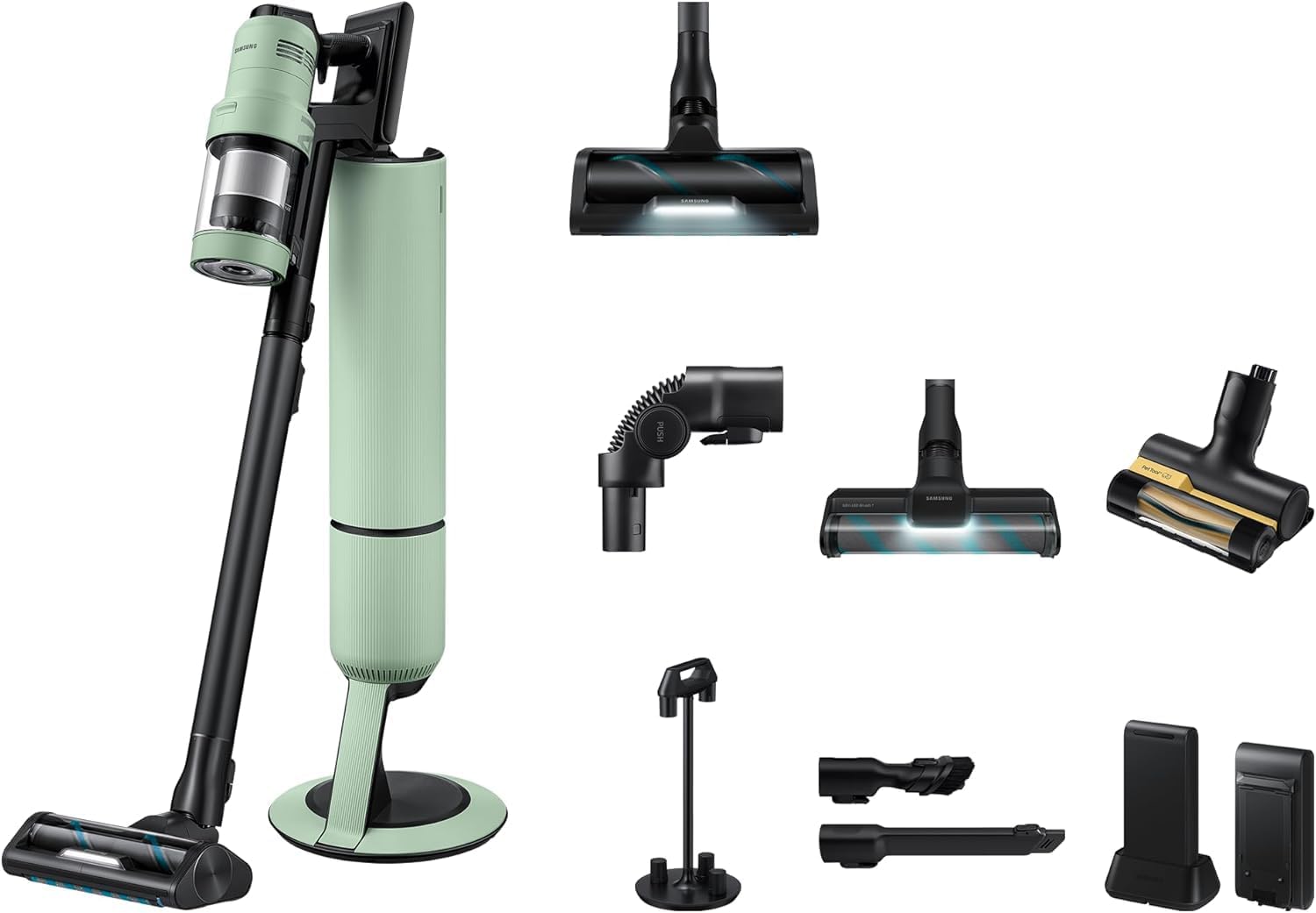
Top alternative — Samsung Bespoke AI Jet Ultra CompleteClean (VS90F40EEM/WD). The exact tested model is UK-listed, and it is an equipment monster: excellent suction at minimum and maximum, 17 minutes of full-power runtime — or up to an hour and a half on low — with two batteries in the box, though their charging times disappoint. The nozzle set includes a hard-floor nozzle and a mini electric brush for pet hair, and the self-empty station with its two-litre textile bag also stores the accessories — its one design misstep is a removal flap on the back. A rare telescopic tube helps taller users; the weight makes cornering slightly stiff; and despite the name, mopping needs an attachment sold separately.
Best mid-range — Dreame Z30. A rounded machine whose lavish kit stands out: an electric upholstery nozzle, a defelting tool for pet fur and assorted dust brushes, plus a bendable main tube that reaches deep under furniture without kneeling. Suction impresses in max mode on hard floors and crevices, stays good on carpet, and an auto mode spares you toggling. It remains comparatively quiet and agile; the costs are weight — over two kilograms in the hand during use — and, oddly for a machine with a display, no remaining-runtime readout.
Value pick — Tineco Pure One A50S. The fundamentals are in order: class-appropriate suction on hard floor and carpet, an auto mode that reacts to how dirty the floor is and shows the pickup on its display, runtime of 12 to 47 minutes, and a one-litre bin. That bin empties comparatively hygienically because the release sits away from the lid — though reseating it is fiddly. It gets loud at full power, ships with only crevice and furniture nozzles, and weighs over two kilograms in the hand.
Alternative value — Xiaomi G20 Max. Reliable and unremarkable in the best sense: good pickup overall, strongest on carpet, with a universal nozzle that copes on hard floor but fades in deep gaps. It steers nimbly and stays civil about noise; the exhaust blows sideways hard enough to sweep loose paper off a desk, which you learn to angle around. The real limit is the non-swappable battery: six minutes at full power, stretched usefully by the dirt-sensing auto mode.
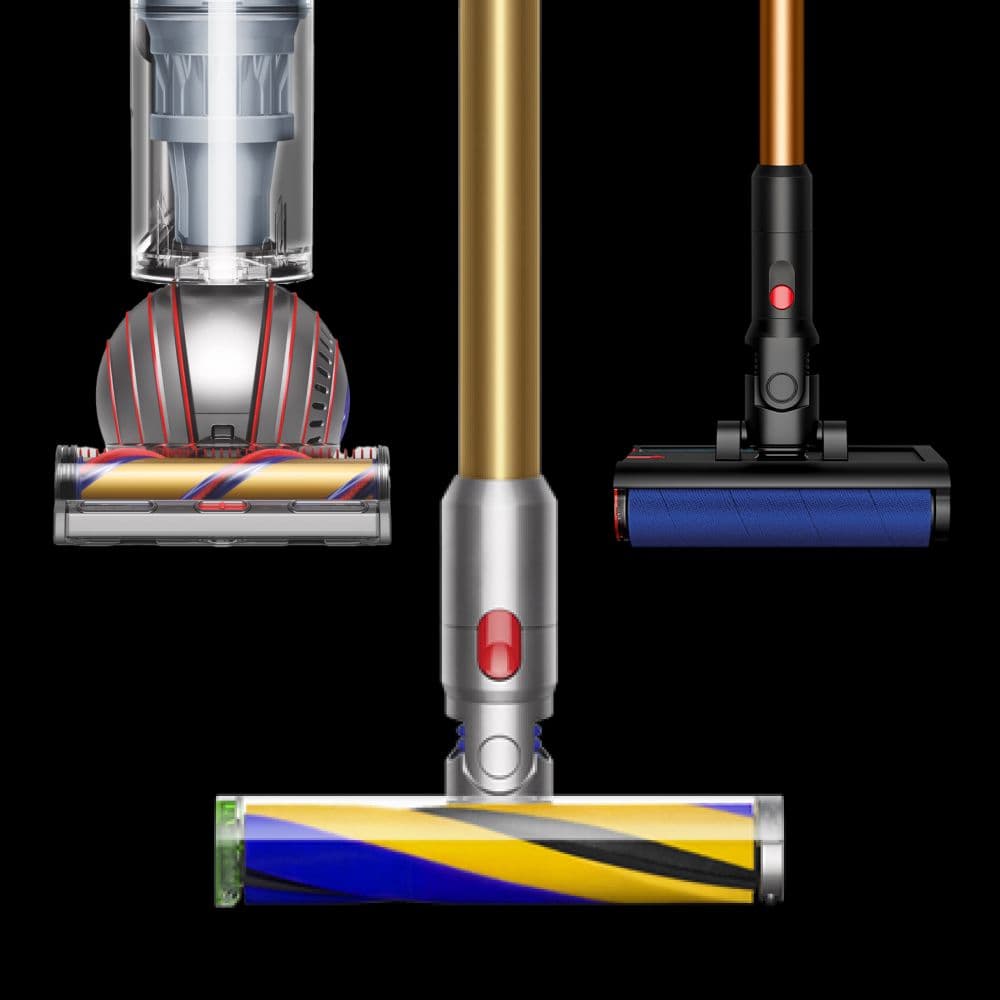
The Dyson case — Dyson Gen5detect Absolute. Its suction is the argument: excellent on every floor type at full power. The generation's refinements are practical — rubberised grip, clearer dust-detection display, lower in-use weight, a furniture nozzle hidden in the wand, and the signature dust-revealing nozzle light. The familiar Dyson costs remain: it is loud, still 1.77 kg in the hand, needs tools to change the brush, and manages nine minutes at maximum before a four-hour charge — softened by the spare battery in the box.
Quietest — Bosch Unlimited 9 (BKS941PET). The proof that cordless can be hushed, paired with a seriously capable battery: 1 hour 16 minutes on low, 12 minutes at maximum, swappable and recharged in about an hour in its cradle — no spare included, though. Dust compression squeezes more into the bin, a foot release drops the nozzle or body from the tube without bending, and the wall mount charges while it stores. The trades: notable weight, limited agility, and an emptying process that could be cleaner.
The dream team
The field's structural finding: a cordless stick and a robot vacuum are complements, not rivals. A good robot handles hard floors and short-pile carpet on a schedule; the stick covers exactly what robots miss — behind opened doors, under very flat furniture, thick carpets — and is carried to the mess in seconds. Our best robot vacuums guide covers the other half of the pairing, and best steam cleaners the wet side.
Before you buy
Four questions. What is the max-mode runtime — and is a spare battery in the box? The averages above say why. Mostly carpet or mostly hard floor? Carpet favours cordless with electric brushes; expanses of tile and parquet still favour a corded machine. Allergies? Then filter class, filter seating and hygienic emptying outrank suction. And how heavy is it in the hand, loaded? — the grip weight during use, not the spec-sheet weight, decides whether stairs are easy.