A window vacuum does one thing: it pulls the dirty water off the glass before it can run, so you are not chasing drips with a cloth. That single mechanism is why the category exists, and it is why these machines also work on mirrors, tiles, shower screens, car windows and glass tables — anything smooth enough to draw water off. This guide covers six cordless models from a hands-on test.
What follows is recorded testing, translated. Nobody at Truthful Reviews has cleaned a window with these. The short version of the result: all six clean glass. What separates them is handling, what comes in the box, and how much noise they make doing it.
How the machines were assessed
After unpacking, build quality came first — how the materials feel, and whether the machine sits heavy in the hand. Ergonomics and handling followed, and then the thing that actually matters: cleaning performance. Does it pull the water off the pane immediately, or does the glass need wiping again afterwards? And does the suction lip leave streaks behind it? To find out, a window was thoroughly wetted and the water vacuumed off, over two runs.
The hard figures were measured rather than taken from the box. Every machine was weighed on an ordinary kitchen scale and its noise recorded with a decibel meter. Charging time was established by running each battery flat first, then timing until the machine itself indicated it was charged and ready. Runtime was checked by laying each machine on a surface and letting it run under observation until it stopped — worth knowing that figures in active use will be shorter than that.
The Picks
Test winner — Kärcher WV 6 Plus
Related Articles
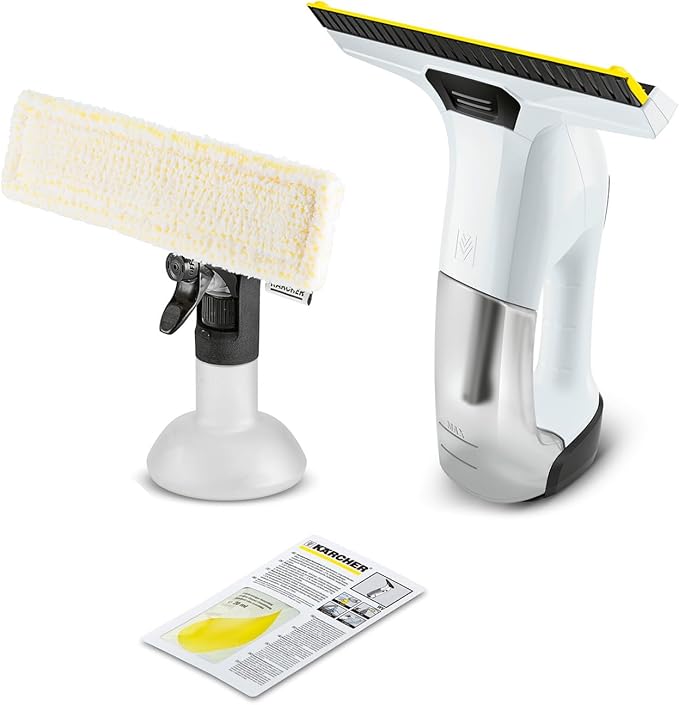
It convinced at the window before anything else. It swallows even larger quantities of water without leaving streaks, and where other machines want a second pass or a bit of touching up, this one glides across the glass without resistance. The ergonomics hold up too: at 780 g it is not the lightest here, but it steers well right into the corners.
The supporting numbers are good. Runtime came in at around 110 minutes, with charging measured at 120 minutes. What genuinely separates it is the dirty-water tank — at 150 ml it is the only one in the test that size, where every other machine holds 100 ml. It is also the only machine here with a battery-level display, which is a small thing until the moment you want one. Noise measured 76 dB.
It arrives with a good deal in the box: an additional narrow suction head, a spray bottle, a microfibre cloth, a charger, and a cleaning concentrate that is best thought of as a sample. The exact model sold on Amazon UK carries a 280 mm suction nozzle, matching the width used in the test.
Check the price on Amazon UK · Search Amazon US
The price pick — Amazon Basics window vacuum
Sold as a "window vacuum cleaner", and the build is the surprise: the housing feels notably well made, and rounded sections mean it sits comfortably. It weighs 780 g, the same as the winner, and you barely notice it.
You do have to accept some compromise on the suction itself. During testing water was left behind on the pane, though after two or three repeat passes it had gone into the tank.
Where it does well is stamina. Runtime of about 60 minutes beats several brand-name machines outright, and a charge time of roughly 120 minutes is competitive. At 76 dB it sits mid-field, level with the winner. The box holds a spray bottle, a microfibre cloth and the charger — there is no narrower suction head, which is the main thing you give up.
Search Amazon UK · Search Amazon US
Lightest — Kärcher WV 2
Related Articles

The smaller sibling of the winner, and a more stripped-back machine. At 600 g it is the lightest thing in the test, and on suction quality it is barely behind the winner: the window test left light streaks, but a quick second wipe cleared them.
Runtime of around 45 minutes is acceptable; the charge time of roughly 240 minutes asks for patience. The tank is the standard 100 ml rather than the winner's larger one, and there is no battery display. Accessories are otherwise identical to the WV 6: the narrower suction head, spray bottle, microfibre cloth, small pack of cleaning fluid and charger.
It has two real advantages over its bigger sibling. At 72 dB it is quieter, and it is lighter. The trade-off for that low weight is that you need to press a little harder as you work.
Search Amazon UK · Search Amazon US
Best for high windows — Leifheit Dry & Clean
Worked reliably streak-free, and although it is relatively long it still reaches into corners properly. At 750 g it is heavier than either Kärcher.
The tank is removable, but it comes away together with the suction unit, which itself detaches from the handle. That is unfamiliar at first and becomes routine once you have the knack.
Runtime of about 50 minutes puts it among the longer-running machines here, and a charge time of roughly 110 minutes is respectable. Tank volume is the standard 100 ml.
Its distinguishing feature turns up as soon as you open the box: an extension pole, included, which is exactly what you want for higher windows and a genuine advantage for shorter users or houses with tall glazing. Beyond that there is only a charger, which is thin provision.
Search Amazon UK · Search Amazon US
Most accessories — Bosch GlassVAC
It feels like a Bosch out of the box — good material, pleasant in the hand. Testing found compromises, though: it left streaks that needed two or three further passes to clear.
Its compact size counts in its favour. Despite weighing over 800 g, the second-heaviest here, it handles and steers well across glass and reaches corners without a fight.
Runtime of around 45 minutes and charging of about 120 minutes are both average for the group. The real caveat is volume: it is quite loud, at over 80 dB, and anyone sensitive to noise should think twice.
It is the best-equipped machine here, arriving with an additional narrow suction head, a spray bottle, two microfibre cloths and the charger.
Search Amazon UK · Search Amazon US
The system buy — Einhell Brillianto Power X-Change
The heavyweight, at 1,400 g including its battery. That weight can tire your arms over a longer session, and the machine looks and feels bulky with it — turning it one-handed into a corner takes some force. It is also the loudest model in the test.
The battery figures look excellent in isolation: about 90 minutes to charge, and roughly 600 minutes of runtime measured with the machine running passively.
Then the catch. Neither the battery nor the charger is in the box. Both have to be bought separately, because that is how the Power X-Change system works. The upside is real if you are already in it: if you own any Einhell 18 V Power X-Change tool — a mower, a leaf blower, a drill driver — that battery and charger will run this too. A spray bottle and a microfibre cloth were supplied with the test unit, and a telescopic pole is available separately.