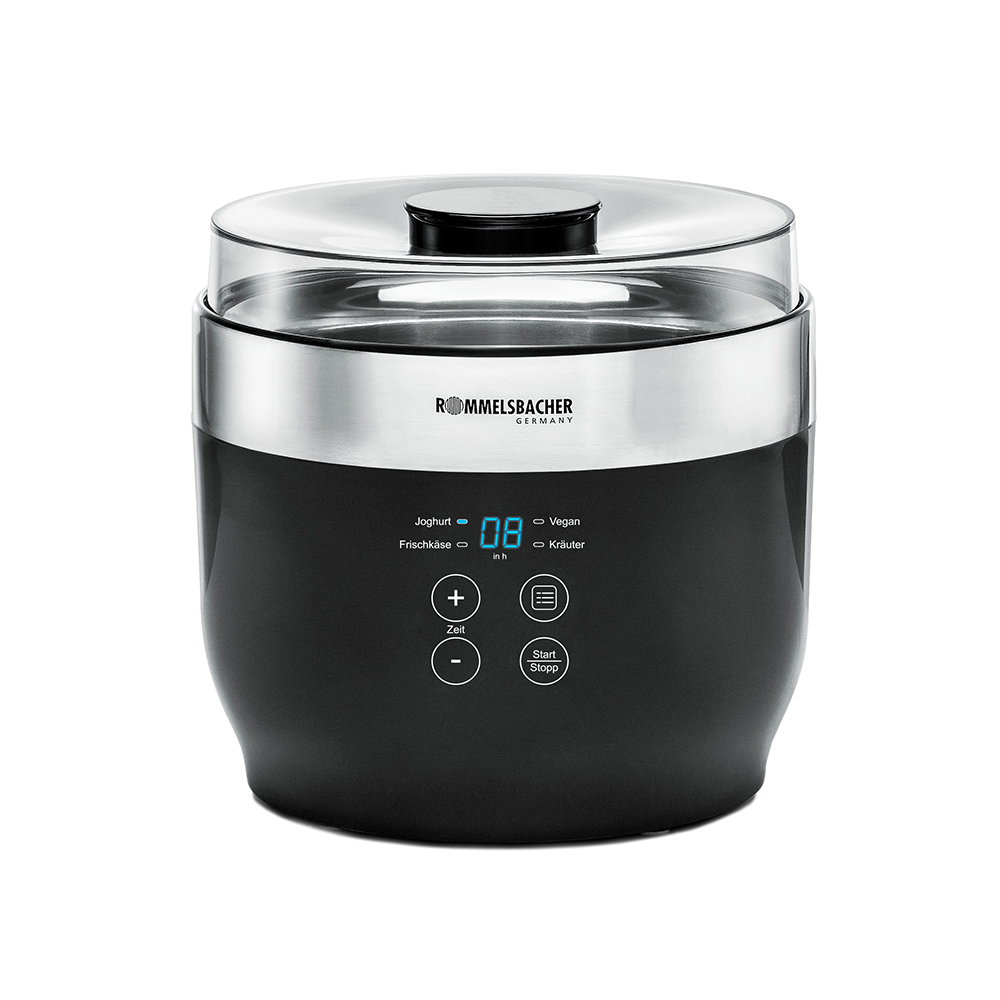
A yoghurt maker does one thing: it holds a milk and culture mixture at a steady warm temperature for hours so that fermentation can run to completion. That is the whole mechanism, which is why these machines differ less in what they do than in how much control they give you and what you store the results in. This guide draws on a recorded test of 21 yoghurt makers, covering mains-powered units and flask-style makers that run on nothing but boiling water.
What follows is recorded testing, translated. Nobody at Truthful Reviews has made yoghurt in any of these machines.
How a yoghurt maker actually works
Fermentation is the process by which micro-organisms convert substances in a food. Yoghurt is milk fermented by lactic acid bacteria, which turn the sugar in the milk into acid — hence the mildly sour taste it shares with sauerkraut, kimchi and kombucha. In good conditions those bacteria double roughly every 30 to 60 minutes, so the longer the mixture sits, the further the process goes.
The machine's only real job is to hold that mixture at a constant temperature of around 40 °C for several hours. A maturing time of 8 to 15 hours is the recommended window; the longer it stays in the machine, the firmer and more sour the finished yoghurt becomes. Industrially produced yoghurt is typically fermented for only about 3 to 4 hours, which is the practical reason a home machine gives a noticeably different texture and flavour.
The recipe is short: about a litre of milk stirred together with two tablespoons of shop-bought yoghurt or a prepared culture. Your own yoghurt then starts the next batch, and if repeated re-starting makes the result too runny, a shop-bought starter fixes it.
There are two systems. Mains-powered makers work in principle like an egg boiler; powerless makers work like a very large vacuum flask, with hot water poured into the body. The powerless type draws no electricity in use, though the water still has to be boiled, and the trade-off is a less constant temperature and a more involved procedure.
Plant milks work too. Soya gives the creamiest result and behaves much like cow's milk; coconut, almond, oat and cashew milks make a firm set harder to achieve, though thickeners such as tapioca starch help. A machine with free temperature and time settings also opens up cream cheese, sour cream, Greek-style yoghurt, crème fraîche, yoghurt drinks, herb extracts and oils, and even sourdough.
The picks
Top pick — Rommelsbacher Jona JG80
The best yoghurt maker in the test, designed with the understanding that a machine like this sits out on the worktop for a long stretch before it goes back in the cupboard: gloss black and stainless steel, high-quality construction, and a set of containers that stand up on their own merits.
There are six of them: four 125 ml ceramic mini pots and two XL jars holding 1.2 litres each. The small pots suit one- or two-person households: filled with the prepared milk mixture, loaded into the machine, then moved to the fridge and eaten straight from the pot before going in the dishwasher. The XL jars work the same way, except the mixture can be stirred up in the jar itself, and filling both in succession yields up to 2.4 litres. The machine body stays clean throughout; apart from the mixing bowl there is nothing to wash up.
Operation runs on four preset programmes. Programme 1 is classic yoghurt at 42 °C for eight hours. Programme 2 makes cream cheese at 30 °C over five hours. Programme 3 handles vegan yoghurt at 38 °C for ten hours. Programme 4 runs four hours at 55 °C for herb extracts. Each programme's run time can be extended with the separate time buttons up to a maximum of 24 hours — the recorded test batch was fermented for ten. Once started, a countdown displays the time remaining, useful on an eight-hour-plus run. A drip sieve for cream cheese and strained yoghurt is included, and replacement jars can be ordered from the manufacturer.
The drawbacks are minor. The ceramic pots are less attractive than glass and, at 125 ml, a little small; their lids press on rather than screw down, so they are not suited to carrying about. The four temperature steps, while ample for most fermentation recipes, are not fully free settings.
Search Amazon UK · Search Amazon US
Also good — TZS First Austria FA-5120-2
The pick if you want full control rather than presets. Temperature is freely selectable from 20 to 55 °C and time from 1 to 48 hours, with an intuitive layout. Anyone who would rather not think about it can accept the default of eight hours at 42 °C, which lights up automatically at switch-on.
It ferments in eight 180 ml jars, portion by portion, which comes to almost 1.5 litres per batch and uses a litre carton of milk completely. The jars are the right size to top with fruit and serve at the table, and go into the fridge as they are; there are no large containers. The recorded result was firm-set, creamy and very good.
The housing is stainless steel with plastic inside, less striking than the Rommelsbacher but still good to look at, and it takes up slightly less cupboard space. The one complaint is the jar lids: white plastic, and liable to discolour in the dishwasher.
Search Amazon UK · Search Amazon US
Budget pick — Clatronic JM3344
Not capable of much, but what it does is enough. It makes about 1.1 litres at a time in seven 160 ml jars, each with a screw lid. Fill them with the — ideally room-temperature — milk mixture, stand them in the machine, put the large lid on and flip the single rocker switch. There are no individual settings of any kind, which is exactly why it is so simple to use.
There is no timer, so it has to be switched off manually. Run overnight for around ten hours in the recorded test, it produced firm-set, good yoghurt that carried on maturing in the small jars. The design is dated plastic, which will not bother the intended buyer: someone who fancies home-made yoghurt now and again without getting deeply into the subject.
Search Amazon UK · Search Amazon US
Best without electricity — Keolia yoghurt starter set
Reinstated as the pick in the powerless category, using the flask principle rather than a heating element, with a stainless steel container and glass of the same quality as comparable kits.