What separates one pot from another
These are mature products and all of them do the job, so the test leaned hard on build and on comfort features. Six things did most of the separating.
The control valve. A valve is not just a valve. The cheap version is plastic and silicone, guided on plastic lugs, with a spring whose compression sets the pressure in the pot. Coil springs of that kind can gum up and plastic lugs wear. The better version is metal throughout, with the encapsulated spring weighted by a solid steel mass and no plastic lugs at all.
Weight and wall thickness. The spread is wide, and it shows in the hand. A 4.5-litre pot of the older generation, ten years old, was weighed at 2.8 kg for the pot alone, which puts the 1.3 to 2.0 kg class the current pots sit in into perspective. Every maker in the field uses stainless steel.
The seal. Some are soft food-grade silicone, some are a harder, more dimensionally stable material. Whether the firmer ones actually last longer was left as speculation rather than claimed as a finding.
Venting. How finely steam can be let out, and which way it travels once it leaves.
The base. Standard base diameters run 18 to 22 centimetres. Two pots here come in far narrower, which changes how they behave on ceramic, gas and induction rings.
The manual. A pressure cooker is a product that needs explaining, so the manual counts — and in this field it was very often the weakest part of the package.
The picks
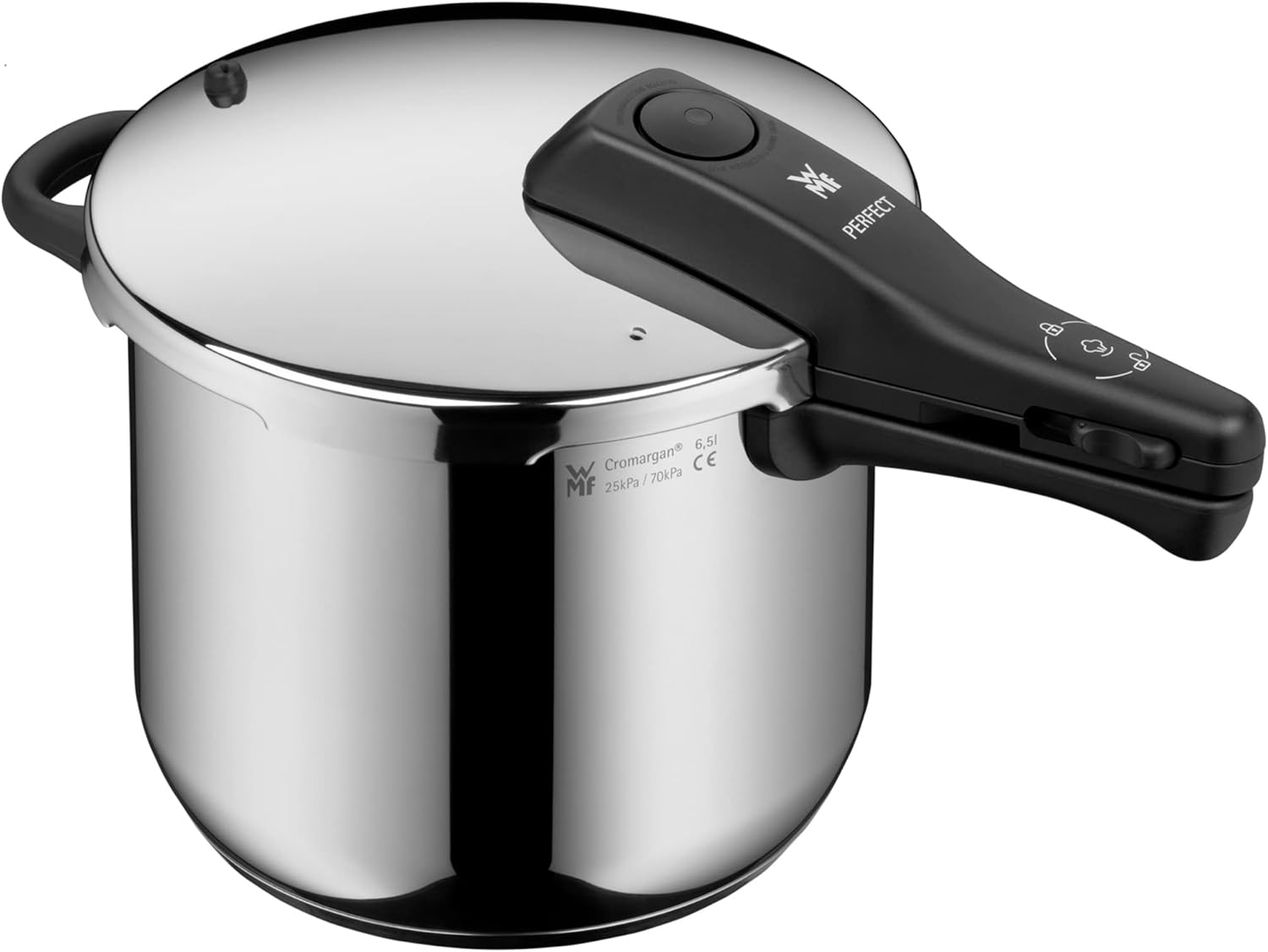
Top pick — WMF Perfect One Pot
The best of the 22 for most kitchens, and the plain kind of pressure cooker: classic looks, a simple operating idea and no gimmicks. Its one modern trick is that the whole lid is rated for the dishwasher.
Sizes run 3, 4.5, 6.5 and 8.5 litres, a genuinely useful spread. The body is rounded Cromargan stainless steel on a sandwich base, and the 6.5-litre version weighs 2.7 kg with the lid, which is middling for the type.
Cleaning is where it wins. The control valve, with its pressure display and its steam slider, sits in the handle rather than in the lid. Those are precisely the parts that are not dishwasher-rated, and here they unclip from the lid in two movements, after which the lid is. A few other pots have detachable handle assemblies, but they come away via screwed fixings and take noticeably longer.
The seal is food-grade silicone and among the better ones in the field, on a par with the Fissler's and the Silit's. Every part of the pot can be reordered if something fails.
The control valve holds the lid shut until the pressure has gone. As pressure starts to rise a pin stands up to signal it, and a two-colour ring then shows which level is being held, the heat being dropped to hold whichever one is wanted. There are no fixed pressure steps at all — the pot is worked by how high the display stands, which for an occasional cook is arguably a simplification rather than a loss.
Steam is let out by pulling a sprung slider in the handle away from the pot with two fingers, so it leaves gently rather than in a rush, venting out of the open head of the handle and well clear of the hand doing the pulling.
The manual is a good one, detailed enough and with a cooking-time table in it. Spares such as the round seal are on general sale.
The drawbacks are small. The detachable handle has a marginally movable fixing at the lid — loose would be the wrong word, but it is not solid. Some buyers will miss fixed pressure steps, which most pots have two of. And the cooking-time table is buried among twenty languages in a book, which is an awkward format to consult in a working kitchen.
Search Amazon UK · Search Amazon US
The sensible saving — BRA Vitesse
Solid, torsion-resistant stainless steel pots and lids, sold in 4, 6 and 9 litres, with a thick sandwich base that suits every hob type including induction. The nine-litre pot weighs just under 2 kg without its lid, which reads heavy on paper and is not much at all in relation to what it holds. Both the nine- and the four-litre versions went through the test, and the four-litre is the identical article to the Pinti Inox Vitesse — pot and lid alike, with the BRA emblem stamped on it.
The reason to have it is the control valve, which is the metal kind: an encapsulated spring weighted with a solid steel mass, and no plastic lugs to wear away.
Handling is classic and legible, and the operator always knows what the pot is doing. A red locking valve visibly blocks the opening mechanism, so the question of why the lid will not turn never arises. The lid is locked and released by a slider, as on every pressure cooker here; on this one the lever is pushed up with the thumb. Steam can be let off in measured amounts with a thumb at the control valve, which was the single thing about it that stood out most in testing.
The manual is good — detailed enough, with a cooking-time table — and spares such as the round seal are available. With the lid not properly closed, steam escapes at the handle, though it does not heat the whole stalk. One small annoyance: the control valve comes off only after a hex nut has been undone with a spanner.
The pot for anyone who wants a properly made pressure cooker without going premium.
Search Amazon UK · Search Amazon US
Stepless pressure control — Fissler Vitavit
The premium pot of the field, with comfort features in a modern, slim shape. The lid is almost flat, matching the slim drawn handle. Control valve and handle are separated here: the valve sits opposite the handle in a round housing, and it is there that the pressure is set — steplessly, rather than in fixed steps — and there that it is displayed. At the lowest setting the pot steams without building pressure at all.
The steam button sits on the handle and is worked with measured thumb pressure, the steam then leaving to the right. At the higher setting that still takes a minute or two, against the 15 to 20 minutes the whole pot takes to come down unaided. Slow venting is possible on rival pots, but none of them manages it as finely, and the steam travels to the right, away from whoever is at the hob, even when the lever is pressed at full force.
The mechanism behind that: to vent, the control valve is pressed more or less firmly to one side. At high pressure it takes more force and at low pressure less, so the pressure dropping inside the pot can be felt through the lever.
Several pots in the range stack inside one another, which together with the removable handle makes for tidy storage on a shelf. Sizes are 2.5, 4.5 and 8 litres.
Handle and control valve come off without tools — a hand screw and a wing screw hold them — and the job takes 10 to 15 seconds, short enough to put the lid in the dishwasher without them, though washing the lid quickly by hand is arguably the more efficient answer.
Pot and lid are heavy, solid German-made stainless steel, and spares exist. The sealing ring is more dimensionally stable and firmer than the silicone rings on the cheaper pots, although whether that translates into a longer life is guesswork.
The Vitavit and the Vitaquick differ in the structured base and the stepless control valve, which makes the Vitavit the better-finished of the two; handle and body are identical across both.
The manual, with fold-out illustrations, is one of the best here, with the same multilingual inconvenience as the rest for anyone consulting the cooking table often.
This is the pot for someone who uses a pressure cooker very often and wants to cook delicate ingredients in it, where stepless pressure selection earns its keep. It is also the pricier pick.
Search Amazon UK · Search Amazon US
The light one — Tefal Clipso Minut' Perfect
Comfortable and light is the whole approach, and it is lighter than any other pot here of comparable size. The six-litre version weighs 1.4 kg without its lid. The thin walls are not completely rigid: the mouth of the pot can be twisted slightly by hand.
There is no bulky lid stalk to handle or to store, only two side handle shells, and the reason is a one-handed lid lock. Folding the lid handle down locks the pot through a mechanism, which removes the business of lining the lid up on the pot precisely.
The wobbly plastic top shell will not please everyone, not least because it cannot be taken off. The control valve, on the other hand, lifts straight out at the zero position.
The base is the unusual part. On the six-litre pot it measures only 15 centimetres across, so it fits narrow ceramic zones and small rings, while the pot itself is 21 centimetres wide, an ordinary diameter for four or six litres.
The manual is reasonably detailed but comes in an awkward, thick format: multilingual, so every glance at the cooking table means picking up a fat book. A single-language manual, or a stiff card with the times on it, would be far more practical.
The black silicone seal is dimensionally stable and looks longer-lived than the softer rings on some pots, though again that is a guess rather than a finding. A timer that clips onto the lid is an option in the range. The pot comes with a sturdy cooking insert, which keeps vegetables or meat clear of the water. One small negative: the control valve has no protective cap, so bits of food can get into the valve opening more easily than on pots that have one.
Sizes are 6 and 7.5 litres.
Search Amazon UK · Search Amazon US
The heavyweight — Silit Sicomatic T-Plus
At 4.4 kg no pot in the field weighed more. The heavy steel body is coated with Silargan and the lid is thick stainless steel. The handle assembly carrying the control valve cannot be dismantled, which for longevity is arguably a point in its favour.
Silargan is fused onto the steel at high temperature and leaves a glass-like, scratch-resistant surface bonded inseparably to the metal, inside and out, so what is cooked never touches the steel beneath.
It has two pressure levels plus ordinary cooking with the lid on and unpressurised. Steam is released slowly by drawing a lever down with the thumb, which takes a little practice — pull too fast and it comes out in a rush. It vents forwards, away from whoever is at the hob. Operation is one-handed apart from opening, which needs the second.
Neither the lid nor the food-grade silicone sealing ring is dishwasher-rated. The ring fitted is the firm, stable type, and one of the same kind was still in service on a twenty-year-old pot of the same make.
The pot for anyone who wants uncompromisingly robust quality and does not mind carrying it.
Search Amazon UK · Search Amazon US
Also tested
Tefal Clipso+ Chef — unusual by traditional standards. The bulky lid is heavier than the pot because of a massive latch mechanism, and it comes away one-handed with a single upward pull. The control valve shows the pressure with a red pin and blocks the unlocking. There is no coloured multi-step pressure display, because of the concept that replaces it: a battery-powered, detachable control unit with a small LCD and a heat sensor, which sets a timer and shows the temperature in the pot with a flame symbol, sounds when the target is reached, starts the set timer and sounds again at the end. In practice that is confusing, loud and inefficient, because the monitoring needs a small amount of steam escaping under the sensor at all times — even with the control valve closed, and even with the control unit off the pot. It does not hold up the cooking, but it makes a constant noise where there could be silence. In its favour, the pressure is graded into four programmes running from vegetables and grains through chicken to fish, more steps than the competition offers, and the finer gradation with accurate timing does allow more precise results — which matters for delicate items rather than for carrots or potatoes. The lid is not dishwasher-rated, and washing it by hand is awkward with so many gaps, crevices and edges, none of which comes apart. Search Amazon UK · Search Amazon US
Quixo 6l VitaSmart — closes by clamping rather than turning. The lid is simply set on from above in any position at all, and a short turn of the knob closes two clamps, sometimes with a light press from above. That is genuinely handy, because it is a one-handed job with no hunting for a starting position. Both the look and the weight are dictated by that closure: the steel clamps make the lid heavier than the pot, and the six-litre version comes to 3.19 kg. Venting is good — a small lever at the control valve is pushed to the left and is finely controllable — and the hot steam then leaves upwards directly at the valve, which is worth knowing in advance. It ships with a plain silicone seal and a spare in the box. It also managed the one thing no other maker in the field did: a cooking-time table printed on card. Search Amazon UK · Search Amazon US
Quixo 4l VitaSmart — the small version of the six-litre pot, using the same clamping closure: set on from above in any position, then closed with a short turn of the knob, occasionally needing a light press. The four-litre version comes to just under 3 kg. Search Amazon UK · Search Amazon US
WMF Perfect Premium — a new operating idea at the end of the handle, turning and pulling out instead of sliding and pressing. Two-handed fiddling is unnecessary because the plunger does not snap back under spring force, and unlike the usual sliders it does not have to be held while the lid is turned to the left; ergonomically that is a pleasant thing. The build is good with it: the lid does not rattle and glides into its detent. The seal is not silicone but a harder, apparently longer-lived material. The pressure display is a cylinder with three coloured lines that runs out of the handle rather than a tiny hole with a colour mark, so what the pot is doing is visible from across the kitchen. In kitchen use the 4.5-litre proved too small and the 6-litre option would be the better choice — a whole chicken fits in that one — with 3-litre and 8.5-litre options also offered. The neat part, for cleaning and for storage alike, is that the entire handle unhooks, so the lid goes to the sink with no valve unscrewing at all; the handle assembly with the valve rubbers is not dishwasher-rated. Steam vents away from the user, for which the removable handle has a U-shaped seal open on one side only. The internal scale carries no litre markings and shows the level relative to the pot's 4.5 litres instead, in thirds and halves, which is down to international sale and is not practical. The manual is a fat booklet weighing 500 grams with a great many languages in it; of its 516 pages exactly one, the cooking-time table, stays interesting, and the paper is so thin that tearing it out and laminating it is the only real option. A folded card would have been better. Search Amazon UK · Search Amazon US
Fissler Vitaquick — a good pressure cooker with contemporary comfort features, the steam button foremost among them, letting steam out under measured thumb pressure. Less contemporary: it has no control valve on which the pressure level is chosen by hand. The removable handle — no tools needed, a wing screw holds it — is also there for easy cleaning, since without the sealing ring, the lid stalk and the cooking-valve unit the lid is dishwasher-rated, though washing it quickly by hand rather than removing those three components every time is arguably the more efficient route. Pot and lid are heavy, solid German-made stainless steel and spares exist. The detailed, illustrated manual is one of the best in the field, with the same multilingual inconvenience. Search Amazon UK · Search Amazon US
Kuhn Rikon Duromatic Inox — answers the venting question with a removable steam shield that spreads the steam in every direction, which brings the lid off promptly. Swiss-made, first-rate in its finish and stable despite a moderate weight. The pressure display of the control valve projects above the shield and carries two notches by which the pressure levels are read and the heat adjusted accordingly. Pot and lid together come to 2.9 kg — not light, not especially heavy. The lid locks in the classic bayonet fashion with a catch against opening under pressure. Handling is simple: the flat handles lie one above the other when the pot is closed, and the lid can also be engaged offset, with the handles not aligned, without any loss of function. The manual is carefully done and explains the pot's behaviour in detail for a newcomer. The 4-litre pot from a range of 2.5, 4, 5 and 6 litres went through the test; the base of the 24-centimetre model measures a standard 18.6 centimetres. Search Amazon UK · Search Amazon US
Tefal Secure Trendy — the six-litre version carried the model code P2580703. Venting travels forwards, away from the operator. Tefal includes genuinely useful accessories in the shape of a strainer insert plus a stand, so cooking can be done on two levels. The base is the talking point: at just 15.5 centimetres across it is an advantage or a drawback depending on the hob, because ceramic, gas and induction rings all have less to bear on, so heating takes longer — against a standard base diameter of 18 to 22 centimetres. The narrow footprint pays off on a crowded hob, where three large pans are already going at once. Search Amazon UK · Search Amazon US
Pinti Inox Vitesse and Pintinox Monix Quick — the Pinti Inox Vitesse is the identical article to the BRA Vitesse range, with BRA stamped on the pots as well; it is simply another name for a different market, offered at 4 and 6 litres, so the recommendation above carries across to it. The Monix Quick is a cheap all-rounder in 4, 6 or 7 litres: a solid, heavy, classic pot with no frills, whose control valve is easy to clean but is the same part as the ELO's — a low-cost plastic item with a spring and two pressure steps, so wear is built in, although spares are available and interchangeable between the two. It gives a classic bright whistle once the pressure is exceeded. The manual is usable and no more. With the lid not fully closed the hot steam escapes directly onto the lower handle shell, which was marked down as inconvenient. The gentle venting at the pressure valve was liked, and the steam travels away from the user. It suits occasional users who care little about comfort features but want a heavy, solid pot. Search Amazon UK · Search Amazon US
ELO Praktika Plus XS — at 2.7 litres a miniature for small jobs, and also offered at 6 litres. A solid, classic pot with two cooking steps and a lid stalk that does not come off. The control valve is easy to clean and pulls out with neither tools nor special knowledge. The metered venting with a finger was liked, the steam travelling forwards and the fingers staying well clear of the opening, though it is not as finely controllable as the Fissler's. The control valve itself, with its plastic lugs and simple spring, is the low-cost variant and is not built to last for ever; replacements are inexpensive. The detailed manual was liked, and times can be looked up in it quickly. Search Amazon UK · Search Amazon US
Monix Veloce 6 litres — inexpensive, and it shows. The round seal is soft silicone and the control valve is made of plastic and rubber. It works to begin with, but there is a concern that the material could go brittle in time, and the construction gives a low-grade impression overall. The control valve at least lifts straight out. Search Amazon UK · Search Amazon US
Tefal Secure 5 Neo — the maker's all-rounder, offered at 3, 4.5, 6.5 and 8.5 litres. There is fundamentally nothing to complain about in a solid pot, except that it drips steadily in vegetable mode, which is the lower of its two pressure steps. The control valve is easy to clean and to replace. As usual for the brand, every language is squeezed into one thick booklet, which is inconvenient for looking a time up quickly. Search Amazon UK · Search Amazon US
AmazonBasics pressure cooker — a 4-litre pot and the least expensive of the whole field. It does not earn a recommendation, because it dripped continuously at the handle on the higher pressure step: the blocking valve simply does not close cleanly. The manual has no cooking-time table either. The control valve, with plastic lugs and a simple spring, is the low end of what is possible, though a spare seal is included and both cleaning and replacing the valve are easy. Search Amazon UK · Search Amazon US
WMF Perfect Plus — falls down here on leaks. The problem, frequent though not constant: no pressure can be built at all, because the round silicone seal is pushed out through the rim window before it can be, and the steam escapes there. That points either to a seal that is too soft or to a rim window that is too large or wrongly positioned, and it showed up on both the 6.5-litre and the 3-litre pot, which share one lid. A pity, because with its removable handle, its good manual, its many size options and its gentle venting it would otherwise have earned a recommendation. Search Amazon UK · Search Amazon US
How they were assessed
The 22 pots were used in a working kitchen over many weeks, cooking vegetables, beef, crackling roast, boiling fowl, peas, rice, potatoes in their skins and a good deal besides.
Differences in operation came first: how the pressure steps are set, whether the control valve comes out, whether steam can be let out in stages so the pot opens sooner. Against that, the finish of pot, lid, seal and control valve was examined closely — how well made the valve is, how thick-walled the pot is, and how much it weighs. Not every pot is the same here, as the large differences in weight already make plain. On material, every maker uses stainless steel without exception.
The manual mattered too, because a pressure cooker is a product that needs explaining, and there the cooking-time table counts for most — ideally as a robust card for the kitchen drawer rather than a page in a multilingual book.
Because these are mature products that all do their job, comfort features carried particular weight in the scoring: the venting, the setting of the cooking steps, the reading of the pressure display, and the seating of the lid in the bayonet.
Every pot was also checked for where the hot steam escapes when the lid is not yet correctly engaged, a state in which no pressure should build.
Heat-up time and the accuracy of the pressure steps were deliberately left unscored. A spot check found that the time taken to build pressure barely differs from pot to pot. The accuracy of the steps could have been measured with a bolted-on gas manometer, but the figure would be immaterial to a buyer, because every user ends up working out an individual set of times for their own food from the table in the manual.
The short answers
Which pressure cooker is the best? The WMF Perfect One Pot. One click and the stalk handle is off, after which the lid goes in the dishwasher. The pressure level is shown prominently by a pin, and when steam is let out the fingers stay well clear of it.
Which lids are dishwasher-rated? Only some. On most pots the lid carries the valves and the locking mechanism and is not rated for it. On a handful of models the handle assembly with the valves detaches from the metal lid, and the lid then is: the top pick is the quickest of those at two movements, against 10 to 15 seconds of unscrewing on the Fissler pots.
Does the base diameter matter? On some hobs, yes. Standard bases run 18 to 22 centimetres. Two pots in this field come in far narrower, at 15 and 15.5 centimetres, which gives a ceramic, gas or induction ring less to bear on, so heating takes longer — while making them the pots to have when three large pans are already on the go.
Do they differ in how quickly they come up to pressure? Barely. A spot check found the time to build pressure much the same across the field, which is exactly why it was left out of the scoring.
Is cooking with one complicated? Occasional cooks, the once-a-week sort, may find it irritating to keep looking up how long a given item needs. Anyone cooking more often gains from the time saved, and after a while the common times are simply remembered.