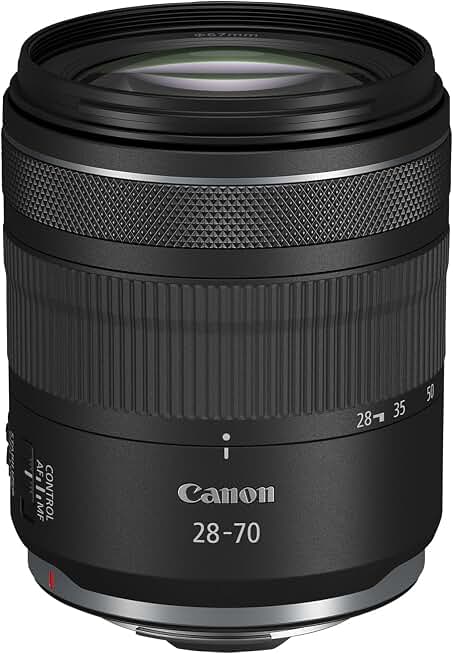
Canon’s RF mount has not been overflowing with affordable full-frame lenses that feel genuinely aspirational. That is what makes the RF 28-70mm F2.8 IS STM such an important addition. It takes the classic constant-aperture standard zoom idea, strips away some of the premium-series luxury, and tries to land in a much more realistic place for photographers who want one lens to cover most of their daily work without carrying professional-series bulk or paying professional-series money.
On that level, Canon has judged this lens well. The RF 28-70mm F2.8 IS STM is compact for what it is, lighter than the L-series alternatives, weather protected, stabilised and optically stronger than its price positioning might suggest. It is not a stealth budget miracle and it does give up things that more expensive Canon zooms still do better, but as a practical, high-quality standard zoom it makes a very persuasive case.
Overview
This lens sits below Canon’s RF 24-70mm F2.8L IS USM and RF 28-70mm F2L USM, which immediately tells you what sort of job it has to do. It is not meant to replace those lenses for demanding professionals who need every ergonomic extra and every last bit of optical polish. It is meant to give enthusiast photographers and working shooters on tighter budgets access to the same general idea: a constant F2.8 zoom that can cover everything from documentary-style wide shots to portraits and everyday event work.
The main compromise is obvious from the name. Wide-angle coverage starts at 28mm rather than 24mm, which means landscape, interior and architecture photographers lose some framing freedom straight away. For many users that will not be fatal, but it does shape the lens’s character. This is a true all-rounder, just not the widest or most fully featured one in Canon’s ecosystem.
Price and positioning
Canon launched the RF 28-70mm F2.8 IS STM in September 2024, and in the UK it now sells for around £1,069. Check the price on Amazon That puts it in a noticeably more approachable bracket than Canon’s professional constant-aperture RF zooms while still keeping it far enough above bargain glass that it has to earn its keep.
The lens therefore stands or falls on whether it can deliver the core benefits people actually want from a daily standard zoom: useful focal coverage, a genuinely bright aperture, strong central sharpness, dependable stabilisation and reasonable size.
Build quality
Physically, the lens is very easy to like. Canon has kept it slim and travel-friendly, with a retractable design that measures roughly 9.2cm when collapsed, around 10.5cm at 28mm and about 15cm when extended to 70mm. Weight stays just under 500g, which makes the lens feel well matched to bodies such as the EOS R8 instead of heavy and front-loaded.
The barrel is largely plastic, so it does not project the same luxurious heft as Canon’s L-series optics. Yet the build still feels serious. Weather sealing is present, the zoom ring is broad and precise, and the overall package is clearly meant for actual field use rather than careful cupboard storage.
Handling and controls
Canon also includes a smooth programmable control ring up front that can be assigned to manual focus, aperture or another preferred setting. That ring adds useful flexibility, especially for photographers who want some extra tactile control without relying entirely on the camera body.
The simplification strategy has limits, though. Ring operation is a little noisy for video use, and some higher-end conveniences are missing. There is no dedicated aperture ring, no additional custom buttons, and the overall control set is deliberately sparse. The lens feels designed for straightforward efficiency rather than obsessive configurability.
Optical sharpness
The most reassuring part of the lens is that the optical story is not built on excuses. Tested on a 45-megapixel EOS R5 Mark II with Canon’s digital corrections active, the RF 28-70mm F2.8 IS STM proves genuinely strong through the centre of the frame and across the mid-zones from its widest aperture onward.
That is exactly what you want from a standard zoom that is supposed to stay on the camera for long stretches. Sharpness remains high and fairly consistent until diffraction begins to bite more seriously beyond F16. The weakness lies in the corners, especially wide open, where they trail the centre more clearly and reveal where Canon’s cost and size compromises begin to show.
Distortion and chromatic aberration
Canon leans on in-camera correction for a number of optical behaviours, and within that real-world setup the results are convincing. Distortion stays low: roughly 0.31 per cent at the wide end, around 0.24 per cent at 50mm and about 0.29 per cent at 70mm. Chromatic aberration is similarly well controlled once the camera applies its usual corrections.
That matters because this lens is not aimed at lab purists chasing purely optical perfection. It is aimed at photographers who want clean files and predictable behaviour from a practical everyday tool, and on that basis Canon has done the right work.
Vignetting
Vignetting is also well managed. It is only very slightly visible at F2.8 and quickly becomes negligible from F4 onward. That gives the lens a polished feel in normal use, because buyers are not constantly being asked to tidy obvious flaws in post.
Again, the point is not that the optic is magically free of compromise. The point is that it behaves cleanly when used in the system context Canon designed it for.
Stabilisation
Canon equips the lens with two-axis optical stabilisation designed to cooperate with in-body stabilisation on compatible RF cameras. Officially, the company claims up to 5.5 stops optically and up to 7.5 stops in combined operation.
In the source’s practical testing at 70mm, the result lands a little below the maximum claim but still close to six stops, which is excellent in handheld terms. That gives the lens a real everyday advantage because it widens the sort of shooting conditions in which you can work confidently without immediately reaching for support.
Autofocus and close focus
Autofocus uses Canon’s STM motor technology, and that fits the brief well. It is quiet, quick enough and particularly smooth for focus transitions, which makes the lens attractive to hybrid shooters who move between stills and video.
The close-focus distance of 27cm at 28mm also helps broaden its utility. It is not a pseudo-macro lens, but it is flexible enough for detail shots and tighter framing in a way that supports the idea of it being a one-lens everyday companion.
Everyday versatility
The best way to think about this lens is as a modern Swiss-army zoom. The 28-70mm range is broad enough to handle street photography, travel, portraits, general reportage and a lot of video coverage. The constant F2.8 aperture lets exposure stay steady throughout the zoom range and opens the door to more comfortable low-light work and stronger background separation.
This is where the lens justifies itself. It does not need to be exotic. It needs to be capable, portable and easy to trust, and most of the time it appears to be exactly that.
APS-C use
Because the lens covers full frame, it can also be mounted on Canon APS-C RF bodies. In that context it behaves like an effective 44.8-112mm optic once the crop factor is taken into account. That changes its personality, but it does not make it useless. It becomes a tighter reportage, portrait and short-telephoto lens rather than a classic standard zoom.
That flexibility adds value, especially for Canon users mixing body formats or planning future upgrades.
Verdict
The RF 28-70mm F2.8 IS STM feels like one of Canon’s more sensible recent RF lenses. It gives photographers a constant-aperture standard zoom that is compact, weather protected, stabilised and optically convincing where it matters most. Centre sharpness is strong, stabilisation is genuinely effective and the overall handling makes the lens easy to keep on the camera all day.
The compromises are real but reasonable. Starting at 28mm instead of 24mm reduces flexibility at the wide end, the corners fall behind the centre wide open, and the ergonomic package is stripped back compared with Canon’s higher-end lenses. Even so, the overall proposition is strong. For many Canon users, this is the lens that will make far more sense than the professional alternatives because it delivers most of the everyday benefit at a far more defensible size and price.
Research sources
Sources recorded for this page are linked below. Reported third-party testing belongs to the original publisher; it is not testing performed by Truthful Reviews.