Why the Jogger still matters
The Dacia Jogger has always occupied a strange but valuable space in the market. It is part estate, part MPV and part crossover in attitude, yet its real appeal is much simpler: it gives families a huge amount of usable car for comparatively little money. That basic proposition was already strong. The arrival of the Hybrid 155 powertrain is important because it tries to improve the one area where the old hybrid version could still feel a little rough around the edges.
The question is not whether the Jogger has turned into a premium family car. It has not. The real question is whether Dacia has made a compelling value proposition even harder to ignore.
A smarter hybrid setup rather than a cosmetic update
The mechanical changes matter more than the subtle visual tweaks. The new Jogger Hybrid 155 replaces the older Hybrid 140 with a more developed powertrain built around a larger 1.8-litre petrol engine running on the Atkinson cycle. Power rises to 155 hp in total and torque reaches 205 Nm, while the battery grows slightly to 1.4 kWh.
On paper those gains may not look dramatic, but they point to a more mature hybrid system rather than a token increase in output. The aim here is not excitement. It is smoother everyday drivability, better efficiency and less strain when the car is fully loaded or climbing.
That seems to be exactly what Dacia has chased. The source road-test material describes a drivetrain that feels more consistent and easier to live with, especially when the battery is not doing all the work.
It still looks like a Jogger, and that is fine
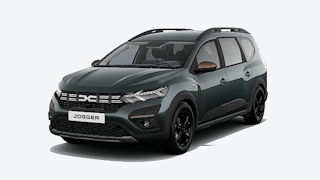
Dacia has not tried to reinvent the Jogger visually. The silhouette remains familiar, with its long roofline, practical stance and slightly SUV-flavoured details. This is a car designed around space and usefulness first, not around making a statement in a supermarket car park.
The updates are mostly restrained. There is a refreshed light signature, some material tweaks including the use of Starkle recycled-content plastic for some trim areas, and a new Sandstone colour option. The overall result is not dramatic, but it does not need to be. The Jogger's shape already explains itself clearly.
The pricing story is still the strongest part
This is where the Jogger remains unusually persuasive. In the UK the full Hybrid 155 is offered across the same Essential, Expression and Extreme trims (see the range on Dacia UK) — with all seven seats fitted as standard rather than charged as an option. The move to the stronger Hybrid 155 does not push the car into a new bracket.
That still leaves the Jogger in a class of its own for buyers who genuinely need space and flexibility. At these prices, there are very few direct alternatives with seven seats and this sort of mixed-use practicality. In that context, the Jogger is not just cheap; it is strategically undercutting a huge part of the market.
Everyday practicality is still the reason to buy one
This remains the car's strongest real-world argument. The Jogger can seat up to seven, and the rear layout stays genuinely useful rather than tokenistic. Fold or remove the third row and the luggage space becomes extremely generous, while the five-seat configuration already offers a boot of over 500 litres that many larger cars would envy.
Small practical details matter too. Rear passengers get USB-C charging, fold-out tables and storage that feels designed around family use rather than brochure talking points. Dacia has also kept the high seating position and clear all-round visibility that make a car easier to place in town and less stressful to drive on longer family trips.
There are also leisure-oriented accessories, including a Sleep Pack and tent arrangement that turn the Jogger into a low-cost activity car. That will not be relevant to every buyer, but it reinforces the basic point: the Jogger tries to be more than transport.
Inside, it is still simple rather than plush
No one should mistake the cabin for something premium. Hard plastics are still everywhere and the overall feel remains functional before anything else. The positive side is that Dacia has become better at making this simplicity feel deliberate rather than merely cheap.
The higher trims add small touches that lift the atmosphere, and the general assembly quality sounds respectable. The central infotainment screen and digital driver display cover the basics well enough, even if the navigation can feel a little slow and the camera quality is only average. The optional Arkamys audio system also sounds more adequate than exciting.
That is all consistent with the broader Jogger formula. It does not overspend in the wrong places, but it gives you enough equipment to avoid feeling short-changed.
On the road, it chooses ease over involvement
The Hybrid 155 does not turn the Jogger into something sporty, and it should not be judged that way. Its job is to make the car easier and more relaxed in everyday use, especially in town and on mixed family routes. By that standard, it sounds like a worthwhile improvement.
The 0-100 km/h time drops to around nine seconds, which is a useful gain over the earlier hybrid. More importantly, the extra torque helps the Jogger respond more confidently and maintain speed more easily on gradients. Around town, frequent electric running and light steering support the car's easygoing character.
The drawbacks are familiar. The engine still makes itself heard when pushed hard, and the multimode automatic gearbox remains something the driver learns to accept rather than enjoy. It works on its own logic, and there is no manual control for those who want more direct involvement. Still, the overall driving impression remains one of competence and straightforward usability.
Fuel economy is where the update earns its place
The official combined figure is 4.5 l/100 km with CO2 emissions around 104 g/km, and the source test returned 5.3 l/100 km over a genuinely mixed route that included town work, secondary roads, mountain sections and faster stretches. That is a strong result for a practical seven-seat family car, especially one sold at this price point.
This is the central reason the new powertrain matters. The Jogger was already easy to justify on price and usefulness. Better hybrid efficiency makes it easier to justify on long-term running costs too, while keeping emissions low enough to avoid the tax pain that increasingly affects buyers in this class.
Early verdict
The Dacia Jogger Hybrid 155 looks like a textbook example of sensible product development. Dacia has not tried to transform the car into something it is not. Instead, it has improved the drivetrain, preserved the pricing and left intact the qualities that made the Jogger attractive in the first place: space, flexibility and genuine value.
It still has obvious compromises. The cabin is basic, the gearbox is not especially engaging and refinement under load remains only average. Even so, it remains one of the clearest cases in the market where pragmatic engineering and disciplined pricing produce something genuinely hard to dismiss.
Research sources
Sources recorded for this page are linked below. Reported third-party testing belongs to the original publisher; it is not testing performed by Truthful Reviews.